
AI Memory Infrastructure Market Report Scope & Overview:
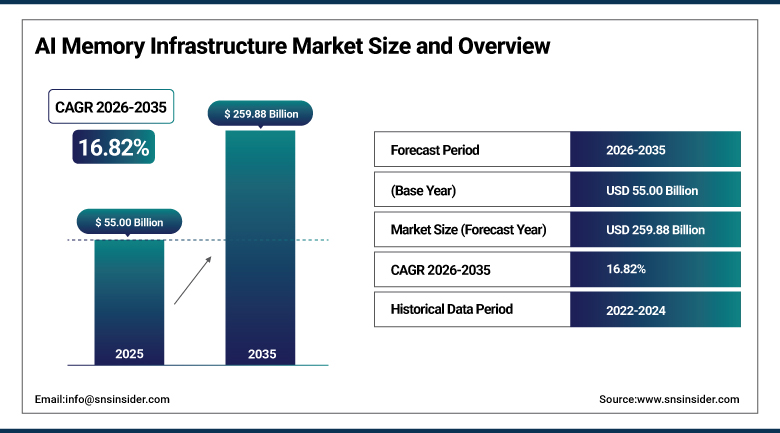
The AI Memory Infrastructure Market was valued at USD 55.00 Billion in 2025 and is expected to reach USD 259.88 Billion by 2035, growing at a CAGR of 16.82% from 2026–2035.
The AI memory infrastructure market is experiencing strong growth due to increasing demand for high-capacity, low-latency, high-bandwidth, and energy-efficient memory infrastructure to support increasingly compute-intensive workloads. The rapid expansion of generative AI, machine learning, high-performance computing, hyperscale data centers, and cloud computing is driving demand for advanced memory solutions capable of delivering greater bandwidth and faster data processing. Growing adoption of High Bandwidth Memory (HBM), DDR5 DRAM, GDDR Memory, CXL Memory, and advanced memory expansion and pooling architectures is enhancing system performance, scalability, and memory utilization. Companies are focusing on higher memory bandwidth, improved power efficiency, reduced latency, greater capacity, and flexible memory architectures.
In March 2026, SK hynix showcased its latest AI memory portfolio at MWC 2026, including HBM4, HBM3E, DDR5, and other advanced memory solutions for AI and data-center applications. The developments highlight the industry's shift toward higher-bandwidth, higher-capacity, and more energy-efficient memory architectures to support increasingly demanding AI workloads, accelerating the adoption of next-generation AI memory infrastructure globally.
To Get more information AI Memory Infrastructure Market - Request Free Sample Report
AI Memory Infrastructure Market Trends
-
Growing demand for high-bandwidth AI computing is driving the adoption of advanced memory infrastructure to support increasingly complex workloads.
-
Rising deployment of generative AI, hyperscale data centers, cloud computing, and high-performance computing is increasing demand for high-capacity, low-latency memory solutions.
-
Increasing adoption of High Bandwidth Memory (HBM), DDR5 DRAM, GDDR Memory, CXL Memory, and memory pooling technologies is supporting higher performance and scalability.
-
Growing focus on memory bandwidth, capacity, power efficiency, latency, and data-access speed is creating opportunities for AI memory infrastructure providers.
-
Advancements in HBM3E, HBM4, CXL-based infrastructure, memory expansion, and memory disaggregation are improving system performance and supporting the adoption of next-generation AI memory solutions.
The U.S. AI Memory Infrastructure Market Outlook
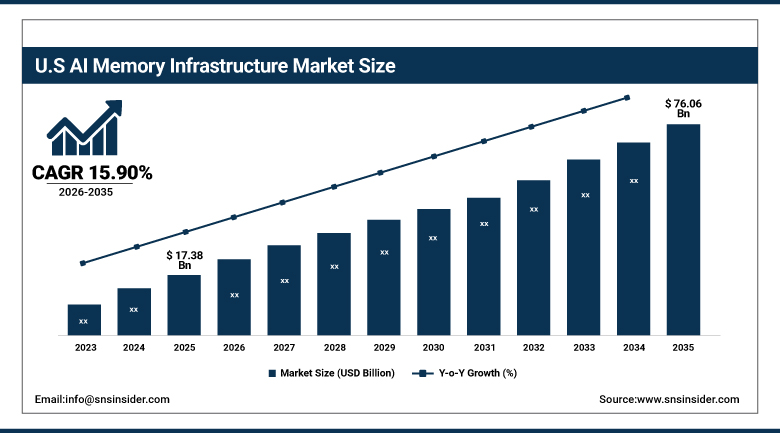
The U.S. AI Memory Infrastructure Market was valued at USD 17.38 Billion in 2025 and is expected to reach around USD 76.06 Billion by 2035, growing at a CAGR of 15.90% from 2026–2035.
The U.S. AI memory infrastructure market is growing rapidly due to rising demand for high-bandwidth, low-latency, and high-capacity memory solutions. The expansion of generative AI, hyperscale data centers, cloud computing, and high-performance computing is increasing demand for advanced memory architectures. Investments in HBM, DDR5 DRAM, GDDR Memory, CXL Memory, and memory expansion infrastructure are improving bandwidth, capacity, scalability, and energy efficiency. Growing deployment of AI servers, AI accelerators, and memory pooling and disaggregation systems is supporting market demand. Companies are focusing on HBM3E, HBM4, CXL-based infrastructure, and advanced memory technologies to address increasing AI workload requirements. The adoption of cloud and hybrid deployments, along with growing demand from hyperscalers and data centers, is further supporting the growth of the AI memory infrastructure market in the U.S.
In March 2026, Applied Materials and Micron announced a collaboration to advance next-generation DRAM, High Bandwidth Memory (HBM), and NAND technologies through research activities in California and Idaho. The initiative is focused on improving energy-efficient memory performance for future AI applications and strengthening the U.S. semiconductor innovation ecosystem, supporting the expansion of domestic AI memory infrastructure.
AI Memory Infrastructure Market Segment Analysis
-
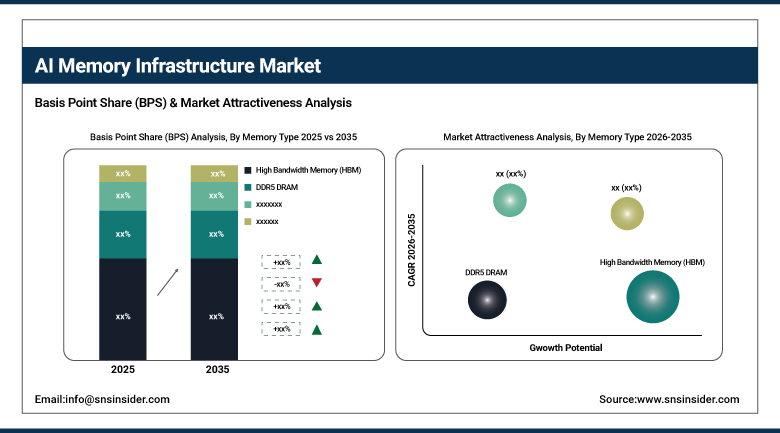
By Memory Type, high bandwidth memory (HBM) dominated the AI memory infrastructure market with a 38.00% share in 2025, while GDDR memory is projected to be the fastest-growing segment, registering a 25.83% CAGR during 2026–2035.
-
By Infrastructure type, AI servers dominated the AI memory infrastructure market with a 31.00% share in 2025, while memory pooling & disaggregation systems are projected to be the fastest-growing segment, registering a 25.15% CAGR during 2026–2035.
-
By Technology, HBM3E dominated the AI memory infrastructure market with a 34.00% share in 2025, while HBM4 is projected to be the fastest-growing segment, registering a 29.31% CAGR during 2026–2035.
-
By Deployment, cloud dominated the AI memory infrastructure market with a 49.00% share in 2025, while hybrid is projected to be the fastest-growing segment, registering a 17.77% CAGR during 2026–2035.
-
By Application, generative AI dominated the AI memory infrastructure market with a 31.00% share in 2025, while natural language processing is projected to be the fastest-growing segment, registering a 25.96% CAGR during 2026–2035.
-
By End Use, data centers dominated the AI memory infrastructure market with a 35.00% share in 2025, while hyperscale are projected to be the fastest-growing segment, registering a 22.65% CAGR during 2026–2035.
By Memory Type, high bandwidth memory (HBM) dominated the AI memory infrastructure market, while GDDR memory is expected to grow fastest.
High bandwidth memory (HBM) held the leading position in the AI memory infrastructure market in 2025, supported by its high bandwidth, low latency, and ability to handle data-intensive AI workloads. The increasing deployment of AI accelerators, generative AI systems, hyperscale data centers, and high-performance computing platforms is driving demand for HBM-based memory infrastructure. Growing requirements for faster data movement and greater memory capacity are further supporting adoption of advanced HBM solutions.
GDDR memory is anticipated to register the highest growth rate during 2026–2035. Its combination of high data throughput, scalability, and suitability for graphics-intensive and AI workloads is encouraging broader adoption across AI computing platforms. Increasing demand for inference, computer vision, accelerated computing, and cost-efficient high-bandwidth memory architectures is expected to further support the expansion of GDDR memory.
By Infrastructure Type, AI servers dominated the AI memory infrastructure market, while memory pooling & disaggregation systems are expected to grow fastest.
AI servers accounted for the dominant share of the AI memory infrastructure market in 2025, driven by the rapid deployment of dedicated computing systems for generative AI, machine learning, and high-performance workloads. Growing demand for high memory bandwidth, capacity, and low-latency data access is increasing the integration of advanced memory technologies within AI servers. The expansion of hyperscale data centers and AI accelerator deployments is further supporting market growth.
Memory pooling & disaggregation systems are projected to register the highest growth rate during 2026–2035. These architectures enable more efficient allocation and utilization of memory resources across computing systems, improving scalability and reducing memory bottlenecks. Increasing adoption of CXL-based architectures, cloud computing, hyperscale infrastructure, and large-scale AI workloads is expected to accelerate demand for flexible and composable memory infrastructure.
By Application, generative AI dominated the AI memory infrastructure market, while natural language processing is expected to grow fastest.
Generative AI held the dominant position in the AI memory infrastructure market in 2025, supported by the increasing deployment of large language models, generative AI applications, and large-scale AI training and inference systems. These workloads require substantial memory capacity, high bandwidth, and rapid data access to process large models efficiently. The expansion of AI data centers and accelerated computing infrastructure is further increasing demand for advanced memory solutions.
Natural language processing is expected to register the highest growth rate during 2026–2035. The rapid development of large language models, conversational AI, language translation, retrieval-augmented generation, and AI-powered content applications is increasing demand for high-capacity and high-bandwidth memory infrastructure. As organizations deploy increasingly complex language models across cloud, enterprise, and hyperscale environments, demand for scalable and low-latency memory architectures is expected to accelerate.
Regional Analysis
|
Region |
Major Country |
Share within Region, 2025(%) |
|---|---|---|
|
North America |
United States |
82.14% |
|
Europe |
Germany |
34.30% |
|
Asia Pacific |
China |
48.54% |
|
Middle East & Africa |
Saudi Arabia |
23.50% |
|
Latin America |
Brazil |
23.00% |
North America AI memory infrastructure market insights
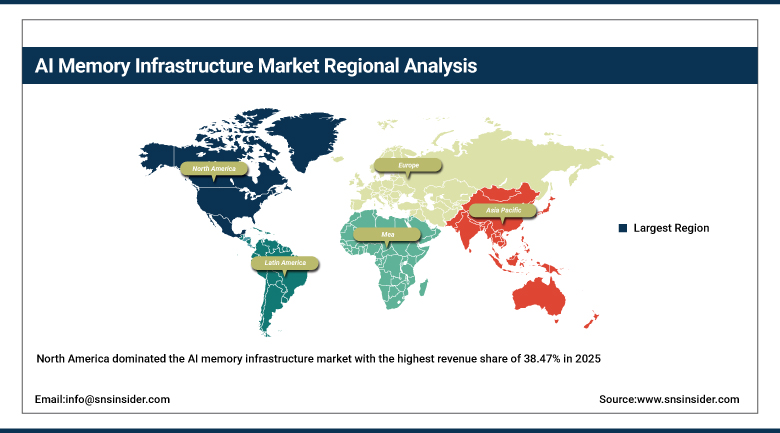
North America dominated the AI memory infrastructure market with the highest revenue share of 38.47% in 2025, supported by its strong hyperscale data center ecosystem, advanced AI computing infrastructure, and significant investments in high-performance computing and cloud platforms. The region has a strong presence of leading semiconductor, memory, cloud, and AI technology companies, supporting rapid deployment of advanced memory solutions. Growing demand for generative AI, machine learning, AI accelerators, and high-performance computing is increasing requirements for high-bandwidth, low-latency, and high-capacity memory infrastructure. The expansion of AI servers, HBM-based systems, DDR5 memory, CXL-based infrastructure, and advanced memory pooling solutions is further supporting regional demand.
Get Customized Report as per Your Business Requirement - Enquiry Now
Europe AI memory infrastructure market insights
The AI memory infrastructure market in Europe is expected to witness steady growth during the forecast period, supported by increasing adoption of cloud computing, artificial intelligence, high-performance computing, and advanced data center infrastructure. Growing investments in digital transformation and AI-enabled enterprise applications are increasing demand for high-bandwidth and scalable memory solutions. The adoption of HBM, DDR5 DRAM, CXL memory, and advanced memory expansion architectures is supporting improvements in computing performance and memory utilization. Germany is anticipated to remain one of the key national markets in Europe, driven by its strong industrial base, expanding data center ecosystem, cloud adoption, and increasing deployment of AI and high-performance computing technologies.
Asia Pacific AI memory infrastructure market insights
Asia Pacific is expected to grow at the fastest CAGR of 18.26% from 2026–2035, driven by rapid expansion of AI computing infrastructure, hyperscale data centers, cloud services, and high-performance computing. Countries including China, Japan, South Korea, India, Singapore, and other Southeast Asian economies are increasing investments in AI servers, data centers, semiconductor manufacturing, and advanced computing infrastructure. The growing deployment of generative AI, machine learning, computer vision, and natural language processing applications is creating substantial demand for high-bandwidth and high-capacity memory technologies. Increasing adoption of HBM3E, HBM4, DDR5, GDDR memory, CXL-based infrastructure, and memory pooling and disaggregation systems is further supporting regional growth.
Middle East & Africa and Latin America AI memory infrastructure market insights
The AI memory infrastructure market in the Middle East & Africa and Latin America is expected to experience consistent growth from 2026 to 2035, supported by expanding data center capacity, cloud adoption, digital transformation, and increasing deployment of AI and high-performance computing technologies. Growing investments in hyperscale and enterprise data centers are creating demand for high-capacity memory infrastructure, AI servers, accelerators, and scalable memory architectures.
In Latin America, Brazil is anticipated to remain a key country-level market due to its expanding data center ecosystem, cloud adoption, enterprise digitalization, and increasing demand for AI-enabled computing. Continued investments in advanced memory technologies, CXL-based infrastructure, and AI computing systems are expected to support regional market expansion.
Market Dynamics
Growth Driver: Increasing demand for high-bandwidth and high-capacity memory infrastructure is driving market growth.
One of the key factors driving the growth of the global AI memory infrastructure market is the rapid expansion of data-intensive AI workloads across hyperscale data centers, cloud platforms, enterprises, and high-performance computing environments. The growing deployment of generative AI, machine learning, large language models, computer vision, and accelerated computing is creating substantial demand for memory infrastructure capable of delivering high bandwidth, low latency, greater capacity, and efficient data access. As AI models become increasingly complex, organizations are adopting advanced memory technologies such as high bandwidth memory (HBM), DDR5 DRAM, GDDR memory, and CXL memory to address memory bandwidth and capacity requirements.
Restraint: High costs and technological complexity can limit market adoption.
The high cost and technical complexity associated with deploying advanced AI memory infrastructure can restrict market adoption, particularly among smaller enterprises and organizations with limited infrastructure budgets. HBM, DDR5 DRAM, GDDR memory, CXL-based systems, and advanced memory expansion solutions require sophisticated hardware architectures and supporting infrastructure. Integrating these technologies into AI servers and accelerated computing platforms can increase system costs and require significant investments in design, validation, and deployment. Moreover, rapid advancements in memory standards and architectures can create compatibility and upgrade challenges for organizations.
Opportunity: Rapid expansion of AI computing and hyperscale data centers creates new market opportunities.
The rapid expansion of AI computing infrastructure and hyperscale data centers presents significant opportunities for AI memory infrastructure providers. Increasing deployment of generative AI systems, large language models, AI accelerators, and high-performance computing clusters is generating substantial demand for high-bandwidth and high-capacity memory solutions. As AI workloads require faster movement and processing of increasingly large datasets, advanced memory technologies are becoming essential for improving computing performance and scalability. Furthermore, the growing adoption of HBM3E, HBM4, CXL-based infrastructure, memory pooling and disaggregation, and advanced memory expansion systems creates opportunities for memory technology and infrastructure providers.
Recent Developments
-
2026: Micron Technology, Inc. continued advancing HBM4 solutions for next-generation AI accelerators and data centers.
-
2026: SK hynix Inc. continued expanding HBM4 and HBM3E solutions for AI servers and hyperscale computing.
-
2026: Samsung Electronics Co., Ltd. continued strengthening its HBM4 and advanced DDR5 portfolio for AI infrastructure.
-
2026: NVIDIA Corporation continued advancing AI computing platforms, driving demand for high-bandwidth memory solutions.
-
2026: Advanced Micro Devices, Inc. continued expanding AI accelerators using advanced HBM-based memory infrastructure.
AI Memory Infrastructure Market key players are:
-
Micron Technology, Inc.
-
SK hynix Inc.
-
Samsung Electronics Co., Ltd.
-
NVIDIA Corporation
-
Advanced Micro Devices, Inc.
-
Intel Corporation
-
Broadcom Inc.
-
Marvell Technology, Inc.
-
Kioxia Corporation
-
Western Digital Corporation
-
Kingston Technology Company, Inc.
-
Mushkin Inc.
-
YMTC
-
Nanya Technology Corporation
-
Winbond Electronics Corporation
-
Powerchip Semiconductor Manufacturing Corporation
-
Rambus Inc.
-
Astera Labs, Inc.
-
Cadence Design Systems, Inc.
-
Synopsys, Inc.
AI Memory Infrastructure Market Report Scope:
| Report Attributes | Details |
|---|---|
| Market Size in 2025 | USD 55.00 Billion |
| Market Size by 2035 | USD 259.88 Billion |
| CAGR | CAGR of 16.82% From 2026 to 2035 |
| Base Year | 2025 |
| Forecast Period | 2026-2035 |
| Historical Data | 2022-2024 |
| Report Scope & Coverage | Market Size, Segments Analysis, Competitive Landscape, Regional Analysis, DROC & SWOT Analysis, Forecast Outlook |
| Key Segments | • By Memory Type (High Bandwidth Memory (HBM), DDR5 DRAM, LPDDR Memory, GDDR Memory, CXL Memory, Other Memory Types) • By Infrastructure Type (AI Servers, AI Accelerators, Memory Expansion Systems, Memory Pooling & Disaggregation Systems, CXL-Based Infrastructure, Other Infrastructure) • By Technology (HBM3, HBM3E, HBM4, DDR5, CXL, Other Technologies) • By Deployment (On-Premises, Cloud, Hybrid) • By Application (Generative AI, Machine Learning, High-Performance Computing, Data Analytics, Computer Vision, Natural Language Processing) • By End Use (Data Centers, Cloud Service Providers, Enterprises, Hyperscalers, Research Institutions, Government & Defense) |
| Regional Analysis/Coverage | North America (US, Canada), Europe (Germany, UK, France, Italy, Spain, Russia, Poland, Rest of Europe), Asia Pacific (China, India, Japan, South Korea, Australia, ASEAN Countries, Rest of Asia Pacific), Middle East & Africa (UAE, Saudi Arabia, Qatar, South Africa, Rest of Middle East & Africa), Latin America (Brazil, Argentina, Mexico, Colombia, Rest of Latin America) |
| Company Profiles | Micron Technology, Inc., SK hynix Inc., Samsung Electronics Co., Ltd., NVIDIA Corporation, Advanced Micro Devices, Inc., Intel Corporation, Broadcom Inc., Marvell Technology, Inc., Kioxia Corporation, Western Digital Corporation, Kingston Technology Company, Inc., Mushkin Inc., YMTC, Nanya Technology Corporation, Winbond Electronics Corporation, Powerchip Semiconductor Manufacturing Corporation, Rambus Inc., Astera Labs, Inc., Cadence Design Systems, Inc., Synopsys, Inc. |

Frequently Asked Questions
Key players include Micron Technology, Inc., SK hynix Inc., Samsung Electronics Co., Ltd., NVIDIA Corporation, Advanced Micro Devices, Inc., Intel Corporation, and Kioxia Corporation, among others.
Key opportunities include expanding AI workloads, hyperscale data centers, cloud computing, HBM4 adoption, CXL-based infrastructure, and advanced memory pooling and disaggregation.
The market is primarily driven by rising demand for high-bandwidth, high-capacity memory to support generative AI, machine learning, HPC, and large-scale AI infrastructure.
North America dominated the AI Memory Infrastructure Market in 2025 with a 38.47% share, supported by strong AI infrastructure, hyperscale data centers, cloud computing, and advanced memory deployments.
