
Fuel Quality Testing Market Report Scope & Overview:
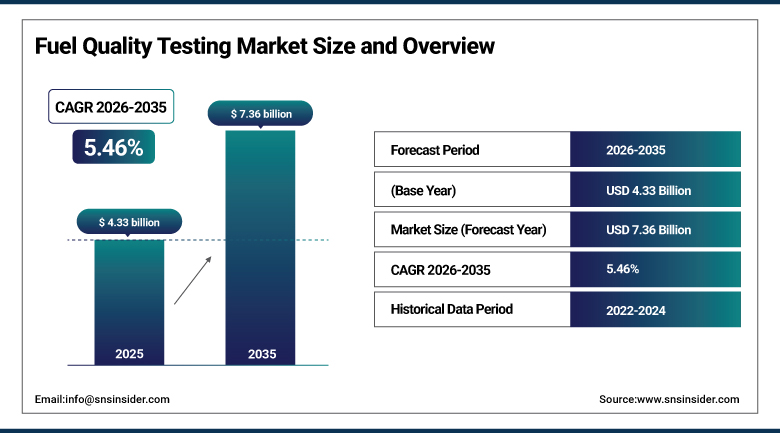
The Fuel Quality Testing Market was valued at USD 4.33 billion in 2025 and is expected to reach USD 7.36 billion by 2035, growing at a CAGR of 5.46% from 2026–2035.
The fuel quality testing market is witnessing steady growth in the global market owing to rising demand for cleaner fuels. Increasing environmental regulations and emission norms are boosting adoption. Growing automotive and aviation fuel consumption is supporting market expansion. Manufacturers are focusing on advanced analytical testing technologies. Rising demand for fuel efficiency and engine performance is driving innovation. Increasing use of biofuels and alternative fuels is further accelerating market adoption.
According to the International Energy Agency Oil Market Report 2025 and the U.S. Energy Information Administration, the consumption of liquid fuels in the world is still more than 100 million barrels per day, where 60% of this consumption is related to transportation, which requires strict monitoring of the fuel quality.
According to the ISO and EPA fuel regulations, the maximum amount of sulfur in the marine fuel shall not exceed 0.5%, according to the IMO 2020 requirement, which was adopted by more than 95% of the world’s shipping tonnage.
To Get more information Fuel Quality Testing Market - Request Free Sample Report
Fuel Quality Testing Market Trends:
-
There has been an increase in the usage of portable and on-site fuel testing equipment which is contributing to real time analysis at remote locations and industries.
-
The quick incorporation of automation and digitization technologies in fuel testing laboratories has improved efficiency, effectiveness, and accuracy.
-
The increasing need for real time monitoring of fuel quality is leading to a change from central laboratories to decentralized laboratories.
-
Improvements in spectroscopy, chromatography, and sensors technology have helped improve the detection capabilities for impurities and other performance characteristics of fuel.
-
There have been increasing research and development efforts from the leading fuel testing firms which are leading to innovative portable fuel testing devices.
-
Operational efficiency and cost-effectiveness are the factors that are promoting the use of portable testing equipment.
U.S. Fuel Quality Testing Market Outlook:
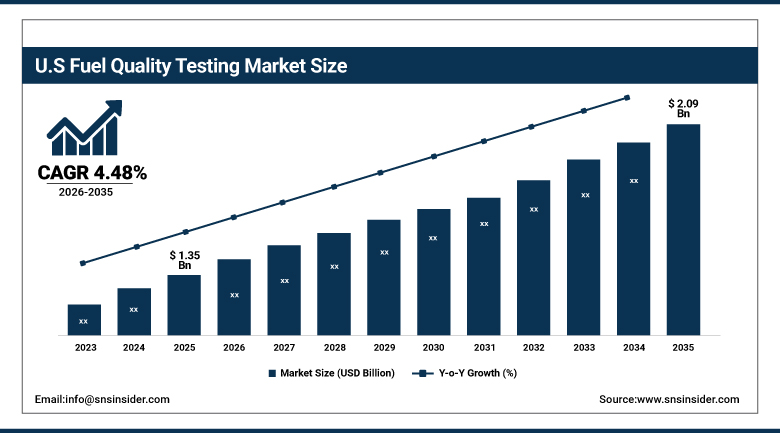
The U.S. Fuel Quality Testing Market was valued at USD 1.35 billion in 2025 and is expected to reach around USD 2.09 billion by 2035, growing at a CAGR of 4.48% from 2026–2035.
The U.S. fuel quality testing market is expanding steadily owing to strict fuel quality regulations. Increasing demand from automotive and aviation sectors is supporting market growth. Rising focus on emission reduction and fuel efficiency is driving adoption across industries. Growth in refinery modernization and fuel distribution networks is further accelerating demand. Manufacturers are focusing on advanced laboratory and portable testing systems. Increasing use of biofuels and alternative fuels is strengthening market penetration.
As per the EPA’s Renewable Fuel Standard Program and 2025 Compliance Reporting, the reduction in lifecycle emissions of renewable fuels from the baseline petroleum fuels should be at least 20%, while for advanced biofuels, the emissions reductions should be up to 50-60%. According to the U.S. Energy Information Administration, the overall consumption of U.S. petroleum products is in excess of 18 million barrels per day.
Fuel Quality Testing Market Segment Analysis:
-
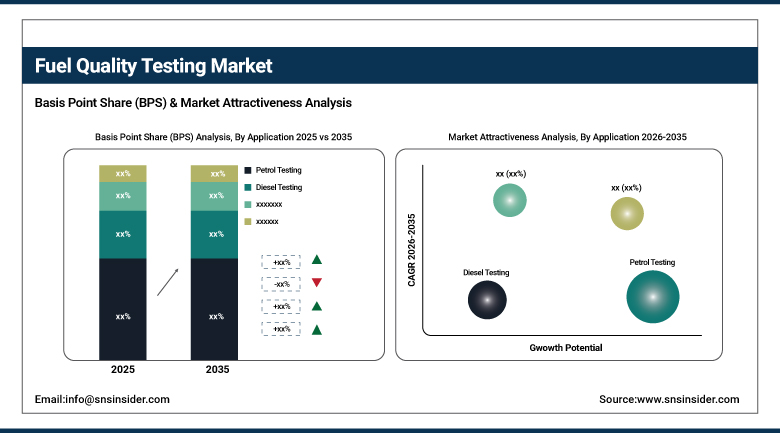
By Application, petrol testing dominated the market with 42.80% share in 2025; while biofuel testing is the fastest growing segment with CAGR of 10.22% during 2026 to 2035.
-
By Testing Method, laboratory testing dominated the market with 58.60% share in 2025; while portable testing is the fastest growing segment with CAGR of 9.67% during 2026 to 2035.
-
By Test Parameters, octane number dominated the market with 37.90% share in 2025; while flash point is the fastest growing segment with CAGR of 9.31% during 2026 to 2035.
-
By End Use, automotive dominated the market with 44.70% share in 2025; while aviation is the fastest growing segment with CAGR of 8.68% during 2026 to 2035.
By Application, petrol testing dominated the fuel quality testing market, while biofuel testing is the fastest growing segment.
The Petrol Testing segment has accounted for the dominated share of revenues in the fuel quality testing market in 2025. It is attributed to high global consumption of petrol in passenger cars. High refining capacity and high fuel quality standards have boosted demand for petrol testing. The well-established petrol distribution network has ensured consistent testing of petrol quality. Automotive usage and compliance requirements have played a significant role in achieving dominance in the entire market scenario.
The Biofuel Testing segment is expected to witness the fastest CAGR between 2026 and 2035. It is due to the rising shift towards green and clean energy sources. Increasing government regulations related to cleaner energy have been playing a key role in driving the demand for biofuels. Growing production of ethanol and biodiesel has boosted the need for biofuel testing.
By Testing Method, laboratory testing dominated the fuel quality testing market, while portable testing is the fastest growing segment.
Laboratory Testing segment was the leading segment of fuel quality testing market by generating the dominated share of revenues in 2025. High precision, compliance with regulatory requirements, and extensive use in refining and certification processes have led to the domination of this segment. Reliable contamination detection and fuel properties identification is guaranteed by this testing. Existing facilities for testing in laboratories and preference of standard results in both automotive and aviation industries contribute to the dominance of this segment in the global market.
Portable Testing segment is anticipated to register the fastest CAGR from 2026 to 2035. The reason behind the rise in the growth rate is high demand for on-site fuel quality assessment and analysis. Demand for timely decision-making in the distribution of fuels is contributing to this trend. Improvement in miniaturized sensor-based devices and increasing use in field applications are also accelerating the growth of the segment.
By Test Parameters, octane number dominated the fuel quality testing market, while flash point is the fastest growing segment.
The Octane Number segment accounted for the dominated market share in terms of revenue in the fuel quality testing market in 2025. The key reason behind its dominance is its significance in assessing fuel quality and engine performance. Fuel producers depend heavily on octane number tests as a result of their importance in maintaining strict fuel standards. Growing demand for high-performance cars and stringent emission norms increase the application of octane number tests across fuel quality control in refineries and automobiles.
The Flash Point segment is anticipated to experience the fastest CAGR from 2026 to 2035 owing to growing safety norms associated with fuel storage and transportation. It is a commonly used test for determining flammability hazards associated with fuels across aviation, marine, and industry applications. Growing focus on accident prevention and safe handling of dangerous substances is leading to higher demand for the test.
By End Use, automotive dominated the fuel quality testing market, while aviation is the fastest growing segment.
The Automotive segment accounted for the dominated market share in terms of revenue generated in 2025 owing to huge vehicle manufacturing and fuel consumption across the globe. Increasing fuel emissions and efficiency requirements have raised the need for fuel quality testing. Growing requirement for testing of gasoline and diesel fuel quality in refineries and transportation networks is propelling its growth. Increase in the size of the fleet of vehicles drives demand for regular fuel testing.
The Aviation segment is anticipated to register the fastest CAGR in terms of value from 2026-2035 due to rising number of passengers in air and increase in the fleet of aircrafts across the globe. High demand for advanced fuels for the aircraft with very high standards is raising the adoption of fuel testing. Need for testing of fuel purity and contamination by the regulatory authorities is boosting its demand.
Regional Analysis:
|
Region |
Major Country |
Share within Region, 2025(%) |
|---|---|---|
|
North America |
United States |
84.60% |
|
Europe |
Germany |
27.00% |
|
Asia Pacific |
China |
42.50% |
|
Middle East & Africa |
UAE |
18.50% |
|
Latin America |
Brazil |
47.50% |
North America Fuel Quality Testing Market Insights.
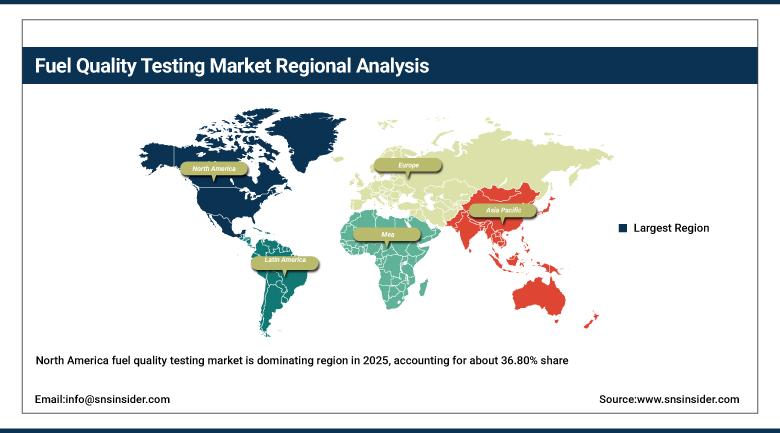
North America fuel quality testing market is dominating region in 2025, accounting for about 36.80% share, driven by strict fuel quality regulations and standards. The region benefits from advanced refinery infrastructure and strong laboratory testing capabilities. Increasing demand from automotive and aviation fuel monitoring is significantly strengthening market penetration. Expansion of fuel distribution networks and compliance requirements is accelerating testing demand. Strong focus on emission control policies further reinforces the region’s dominant position in the market.
As per the U.S. Energy Information Administration and Environment and Climate Change Canada, the production rate of crude oil from the United States was an average of 13.2 million barrels per day, whereas the production rate of crude oil from Canada was an average of 5.8 million barrels per day, facilitating comprehensive fuel quality testing throughout North America.
According to the U.S. Environmental Protection Agency Tier 3 Fuel Standards and ASTM International standards for 2025, the sulfur content of gasoline is restricted to an annual average of 10 ppm.
Get Customized Report as per Your Business Requirement - Enquiry Now
Europe Fuel Quality Testing Market Insights.
Europe fuel quality testing market is characterized by stable growth in 2025 owing to strong regulatory enforcement and sustainability targets. Key countries include Germany, France, United Kingdom, and Italy. Rising focus on carbon emission reduction and fuel efficiency is driving adoption. Increasing demand from automotive and industrial sectors is boosting market expansion. Strict European fuel quality directives are encouraging advanced laboratory testing technologies and continuous fuel monitoring systems across the region.
According to the report provided by the European Environment Agency and the European Commission Renewable Energy Progress Report 2025, the contribution of renewable energy sources was about 24.5% of the gross final energy consumption of the European Union, and the Fuel Quality Directive ensures that fuel providers monitor and improve the greenhouse gas intensity on the fuel lifecycle.
Asia Pacific Fuel Quality Testing Market Insights.
Asia Pacific is the fastest growing region in the fuel quality testing market, registering a CAGR of about 6.94% during 2026–2035. Rapid industrialization and rising vehicle ownership are driving strong demand across China, India, Japan, South Korea, and Southeast Asia. Expanding refinery capacity and fuel consumption are boosting market growth. Increasing environmental concerns and fuel adulteration issues are further accelerating adoption. Growth in transportation and energy sectors is supporting large scale testing demand expansion.
As highlighted in the IEA Oil Market Report 2025 and APEC energy statistics, Asia Pacific contributes to over 35% of total oil consumption and over 50% of total coal consumption in the world. According to the World Bank energy access data, more than 90% of the urban population in East and Southeast Asia has access to fuel distribution systems that are well regulated. The industrial fuel quality standards compatible with emission norms of Euro equivalent have been implemented by more than 20 countries of the Asia Pacific region.
Middle East & Africa and Latin America Fuel Quality Testing Market Insights.
The Middle East & Africa along with Latin America regions are witnessing steady growth due to expanding oil refining activities and fuel trade. Key contributing countries include Brazil, Mexico, UAE, Saudi Arabia, and South Africa. Increasing demand for fuel quality compliance in transportation and industrial sectors is driving adoption. Growth in aviation and marine fuel usage is further supporting market expansion. Rising investments in refinery modernization are boosting regional testing demand.
According to IEA World Energy Statistics 2025 and OPEC Annual Statistical Bulletin, Middle East is responsible for producing over 31% of the world's crude oil, while Latin America's contribution in the same stands at around 8-9%, out of which Brazil contributes more than 3%. According to ISO fuel quality requirements and energy access by World Bank, over 90% of the transport fuel used in the OECD and other major export countries undergoes sulfur and contaminants testing.
Market Dynamics:
Growth Drivers: Growing adoption of advanced analytical technologies and automation in fuel testing laboratories worldwide.
The incorporation of automation technology and digitization in testing machines is increasing the precision and effectiveness in the testing of fuel quality. High-precision machinery is being preferred in laboratories to ensure promptness and preciseness in the test procedures. The need for portable and real-time testing systems is on the rise within industrial as well as field applications. Technological improvements in the fields of spectroscopy, chromatography, and sensors are increasing the sensitivity in the detection of fuel qualities. Increased R&D activities among the leading fuel test players are boosting innovations in the testing processes.
In accordance with the IEA Oil Market Report 2025 and EIA refinery statistics, global oil consumption is still higher than 100 million barrels per day, necessitating constant monitoring of oil quality throughout the process of its refinement and distribution. In accordance with the API and ASTM International standards system, more than 12,000 test methods of quality control of fuel exist worldwide, which promotes automation of laboratory work and application of spectroscopy.
Restraints: Complex regulatory frameworks and lack of standardization across different regional fuel quality norms.
There exist differences in standards for fuels among different nations that make it difficult to have uniformity in compliance. The frequent changes in regulations create difficulty for testing labs in terms of operations. There is no common set of standards globally, which results in inconsistencies in the methods of testing and reporting. Businesses find it challenging to satisfy the various certification processes involved in international fuel trading. Such inconsistencies create problems in the adoption of more efficient testing systems.
Opportunities:Increasing demand for portable and on-site fuel testing solutions in remote and industrial applications.
Increasing requirement for real-time fuel analysis at remote sites is propelling the use of portable test devices. Sectors like mining, maritime, and logistics have to check the quality of fuel on an urgent basis to maintain efficiency. Portability decreases the reliance on centralized labs and enhances the speed of decision-making process. Technical progress in small size sensors and portable analyzers increases the precision and ease-of-use. Increasing emphasis on flexible operations and costs savings is fostering the adoption of portable fuel testing systems.
As stated by the International Organization for Standardization, the fuel quality factors including the sulfur level can go up to 0.5% only across the globe according to the IMO 2020 standards, which affect more than 90% of the international shipping fuel consumption. As per the World Bank infrastructure and energy accessibility statistics, there are more than 1 billion people who depend on isolated energy distribution, thus creating a market demand for portable fuel tests.
Recent Developments:
-
2026: AmSpec Group expanded independent fuel inspection services and enhanced digital laboratory reporting systems for global energy trading markets.
-
2025: Intertek Group plc continued expanding assurance and testing services with focus on petroleum fuel quality compliance and sustainability-driven laboratory modernization initiatives.
-
2025: Bureau Veritas SA expanded digital testing capabilities and sustainability-focused fuel assurance services supporting global energy transition and regulatory compliance requirements.
-
2024: TÜV SÜD AG enhanced laboratory testing infrastructure supporting fuel quality verification, emissions compliance, and advanced analytical instrumentation for energy sector clients.
Fuel Quality Testing Market Key Players are:
-
SGS SA
-
Bureau Veritas SA
-
Intertek Group plc
-
Eurofins Scientific SE
-
ALS Limited
-
Mérieux NutriSciences Corporation
-
AmSpec Group
-
Petrolab Company
-
Core Laboratories Inc.
-
Inspectorate International Limited
-
Saybolt LP
-
Vinci Technologies
-
FOI Laboratories
-
COTECNA Inspection SA
-
Bureau Veritas Consumer Products Services
-
TÜV SÜD AG
-
TÜV Rheinland AG
-
DEKRA SE
-
SGS Baseefa Limited
-
Petro Lab Inc.
Fuel Quality Testing Market Report Scope:
| Report Attributes | Details |
|---|---|
| Market Size in 2025 | USD 4.33 Billion |
| Market Size by 2035 | USD 7.36 Billion |
| CAGR | CAGR of 5.46% From 2026 to 2035 |
| Base Year | 2025 |
| Forecast Period | 2026-2035 |
| Historical Data | 2022-2024 |
| Report Scope & Coverage | Market Size, Segments Analysis, Competitive Landscape, Regional Analysis, DROC & SWOT Analysis, Forecast Outlook |
| Key Segments | • By Application (Petrol Testing, Diesel Testing, Biofuel Testing, Additive Testing) • By Testing Method (Laboratory Testing, On-Site Testing, Portable Testing) • By Test Parameters (Octane Number, Cetane Number, Density, Flash Point) • By End Use (Automotive, Aviation, Marine, Industrial) |
| Regional Analysis/Coverage | North America (US, Canada), Europe (Germany, UK, France, Italy, Spain, Russia, Poland, Rest of Europe), Asia Pacific (China, India, Japan, South Korea, Australia, ASEAN Countries, Rest of Asia Pacific), Middle East & Africa (UAE, Saudi Arabia, Qatar, South Africa, Rest of Middle East & Africa), Latin America (Brazil, Argentina, Mexico, Colombia, Rest of Latin America). |
| Company Profiles | SGS SA, Bureau Veritas SA, Intertek Group plc, Eurofins Scientific SE, ALS Limited, Mérieux NutriSciences Corporation, AmSpec Group, Petrolab Company, Core Laboratories Inc., Inspectorate International Limited, Saybolt LP, Vinci Technologies, FOI Laboratories, COTECNA Inspection SA, Bureau Veritas Consumer Products Services, TÜV SÜD AG, TÜV Rheinland AG, DEKRA SE, SGS Baseefa Limited, Petro Lab Inc. |

