
Mobile Fuel Storage Tank Market Report Scope & Overview:
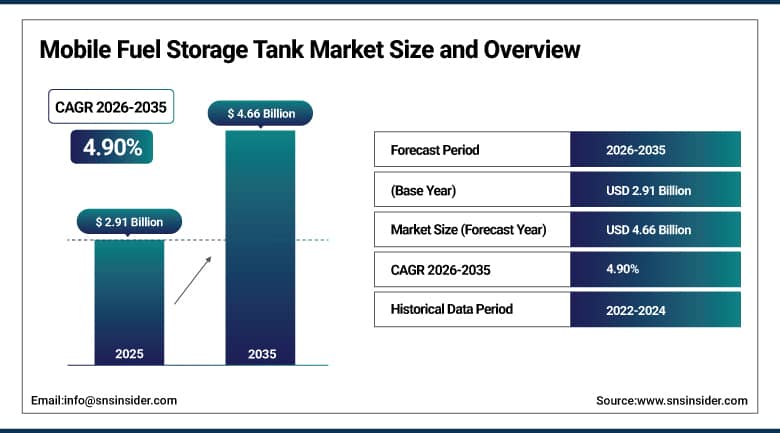
The Mobile Fuel Storage Tank Market was valued at USD 2.91 billion in 2025 and is expected to reach USD 4.66 billion by 2035, growing at a CAGR of 4.90% from 2026–2035.
Mobile fuel storage tanks are experiencing significant market growth due to the rising demand for mobile on-site fuel storage for industries like construction, mining, military operations, agriculture, and disaster relief services. The use of large equipment on different sites without adequate fuel storage facilities has increased the demand for fast mobilization and high-capacity fuel storage tanks. Increasing stringent fuel handling requirements along with growing industries and continuous fuel supply chain has been boosting the mobile fuel storage tank market significantly.
Next Generation Modular Fuel Storage Tank Containers have been introduced by some leading mobile fuel tank makers and industrial logistic providers in the month of February 2026, which can be deployed in the field rapidly and feature stackable tank design with quick connect refuelling systems for mining and construction operations in remote locations.
Market Size and Forecast
-
Market Size 2026E: USD 3.03 Billion
-
Market Size 2035: USD 4.66 Billion
-
CAGR (2026 - 2035): 4.90%
-
Fastest Growing Region: Asia Pacific
-
Largest Region: North America
To Get More Information On Mobile Fuel Storage Tank Market - Request Free Sample Report
Mobile Fuel Storage Tank Market Trends
-
Rising construction, mining, and infrastructure activities in remote areas are driving demand for mobile fuel storage systems.
-
Increasing adoption of trailer-mounted and modular tanks is improving deployment flexibility and fuel accessibility.
-
Growing integration of IoT-based monitoring and tracking systems is enhancing fuel management efficiency and safety.
-
Rising focus on spill-proof, double-wall, and safety-compliant designs is boosting product innovation.
-
Increasing defense and emergency response applications are accelerating demand for high-capacity mobile fuel tanks.
The US Mobile Fuel Storage Tank Market Size Outlook
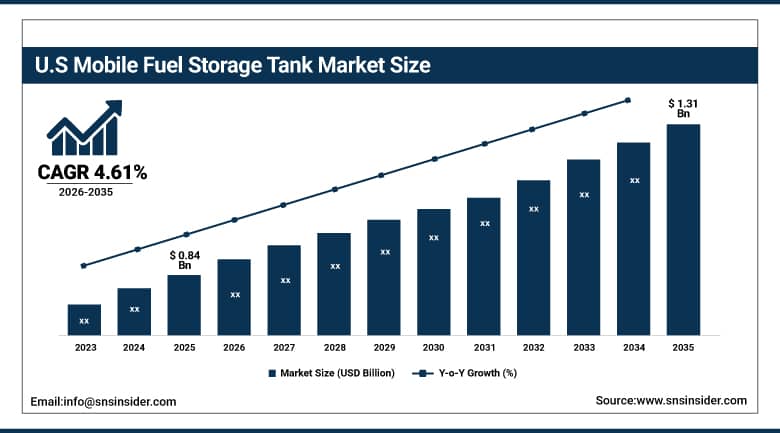
The U.S. Mobile Fuel Storage Tank Market was valued at USD 0.84 billion in 2025 and is expected to reach around USD 1.31 billion by 2035, growing at a CAGR of 4.61% from 2026–2035.
The US is leading in the market for mobile fuel storage tanks owing to high demand for mobile tanks in industries such as construction, mining, oil and gas extraction, and the defense sector. Also, there is a presence of some high-performing companies in this market including Western Global, Transcube Global, Kingspan Group, and Hoover Ferguson. High number of large-scale construction projects, increased shale oil drilling operations, and wide logistics for its defense industry are some major reasons why there is widespread usage of mobile fuel storage tanks through trailers and skids in the US to provide regular fuel supply.
In March 2026, several U.S. equipment manufacturers and fuel logistics contractors introduced rapid-deployment modular fuel storage units designed for emergency response and disaster relief operations, featuring stackable tank systems, enhanced spill containment barriers, and quick-connect refueling interfaces to support wildfire response and hurricane recovery missions across multiple states.
Mobile Fuel Storage Tank Market Segment Analysis
-
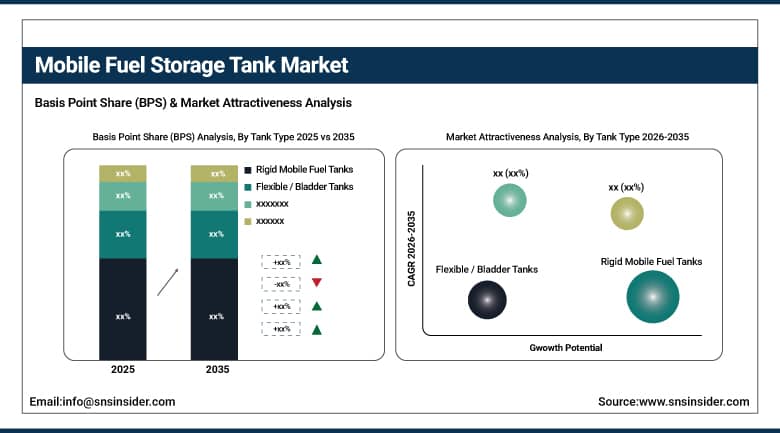
By Tank Type, rigid mobile fuel tanks dominated the market with 40.56% share in 2025; trailer-mounted fuel tanks are the fastest-growing segment with the highest CAGR.
-
By Fuel Type, diesel dominated the market with 55.41% share in 2025; biofuels are the fastest-growing segment with the highest CAGR.
-
By Capacity, 1,000–5,000 liters segment dominated the market with 39.14% share in 2025; 5,000–10,000 liters is the fastest-growing segment with the highest CAGR.
-
By End-Use industry, construction & infrastructure dominated the market with 30.21% share in 2025; mining & oil & gas is the fastest-growing segment with the highest CAGR.
By Tank Type, rigid mobile fuel tanks dominate the mobile fuel storage tank market, while trailer-mounted fuel tanks are the fastest-growing segment.
Rigid mobile fuel tanks segment dominated the market with the highest revenue share of about 40.56% in 2025 due to their extensive deployment across construction fleets, mining operations, industrial backup power systems, and defense logistics where durable, high-capacity, and reliable on-site fuel storage is critical. Their strong structural integrity, ease of integration with heavy equipment, and cost-efficient lifecycle performance make them the preferred choice for long-duration field operations across both developed and emerging economies. Additionally, widespread availability through OEM and aftermarket channels further strengthens their dominant position globally.
Trailer-mounted fuel tanks segment is projected to register the fastest CAGR during 2026–2035 driven by rising demand for highly mobile, rapidly deployable fuel logistics solutions in remote construction sites, oil & gas exploration zones, military field operations, and disaster response applications. Increasing emphasis on operational flexibility, reduced refueling downtime, and on-site fuel autonomy is significantly accelerating adoption of trailer-based mobile fuel systems.
By Fuel Type, diesel dominates the mobile fuel storage tank market, while biofuels are the fastest-growing segment.
Diesel segment held the dominant share of about 55.41% in 2025 owing to its widespread use in heavy machinery, off-grid power generation units, mining equipment, and large construction fleets where operational continuity is heavily dependent on diesel-based systems. The high energy density of diesel, combined with its established global supply infrastructure and compatibility with industrial-grade engines, continues to make it the primary fuel driving demand for mobile storage solutions.
Biofuels segment is expected to register the fastest CAGR during 2026–2035 due to accelerating global decarbonization initiatives, stricter emission regulations, and rising adoption of renewable fuel blends across industrial, agricultural, and transportation sectors. Growing investments in sustainable fuel logistics and hybrid energy systems are further boosting the shift toward biofuel-compatible mobile storage infrastructure.
By Capacity, 1,000–5,000 liters segment dominates the mobile fuel storage tank market, while 5,000–10,000 liters is the fastest-growing segment.
1,000–5,000 liters segment led the mobile fuel storage tank market with the highest share of about 39.14% in 2025 due to its optimal balance between portability, operational efficiency, and storage adequacy, making it highly suitable for construction sites, agricultural operations, and medium-scale industrial applications. Its versatility, ease of transportation, and compatibility with multiple end-use industries have made it the most widely adopted capacity range globally.
5,000–10,000 liters segment is projected to grow at the fastest CAGR during 2026–2035 driven by increasing demand from large-scale mining projects, infrastructure megacities, defense logistics operations, and remote energy installations where higher fuel autonomy and reduced refilling frequency are critical for operational efficiency and cost optimization.
By End-Use Industry, construction & infrastructure dominates the mobile fuel storage tank market, while mining & oil & gas is the fastest-growing segment.
Construction & Infrastructure segment dominated the mobile fuel storage tank market with the highest share of about 30.21% in 2025 due to rapid urbanization, global infrastructure expansion, highway development projects, and large-scale commercial construction activities requiring uninterrupted on-site fuel supply for heavy equipment and machinery. The rising number of smart city developments and megaprojects across emerging economies further reinforces sustained demand.
Mining & Oil & Gas segment is expected to record the fastest CAGR during 2026–2035 owing to increased exploration activities in remote and harsh environments, rising global energy demand, and growing dependence on mobile fuel logistics systems to ensure continuous operations in off-grid and high-risk extraction zones. The need for operational resilience and fuel independence is significantly accelerating adoption in this segment.
Regional Analysis:
|
Region |
Major Country |
Share within Region, 2025(%) |
|---|---|---|
|
North America |
United States |
81.54% |
|
Europe |
Germany |
27.29% |
|
Asia Pacific |
China |
49.35% |
|
Middle East & Africa |
UAE |
27.96% |
|
Latin America |
Brazil |
35.71% |
North America Mobile Fuel Storage Tank Market Insights
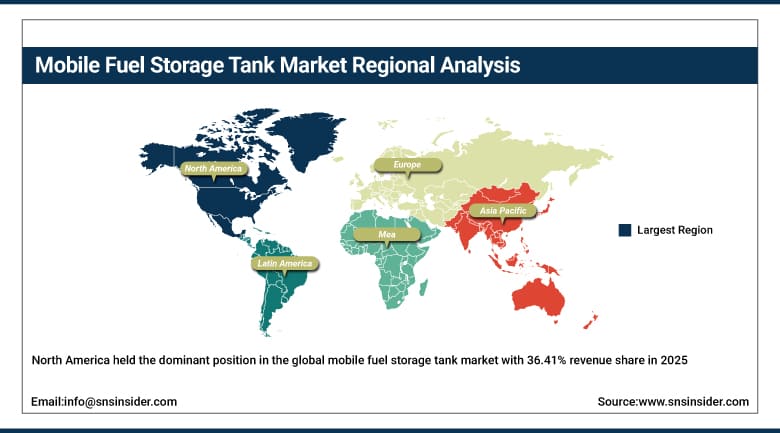
North America held the dominant position in the global mobile fuel storage tank market with 36.41% revenue share in 2025, backed up by the extensive development in defense logistics modernization, efficient construction equipment, shale oil and gas production processes, and established infrastructure for industrial fuel. Mobile fuel storage solutions using trailers and skids have gained significant traction in the region due to their ability to provide uninterrupted fuel supply without depending on any grids for military, mining, and infrastructure activities. The US continues to dominate as a major market because of government procurement initiatives, contingency planning, and field deployment of fuel distribution units. Moreover, investments being made in smart fuel logistics and automated fuel dispensing technology are propelling the demand for digital fuel storage systems.
Canadian infrastructure and energy contractors deployed over 2,500+ smart mobile fuel storage tanks across large-scale construction and remote energy projects in 2025, integrating IoT-based fuel monitoring and leak detection systems to enhance operational efficiency, regulatory compliance, and fuel management accuracy in off-grid environments.
Get Customized Report as Per Your Business Requirement - Enquiry Now
Asia Pacific Mobile Fuel Storage Tank Market Insights
The Asia Pacific is projected to register the highest CAGR of 5.63% from 2026–2035, driven by unprecedented growth in the form of infrastructural development, mining activities, energy exploration, and agriculture mechanization in regions such as China, India, Australia, Indonesia, and Southeast Asia. The region relies extensively on diesel-driven construction machinery and mining equipment that work in areas that are either rural or semi-urban, thus creating a need for portable high-volume storage containers. Industrialization, along with significant government investments in infrastructure, has also been boosting the installation of fuel tanks mounted on trailers and skids. Moreover, expansion in smart cities, metros, and logistical routes has been spurring the demand for fuel infrastructure that can be rapidly installed.
Some of the recent advances in this area involve India's use of mobile fuel tanks for various national highways and metro rail constructions which help maintain heavy machine operation within construction corridors stretching more than 5,000 km long, and China’s utilization of mobile fuel tanks for mining equipment in their mining areas of Inner Mongolia and western China.
Europe Mobile Fuel Storage Tank Market Insights
Europe is an important player in the market for mobile fuel storage tanks, owing to strict environmental policies, sophisticated industrial processes, and high usage of fuel logistic systems that adhere to safety requirements. The need for mobile fuel storage tanks comes from industries like construction, logistics, defense, and agricultural sectors, where there is a need for adhering to environmental standards and safety protocols in relation to emissions and fuel handling according to ADR and EU environmental directives. Important countries adopting such mobile fuel storage tanks include Germany, France, United Kingdom, and Nordic countries.
A €2.5 billion European Defense Fund–supported logistics modernization initiative is integrating modular mobile fuel systems to strengthen NATO’s field refueling capabilities across multinational operations. In parallel, German infrastructure and construction companies are deploying IoT-enabled mobile fuel tanks in large-scale transport and rail projects, enabling real-time monitoring and automated dispensing systems that reduce fuel wastage by 15%.
Latin America, Middle East & Africa (LAMEA) Mobile Fuel Storage Tank Market Insights
LAMEA is experiencing continuous growth due to increased oil and gas exploration, mining operations, infrastructural projects, and demand for mobile fuel logistics due to the need for fuel in underserved areas. Some of the countries that constitute the market are Brazil, Mexico, Saudi Arabia, UAE, South Africa, and Nigeria, which have limited infrastructure for fuel logistics and are heavily dependent on mobile fuel systems because of remote operations. This region has experienced increased investments by both private and public sectors in energy, construction, and modernization of defense. One of the most recent events is the implementation of a Saudi Arabia NEOM giga-project for fuel logistics in the multibillion-dollar construction project.
Across over 10,000+ construction vehicles operating in off-grid zones, and Brazilian mining operators expanding trailer-mounted fuel storage fleets across Amazon basin projects supporting continuous fuel supply for heavy extraction equipment operating in remote terrain exceeding 500+ active mining sites.
Market Dynamics:
Growth Drivers: Rising dependency on off-grid fuel mobility solutions across industrial and infrastructure sectors is significantly accelerating adoption of mobile fuel storage tanks
The fast growth in construction megaprojects, mining ventures, oil and gas exploration, as well as the logistics requirements of defense-related field operations is causing robust demand for fuel storage units that are mobile. Since such operations are moving increasingly into remote and uncharted areas, there has been the need to keep continuous access to fuel on site, which has become a critical necessity for ensuring smooth progress. This has been a significant impetus behind the increased use of portable tanks installed on trailers or skids. The growing mechanization of the construction and mining industry fleets, coupled with increased usage of diesel-powered machinery, is causing even more robust demand.
Restraints: Regulatory complexity, safety risks, and high compliance burden are constraining large-scale adoption of mobile fuel storage systems
In spite of the robust demand for mobile fuel tanks, the market is facing considerable headwinds because of strict laws related to the transportation of fuels, safety during storage, environmental issues, and transportation of hazardous materials. Adhering to regional laws and guidelines such as ADR regulation in Europe and EPA rules in North America, among others, adds to the total cost of operations while hampering adoption rates, especially among smaller firms. Additionally, mobile fuel storage units need constant checks to ensure that there is no leakage or contamination that can cause a fire hazard, thereby increasing costs. The market also faces competition from affordable alternative methods of fuel storage and distribution, such as stationary fuel stores and fuel drums and third-party fuel delivery services.
Opportunities: Digital fuel logistics transformation and clean fuel transition are unlocking high-value growth opportunities in mobile fuel storage solutions
The incorporation of technological developments like IoT-based fuel monitoring, live telemetry data, automated fueling stations, and fuel forecasting technology presents huge potential for advanced mobile fuel tank systems. Such developments help organizations to maximize fuel efficiency and reduce wastage and increase the productivity of their fleets during large-scale operations. The global trend of decarbonization will present a lot of opportunities in terms of developing advanced mobile fuel storage systems which will be able to carry both conventional diesel as well as biofuel blends and alternative fuels. Increased focus on renewable energy ventures, smart cities, and sustainable mining is contributing to the demand for fuel management systems.
Recent Developments
-
2026: Caterpillar Inc. enhanced its mobile fuel storage ecosystem by integrating digital fuel monitoring and telematics-enabled dispensing systems for construction and mining fleets, improving fuel efficiency and reducing downtime in off-grid operations.
-
2026: Dover Corporation (OPW Division) expanded its mobile fuel handling solutions with upgraded trailer-compatible storage tanks featuring improved spill control and automated safety systems for industrial applications in North America and Europe.
-
2025: Chart Industries expanded modular fuel and energy storage solutions supporting mobile and remote operations, strengthening its presence in decentralized industrial fuel logistics projects across North America.
-
2025: Westeel (AGI) upgraded its portable and trailer-mounted fuel tank systems with enhanced corrosion resistance and safety compliance features, targeting agriculture and oilfield applications in Canada and export markets.
Mobile Fuel Storage Tank Market Key Players are:
-
Western Global
-
Transcube Global
-
Kingspan Group
-
Hoover Ferguson Group
-
Enduraplas
-
Cemo GmbH
-
Snyder Industries
-
FuelProof Ltd
-
Poly Processing Company
-
Sintex Industries
-
ZCL Composites Inc.
-
SCHÜTZ GmbH & Co. KGaA
-
DENIOS AG
-
Westeel (AGI)
-
Duraplas Australia
-
Tuffa Tanks Ltd
-
Rapid Spray
-
Oasis Containers Ltd
-
Gallegos Industries
-
Armorgard Ltd.
Mobile Fuel Storage Tank Market Report Scope:
| Report Attributes | Details |
|---|---|
| Market Size in 2025 | USD 2.91 Billion |
| Market Size by 2035 | USD 4.66 Billion |
| CAGR | CAGR of 4.90% From 2026 to 2035 |
| Base Year | 2025 |
| Forecast Period | 2026-2035 |
| Historical Data | 2022-2024 |
| Report Scope & Coverage | Market Size, Segments Analysis, Competitive Landscape, Regional Analysis, DROC & SWOT Analysis, Forecast Outlook |
| Key Segments | • By Tank Type (Rigid Mobile Fuel Tanks, Flexible / Bladder Tanks, Trailer-Mounted Fuel Tanks, Intermediate Bulk Containers (IBC) Fuel Tanks) • By Fuel Type (Diesel, Gasoline, Jet Fuel / Aviation Fuel, Biofuels, LPG / LNG (Specialized Mobile Systems) • By Capacity (1,000 – 5,000 Liters,Below 1,000 Liter, 5,000 – 10,000 Liters, Above 10,000 Liters) • By End-Use Industry (Construction & Infrastructure, Mining & Oil & Gas, Defense & Military, Agriculture, Transportation & Logistics, Marine & Ports, Emergency & Disaster Management,Others) |
| Regional Analysis/Coverage | North America (US, Canada), Europe (Germany, UK, France, Italy, Spain, Russia, Poland, Rest of Europe), Asia Pacific (China, India, Japan, South Korea, Australia, ASEAN Countries, Rest of Asia Pacific), Middle East & Africa (UAE, Saudi Arabia, Qatar, South Africa, Rest of Middle East & Africa), Latin America (Brazil, Argentina, Mexico, Colombia, Rest of Latin America). |
| Company Profiles | Western Global, Transcube Global, Kingspan Group, Hoover Ferguson Group, Enduraplas, Cemo GmbH, Snyder Industries, FuelProof Ltd, Poly Processing Company, Sintex Industries, ZCL Composites Inc., SCHÜTZ GmbH & Co. KGaA, DENIOS AG, Westeel (AGI), Duraplas Australia, Tuffa Tanks Ltd, Rapid Spray, Oasis Containers Ltd, Gallegos Industries, Armorgard Ltd |
Frequently Asked Questions
The mobile fuel storage tank market is expected to grow at a CAGR of 4.90% from 2026 to 2035.
The mobile fuel storage tank market was valued at USD 2.91 billion in 2025.
Rising demand from off-grid construction activities, mining expansion in remote locations, oil & gas exploration projects, defense field operations, and large-scale infrastructure development is driving adoption of mobile fuel storage tanks globally.
The Rigid Mobile Fuel Tanks segment dominated the mobile fuel storage tank market in 2025.
North America dominated the mobile fuel storage tank Market in 2025.
Get in Touch
