
Solid Recovered Fuel Market Report Scope & Overview:
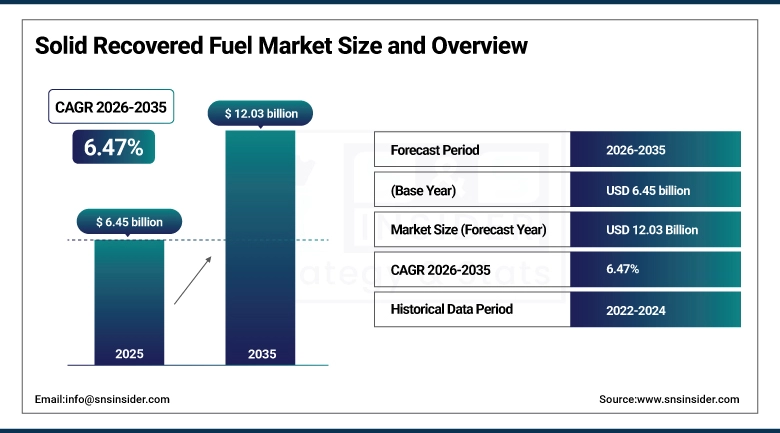
The Solid Recovered Fuel Market was valued at USD 6.45 billion in 2025 and is expected to reach USD 12.03 billion by 2035, growing at a CAGR of 6.47% from 2026-2035.
Solid Recovered Fuel Market growth is driven by rising demand for alternative sources of energy in energy-consuming industries like cement manufacturing and power production. There has been a growing concern to minimize waste disposal into landfills. The strict environment-related policies and carbon-free initiatives have motivated organizations to opt for waste-to-energy processes. The rapid pace of urbanization and industrialization is contributing to the increased amount of waste produced, and technological innovations in waste management have made SRF more efficient.
Supporting this trend, the European Cement Association (CEMBUREAU) reports that alternative fuels, including Solid Recovered Fuel (SRF) and Refuse-Derived Fuel (RDF), already account for over 50% of thermal energy use in several EU cement plants, with some facilities achieving substitution rates exceeding 80%, highlighting strong industrial uptake.
In addition, the European Commission enforces landfill diversion through the Landfill Directive (1999/31/EC), which actively promotes recycling and energy recovery pathways, including SRF production, to reduce dependence on landfilling and support circular economy objectives.
To Get more information on Solid Recovered Fuel Market - Request Free Sample Report
Solid Recovered Fuel Market Trends
-
Rising focus on waste-to-energy solutions and landfill reduction is driving the solid recovered fuel (SRF) market.
-
Growing demand for alternative fuels in cement, power generation, and industrial sectors is boosting market growth.
-
Expansion of municipal and industrial waste processing is fueling SRF production.
-
Increasing emphasis on reducing carbon emissions and replacing fossil fuels is shaping adoption trends.
-
Advancements in waste sorting, shredding, and processing technologies are enhancing fuel quality and efficiency.
-
Rising government regulations and sustainability initiatives are supporting market expansion.
-
Collaborations between waste management companies, industrial users, and energy producers are accelerating innovation and global adoption.
U.S. Solid Recovered Fuel Market Size Outlook:
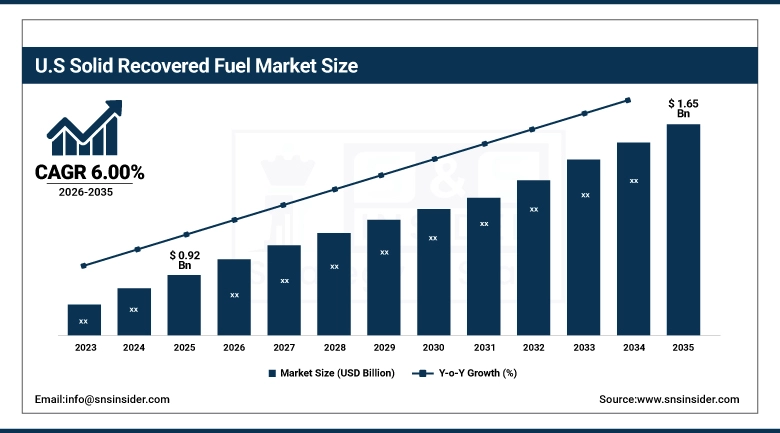
The U.S. Solid Recovered Fuel Market was valued at USD 0.92 billion in 2025 and is expected to reach USD 1.65 billion by 2035, growing at a CAGR of 6.00% from 2026-2035. The U.S. Solid Recovered Fuel Market is being fueled by increased demand for alternatives to conventional fuels used in the cement and power sectors, stringent landfill reduction regulations, and increasing capital investments in energy recovery technologies. The focus on sustainable practices is aiding market growth.
Supporting this trend, the U.S. Environmental Protection Agency (EPA) reports that the country generates over 290 million tons of municipal solid waste annually, providing a strong and consistent feedstock base for Solid Recovered Fuel (SRF) production.
Additionally, the EPA’s Landfill Methane Outreach Program (LMOP) highlights efforts to reduce landfill methane emissions by diverting organic and combustible waste into energy recovery systems, further reinforcing SRF adoption as a key component of circular economy and waste-to-energy strategies.
Solid Recovered Fuel Market Growth Drivers:
-
Rising demand for alternative low-cost fuels in energy-intensive industries like cement and power generation to reduce fossil fuel dependency
The rising need for affordable and sustainable fuel sources is encouraging more industries to embrace SRF. For instance, cement kilns and power stations are increasingly moving away from coal toward SRF because it is relatively cheaper and maintains constant calorific value. More pressure to minimize carbon footprints and comply with environmental regulations also encourages this shift. There are advantages to using SRF in that industries get cheaper energy sources while maximizing the use of wastes. Moreover, the government also promotes waste conversion to energy sources, which fosters more market growth for SRF.
Supporting this growth, the World Bank (What a Waste 2.0) reports that global waste generation stands at 2.01 billion tonnes per year and is expected to rise significantly with increasing urbanization, thereby expanding the availability of feedstock for SRF production as a low-cost fuel source.
The UK Environment Agency further supports the controlled use of waste-derived fuels in industrial processes under regulated permits, positioning it as a compliant method for both waste recovery and emissions reduction.
In addition, the European Commission’s Joint Research Centre (JRC) highlights that properly processed SRF can achieve calorific values of 12–18 MJ/kg, making it technically suitable to substitute coal in cement kiln operations without disrupting industrial processes.
Solid Recovered Fuel Market Restraints:
-
High initial investment and operational costs associated with advanced waste processing technologies limiting adoption among small and medium enterprises globally
A huge amount of capital required to install the SRF production plants represents one of the major limitations in market growth. The high costs of installing the technology, including advanced processes like mechanical biological treatment and pelletizing, require heavy capital expenditures for equipment purchase, facility installation, and labor training. Besides, the cost of sorting, drying, and other operations is another financial aspect that makes the process expensive. Many SMEs cannot afford to incorporate these technologies due to financial limitations. Another important cost factor includes maintenance expenses and variable waste stream quality.
Solid Recovered Fuel Market Opportunities:
-
Expansion of circular economy initiatives and increasing investments in waste-to-energy infrastructure creating significant growth potential for solid recovered fuel adoption worldwide
Rising awareness regarding the concepts of circular economy provides great potential for the solid recovered fuels market. Waste-to-energy plants are being established on a large scale by governments as well as businesses to ensure effective use of resources. SRF helps convert non-recyclable waste into useful energy sources, thereby minimizing reliance on landfills. Rising collaboration among cities and industries is fostering stable long-term contracts for supply. Advancements in waste sorting technologies and SRF production are increasing efficiency levels and improving the product quality. Developing countries are moving towards sustainable waste management practices, thus widening the scope of the market.
Solid Recovered Fuel Market Segment Highlights
-
By Fuel Grade, Mid-Grade SRF dominated the Solid Recovered Fuel Market with ~47% share in 2025; High-Grade SRF fastest growing (CAGR).
-
By Processing Technology, MBT dominated the Solid Recovered Fuel Market with ~51% share in 2025; Advanced Dry Recovery fastest growing (CAGR).
-
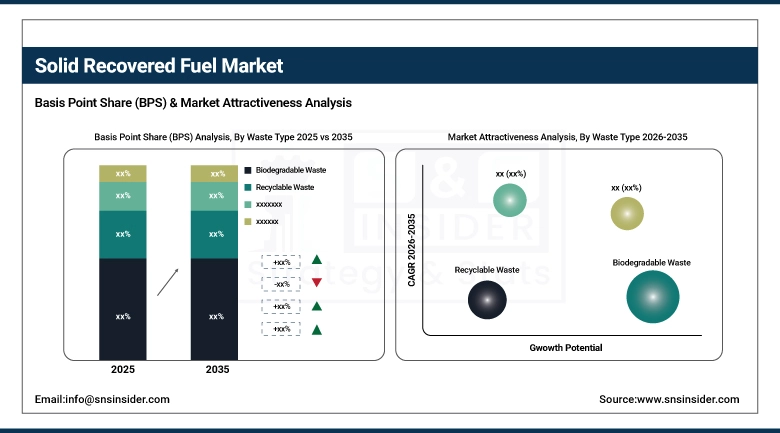
By Waste Type, Biodegradable Waste dominated the Solid Recovered Fuel Market with ~38% share in 2025; Composite Waste fastest growing (CAGR).
-
By End Use, Cement Manufacturing dominated the Solid Recovered Fuel Market with ~68% share in 2025; Power & CHP fastest growing (CAGR).
By Fuel Grade, Mid-grade SRF segment dominates the Solid Recovered Fuel Market, High-grade SRF segment expected to grow fastest
In 2025, mid-grade SRF was the leading segment in the Solid Recovered Fuel Market, owing to its ideal combination of price and calorific value. It provided consistent combustion properties while requiring minimal processing in comparison to other grades. The affordable pricing and suitability for existing installations contributed to its popularity among industries opting for alternative fuel sources.
From 2026 to 2035, high-grade SRF was projected to witness the highest growth rate, driven by the rising demand for clean and efficient fuels in industries. Its high calorific value, low moisture content, and decreased emissions made it an excellent choice for more sophisticated energy recovery facilities. Increasing environmental concerns and the need for decarbonization were prompting industries to adopt high-quality fuels.
By Processing Technology, MBT segment dominates the Solid Recovered Fuel Market, Advanced Dry Recovery segment expected to grow fastest
MBT segment had the highest share in the Solid Recovered Fuel market in 2025 because of its wide use in treating the mixed municipal waste in an efficient manner. It uses both mechanical and biological processes in order to generate the required solid recovered fuel and helps in minimizing the amount of landfilled waste as well. Its capability to treat high amounts of waste with less complex operating conditions made it highly popular among municipalities and other waste treatment plants.
Advanced Dry Recovery segment is predicted to have the highest growth rate between 2026 and 2035 due to its capability to generate a better-quality solid recovered fuel along with high sorting efficiency and low moisture content in the fuel. Its capability to increase the calorific value of the produced fuel is helping it gain more popularity with increasing investments in the industry.
By Waste Type, Biodegradable Waste segment dominates the Solid Recovered Fuel Market, Composite Waste segment expected to grow fastest
Biodegradable waste segment held the largest share of the SRF market in 2025 owing to the high supply from municipal solid wastes and easy processability. This waste type played an important role in the formation of SRFs since it could be readily processed into fuel form without requiring much effort. The rising supply of organic waste and efficient waste management processes led to its dominance.
The composite waste segment is anticipated to witness the highest CAGR between 2026 and 2035 due to growing waste generation in terms of various complex materials that cannot be recycled. Better sorting techniques are contributing towards its growing usage. The increasing focus on cutting landfilling and increasing resource recovery is propelling the usage of the material.
By End Use, Cement Manufacturing segment dominates the Solid Recovered Fuel Market, Power & CHP segment expected to grow fastest
The cement manufacturing segment accounted for the highest market share of the Solid Recovered Fuel Market in 2025 owing to high energy requirements as well as its capacity to use SRF as an alternative fuel source to fossil fuels. The usage of SRF does not require much modification to the cement kilns, and hence helps in reducing energy costs. Industry acceptance of alternate fuel sources along with favorable regulations has helped the segment retain its dominance in the market.
The power and combined heat power (CHP) segment will witness the highest CAGR during 2026-2035 owing to rising demand for decentralized energy production. The capability of SRF to produce uninterrupted power supply helps in gaining rapid adoption in the segment. Increasing investments in waste to energy facilities will also propel the segment's growth.
Solid Recovered Fuel Market Regional Analysis
Europe Solid Recovered Fuel Market Insights
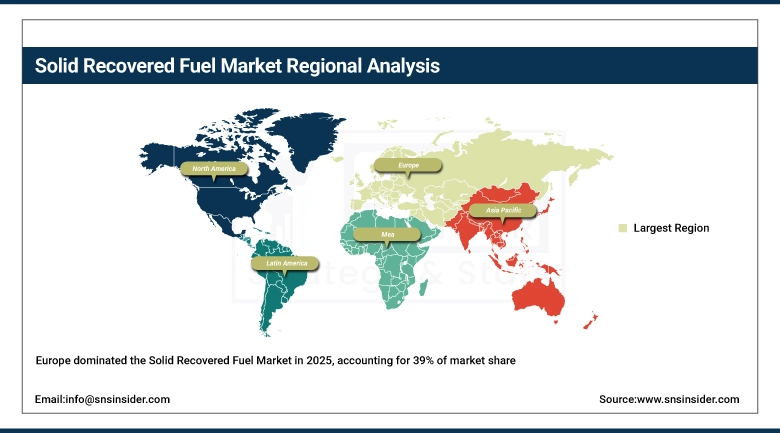
The Europe region held the dominant market position in the Solid Recovered Fuel industry, accounting for a revenue share of nearly 39% in 2025, owing to the well-established waste management facilities and stringent regulatory policies for landfill diversion. Europe is characterized by extensive usage of energy from waste systems and state-of-the-art SRF processing plants. The cement and industrial industries in the region widely utilize SRF as an alternative to traditional fossil fuels.
Get Customized Report as per Your Business Requirement - Enquiry Now
Asia Pacific Solid Recovered Fuel Market Insights
The Asia Pacific region is predicted to experience the highest growth rate in terms of CAGR of 7.72% over the forecast period of 2026-2035 because of its increasing population, high rates of urbanization, and increasing production of municipal solid wastes. The increasing number of investments in waste-to-energy plants coupled with favorable policies from governments are driving the adoption of SRFs. Rising demand from the cement and power industry for inexpensive alternative energy sources is also contributing to the growth.
North America Solid Recovered Fuel Market Insights
The North American region plays a pivotal role in the Solid Recovered Fuel Market owing to its efficient waste management system, superior recycling facilities, and rising use of waste-to-energy methods. The region enjoys several advantages such as stringent environmental policies that encourage the diversion of wastes from landfills and harnessing renewable energy. Rising demands from the cement and power sectors for fuel alternatives have been driving the growth of the market in recent times.
Middle East & Africa and Latin America Solid Recovered Fuel Market Insights
The Middle East & Africa region as well as Latin America is seeing consistent growth within the Solid Recovered Fuel Market due to the rise in attention toward sustainability and waste management, increased urbanization, and increased industrial activity leading to increased generation of waste. Waste to energy initiatives have been adopted in both regions to cut down landfill reliance as well as reduce the use of fossil fuels.
Solid Recovered Fuel Market Competitive Landscape:
SUEZ
SUEZ is a France-based environmental services firm (established in 1858), which operates in areas of water management, waste treatment, and resource recovery. The firm's business strategy revolves around circular economy principles where waste is turned into assets through the production of energy as well as other forms of fuels, including solid recovered fuel (SRF). As part of its international operations in different geographical regions, the firm helps achieve industrial decarbonization, sustainable waste management, and energy recovery systems.
-
2026: SUEZ secured long-term contracts to operate waste recovery facilities in France, integrating sorting and preparation of non-recyclable waste streams into fuel production systems supporting energy recovery and circular economy solutions aligned with SRF development.
-
2024: SUEZ advanced solid recovered fuel (SRF) production infrastructure, supplying long-term contracts to industrial clients including cement producers, while developing SRF-fired energy plants to reduce fossil fuel consumption and enable circular energy solutions.
Veolia Environment S.A.
Veolia Environment S.A., headquartered in France, is a major international environmental services company founded in 1853, offering expertise in the areas of water, waste, and energy management. It focuses on efficient utilization of resources by means of waste-to-energy technology, bioenergy production, and the concept of circular economy. Veolia's holistic strategy helps turn unrecyclable waste into alternative fuel sources like SRF.
-
2025: Veolia continued expanding waste-to-energy and bioenergy “booster” activities under its GreenUp strategy, focusing on converting non-recyclable waste into alternative fuels, including SRF, supporting industrial decarbonization and circular resource recovery initiatives globally.
Solid Recovered Fuel Companies are:
-
Veolia Environment S.A.
-
Renewi plc
-
Biffa plc
-
FCC Environment
-
Covanta Holding Corporation
-
Hitachi Zosen Corporation
-
Babcock & Wilcox Enterprises, Inc
-
Dalkia
-
Geminor
-
Beauparc Group
-
BMH Technology
-
Carey Group
-
Countrystyle Recycling
-
EcoUrja Renewable Energy
-
Ecomondis
-
Estre Ambiental
-
Renelux Group
-
Enva
Solid Recovered Fuel Market Report Scope
| Report Attributes | Details |
|---|---|
| Market Size in 2025 | USD 6.45 Billion |
| Market Size by 2035 | USD 12.03 Billion |
| CAGR | CAGR of 6.47% From 2026 to 2035 |
| Base Year | 2025 |
| Forecast Period | 2026-2035 |
| Historical Data | 2022-2024 |
| Report Scope & Coverage | Market Size, Segments Analysis, Competitive Landscape, Regional Analysis, DROC & SWOT Analysis, Forecast Outlook |
| Key Segments | • By Waste Type (Biodegradable Waste, Recyclable Waste, Inert Waste, Composite Waste) • By Fuel Grade (High-Grade SRF, Mid-Grade SRF, Low-Grade SRF) • By Processing Technology (MBT, Advanced Dry Recovery, Pelletization) • By End Use (Cement Manufacturing, Power & CHP, Industrial Heating) |
| Regional Analysis/Coverage | North America (US, Canada), Europe (Germany, UK, France, Italy, Spain, Russia, Poland, Rest of Europe), Asia Pacific (China, India, Japan, South Korea, Australia, ASEAN Countries, Rest of Asia Pacific), Middle East & Africa (UAE, Saudi Arabia, Qatar, South Africa, Rest of Middle East & Africa), Latin America (Brazil, Argentina, Mexico, Colombia, Rest of Latin America). |
| Company Profiles | Veolia Environment S.A., SUEZ, Renewi plc, Biffa plc, FCC Environment, Covanta Holding Corporation, Hitachi Zosen Corporation, Babcock & Wilcox Enterprises, Inc., Wheelabrator Technologies Inc., Dalkia, Geminor, Beauparc Group, BMH Technology, Carey Group, Countrystyle Recycling, EcoUrja Renewable Energy, Ecomondis, Estre Ambiental, Renelux Group, Enva. |
Frequently Asked Questions
Europe dominated the Solid Recovered Fuel Market in 2025.
The Biodegradable Waste segment dominated the Solid Recovered Fuel Market in 2025.
Rising demand for alternative low-cost fuels in energy-intensive industries like cement and power generation to reduce fossil fuel dependency.
The Solid Recovered Fuel Market was valued at USD 6.45 billion in 2025.
The Solid Recovered Fuel Market is expected to grow at a CAGR of 6.47% from 2026 to 2035.
