
Harbor Management Software Market Report Scope & Overview:
The Harbor Management Software Market was valued at USD 1.32 billion in 2023 and is expected to reach USD 3.14 billion by 2032, growing at a CAGR of 10.19% from 2024-2032.

To Get more information on Harbor Management Software Market - Request Free Sample Report
This report includes insights on software deployment trends, highlighting the increasing adoption of cloud-based solutions for seamless port operations. Operational efficiency improvements are being driven by automation, AI-powered analytics, and real-time data tracking, enhancing cargo handling and reducing delays. Investment & funding trends indicate strong venture capital interest in digitalizing maritime infrastructure. Cybersecurity & compliance remain critical, with regulatory frameworks pushing for enhanced data protection measures. The impact on revenue & cost savings is significant, as optimized logistics and automated workflows contribute to reducing operational expenses while boosting profitability.
The market’s expansion is fueled by the rising demand for digital transformation in port operations, ensuring enhanced efficiency and security.
U.S. Harbor Management Software Market was valued at USD 0.33 billion in 2023 and is expected to reach USD 0.78 billion by 2032, growing at a CAGR of 9.91% from 2024-2032.
The U.S. Harbor Management Software Market is experiencing growth due to the increasing need for digitalization in port operations, improving efficiency and security. Rising cargo traffic and trade volumes are pushing ports to adopt automated solutions for real-time tracking, vessel scheduling, and resource management. Regulatory compliance and cybersecurity requirements are also driving investment in advanced software solutions. Additionally, the shift towards cloud-based and AI-driven technologies enhances predictive analytics, reducing delays and operational costs. Growing government and private sector funding in smart port infrastructure further accelerates adoption, making harbor management software essential for optimizing logistics and port efficiency.
Harbor Management Software Market Dynamics
Drivers
-
Smart Port Solutions and Automation Drive Adoption of Harbor Management Software for Enhanced Efficiency, Real-Time Decision-Making, and Operational Optimization.
Ports worldwide are embracing digital transformation as a way of increasing efficiency, lessening congestion, and improving resource use. With the increased traffic by vessels and cargos, the normal manual procedures do not cope as well as there is vessel retardation and wastage. Port solutions, with automation and innovative analytics as power, make seamless coordination of ship movement, berthing allocation, and cargo discharge possible. The integration of IoT, AI, and cloud-based systems further enhances real-time decision-making, predictive maintenance, and security management. Automated workflows and digital documentation reduce human error while optimizing turnaround times. As global trade intensifies, the need for intelligent port management solutions is accelerating. Port terminals and terminal operators are investing in sophisticated software to facilitate faster operations, maintain regulatory standards, and foster green growth, thereby making harbor management software an essential part of future-proof port infrastructure.
Restraints
-
Increasing Cybersecurity Threats and Data Breaches Challenge the Adoption of Harbor Management Software, Requiring Robust Protection and Continuous Monitoring.
Ports are now making greater use of digital solutions to make their operations more efficient are also becoming high-risk targets for cyber threats. The convergence of IoT, cloud computing, and AI-based systems in harbor administration opens up critical infrastructure to possible vulnerabilities, ransomware attacks, and data theft. Infiltration of critical operational information, including vessel schedules and cargo details, can disturb port operations, incurring economic and reputational costs. Most ports, particularly smaller ports, do not have adequate cybersecurity models, leaving them open to new and emerging threats. Moreover, adherence to strict data protection laws complicates software adoption. The requirement for ongoing monitoring, frequent system maintenance, and cybersecurity training raises operating expenses and makes adoption difficult. Maintaining data security and avoiding risks are at the top of the agenda for port operators to adopt digital transformation while protecting their infrastructure.
Opportunities
-
Increasing IoT and Automation in Ports Boosts Real-Time Monitoring, Process Optimization, and Efficiency in Harbor Management Operations.
Ports are increasingly leveraging IoT sensors and automation to improve efficiency, reduce operational delays, and enhance safety. The integration of smart sensors enables real-time tracking of vessel movements, cargo handling, and equipment performance, allowing port authorities to make data-driven decisions. Automated processes, such as robotic container handling and AI-driven predictive maintenance, minimize downtime and reduce human errors. With rising trade volumes and congestion at ports, automation streamlines workflows, optimizes berth utilization, and enhances turnaround times. Additionally, IoT-powered remote monitoring improves security, ensuring seamless tracking of assets and compliance with regulatory standards. As ports move towards digital transformation, the demand for intelligent harbor management solutions continues to grow, creating new possibilities for software providers to deliver innovative and scalable automation-driven solutions.
Challenges
-
High Implementation and Maintenance Costs Limit Adoption of Harbor Management Software, Creating Financial Barriers for Smaller Ports and Slowing Digital Transformation.
Deploying harbor management software requires substantial investment in infrastructure, software licensing, and customization to meet port-specific needs. Smaller ports with limited budgets often struggle to allocate funds for advanced digital solutions, delaying adoption. Beyond initial deployment, ongoing maintenance costs, including software updates, cybersecurity measures, and technical support, add to the financial burden. The need for skilled personnel to manage and operate these systems further increases expenses. Additionally, integrating new software with existing legacy systems can require costly modifications, making the transition complex. For many ports, justifying the return on investment in the short term remains a concern, slowing digital transformation efforts. Without cost-effective solutions or financial support, widespread implementation of harbor management software remains a challenge, particularly for smaller and resource-constrained ports.
Harbor Management Software Market Segment Analysis
By Component
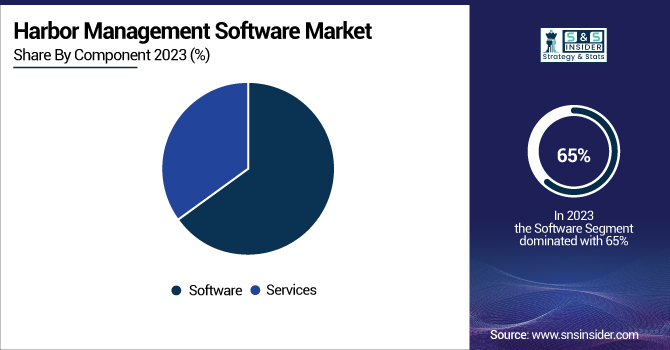
The Software segment led the Harbor Management Software Market with a revenue market share of around 65% in 2023 because of its critical role in port automation, logistics streamlining, and real-time decision-making improvement. Growing demand for digital solutions to track vessels, manage berths, and handle cargo has been driving demand. Secondarily, the marriage of AI, IoT, and cloud analytics further fortified software functionalities, rendering it an absolute essential for contemporary harbour management, further cementing its market leadership.
The Services segment is expected to grow at the fastest growth CAGR at approximately 11.24% during the years 2024-2032, as consultancy, implementation, and maintenance solutions become ever-growing necessities. As harbors and ports transition towards sophisticated digital solutions, there is increased demand for customization, training, and continuous technical support. Moreover, security concerns and compliance with regulations lead operators to spend on specialized services, making implementation smooth and secure. This increased dependence on professional services boosts the growth of the segment.
By Deployment
The Cloud segment led the Harbor Management Software Market with a revenue share of approximately 69% in 2023, largely because of its scalability, affordability, and ease of implementation. Cloud-based systems provide real-time access to data, easy integration with other digital systems, and improved security. Moreover, the demand for remote operations and centralized control has prompted the use of cloud platforms. Ports and harbor authorities prefer cloud solutions due to their capacity to maximize resource utilization, minimize infrastructure expenses, and enhance operational efficiency.
The On-premise segment is anticipated to grow at the fastest CAGR of approximately 12.11% during the period between 2024 and 2032, based on data security concerns, regulatory compliance, and control over operations. On-premise solutions are the choice of most port authorities and terminal operators to have total control over their data and uninterrupted operations, even in areas of poor internet connectivity. Large ports with infrastructure investment also prefer on-premise installation for customization and integration with old systems, causing its rapid expansion.
By Application
The Port Management segment led the Harbor Management Software Market with a revenue contribution of nearly 30% in 2023 because of its central role in optimizing port operations, berth assignments, and cargo movement. As global trade grows and efficient logistics become more important, ports are investing in innovative digital solutions to automate workflows, eliminate congestion, and improve security. Furthermore, regulatory compliance and sustainability efforts have propelled the need for integrated port management systems, cementing this segment's leadership in the market.
The Cruise & Yacht Management segment is expected to grow at the fastest CAGR of approximately 12.50% during the period 2024-2032, driven by the increasing popularity of cruise tourism and luxury yachting. More investment in marina facilities, along with a greater need for efficient berth reservation systems, fleet tracking and guest services management, boost demand for purpose-built software. Increased environmental regulations also create a requirement for more sophisticated compliance solutions, further driving adoption. Growth in high-end maritime tourism enhances the segment's solid growth path.
By Software
The Management segment led the Harbor Management Software Market with a revenue share of roughly 34% in 2023 due to the necessity of having central command over terminal and port activities. The segment provides several functionalities such as asset management, resource planning, and regulation compliance that enhance its relevance in harbor operation optimization. With more maritime logistics getting complicated, digital transformation has prompted higher reliance on management solutions. Second, ports also endeavor to raise transparency of operations and lower costs, adding further vigor to this market's market leader status.
The Monitoring segment is expected to grow at the fastest CAGR of nearly 11.98% between 2024 and 2032 as more priority is laid on security, ecological sustainability, and real-time operating observation. Escalating alarms on unreported ship movement, theft of cargos, and ecological regulations prompted advanced monitoring systems' usage. Use of AI-powered analytics, IoT sensors, and autonomous surveillance systems increases efficiency further. Ports and harbors give the highest priority to anticipatory monitoring for enhancing safety, operational visibility, and regulatory compliance, resulting in the rapid growth of this segment.
Regional Analysis
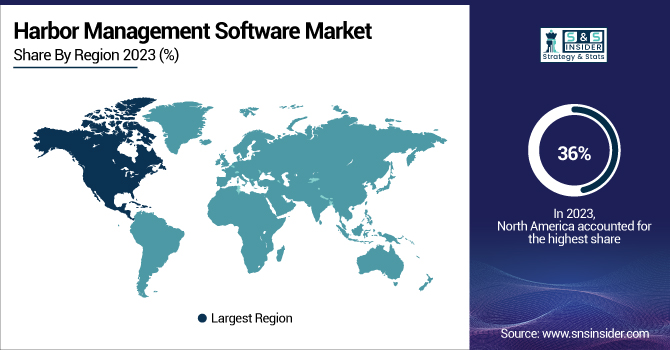
North America led the Harbor Management Software Market with a revenue share of around 36% in 2023 due to advanced port infrastructure, high digitalization, and stringent regulatory requirements. The high trade activities in the region, combined with high investments in automation and smart port projects, have driven software adoption at a faster pace. Moreover, the presence of key technology providers and emphasis on cybersecurity and sustainability have enhanced the need for integrated harbor management solutions. All these factors combined placed North America as the top market.
The Asia Pacific region is expected to grow at the fastest CAGR of around 12.37% from 2024 to 2032, driven by explosive port development, rising trade volumes, and government digitalization efforts. Expansion in maritime trade in the rising economies of the region is fueling the demand for efficient harbor management tools. Moreover, investment in smart port infrastructure, automation, and IoT-based monitoring systems is accelerating adoption. With global shipping centers increasingly spreading, the requirement for sophisticated software solutions to enhance the performance of ports is speeding up market expansion.
Get Customized Report as per Your Business Requirement - Enquiry Now
Key Players
-
Harba ApS (HarbaDock, HarbaSmart)
-
Harbour Mastery Inc. (HarbourMaster, Harbour Management System)
-
Havenstar MMS Ltd. (Havenstar MMS, Havenstar Port Management)
-
J.F. Brennan Company Inc. (Harbor Maintenance, Dock Repair Services)
-
James Fisher and Sons Plc (James Fisher Marine Services, Marine Support Solutions)
-
Leonardo Spa (Port Management, Vessel Tracking Systems)
-
Mission Critical Software LLC (HarborVision, PortWatch)
-
Nautical Software Solution (PortMaster, Docking Management System)
-
Pacsoft International Ltd. (Pacsoft Harbour, Port Management Solutions)
-
DockMaster Software (DockMaster, Port Operations Software)
-
Envision Enterprise Solutions (HarborWorks, Port Management Suite)
-
Innovez One (PortMate, Harbour Management Solutions)
Recent Developments:
-
In August 2024, James Fisher Fendercare completed its first LNG ship-to-ship transfer off the coast of Southwold, UK, ensuring a safe and efficient process. The operation, supporting a gas-up/cool-down service, was conducted with stringent safety and quality standards.
-
In March 2023, the Port of Cork partnered with Innovez One to digitalize port operations using the AI-powered marineM software, enhancing scheduling, berth management, and service efficiency while reducing emissions and operational delays.
| Report Attributes | Details |
|---|---|
| Market Size in 2023 | US$ 1.32 Billion |
| Market Size by 2032 | US$ 3.14 Billion |
| CAGR | CAGR of 10.19% From 2024 to 2032 |
| Base Year | 2023 |
| Forecast Period | 2024-2032 |
| Historical Data | 2020-2022 |
| Report Scope & Coverage | Market Size, Segments Analysis, Competitive Landscape, Regional Analysis, DROC & SWOT Analysis, Forecast Outlook |
| Key Segments | • By Component (Software, Services) • By Software (Management, Monitoring, Test, Communication, Others) • By Deployment (Cloud, On-premise) • By Application (Crew Management, Port Management, Harbor Management, Reservation Management, Cruise & Yacht Management, Others) |
| Regional Analysis/Coverage | North America (US, Canada, Mexico), Europe (Eastern Europe [Poland, Romania, Hungary, Turkey, Rest of Eastern Europe] Western Europe] Germany, France, UK, Italy, Spain, Netherlands, Switzerland, Austria, Rest of Western Europe]), Asia Pacific (China, India, Japan, South Korea, Vietnam, Singapore, Australia, Rest of Asia Pacific), Middle East & Africa (Middle East [UAE, Egypt, Saudi Arabia, Qatar, Rest of Middle East], Africa [Nigeria, South Africa, Rest of Africa], Latin America (Brazil, Argentina, Colombia, Rest of Latin America) |
| Company Profiles | Harba ApS, Harbour Mastery Inc., Havenstar MMS Ltd., J.F. Brennan Company Inc., James Fisher and Sons Plc, Leonardo Spa, Mission Critical Software LLC, Nautical Software Solution, Pacsoft International Ltd., DockMaster Software, Envision Enterprise Solutions, Innovez One |
Frequently Asked Questions
North America led with a 36% revenue share due to advanced port infrastructure, automation, and regulatory compliance.
Cloud-based solutions dominated with 69% in 2023 due to scalability, cost-effectiveness, and real-time data access.
The Software segment led with a 65% revenue share due to its role in automating port operations, logistics, and decision-making.
Increasing digital transformation, automation, AI-powered analytics, and cloud adoption are enhancing port efficiency, security, and real-time decision-making.
Harbor Management Software Market was valued at USD 1.32 billion in 2023 and is expected to reach USD 3.14 billion by 2032, growing at a CAGR of 10.19% from 2024-2032.
