
Change Detection Analytics Market Report Scope & Overview:
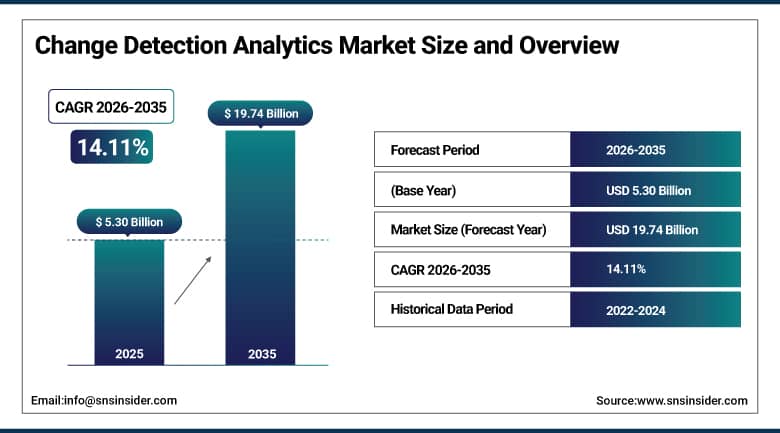
The Change Detection Analytics Market was valued at USD 5.30 billion in 2025 and is expected to reach USD 19.74 billion by 2035, growing at a CAGR of 14.11% from 2026-2035.
The Change Detection Analytics Market is witnessing strong growth because of the growing need for effective and timely detection of changes in the infrastructure, environment, land usage, and security purposes. Companies are relying more and more on change detection tools for identifying changes in structures, urbanization, vegetation, and even threats. The increase in the usage of satellite imagery, remote sensing, drone technology, geographic information systems, and artificial intelligence is helping in achieving higher accuracy levels and analysis. Moreover, the investments in smart cities, infrastructure monitoring, environmental management, defense, and disaster management are also contributing to its growth.
In 2025, the Landsat archive reached 12 million Level-1 images, providing more than five decades of consistent observations for detecting land, vegetation, water, and environmental changes.
To Get More Information On Change Detection Analytics Market - Request Free Sample Report
Change Detection Analytics Market Trends:
-
Rising adoption of satellite imagery and remote sensing technologies is driving demand for advanced change detection analytics across diverse monitoring applications.
-
Increasing use of artificial intelligence and machine learning is improving automated identification, classification, and analysis of changes in geospatial environments.
-
Growing demand for real-time monitoring is accelerating adoption across urban development, infrastructure management, environmental monitoring, agriculture, and disaster response applications.
-
Advancements in high-resolution satellite imagery, LiDAR, drones, and geospatial sensors are enhancing detection accuracy and expanding analytical capabilities.
-
Increasing investments in smart cities and infrastructure development are creating demand for continuous monitoring of construction, land use, and structural changes.
U.S. Change Detection Analytics Market Outlook:
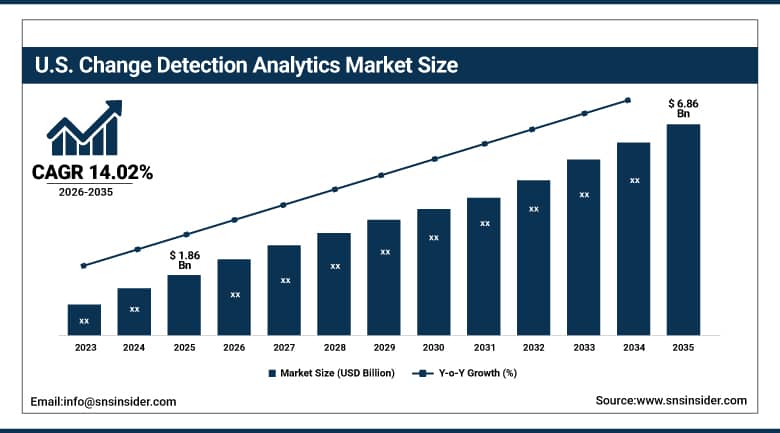
The U.S. Change Detection Analytics Market was valued at USD 1.86 billion in 2025 and is expected to reach USD 6.86 billion by 2035, growing at a CAGR of 14.02% from 2026-2035.
The U.S. Change Detection Analytics Market is witnessing strong growth owing to the rise in the requirement for accurate and real-time tracking of infrastructure, land usage, environmental factors, and changes related to security. Rising use of satellite imagery, remote sensing, drones, GIS, and AI technology is enhancing the efficiency and accuracy of change detection systems. Infrastructure development, smart cities, environmental monitoring, disaster management, and defense application are some more factors contributing to the growth in the demand. Furthermore, rising investments in geospatial technologies, image analysis automation, machine learning, and cloud analytics are helping to identify changes and risks at a faster pace.
In August 2025, USGS developed a land-change monitoring capability using the Continuous Change Detection and Classification (CCDC) time-series approach to generate annual land-cover and change outputs.
Change Detection Analytics Market Segment Analysis:
-
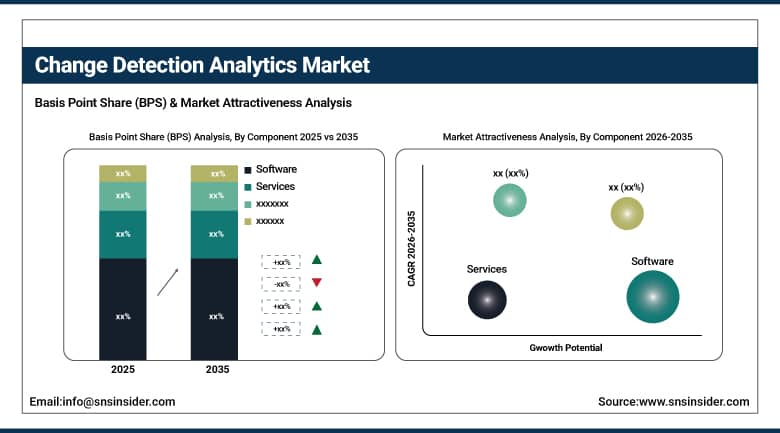
By Component, Software dominates the Change Detection Analytics Market with 62% share in 2025, while Software is expected to grow fastest at a CAGR of 14.54% from 2026–2035.
-
By Deployment Mode, Cloud dominates the Change Detection Analytics Market with 64% share in 2025, while Cloud is expected to grow fastest at a CAGR of 14.51% from 2026–2035.
-
By Application, Land Use and Land Cover Change dominates the Change Detection Analytics Market with 26% share in 2025, while Urban Change Detection is expected to grow fastest at a CAGR of 16.12% from 2026–2035.
-
By End-User, Government dominates the Change Detection Analytics Market with 24% share in 2025, while Defense & Security is expected to grow fastest at a CAGR of 15.86% from 2026–2035.
By Component, Software dominates the change detection analytics market and grows fastest.
Software segment dominated the Change Detection Analytics Market with the highest market share of about 62% in 2025 because of the growing demand for image processing and change detection. Software helps in effective analysis of satellite images, drone imagery, and geospatial datasets. The use of artificial intelligence and machine learning is another reason that adds to its market strength.
Software segment is expected to grow at the fastest CAGR of 14.54% from 2026-2035 due to increasing use of artificial intelligence, machine learning, computer vision, and automated change detection technologies. Large amounts of satellite, drone, and remote sensing data necessitate more advanced software solutions for analysis. Advancements in technology, cloud computing, and the need for real-time monitoring will help boost the uptake.
By Deployment Mode, Cloud dominates the change detection analytics market and grows fastest.
Cloud segment dominated the Change Detection Analytics Market with the highest market share of about 64% in 2025 since cloud-based systems offer scalable data storage, accessibility from afar, flexibility in computation and data processing, and processing of large volumes of geospatial data. Increased utilization of satellite imagery, drone data, and high-resolution remote sensing data demands a reliable infrastructure system, which is provided by cloud-based solutions.
Cloud segment is expected to grow at the fastest CAGR of 14.51% from 2026-2035 Cloud computing as a result of rising geospatial data and growing need for scalable and remotely accessible change detection systems. Cloud computing facilitates real-time processing, automatic analysis, collaboration, and integration with artificial intelligence. Future growth of applications in urban planning, environment monitoring, infrastructure, agriculture, and disaster management will further boost the adoption of cloud computing.
By Application, Land Use and Land Cover Change dominates the change detection analytics market, Urban Change Detection grows fastest.
Land Use and Land Cover Change segment dominated the Change Detection Analytics Market with the highest market share of about 26% in 2025 owing to the growing needs of monitoring urbanization, deforestation, agriculture and environmental changes. The use of satellite imaging and remote sensing techniques makes it possible to carry out monitoring of land changes regularly and precisely.
Urban Change Detection segment is expected to grow at the fastest CAGR of 16.12% from 2026-2035 driven by urbanization, infrastructural growth, and demand for monitoring urban development continuously. Change detection technologies facilitate identification of construction, change in land use, roads, and other illegal activities. Increased smart city development, advanced imagery, and analytics powered by artificial intelligence is anticipated to fuel the growth.
By End-User, Government dominates the change detection analytics market, Defense & Security grows fastest.
Government segment dominated the Change Detection Analytics Market with the highest market share of about 24% in 2025 as a result of growing utilization of change detection tools for land administration, environmental monitoring, urban planning, infrastructure evaluation, and disaster management. It helps the government organizations with accurate and timely geospatial data, leading to proper resource management, policy-making, regulation monitoring, and decision-making within the public sector.
Defense & Security segment is expected to grow at the fastest CAGR of 15.86% from 2026-2035 This is as a result of the rising demand for constant surveillance, border control, threat detection, and situation awareness. Change detection analytics helps detect any movement that is not authorized, changes made on the infrastructure, and threats to security by use of satellite and remote sensing technologies. The rising modernization in defense is anticipated to drive growth.
Regional Insights:
|
Region |
Major Country |
Share within Region, 2025 (%) |
|---|---|---|
|
North America |
United States |
91.0% |
|
Europe |
Germany |
25.5% |
|
Asia Pacific |
China |
34.0% |
|
Middle East & Africa |
UAE |
22.5% |
|
Latin America |
Brazil |
40.0% |
North America Change Detection Analytics Market Insights
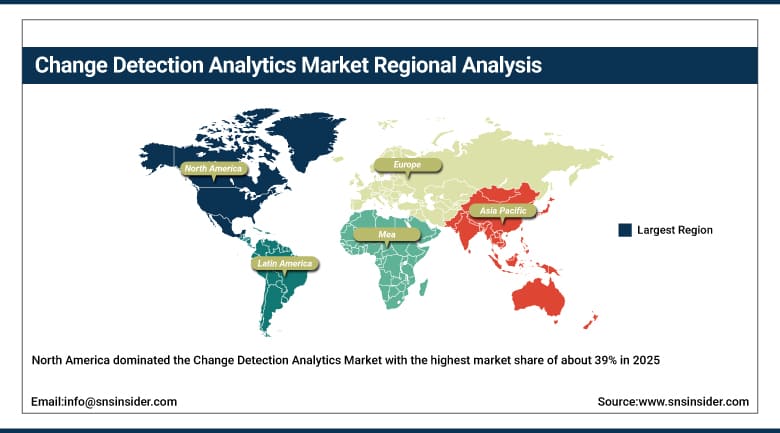
North America dominated the Change Detection Analytics Market with the highest market share of about 39% in 2025, Fuelled by advancements in satellite and remote sensing technologies, the extensive use of GIS technologies, and the growing need for environment monitoring, urban planning, defense, and infrastructure management. Further, investments in AI, machine learning, geospatial technology, and real-time analytics will help the region maintain its market leadership.
The U.S. Change Detection Analytics Market accounted for a market share of 91.0%, backed by satellite technology, remote sensing, the use of Geographic Information Systems, and high demand for tracking changes in environment, urbanization, defense, and infrastructure. Increased investments in artificial intelligence, machine learning, geospatial technology, and real-time analysis have helped boost its adoption further. Government initiatives, technological innovations, and extensive use of drones and satellites are also contributing to market growth.
Get Customized Report as Per Your Business Requirement - Enquiry Now
Europe Change Detection Analytics Market Insights
Europe Change Detection Analytics Market is witnessing steady growth, These factors include the availability of advanced satellite imagery, remote sensing technologies, GIS infrastructure, and rising demands for environmental and infrastructural monitoring. Uses have increased in fields such as urban planning, agriculture, forestry, disaster management, and defense. Investments made in geospatial analysis using AI, climate monitoring, smart cities, and sustainable resource management, as well as regulation aimed at environmental protection, have also aided growth.
The Germany Change Detection Analytics Market accounted for a market share of 25.5%, powered by the advancement of GIS and remote sensing technology as well as growing needs for monitoring of environmental conditions, infrastructure, agriculture, and cities. The rising popularity of satellite images, drones, and artificial intelligence algorithms will foster the growth of the market. Developments in smart city initiatives, climate monitoring, sustainable resource management, and digitalization are additionally boosting change detection software usage in Germany.
Asia Pacific Change Detection Analytics Market Insights
Asia Pacific is expected to grow at the fastest CAGR of about 15.82% from 2026–2035, Backed by urbanization, infrastructure development, environment monitoring, and increased use of satellites and drones. With growing investments in smart cities, disaster management, agriculture, defense, and resource monitoring and government geospatial programs, along with rising adoption of AI-driven analytics solutions, the regional market is expected to grow at an even faster pace.
The China Change Detection Analytics Market accounted for a market share of 34.0%, fueled by rapid urbanization, infrastructure development, and growing use of satellite images, drones, GIS, and remote sensing technology. Increase in usage in urban planning, agriculture, environment monitoring, disaster management, and defense is driving the growth of demand for change detection systems. Investments by government in smart cities and geospatial infrastructure are further aiding the growth of change detection systems in China.
Middle East & Africa and Latin America Change Detection Analytics Market Insights
The Middle East & Africa and Latin America Change Detection Analytics Market The market is growing gradually on the account of high demand for environmental monitoring, urban planning, agriculture, infrastructure management, and disaster assessment. Increasing use of satellite imagery, UAVs, GIS, and remote sensing technology is providing additional business prospects. The rise in investments in smart city projects, natural resource monitoring, climate resilience, and digital transformation is also adding impetus to regional market growth.
The UAE Change Detection Analytics Market accounted for a market share of 22.5%, Driven by rapid urbanization, smart city initiatives, expansion of infrastructure, and increasing usage of satellite & drone-based surveillance systems. The rising requirement for environmental & resource surveillance is fueling the market acceptance. Digital transformation led by the government, investments in geospatial infrastructure, AI-based analytics, and urban planning & construction along with disaster management applications are expected to drive the market growth in UAE.
Growth Drivers: Growing demand for continuous land monitoring and environmental assessment is accelerating adoption of change detection analytics solutions
Increasing demand for continuous monitoring of land, infrastructure, vegetation, water bodies, and environmental conditions is significantly driving the Change Detection Analytics Market. Change detection analytics allows companies to analyze geospatial images captured in varying time frames to detect any changes that might occur. This software is being used by government bodies, environmental organizations, agricultural firms, urban planners, and other infrastructure managers to track deforestation, urban sprawl, changes in land use, natural resources, and environmental degradation. With increasing availability of high-resolution satellite images and remote sensing data, along with the ability to conduct analytics through cloud-based platforms, there is increasing scope in monitoring. There is an increasing need for companies to automate the process of analyzing geospatial images taken over time.
Restraints: High data processing requirements and infrastructure costs can limit adoption of advanced change detection analytics platforms
Large volumes of satellite, aerial, and drone imagery can create significant data storage, processing, and computational requirements, particularly for organizations conducting frequent and large-scale monitoring. The processing, comparison, classification, and analysis of high-resolution images demand a good deal of computing capacity and software capabilities. Cloud computing technologies might help lower some infrastructure costs, but at the same time, they could bring about ongoing costs associated with storage, processing, and data transfer services. In addition, companies might need highly trained personnel who have knowledge and skills in remote sensing, GIS, image processing, and data analytics. All the above-discussed technical and financial prerequisites might become a barrier for smaller companies and governments that lack adequate funds.
Opportunities: Integration of artificial intelligence and machine learning creates significant opportunities for automated real-time change detection analytics solutions
The integration of artificial intelligence and machine learning is creating significant opportunities for the Change Detection Analytics Market. Algorithms driven by AI have the capability to automatically analyze large amounts of temporal images, find patterns, make classifications, and differentiate between significant incidents and variations in the background. Technologies such as deep learning and computer vision can enhance the detection of urbanization, infrastructure development, deforestation, natural catastrophes, and land use change while minimizing the need for interpretation of data by humans. Real-time or near real-time analysis can also help with quicker decision making in relation to emergency response, environment monitoring, defense, farming, and infrastructure management. More high-resolution images and cloud computing are making scalable AI-driven processing more feasible.
Recent Developments:
-
2025: Planet expanded its AI-powered Earth-observation capabilities, combining high-frequency satellite imagery with machine learning to support automated monitoring and detection of changes across locations and assets.
-
2025: Hexagon continued strengthening geospatial intelligence and digital-reality capabilities, combining satellite, aerial, and terrestrial data with AI-driven analytics for monitoring changes across physical environments.
-
2025: BlackSky expanded its Spectra AI platform, combining high-frequency satellite imagery with automated analytics to provide rapid alerts and intelligence about changes occurring at monitored locations.
-
2025: Google continued expanding Earth Engine capabilities, enabling organizations and researchers to analyze large-scale satellite datasets and monitor environmental and land-use changes using cloud-based geospatial analytics.
Change Detection Analytics Market Key Players are:
-
Planet Labs PBC
-
Esri
-
Trimble Inc.
-
Airbus Defence and Space
-
Vantor
-
BlackSky Technology Inc.
-
Capella Space
-
ICEYE
-
Descartes Labs
-
Google LLC
-
Microsoft Corporation
-
Oracle Corporation
-
IBM Corporation
-
SAP SE
-
Harris Geospatial Solutions
-
Sparkgeo
-
Mapbox, Inc.
-
PCI Geomatics
Change Detection Analytics Market Report Scope:
| Report Attributes | Details |
|---|---|
| Market Size in 2025 | USD 5.30 Billion |
| Market Size by 2035 | USD 19.74 Billion |
| CAGR | CAGR of 14.11% From 2026 to 2035 |
| Base Year | 2025 |
| Forecast Period | 2026-2035 |
| Historical Data | 2022-2024 |
| Report Scope & Coverage | Market Size, Segments Analysis, Competitive Landscape, Regional Analysis, DROC & SWOT Analysis, Forecast Outlook |
| Key Segments | • By Component (Software, Services) • By Deployment Mode (On-Premises, Cloud) • By Application (Land Use and Land Cover Change, Urban Change Detection, Disaster Management, Environmental Monitoring, Agriculture, Forestry, Others) • By End-User (Government, Defense & Security, Agriculture, Environmental Monitoring, Urban Planning, Utilities, Others) |
| Regional Analysis/Coverage | North America (US, Canada), Europe (Germany, UK, France, Italy, Spain, Russia, Poland, Rest of Europe), Asia Pacific (China, India, Japan, South Korea, Australia, ASEAN Countries, Rest of Asia Pacific), Middle East & Africa (UAE, Saudi Arabia, Qatar, South Africa, Rest of Middle East & Africa), Latin America (Brazil, Argentina, Mexico, Colombia, Rest of Latin America). |
| Company Profiles | Planet Labs PBC, Esri, Hexagon AB, Trimble Inc., Airbus Defence and Space, Vantor , BlackSky Technology Inc., Capella Space, ICEYE, Satellogic Inc., Descartes Labs, Google LLC, Microsoft Corporation, Oracle Corporation, IBM Corporation, SAP SE, Harris Geospatial Solutions (L3Harris Technologies), Sparkgeo, Mapbox, Inc., and PCI Geomatics. |

Frequently Asked Questions
The Change Detection Analytics Market is expected to grow at a CAGR of 14.11% from 2026 to 2035.
The Change Detection Analytics Market was valued at USD 5.30 billion in 2025.
The major growth factor is increasing adoption of smart city initiatives, which drives demand for real-time monitoring of urban development, infrastructure changes, land use, and resource management.
The Software segment dominated the Change Detection Analytics Market in 2025.
North America dominated the Change Detection Analytics Market in 2025.
