
Cross-Device Sync Platform Market Report Scope & Overview:
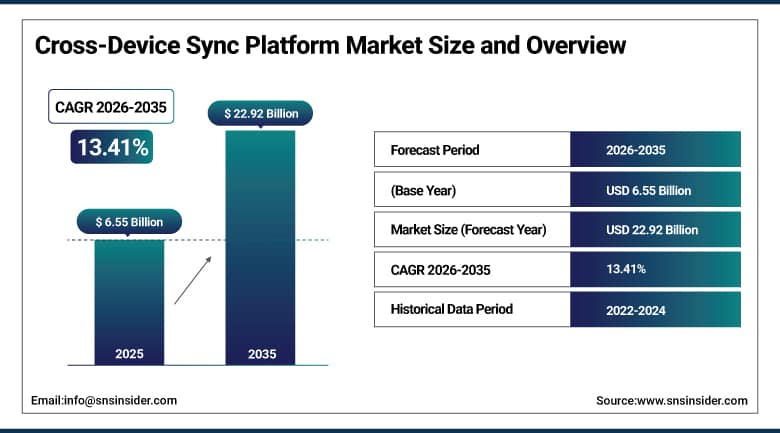
The Cross-Device Sync Platform Market was valued at USD 6.55 billion in 2025 and is expected to reach USD 22.92 billion by 2035, growing at a CAGR of 13.41% from 2026-2035.
The Cross-Device Sync Platform Market is witnessing strong growth because of the increase in the usage of multiple devices that are interconnected and due to the increased need for file sharing and accessing applications, data, and digital content through smartphones, tablets, laptops, and other devices. As cloud usage increases, along with digital transformation, there is an encouragement of consumers and companies to synchronize their data effectively. Asynchronous communication technologies will be more adopted due to such factors as increased remote and hybrid work, need for real-time collaboration, and reliance on cloud-based solutions. In addition, there are improvements in cloud computing, cyber security, automation, and cross-platform application development, which facilitate synchronization.
In FY2025, Microsoft reported US$168.9 billion in Intelligent Cloud revenue, reflecting the continued expansion of cloud infrastructure and services supporting distributed applications and data access.
To Get More Information On Cross-Device Sync Platform Market - Request Free Sample Report
Cross-Device Sync Platform Market Trends:
-
Rising use of smartphones, tablets, laptops, and connected devices is driving demand for seamless synchronization of data across multiple platforms.
-
Increasing adoption of cloud computing and digital services is accelerating demand for real-time access to files, applications, and information across devices.
-
Growing remote and hybrid work environments are encouraging organizations to deploy cross-device synchronization solutions for improved collaboration and workforce productivity.
-
Increasing reliance on cloud-based storage and backup services is expanding demand for automated synchronization, data accessibility, and device continuity.
-
Advancements in artificial intelligence and automation are improving synchronization performance, intelligent file management, security, and personalized cross-device experiences.
U.S. Cross-Device Sync Platform Market Outlook:
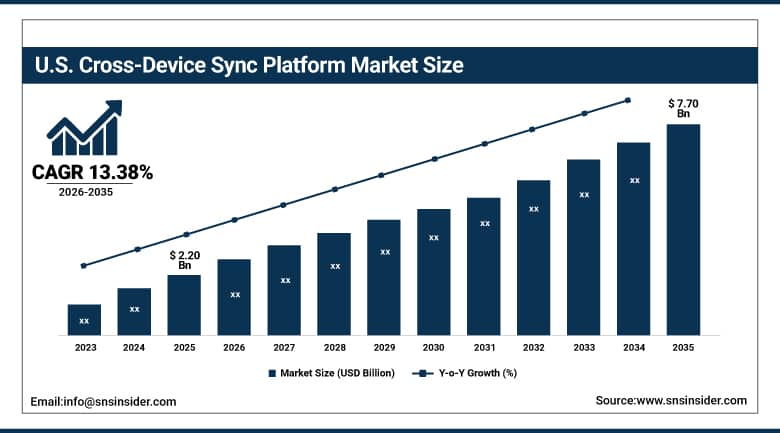
The U.S. Cross-Device Sync Platform Market was valued at USD 2.20 billion in 2025 and is expected to reach USD 7.70 billion by 2035, growing at a CAGR of 13.38% from 2026-2035.
The U.S. Cross-Device Sync Platform Market is witnessing strong growth because of increased usage of several connected devices along with the requirement for accessing the data seamlessly through smartphones, tablets, laptops, and various other digital devices. Increased cloud computing, hybrid, and remote work environments are increasing the usage of synchronization tools by various enterprises as well as individuals. Besides, increased digitization, higher security demands, and developments in cloud computing are contributing to enhanced data management across various devices. Moreover, growth in the ecosystem of connected devices, use of AI and automation, and the need for a seamless digital experience are encouraging the usage of cross-device synchronization platforms in the US.
In 2025, the U.S. Bureau of Labor Statistics reported that 22.3% of employed people teleworked, highlighting continued demand for digital tools enabling seamless access and collaboration across locations and devices.
Cross-Device Sync Platform Market Segment Analysis:
-
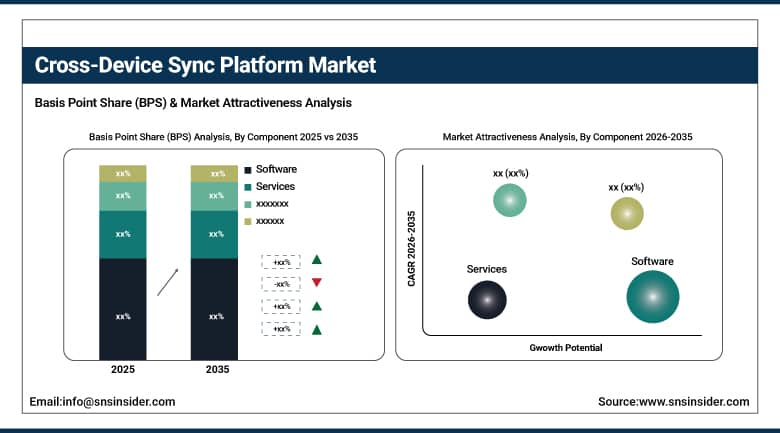
By Component, Software dominates the Cross-Device Sync Platform Market with 63% share in 2025, while Services are expected to grow fastest at a CAGR of 13.99% from 2026–2035.
-
By Device Type, Smartphones dominate the Cross-Device Sync Platform Market with 32% share in 2025, while Wearables are expected to grow fastest at a CAGR of 18.17% from 2026–2035.
-
By Application, Enterprise Use dominates the Cross-Device Sync Platform Market with 58% share in 2025, while Enterprise Use is expected to grow fastest at a CAGR of 13.78% from 2026–2035.
-
By Deployment Mode, Cloud-Based dominates the Cross-Device Sync Platform Market with 71% share in 2025, while Cloud-Based is expected to grow fastest at a CAGR of 13.64% from 2026–2035.
-
By End-User, Individual dominates the Cross-Device Sync Platform Market with 36% share in 2025, while Large Enterprises are expected to grow fastest at a CAGR of 14.19% from 2026–2035.
By Component, Software dominates the cross-device sync platform market, Services grow fastest.
Software segment dominated the Cross-Device Sync Platform Market with the highest market share of about 63% in 2025 As a result of increasing demands for synchronization and sharing of data, software is now being used to automate the updating of files and applications. This trend has been fueled by increased digital workload and cloud connections in organizations and individuals alike.
Services segment is expected to grow at the fastest CAGR of 13.99% from 2026-2035 because of growing needs for implementation, integration, customization, maintenance, technical support, and synchronization services. Businesses will have more need for expertise to securely integrate different devices and platforms. The growing complexity of the multi-device environment, along with the need for service optimization, is expected to drive services adoption worldwide.
By Device Type, Smartphones dominate the cross-device sync platform market, Wearables grow fastest.
Smartphones segment dominated the Cross-Device Sync Platform Market with the highest market share of about 32% in 2025 As a result of the widespread adoption of smartphones for communications, productivity, entertainment, payment, and content consumption, there is a need for synchronization of contacts, documents, applications, messaging, and multimedia on these devices. The growth in smartphone penetration and switching between devices also contributes to this need.
Wearables segment is expected to grow at the fastest CAGR of 18.17% from 2026-2035 powered by increasing usage of smartwatches, fitness devices, smart rings, and other wearable technologies. Wearable devices constantly create data that need to be synchronized with smartphones, tablets, and cloud services. Increasing preference for connected living, real-time notifications, personalized experience, and growing Internet of Things (IoT) ecosystem will increase the usage rate.
By Application, Enterprise Use dominates the cross-device sync platform market and grows fastest.
Enterprise Use segment dominated the Cross-Device Sync Platform Market with the highest market share of about 58% in 2025 Due to increased digitization, distributed workplaces, and requirements of smooth access to business information on various devices. There is need of secure synchronization of files, applications, workflows, and collaboration. Increased use of the cloud has further increased the need of such platforms among enterprises.
Enterprise Use segment is expected to grow at the fastest CAGR of 13.78% from 2026-2035 resulting from the increased use of hybrid work, BYOD policies, cloud software, and collaboration. Companies need to have security, reliability, and centralized synchronization across all devices used by employees. Increased needs for cybersecurity, mobility of the workforce, and digital transformations are anticipated to lead to greater enterprise adoption worldwide.
By Deployment Mode, Cloud-Based dominates the cross-device sync platform market and grows fastest.
Cloud-Based segment dominated the Cross-Device Sync Platform Market with the highest market share of about 71% in 2025 since cloud platforms offer scalable storage capacity, accessibility from anywhere, automatic synchronization, and real-time access to data through connected devices. The growing use of cloud solutions and distributed teams is pushing the need for their implementation. Cloud solutions help to minimize infrastructure needs while offering cost-effective synchronization.
Cloud-Based segment is expected to grow at the fastest CAGR of 13.64% from 2026-2035 Due to the rise of cloud usage, increased amounts of digital data and the requirement of real-time synchronization between geographically dispersed devices. Cloud computing provides seamless synchronization, centralized control, accessibility, and integration capabilities with modern applications. Increasing trends of digitalization and hybrid workplaces will drive future growth.
By End-User, Individual dominates the cross-device sync platform market, Large Enterprises grow fastest.
Individual segment dominated the Cross-Device Sync Platform Market with the highest market share of about 36% in 2025 This is because of the broad usage of various devices such as smartphones, laptops, tablets, and wearable devices. There is need for easy access to files, pictures, apps and settings from different devices.
Large Enterprises segment is expected to grow at the fastest CAGR of 14.19% from 2026-2035 due to increasing employee mobility, more complicated device environments, and the need for secure synchronization enterprise-wide. Organizations need centralized control, collaboration, and access from anywhere. Demand is driven by digital transformation and cloud migration.
Regional Insights:
|
Region |
Major Country |
Share within Region, 2025 (%) |
|---|---|---|
|
North America |
United States |
91.5% |
|
Europe |
Germany |
27.0% |
|
Asia Pacific |
China |
34.5% |
|
Middle East & Africa |
UAE |
22.5% |
|
Latin America |
Brazil |
39.5% |
North America Cross-Device Sync Platform Market Insights
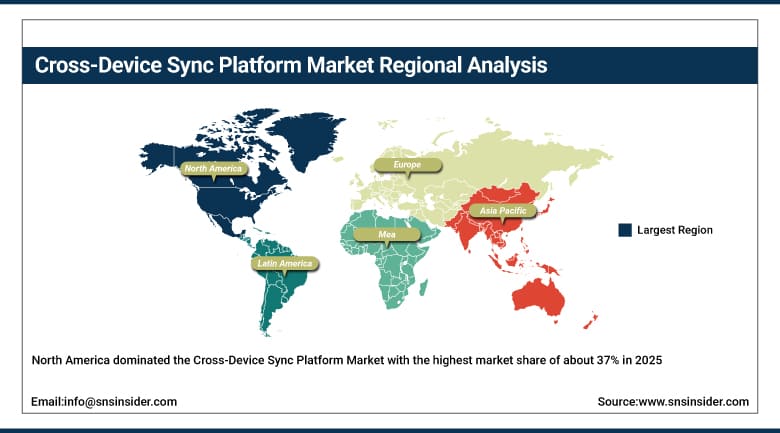
North America dominated the Cross-Device Sync Platform Market with the highest market share of about 37% in 2025, fueled by increasing cloud uptake, growing number of connected devices, and rising requirements for easy data access on smartphones, laptops, tablets, and desktop computers. Other factors contributing to growth in the region’s market include advanced digital infrastructure, remote working, enterprise mobility, and technology investments.
The U.S. Cross-Device Sync Platform Market accounted for a market share of 91.5%, facilitated by the prevalence of cloud services, usage of smartphones and connected devices, and high demand for easy and continuous access to data on several devices at once. The development of digital infrastructure, working from home/remote work, enterprise mobility, and technology investment have also contributed to the proliferation of cross-device synchronization technologies.
Get Customized Report as Per Your Business Requirement - Enquiry Now
Europe Cross-Device Sync Platform Market Insights
Europe Cross-Device Sync Platform Market is witnessing steady growth, facilitated by the popularity of the cloud, higher usage of connectivity-enabled devices, and higher demand for effortless data access across different platforms. Workplace digitization, remote and hybrid working models, enterprise mobility, and data sharing needs are driving adoption. Investments in the cloud, cybersecurity, digital services, and productivity tools are contributing to market growth within the region.
The Germany Cross-Device Sync Platform Market accounted for a market share of 27.0%, driven by high adoption of cloud services, enterprise digitization, and connected devices. Rising need for smooth data access, working from home, and mobility in the workplace will contribute to increased adoption. Investment in cloud services, security, digital productivity applications, and connected technologies will drive the need for cross-device synchronization services in Germany.
Asia Pacific Cross-Device Sync Platform Market Insights
Asia Pacific is expected to grow at the fastest CAGR of about 14.29% from 2026–2035, backed by swift proliferation of smartphones and connected devices, the expansion of cloud services, digital transformation, and internet growth. The trend of working from home, e-commerce, mobile apps, digital transformation of enterprises, and investment in cloud infrastructures is contributing to rising need for flawless device synchronization.
The China Cross-Device Sync Platform Market accounted for a market share of 34.5%, enabled by high smartphone penetration, rising cloud adoption, fast digital transformation, and increased use of interconnected devices. Growing use of mobile apps, e-commerce, telecommuting, and digital business models is leading to a need for smooth integration. Investments in cloud technology, 5G, and enterprise digital transformation are contributing even more to market expansion within China.
Middle East & Africa and Latin America Cross-Device Sync Platform Market Insights
The Middle East & Africa and Latin America Cross-Device Sync Platform Market is steadily growing due to an increase in use of smartphones, improvement in connectivity of the internet, cloud computing, and digitalization. The need for device-to-device synchronization is arising because of the rise in remote work, mobile-first products, ecommerce, and enterprise digitization. Growth in cloud infrastructure, digitalization, and connected technologies is further fuelling growth in the region.
The UAE Cross-Device Sync Platform Market accounted for a market share of 22.5%, facilitated by fast digital transformation, extensive smartphone usage, growing adoption of cloud technology, and increasing dependency on connected devices. Increasing need for seamless access to data from both work and personal devices is driving the adoption process. Digital projects initiated by governments, strong connectivity, investments made into cloud technology infrastructure, and enterprise mobility are among other factors driving the adoption.
Growth Drivers: Growing multi-device usage and demand for seamless data access are accelerating adoption of cross-device synchronization platforms globally
Increasing use of smartphones, tablets, laptops, desktops, smartwatches, and other connected devices is significantly driving demand for cross-device sync platforms. Consumers as well as businesses have become more demanding regarding keeping their files, applications, messages, settings, and content synchronized between different devices. Cross-device synchronization solutions allow for accessing the most current information independently of which device is being used, thereby ensuring convenience, productivity, and continuity. The greater usage of cloud-based software and online services will only further reinforce this demand. Synchronized data is also required by enterprises that employ a decentralized workforce. The growing dependence on connected systems offered by big tech companies will encourage consumers to keep their experience consistent on different devices.
Restraints: Data security and privacy concerns can limit adoption of cross-device synchronization platforms among enterprises and consumers
Security and privacy concerns remain significant challenges for the Cross-Device Sync Platform Market. Synchronization systems constantly move and retain sensitive data such as documents, credentials, personal details, and business information through different computing devices and clouds. The threat of security breaches, breaches of confidentiality, and data breaches could put synchronized data at great risk. This is because businesses working with highly sensitive data about customers, finances, health, or proprietary intellectual property need robust security mechanisms before employing any synchronization software. It becomes incumbent upon the service providers to implement various security measures in order to retain user confidence. In addition, compliance with different data protection rules could make their implementation quite complicated and costly.
Opportunities: Growing adoption of connected devices and IoT ecosystems creates significant opportunities for advanced cross-device synchronization solutions
The rapid expansion of connected devices and Internet of Things ecosystems is creating significant opportunities for cross-device synchronization platforms. In recent years, more and more consumers have been using interconnected mobile phones, tablets, computers, wearables, home appliances, vehicles, and other interconnected gadgets that collect and exchange information. The need for synchronization tools may be of great assistance to ensure data consistency, settings consistency, preferences consistency, and consistency in users’ experience in such expanding ecosystems. Companies are also using interconnected devices in workspaces, logistics, healthcare facilities, and industries, thus increasing the need for data synchronization. Cloud computing, edge computing, and API integration may assist in improving synchronization opportunities. Suppliers who will be able to offer safe synchronization platforms for various types of devices in various environments may benefit from the trend.
Recent Developments:
-
2026: Apple introduced new software capabilities across iPhone, iPad, Mac, Apple Watch, and Vision Pro, with iCloud continuing to synchronize information and Siri conversational history across Apple devices.
-
2026: Microsoft introduced a new native OneDrive Sync Engine for macOS, delivering up to twice the speed for initial synchronization while reducing CPU, memory, and battery consumption.
-
2026: Box announced that Box Sync will reach end-of-life in December 2026, encouraging users to migrate to Box Drive for faster performance, enhanced security, and modern collaboration capabilities.
-
2026: Nextcloud released Hub 26 Winter with improved desktop virtual file-system capabilities, on-demand synchronization, faster mobile file sync, and enhanced cross-server federation.
Cross-Device Sync Platform Market Key Players:
-
Apple Inc.
-
Microsoft Corporation
-
Google LLC
-
Samsung Electronics Co., Ltd.
-
Amazon.com, Inc.
-
Box, Inc.
-
Citrix Systems, Inc.
-
GoTo (LogMeIn, Inc.)
-
Egnyte, Inc.
-
Resilio, Inc.
-
Synology Inc.
-
pCloud AG
-
MEGA Limited
-
GoodSync (Siber Systems, Inc.)
-
Huawei Technologies Co., Ltd.
-
Lenovo Group Limited
-
Seagate Technology Holdings plc
-
Western Digital Corporation
Cross-Device Sync Platform Market Report Scope:
| Report Attributes | Details |
|---|---|
| Market Size in 2025 | USD 6.55 Billion |
| Market Size by 2035 | USD 22.92 Billion |
| CAGR | CAGR of 13.41% From 2026 to 2035 |
| Base Year | 2025 |
| Forecast Period | 2026-2035 |
| Historical Data | 2022-2024 |
| Report Scope & Coverage | Market Size, Segments Analysis, Competitive Landscape, Regional Analysis, DROC & SWOT Analysis, Forecast Outlook |
| Key Segments | • By Component (Software, Services) • By Device Type (Smartphones, Tablets, Laptops & PCs, Smart TVs, Wearables, Others) • By Application (Personal Use, Enterprise Use, Others) • By Deployment Mode (Cloud-Based, On-Premises) • By End-User (Individual, Small & Medium Enterprises, Large Enterprises) |
| Regional Analysis/Coverage | North America (US, Canada), Europe (Germany, UK, France, Italy, Spain, Russia, Poland, Rest of Europe), Asia Pacific (China, India, Japan, South Korea, Australia, ASEAN Countries, Rest of Asia Pacific), Middle East & Africa (UAE, Saudi Arabia, Qatar, South Africa, Rest of Middle East & Africa), Latin America (Brazil, Argentina, Mexico, Colombia, Rest of Latin America). |
| Company Profiles | Apple Inc., Microsoft Corporation, Google LLC, Samsung Electronics Co., Ltd., Amazon.com, Inc., Dropbox, Inc., Box, Inc., Citrix Systems, Inc., GoTo (LogMeIn, Inc.), Egnyte, Inc., Nextcloud GmbH, Resilio, Inc., Synology Inc., pCloud AG, MEGA Limited, GoodSync (Siber Systems, Inc.), Huawei Technologies Co., Ltd., Lenovo Group Limited, Seagate Technology Holdings plc, and Western Digital Corporation. |
Frequently Asked Questions
The Cross-Device Sync Platform Market is expected to grow at a CAGR of 13.41% from 2026 to 2035.
The Cross-Device Sync Platform Market was valued at USD 6.55 billion in 2025.
The major growth factor is rising adoption of smart and IoT devices, increasing demand for seamless data synchronization, real-time connectivity, and consistent digital experiences across multiple connected devices.
The Software segment dominated the Cross-Device Sync Platform Market in 2025
The Software segment dominated the Cross-Device Sync Platform Market in 2025
