
Healthcare IT Outsourcing Market Report Scope and Overview
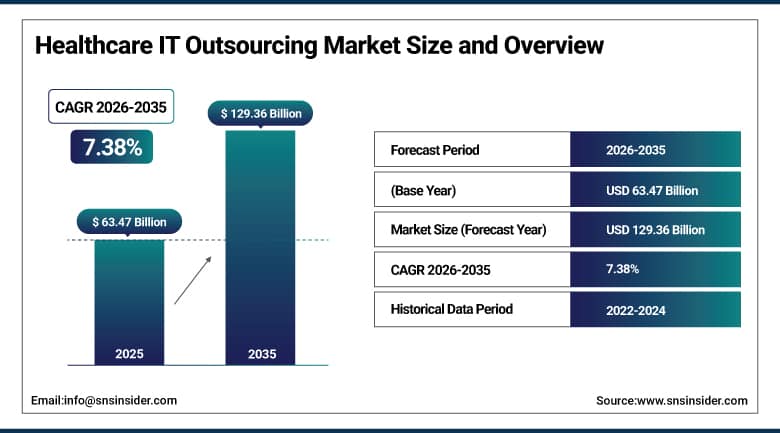
The Healthcare IT Outsourcing Market was valued at USD 63.47 Billion in 2025 and is estimated at USD 68.15 Billion in 2026. The market is forecast to reach USD 129.36 Billion by 2035, registering a CAGR of 7.38% from 2026 to 2035. Hospitals, health plans, and life science companies hand application management, infrastructure operations, revenue cycle work, and security monitoring to outside providers as skilled staff become scarce and compliance duties grow. North America accounted for the largest regional share at 39.62% in 2025, while Asia Pacific is expected to expand fastest.
To Get More Information On Healthcare IT Outsourcing Market - Request Free Sample Report
Key Market Trends & Insights
-
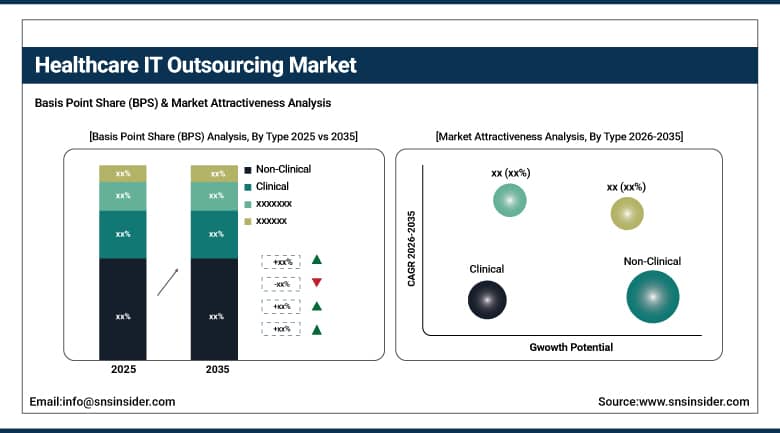
By type: Non-clinical services held the largest market share of 62.51% in 2025.
-
By service model: Business process outsourcing held the largest market share of 35.26% in 2025.
-
By application: Electronic health records held the largest market share of 30.41% in 2025.
-
By end user: Healthcare provider systems held the largest market share of 41.83% in 2025.
-
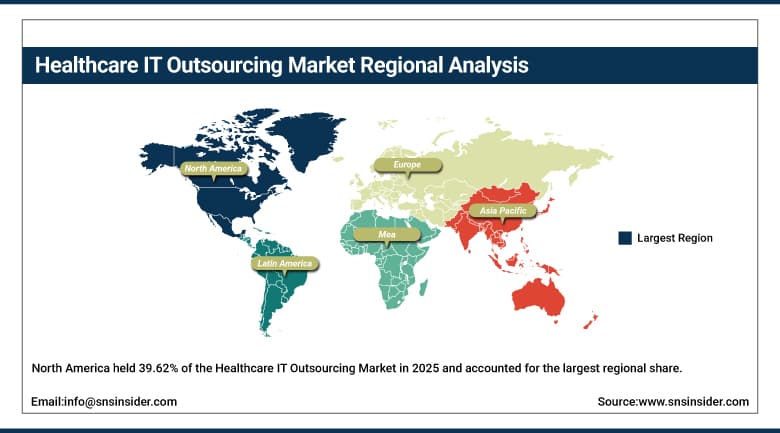
North America accounted for the largest regional share of 39.62% in 2025.
-
Asia Pacific is projected to register the fastest regional CAGR of 9.27% from 2026 to 2035.
-
The U.S. is the leading country market, supported by interoperability rules, staffing shortages, and large hospital and payer outsourcing budgets.
Growth Outlook
Payers and providers in the United States are working to fixed dates for interoperability and prior authorization. In January 2026, the Centers for Medicare & Medicaid Services began applying the operational provisions of its Interoperability and Prior Authorization final rule, which requires expedited decisions within 72 hours, with application programming interface requirements following on 1 January 2027. Many plans and hospitals lack the integration engineers needed to meet these deadlines, so they contract firms to build interfaces and run the supporting operations.
Health data regulation outside the United States is creating similar demand. In March 2025, the European Union brought the European Health Data Space Regulation into force, and priority categories of health data must become exchangeable across member states later in the decade. Hospitals, insurers, and national agencies need consent management, secure access, and record exchange capabilities well before those dates, and many are contracting external partners for integration, data quality, and hosting. Programs run for years and widen the base for experienced providers.
Market Dynamics
Driver: Cost Containment, Talent Shortages, and Interoperability Duties Increase Demand for Outsourced Healthcare IT
Hospitals and health plans operate on narrow margins, and information technology budgets compete with clinical equipment and staffing. Outsourcing converts fixed internal teams into variable service contracts for application support, infrastructure, claims, and revenue cycle work, and providers that run similar processes for many clients spread tooling and labor costs across them. Shortages of certified analysts, security engineers, and coders add to the pressure, since few organizations can offer round-the-clock coverage. Partners with delivery centers in several time zones provide continuous support that internal teams find difficult to match. Contracts with defined service levels also give finance leaders clearer budgets and faster approvals.
Digital care programs enlarge the workload. In June 2026, the Office of the National Coordinator for Health Information Technology reported that the Trusted Exchange Framework and Common Agreement network had exchanged 1 billion health records, which shows how quickly connected data flows are growing. Electronic health records, telehealth, remote monitoring, and artificial intelligence tools all need configuration, integration, and monitoring, and providers with automation assets can deliver these services at a lower unit cost than most in-house teams. Providers also bring benchmarking data from many client sites, which helps buyers set realistic targets for ticket resolution, uptime, and claim turnaround.
Restraint: Data Privacy Exposure, Vendor Lock-In, and Legacy Integration Complexity Slow Contracting Decisions
Providers manage patient IDs, health data, and payments, thus every contract carries some risks associated with confidentiality and security. In January 2025, the U.S. Department of Health and Human Services released an updated proposal for the HIPAA Security Rule aimed to increase security of electronically transmitted information, which adds uncertainty on final requirements. As a result, healthcare organizations conduct longer security evaluations, audit rights, and demand for data residency, which make sales cycles longer and increase delivery costs for providers. Small vendors face the greatest challenges in terms of increased security due to certification costs independent of contract volume. Vendor cyber attacks may affect many customers.
Vendor dependence and legacy systems add to challenges. Once a vendor has been working on a core process of an organization for several years, switching to another vendor is expensive and risky. Change request fees often lead to extra costs and make savings insignificant. Complex systems and data standardization issues prevent smooth switch. Exit right, subcontractor transparency, security certifications, and phased transition should be considered by buyers because lack of such provisions will bind an organization to one vendor for ten years or more.
Opportunity: AI-Enabled Operations, Managed Cybersecurity, and Sovereign Cloud Programs Open New Service Lines
Artificial intelligence is creating new managed service categories. Providers already run coding, claims, and documentation workflows for health systems and can add ambient clinical documentation, automated prior authorization, and denial prediction under per-transaction or outcome-based pricing. Clients value these offers because savings can be measured and human reviewers keep final decisions. Providers that hold large volumes of process data, strong governance, and healthcare-trained staff are best placed to deploy such tools safely and to price them against clear results for each client. Health systems also welcome pilots that start small, prove value in one department, and then expand across facilities.
Security and sovereignty open further routes. Ransomware and tighter privacy rules push hospitals toward round-the-clock monitoring, identity management, and recovery services, and governments in the Gulf, Brazil, and Europe are asking for local hosting of health data. Providers that build regional cloud capacity and partner with national programs can win long contracts for platform operation. Emerging markets with fast-growing insured populations also offer new customers that lack legacy systems and prefer managed platforms with local language support. Partnerships between providers and public cloud suppliers can shorten the path to approval in regulated markets. Local language support further helps adoption. Training programs also help.
Market Characteristics & Concentration
The Healthcare IT Outsourcing Market is Moderately Consolidated. Large global technology and consulting firms, including Accenture, Cognizant, Infosys, HCLTech, and Tata Consultancy Services, hold many of the largest accounts, while specialists such as R1 RCM, Conduent, Firstsource, and GeBBS Healthcare Solutions lead in revenue cycle and payer operations. No provider holds a dominant share. Contract values range from small support agreements to multi-year programs worth many millions. Deals vary widely.
There is a high number of mergers and acquisitions. Providers acquire revenue cycle, coding automation, and healthcare consulting firms since 2025, adding domain competencies and client references, and private equity ownership fosters the consolidation of mid-sized specialists. Regulation forms barriers to entry, because rules on privacy, interoperability, and security require providers to have healthcare expertise and certified delivery centers. Clients seek references from companies that are similar to them.
Regional expansion happens via delivery center opening in India, the Philippines, and Eastern Europe, along with regional teams in North America and Europe. Also, providers construct their sovereign cloud and local hosting services in the Gulf, Brazil, and Europe to be compliant with data residency requirements. Price competition is still strong in transaction-based services, so providers try to differentiate themselves by using automation, analytics, and security certifications.
Analyst Perspective
Healthcare IT outsourcing is shifting from labor cost savings toward outcome-based partnerships in which providers share responsibility for security, data exchange, and automation results. Interoperability deadlines, workforce shortages, and cyber risk will keep health systems and payers reliant on outside help, while buyers will judge providers on measurable performance, and resilience. Providers with domain depth and secure platforms are positioned to win the largest mandates. An SNS Insider Analyst, Santosh Bhul, commented, "Healthcare organizations are no longer buying labor hours. They are buying secure, interoperable operations with proven results, and the providers that deliver that reliably will lead the next phase of growth."
Segment Analysis
Type Insights
Non-clinical services accounted for 62.51% of the market in 2025. Revenue cycle management, claims processing, billing and coding, supply chain management, and contact center work are rules-driven activities that health systems and payers can hand to outside providers without affecting direct patient care. Providers run these functions from shared delivery centers, apply automation across clients, and price contracts per transaction, which gives buyers predictable costs. Labor shortages in billing departments and rising denial rates push hospitals toward partners that can scale staff quickly. Coding review and denial management are common add-ons.
Clinical services are anticipated to grow at the fastest CAGR of 8.31% from 2026 to 2035. Hospitals are outsourcing the operation of electronic health records, clinical applications, interoperability engines, and telehealth platforms because few organizations can recruit enough certified analysts and engineers. Ambient documentation, remote monitoring, and clinical decision support add workloads that need specialist configuration and round-the-clock support. Telehealth platforms create fresh integration work with billing, scheduling, and records systems, and the resulting data flows need trained monitors. Data exchange duties raise demand for connectors to national networks. Demand is steady.
Service Model Insights
Business process outsourcing accounted for the largest share of 35.26% in 2025. Health systems and payers transfer revenue cycle, claims, enrollment, coding, and contact center work to providers with delivery centers in India, the Philippines, and the United States, and they gain lower unit costs and defined service levels. Long contract terms and automation tools such as document extraction and rules engines make these relationships stable. Many providers now bundle analytics with processing so that clients see denial patterns and productivity data alongside completed work. Bundled offers covering infrastructure and applications help buyers retire smaller contracts.
Cybersecurity and compliance managed services are projected to register the fastest CAGR of 10.46% from 2026 to 2035. Ransomware attacks on hospitals, tougher privacy rules, and shortages of security analysts push providers toward outside monitoring centers that run around the clock. Services include threat detection, vulnerability management, identity controls, and audit support for frameworks such as HIPAA and GDPR. Application development and maintenance and IT infrastructure management remain large and steady as hospitals move legacy systems and hosting to partners. Managed detection also frees internal staff to focus on clinical systems and strategy.
Application Insights
Electronic health records captured the biggest market share of 30.41% in 2025. The configuration, implementation, upgrading, and hosting of records management systems are done by external teams and require frequent optimization of workflows, order sets, and interfaces. Go live support services, optimization services, and helpdesks lead to sizable and repetitive contracts. Hospital and clinic mergers provide an additional burden for outsourcing since different records have to be either integrated or interfaced with each other and migration know-how is hard to come by locally. Clinical informatics teams that are rare are augmented by consulting analysts. Renewal cycles are short.
Telehealth and mHealth outsourcing is forecast to have the highest CAGR of 9.64% from 2026 to 2035. Virtual visits, remote patient monitoring, and mobile applications require platform management, integration with medical devices, and around-the-clock technical support that most providers choose to outsource. Health system launches virtual care and monitoring programs through partners that already have set up their secure video conferencing, messaging, and data transfer infrastructure. Health information management services, revenue cycle services, and pharmaceutical IT services continue to play an important role while telehealth grows much faster due to increased reimbursement and acceptance.
End User Insights
Healthcare provider systems constituted the largest share of 41.83% in 2025. Margins are thin, shortages are rampant, and there are heavy responsibilities of interoperability on hospitals, clinics, and diagnostic centers. They contract other providers for managing applications, infrastructure, and support desks. Large healthcare providers usually make multiyear agreements for several locations, whereas small hospitals purchase managed services since they do not have enough personnel to manage an information technology department. Contracts usually encompass security monitoring and cloud migration. These aspects expand the list of responsibilities entrusted to partners. Providers offer such services as staff scheduling and supplier management. Migration of systems to clouds is a part of contracts too.
Clinical research organizations will show the fastest growth rate, CAGR of 9.08%, during 2026-2035. Trial sponsors and research organizations operate platforms for data capture, randomization, safety reporting, and patient recruitment. Platforms require validation and ongoing support. Trials are decentralized, wearable data is used, and electronic recordkeeping is mandatory by regulatory authorities, thus, adding technological activities to the list. Both payers and biopharmaceutical companies continue their traditional purchasing of outsourcing services. Research organizations grow fastest since any new trial involves configuration and data integration. Sponsor companies prefer providers which have validated environments
Regional Insights
North America held 39.62% of the Healthcare IT Outsourcing Market in 2025 and accounted for the largest regional share. The region combines high health spending, wide use of electronic health records, strict privacy rules, and a large pool of technology service providers. Hospitals and payers outsource applications, infrastructure, security, and revenue cycle work to control cost and meet compliance duties. Canada adds demand through provincial programs, and Mexico is reported within Latin America. Hospitals prefer vendors with certified delivery.
Get Customized Report as Per Your Business Requirement - Enquiry Now
U.S. Healthcare IT Outsourcing Market
The U.S. Healthcare IT Outsourcing Market was valued at USD 22.94 Billion in 2025 and is projected to expand at a CAGR of 7.59% from 2026 to 2035. Hospitals, physician groups, and payers buy application management, infrastructure, security, and revenue cycle services, and shortages of staff in information technology and billing departments keep demand high. Large health systems also consolidate vendors to reduce complexity and negotiate multi-year agreements that combine several services. Demand also rises with an aging population.
Federal programs add pressure for connected data. Prior authorization and interoperability duties are pushing health plans to rebuild interfaces and decision workflows, and cybersecurity expectations are rising for every organization that handles patient information. Providers that offer certified delivery, security monitoring, and automation for claims and prior authorization are well placed, since buyers prefer partners that can show compliance experience across many clients. Regional payers and mid-sized hospitals, which cannot support large internal teams, drive many new contracts.
Europe Healthcare IT Outsourcing Market
In 2025, Europe accounted for 27.84% of the market, driven by Germany, the United Kingdom, France, and Italy. Health care systems and insurance companies are investing in common platforms, while cross-border data regulation creates additional compliance activities. As reported in November 2025 by NHS England, 125 of 157 trusts of the Federation platform have been launched or implemented, indicating the size of interconnected data initiatives requiring integration services. Insurers in regions have the same requirements. Insurance companies in regions are creating extra demand.
Germany is the leading national market of the region. According to gematik, the country's digital health agency, in February 2025, there were 70.49 million activated electronic patient files due to the launch of national initiative. Hospitals and insurers are connected to the system, using external service providers for such purposes as integration, security, and help desk services. France, Italy, and Spain continue with the smaller projects. Spain and the Nordic countries develop regional platforms, seeking hosting partners.
Asia Pacific Healthcare IT Outsourcing Market
Asia Pacific is projected to register the fastest regional CAGR of 9.27% from 2026 to 2035, and the region held 23.17% of the market in 2025. China, India, Japan, South Korea, and Australia lead demand as hospital digitization and insurance coverage expand. In May 2026, India reported that the Ayushman Bharat Digital Mission had crossed 900 million ABHA health accounts, which shows the scale of the national records network that hospitals and service providers must connect to.
Japan is moving small hospitals toward cloud systems. In October 2026, the Ministry of Health, Labour and Welfare said that it plans to certify and subsidize cloud-based electronic medical record systems from fiscal 2027, with 73.50% of hospitals of 199 or fewer beds having adopted such records as of June. Southeast Asia and Australia add demand for managed services as digital health programs expand. Singapore and South Korea add demand for security and analytics services.
Latin America Healthcare IT Outsourcing Market
Latin America had an adoption rate of 5.92% in 2025 with Brazil taking the lead and Mexico, Argentina, and Colombia providing the additional demand. The Ministry of Health of Brazil started its sovereign cloud initiative for the health sector in August 2026, while the national health data network has more than 5 billion data records. Public and private organizations use outsourcing companies to manage hosting and integration for compliance with data residency regulations. There is demand from private hospital chains, as well. Chile and Peru offer a few smaller deals.
In Mexico, there is a development of the connected public network. In April 2026, the Mexican federal government has issued a decree on the creation of the Universal Health Service connecting IMSS, IMSS-Bienestar, and ISSSTE through digital health records in 24 states. Interoperability, identity, and data migration solutions would be required by such programs and are being prepared by local providers and international vendors. There is demand from Colombia and Argentina from private health insurance and hospital groups buying the managed platform and claims solutions.
Middle East & Africa Healthcare IT Outsourcing Market
The Middle East & Africa accounted for 3.45% of the market in 2025, led by Saudi Arabia and the United Arab Emirates, with Qatar, Egypt, and South Africa following. In August 2025, the Department of Health Abu Dhabi reported that the Malaffi health information exchange held 3.5 billion clinical records. Gulf governments buy managed services to run national platforms and exchanges, and international providers hold many of these contracts. Private hospital groups follow the same pattern.
In June 2026, the Saudi Ministry of Health reported that its Seha Virtual Hospital had reached more than 365,000 beneficiaries, as part of the Health Sector Transformation Program. Virtual care at this scale depends on platform operation, integration, and security services, which international providers often supply under multi-year contracts. Egypt and South Africa add smaller but growing contracts as insurers and hospital networks digitize billing and records. Private hospital groups lead adoption in Africa. Local hospital groups prefer managed platforms.
Key Healthcare IT Outsourcing Market Company Insights
Companies are focusing on AI-enabled operations, managed security, and acquisitions that add healthcare skills. Global technology firms compete with revenue cycle and payer operations specialists, and contracts are moving toward outcome-linked pricing. Providers are building automation assets and security centers to defend their positions.
Key Healthcare IT Outsourcing Companies:
-
Accenture plc
-
Cognizant Technology Solutions Corporation (TriZetto)
-
Infosys Limited
-
HCL Technologies Limited (HCLTech)
-
Tata Consultancy Services Limited
-
Wipro Limited
-
Tech Mahindra Limited
-
NTT DATA Group Corporation
-
Capgemini SE (including WNS)
-
Kyndryl Holdings, Inc.
-
CitiusTech Healthcare Technology Pvt. Ltd.
-
Genpact Limited
-
EXL Service Holdings, Inc.
-
Sutherland Global Services, Inc.
-
R1 RCM Inc.
-
Conduent Incorporated
-
Omega Healthcare Management Services
-
Ensemble Health Partners, Inc.
-
Firstsource Solutions Limited
-
GeBBS Healthcare Solutions
Recent Developments
-
In August 2026, Kyndryl agreed to acquire Healthcare IT Leaders, a provider of managed application services for clinical, operational, and workforce systems. The transaction pairs Kyndryl infrastructure operations with specialist EHR support, and the companies did not disclose terms.
-
In July 2026, Conduent won the UnitedHealthcare and Optum 2026 Global Innovation Challenge with an agentic AI navigator designed to guide healthcare members to benefits and services. The entry was selected from 40 invited companies.
-
In June 2026, Accenture agreed to acquire Alfahealth, an Italian digital health firm with about 1,200 professionals. The acquisition expands delivery capacity for health system transformation work in Italy and wider Europe.
-
In May 2026, Cognizant opened its TriZetto Unify platform to AI agents, starting with electronic prior authorization. TriZetto supports more than 200 million U.S. health plan members, so the release widens the reach of automated payer workflows.
-
In May 2026, Infosys completed the acquisition of Optimum Healthcare IT, which it announced in March 2026. The deal adds enterprise application, digital transformation, and workforce management capabilities for U.S. provider clients.
-
In March 2026, GeBBS Healthcare Solutions acquired RND OptimizAR, a revenue cycle provider for durable medical equipment and home medical equipment suppliers. The transaction brings about 2,200 staff and a new specialty segment into the GeBBS portfolio.
-
In March 2026, Ensemble Health Partners was selected by Stamford Health in Connecticut as its strategic end-to-end revenue cycle partner. The agreement reflects continued health system demand for full revenue cycle outsourcing.
-
In November 2025, NTT DATA delivered, with Nervecentre, a new patient administration system at University Hospitals of Leicester NHS Trust. More than 50 million records were migrated for over 18,000 staff users, and NTT DATA continues to run the 24x7 service desk and application support.
-
In November 2025, Tata Consultancy Services won a five-year contract from NHS Supply Chain covering application development, support, and maintenance of its IT and cloud platforms. The award shows growing use of outsourced platform modernization within public health supply operations.
-
In October 2025, Capgemini completed the USD 3.30 Billion acquisition of WNS. The transaction adds a large business process platform that includes a payer and provider healthcare unit covering claims, care management, and revenue cycle services.
-
In October 2025, R1 RCM agreed to acquire Phare Health, an AI platform for inpatient coding and pre-bill clinical documentation improvement. The purchase strengthens the revenue cycle provider automation portfolio for hospital clients.
-
In September 2025, Tech Mahindra became a strategic implementation partner for the Abacus Insights solution that helps payers comply with the CMS-0057-F rule. The collaboration targets health plans that must build interoperability interfaces by the 2027 deadline.
-
In August 2025, CitiusTech acquired Health Data Movers, a services firm with Epic, Workday, and ServiceNow capabilities. The deal adds Epic implementation skills to its provider offering.
-
In July 2025, Omega Healthcare Management Services expanded its collaboration with Microsoft and launched more than 20 generative and agentic AI solutions for revenue cycle work on Azure. The company states that the tools reduce accounts receivable follow-up days by as much as 75.00%.
-
In March 2025, Wipro announced AI agent solutions for healthcare built on Salesforce Agentforce, covering provider onboarding, credentialing, and verification tasks for payers and provider networks.
-
In February 2025, HCLTech was selected by a Minnesota pediatric health system to modernize hospital operations with its AI Force platform. The engagement applies automation to clinical and administrative workflows at the pediatric health system.
Scope and Research Methodology
The study defines the Healthcare IT Outsourcing Market as information technology and technology-enabled services that hospitals, health plans, life science companies, and research organizations purchase from external providers. Application development and maintenance, infrastructure management, business process outsourcing, and cybersecurity and compliance managed services are covered, while stand-alone software licenses and hardware sales are outside the scope. The base year is 2025, the forecast period runs from 2026 to 2035, and all values are expressed in USD. The segmentation covers type, service model, application, end user, and region, with leading countries per region. Leading countries within each region are profiled to show where contracts are concentrated and which delivery locations support them.
Evidence gathering starts with desk research on provider annual reports and investor materials, regulator filings, government health technology programs, trade association statistics, and academic and industry literature. It is followed by structured conversations with chief information officers, procurement and vendor management leaders, and delivery heads at health systems, health plans, and service companies. Interviewees are asked about contract length, pricing models, service scope, and adoption barriers, and their views are weighted according to seniority and direct experience with outsourced healthcare technology. Interview programs span North America, Europe, and Asia Pacific so that no single health system shapes the findings.
Sizing is built bottom-up from provider revenue, contract counts, and delivery capacity, then tested top-down against health system and payer technology budgets. Gaps between the two views are narrowed through iteration until each estimate can be defended. The forecast incorporates regulatory timelines, cloud and automation adoption, labor availability, and economic conditions. Analysts review every figure for internal consistency across segments, regions, and years, and country values are summed so that they match regional totals and the global figure. Scenario analysis tests the effect of tighter privacy rules and slower cloud adoption on the forecast, and results are documented for client review.
Healthcare IT Outsourcing Market Report Scope:
| Report Attributes | Details |
|---|---|
| Market Size in 2025 | USD 63.47 Billion |
| Market Size by 2035 | USD 129.36 Billion |
| CAGR | CAGR of 7.38% From 2026 to 2035 |
| Base Year | 2025 |
| Forecast Period | 2026-2035 |
| Historical Data | 2022-2024 |
| Report Scope & Coverage | Market Size, Segments Analysis, Competitive Landscape, Regional Analysis, DROC & SWOT Analysis, Forecast Outlook |
| Key Segments | • By Type (Clinical and Non-Clinical) • By Service Model (Application Development and Maintenance, IT Infrastructure Management, Business Process Outsourcing, and Cybersecurity and Compliance Managed Services) • By Application (Electronic Health Records, Health Information Management, Telehealth and mHealth, Revenue Cycle and Claims Processing, Pharmaceutical IT, and Others) • By End User (Healthcare Provider Systems, Payers, Biopharmaceutical Companies, Clinical Research Organizations, and Others) |
| Regional Analysis/Coverage | North America (US, Canada), Europe (Germany, UK, France, Italy, Spain, Russia, Poland, Rest of Europe), Asia Pacific (China, India, Japan, South Korea, Australia, ASEAN Countries, Rest of Asia Pacific), Middle East & Africa (UAE, Saudi Arabia, Qatar, South Africa, Rest of Middle East & Africa), Latin America (Brazil, Argentina, Mexico, Colombia, Rest of Latin America). |
| Company Profiles | Accenture plc, Cognizant Technology Solutions Corporation (TriZetto), Infosys Limited, HCL Technologies Limited (HCLTech), Tata Consultancy Services Limited, Wipro Limited, Tech Mahindra Limited, NTT DATA Group Corporation, Capgemini SE (including WNS), Kyndryl Holdings, Inc., CitiusTech Healthcare Technology Pvt. Ltd., Genpact Limited, EXL Service Holdings, Inc., Sutherland Global Services, Inc., R1 RCM Inc., Conduent Incorporated, Omega Healthcare Management Services, Ensemble Health Partners, Inc., Firstsource Solutions Limited, GeBBS Healthcare Solutions |

Frequently Asked Questions
The market was valued at USD 63.47 Billion in 2025 and is projected to reach USD 129.36 Billion by 2035.
The market is expected to register a CAGR of 7.38% from 2026 to 2035.
North America led the market with a 39.62% share in 2025.
Asia Pacific is expected to grow the fastest, at a CAGR of 9.27% from 2026 to 2035.
Key players include Accenture, Cognizant, Infosys, HCLTech, and Tata Consultancy Services.
