
Hempcrete market Report Scope & Overview:
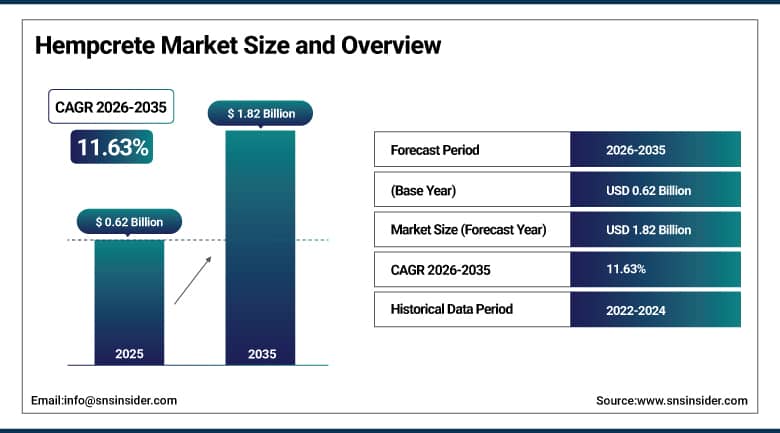
The Hempcrete Market was valued at USD 0.62 billion in 2025 and is expected to reach USD 1.82 billion by 2035, growing at a CAGR of 11.63% from 2026–2035.
The Hempcrete Market is witnessing significant expansion owing to the growing use of environmentally friendly building materials, rising interest in carbon negative buildings, and increased preference for energy-saving insulating systems. The growing role of government policies that favor green building practices and eco-friendly city planning is expected to drive the adoption of environmentally sustainable building materials.
The growing penetration of bio-based insulation systems, prefabricated hempcrete panels, and circular construction practices is further driving innovation and investment activities among construction material manufacturers, green builders, and sustainable infrastructure developers.
Recent developments including large-scale hemp processing facility expansions in Europe and North America, advancements in prefabricated hempcrete block manufacturing technologies, and strategic collaborations between sustainable construction firms and industrial hemp suppliers are accelerating commercialization across the global hempcrete industry.
To Get More Information On Hempcrete Market - Request Free Sample Report
Hempcrete market Trends
-
Rising adoption of carbon-negative and low-emission construction materials is accelerating demand for hempcrete across sustainable building projects.
-
Increasing focus on energy-efficient buildings and thermal insulation performance is boosting utilization of hempcrete in residential and commercial infrastructure.
-
Rapid integration of prefabricated hempcrete panels and modular construction technologies is improving installation efficiency and reducing construction timelines.
-
Growing demand for non-toxic, moisture-regulating, and breathable wall systems is enhancing adoption in eco-friendly and healthy indoor building environments.
-
Increasing government support for green building certifications and sustainable housing initiatives is accelerating investments in hemp-based construction materials.
-
Rising use of industrial hemp cultivation and bio-based binders is strengthening circular economy practices and sustainable raw material sourcing.
-
Expanding development of lightweight, fire-resistant, and acoustically efficient hempcrete formulations is driving innovation in advanced building material applications.
The U.S. Hempcrete Market Outlook
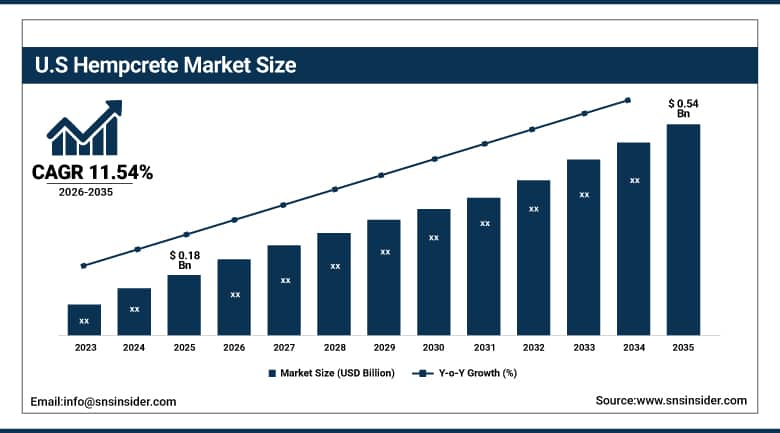
The U.S. Hempcrete Market was valued at USD 0.18 billion in 2025 and is expected to reach around USD 0.54 billion by 2035, growing at a CAGR of 11.54% from 2026–2035.
The United States is the leading market for hempcrete within North America due to growing awareness regarding sustainable construction materials, green building projects, and the need for negative-carbon insulation systems in both domestic and commercial infrastructure developments. Rising popularity of energy-efficient construction requirements, supportive policies for industrial hemp farming, and increasing investments in eco-housing projects are major factors boosting the use of hempcrete products in contemporary constructions.
Supporting this growth, the U.S. Green Building Council (USGBC) and LEED certification programs continue to encourage adoption of low-emission and sustainable building materials, strengthening demand for hemp-based construction solutions across institutional and private sector projects.
Additionally, recent investments in industrial hemp processing facilities, expansion of prefabricated hempcrete manufacturing capabilities, and collaborations between sustainable construction firms and hemp material suppliers are reinforcing long-term commercialization opportunities across the U.S. hempcrete industry.
Hempcrete market Segment Highlights
-
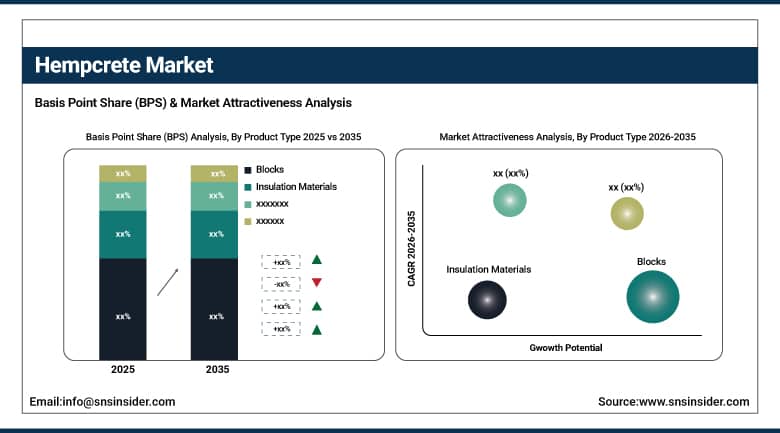
By Product Type, Blocks dominated the Hempcrete Market with 34.84% share in 2025; Insulation Materials fastest growing CAGR.
-
By Application, Residential Construction dominated the Hempcrete Market with 46.15% share in 2025; Renovation & Retrofitting fastest growing CAGR.
-
By End-Use, Walls dominated the Hempcrete Market with 47.85% share in 2025; Roofing Insulation fastest growing CAGR.
-
By Density Type, Medium-Density Hempcrete dominated the Hempcrete Market with 46.24% share in 2025; Low-Density Hempcrete fastest growing CAGR.
-
By Raw Material, Hemp Shiv (Hurds) dominated the Hempcrete Market with 44.51% share in 2025; Mixed Natural Additives fastest growing CAGR.
By Product Type, Blocks segment dominates the Hempcrete Market, Insulation Materials segment expected to grow fastest
In 2025, the Blocks segment maintained its dominant position in the Hempcrete Market, accounting for 34.84% of total revenue. The major factors behind this kind of leadership include the growing use of hempcrete block in house walls, low-rise eco-housing constructions, and sustainable infrastructural buildings. The hempcrete block is gaining popularity because of its effective performance as a thermal insulator, moisture regulator, fire retardant, and its low carbon construction.
From 2026 to 2035, the Insulation Materials segment is projected to record the highest CAGR. This rapid growth is driven by increasing demand for energy-efficient buildings, stricter environmental construction regulations, and rising adoption of bio-based insulation systems in residential and commercial applications.
By Application, Residential Construction segment dominates the Hempcrete Market, Renovation & Retrofitting segment expected to grow fastest
In 2025, the Residential Construction segment maintained its dominant position in the Hempcrete Market, accounting for 46.15% of total revenue. This dominance is driven by rising construction of sustainable homes, increasing consumer awareness regarding carbon-negative building materials, and expanding adoption of energy-efficient housing concepts.
From 2026 to 2035, the Renovation & Retrofitting segment is projected to record the highest CAGR. The growth is primarily supported by increasing renovation activities focused on improving building energy performance, strengthening insulation efficiency, and meeting updated environmental compliance standards.
By End-Use, Walls segment dominates the Hempcrete Market, Roofing Insulation segment expected to grow fastest
In 2025, the Walls segment maintained its dominant position in the Hempcrete Market, accounting for 47.85% of total revenue. It is because of this reason that the dominance of hempcrete wall construction is seen today. The use of hempcrete wall constructions provides better insulation, humidity control, soundproofing, and fire resistance. Hence, the application of hempcrete walls is highly beneficial for green building construction.
From 2026 to 2035, the Roofing Insulation segment is projected to record the highest CAGR. The growth is driven by increasing adoption of energy-efficient roofing systems, growing focus on reducing heating and cooling costs, and rising demand for natural insulation materials in environmentally certified buildings.
By Density Type, Medium-Density Hempcrete segment dominates the Hempcrete Market, Low-Density Hempcrete segment expected to grow fastest
The Medium-Density Hempcrete segment maintained the highest share of 46.24% in 2025. The dominance of such a material results from its perfect structural performance, efficient thermal insulation, and wide range of uses. The medium density of hempcrete is widely used in wall structures, partitions, and insulation works owing to the perfect balance between strength, breathability, moisture resistance, and lightweight nature.
The Low-Density Hempcrete segment is projected to achieve the highest growth rate during 2026–2035.
By Raw Material, Hemp Shiv (Hurds) segment dominates the Hempcrete Market, Mixed Natural Additives segment expected to grow fastest
The Hemp Shiv (Hurds) segment held the largest share of 44.51% in 2025. This dominance can be owed to its critical importance as one of the fundamental biological aggregates utilized in hempcrete manufacture. The plant’s hurd is known to provide better thermal insulation, lightness in weight, ability to absorb carbon dioxide, and better compatibility with lime-based binders. Increased farming of industrial hemp and growing preference for eco-friendly construction materials have been driving growth in the sector.
The Mixed Natural Additives segment is projected to register the highest CAGR during 2026–2035.
Hempcrete market Regional Analysis
|
Region |
Major Country |
Share within Region (%) |
|---|---|---|
|
North America |
United States |
35.04% |
|
Europe |
Germany |
38.24% |
|
Asia Pacific |
China |
19.09% |
|
Middle East & Africa |
UAE |
4.54% |
|
Latin America |
Brazil |
3.09% |
Europe Hempcrete Market Insights
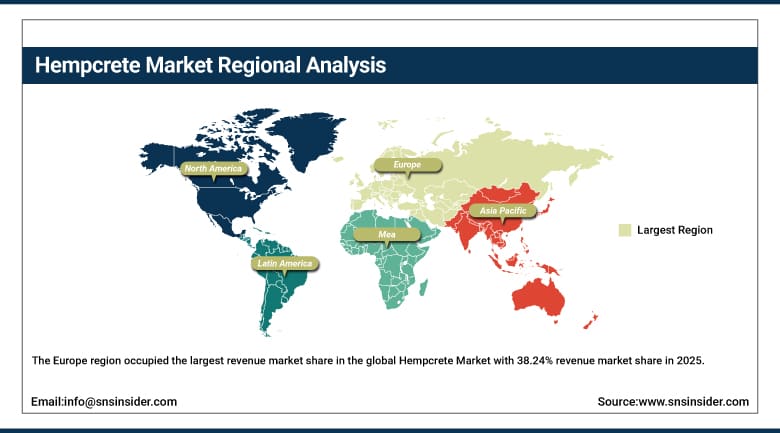
The Europe region occupied the largest revenue market share in the global Hempcrete Market with 38.24% revenue market share in 2025 owing to stringent environmental laws, early adoption of carbon-neutral practices, and the extensive use of sustainable construction materials. Some of the leading countries contributing to hempcrete construction include Germany, France, the UK, Italy, and the Netherlands. The regions adopt rigorous building emission requirements and a high demand for energy-efficient constructions.
Supporting this position, European construction stakeholders are increasingly prioritizing circular economy principles, bio-based material integration, and low-impact building designs. Hempcrete is widely used in renovation projects, passive houses, and green-certified commercial developments, particularly in applications requiring superior thermal insulation and humidity regulation.
Additionally, growing demand for net-zero energy buildings, expansion of sustainable urban redevelopment projects, and increasing innovation in natural composite materials are reinforcing Europe’s role as a key innovation hub in the global hempcrete ecosystem.
Get Customized Report as Per Your Business Requirement - Enquiry Now
North America Hempcrete Market Insights
The North American region is fast establishing itself as one of the most progressive areas in the Hempcrete Market due to strict sustainability regulations, widespread use of low carbon footprint building materials, and the quick development of green building certification schemes. The North American region has an established construction industry that is making huge investments in sustainable residential and commercial structures, along with rising recognition of the potential of bio-based building materials such as hempcrete as an alternative to concrete. The US leads in terms of regional consumption.
Supporting this growth, construction stakeholders across the U.S. and Canada are increasingly integrating hempcrete into passive housing models, modular construction systems, and energy-efficient building envelopes. Demand is also rising for carbon-negative building materials as developers aim to meet stricter environmental compliance standards and corporate sustainability targets.
Additionally, recent developments such as increased adoption of hemp-lime wall systems in U.S. green housing projects and rising collaboration between construction firms and bio-material innovators for scalable hempcrete applications are strengthening innovation across sustainable construction ecosystems.
Asia Pacific Hempcrete Market Insights
The region of Asia Pacific is expected to have the fastest CAGR of 12.80% between 2026 and 2035, mainly due to the fast pace of urbanization, extensive construction activities for residential buildings, and emphasis on building sustainable infrastructure. The countries that are leading the way with regards to the usage of eco-friendly concrete include China, India, Japan, South Korea, and Australia, out of which China and India are leading the pack.
Supporting this growth, increasing industrial hemp cultivation programs, rising green building certifications, and growing adoption of low-cost sustainable housing solutions are significantly accelerating demand for hempcrete-based blocks, insulation systems, and precast construction components across the region.
In addition, expanding construction technology adoption, rapid growth of prefabricated building systems, and increasing awareness of energy-efficient housing solutions are strengthening Asia Pacific’s position as the fastest-growing regional market for hempcrete applications.
Latin America, Middle East & Africa (LAMEA) Hempcrete Market Insights
The Hempcrete Market in the LAMEA region is experiencing slow but consistent growth owing to the rising awareness about sustainability in the construction industry, growing infrastructural developments in urban regions, and the growing popularity of energy-efficient construction materials. Nations like Brazil, Mexico, UAE, Saudi Arabia, and South Africa are playing an important role in fuelling demand in the region.
Supporting this growth, Middle Eastern countries are increasingly integrating green building frameworks into smart city initiatives, driving adoption of alternative construction materials like hempcrete in modern urban developments. Meanwhile, Africa and Latin America are gradually exploring bio-based construction solutions as cost-effective and climate-resilient alternatives to conventional materials.
In addition, improving supply chain networks, increasing participation of international green construction firms, and rising pilot projects in sustainable housing are gradually expanding awareness and adoption of hempcrete technologies across emerging markets.
Hempcrete market Growth Drivers:
-
Rising demand for sustainable, carbon-negative construction materials and energy-efficient building solutions is driving strong adoption of Hempcrete in global green construction projects.
The major factor shaping the Hempcrete Market is the rapid shift towards sustainable construction processes across the globe, with a focus on using low-emission, efficient, and environmental-friendly materials in construction. With the emergence of environmental laws, the stringent carbon emissions policy for the construction industry, and a higher preference for green building materials for homes and offices, the use of hempcrete has become quite popular.
Supporting this growth, increasing investments in green building certification programs, expansion of eco-housing developments across Europe and North America, and rising industrial hemp cultivation initiatives in Asia Pacific are significantly accelerating the supply and adoption of hemp-based construction materials.
Additionally, recent developments such as growing adoption of hemp-lime composite systems in EU net-zero housing projects and increasing collaborations between construction firms and bio-material innovators for scalable hempcrete production technologies are strengthening market commercialization.
Hempcrete market Restraints:
-
Rising dependency on natural raw materials, supply chain constraints, and variability in hemp cultivation output are increasing production complexity and limiting scalability in the Hempcrete Market
Limitations in the Hempcrete Market include the inability to procure hemp shives and lime binders consistently and efficiently, coupled with poorly developed logistical frameworks within the industries for the use of biological construction materials. This hinders effective quality control of raw materials, stability of prices, and efficient manufacturing processes, particularly in areas where industrial hemp cultivation and processing are just starting. In line with this limitation, lengthy curing periods, the absence of building regulations in some nations, and inadequate knowledge among contractors on the application of hempcrete are additional hurdles that hinder its adoption.
Hempcrete market Opportunities:
-
Expansion of green building initiatives, carbon-neutral construction mandates, and regenerative architecture practices is creating strong opportunities for hempcrete adoption across sustainable residential and commercial infrastructure globally
The key opportunity in the Hempcrete Market includes the incorporation of bio-based building materials in standard building regulations and sustainable city planning strategies, where hempcrete is seen as the primary tool to help create efficient infrastructure with reduced carbon footprints. The increasing trend of using circular construction techniques, net-zero housing communities, and eco-friendly real estate projects has created a growing demand for hempcrete blocks, hempcrete insulation products, and prefab building solutions. This trend has been fueled by increased investment in hemp cultivation, bio-material innovations, and government incentives for sustainable building projects.
Recent Developments:
-
2026: European sustainable construction developers expanded large-scale adoption of hempcrete-based building envelopes in net-zero residential projects, integrating hemp-lime wall systems to comply with tightening carbon-emission regulations and improve long-term building energy efficiency.
-
2026: In North America, green housing initiatives accelerated the use of hempcrete insulation materials in passive home developments, with builders increasingly prioritizing bio-based alternatives to conventional insulation to reduce embodied carbon and enhance indoor air quality.
-
2025: Leading eco-construction firms in Asia Pacific initiated pilot projects using prefabricated hempcrete blocks and panels in affordable housing and smart city developments, supported by growing government incentives for sustainable urban infrastructure.
-
2025: Sustainable materials innovators and construction technology firms advanced R&D in improved hempcrete formulations, focusing on enhanced durability, faster curing systems, and scalable production methods to support wider commercial construction adoption globally.
Hempcrete Companies are:
-
IsoHemp SA
-
Hempitecture Inc.
-
Americhanvre Cast Hemp
-
JustBioFiber Structural Solutions Corp.
-
American Lime Technology Ltd.
-
HempFlax Group B.V.
-
Lime Technology Ltd.
-
Hempcrete Natural Building Ltd.
-
Australian Hemp Masonry Company
-
HempEco Systems
-
HempBLOCK USA
-
UK Hempcrete
-
Biohm
-
Hemp and Block
-
Cavac Biomatériaux
-
BAFA Neu GmbH
-
Hemp Technology Ltd.
-
Sativa Building Systems
Hempcrete market Report Scope:
| Report Attributes | Details |
|---|---|
| Market Size in 2025 | USD 0.62 Billion |
| Market Size by 2035 | USD 1.82 Billion |
| CAGR | CAGR of 11.63% From 2026 to 2035 |
| Base Year | 2025 |
| Forecast Period | 2026-2035 |
| Historical Data | 2022-2024 |
| Report Scope & Coverage | Market Size, Segments Analysis, Competitive Landscape, Regional Analysis, DROC & SWOT Analysis, Forecast Outlook |
| Key Segments | • By Product Type (Blocks, Panels, Insulation Materials, Precast Walls, Others) • By Application (Residential Construction, Commercial Construction, Industrial Construction, Renovation & Retrofitting) • By End-Use (Walls, Roofing Insulation, Flooring, Partition Systems) • By Density Type ( Medium-Density Hempcrete,High-Density Hempcrete, Low-Density Hempcrete) • By Raw Material (Hemp Shiv (Hurds), Lime-Based Binder, Mixed Natural Additives, Others) |
| Regional Analysis/Coverage | North America (US, Canada), Europe (Germany, UK, France, Italy, Spain, Russia, Poland, Rest of Europe), Asia Pacific (China, India, Japan, South Korea, Australia, ASEAN Countries, Rest of Asia Pacific), Middle East & Africa (UAE, Saudi Arabia, Qatar, South Africa, Rest of Middle East & Africa), Latin America (Brazil, Argentina, Mexico, Colombia, Rest of Latin America). |
| Company Profiles | IsoHemp SA, Hempitecture Inc., Americhanvre Cast Hemp, JustBioFiber Structural Solutions Corp., American Lime Technology Ltd., Dun Agro Hemp Group, HempFlax Group B.V., Lime Technology Ltd., Hempcrete Natural Building Ltd., Australian Hemp Masonry Company, HempEco Systems, HempBLOCK USA, UK Hempcrete, Biohm, HempStone, Hemp and Block, Cavac Biomatériaux, BAFA Neu GmbH, Hemp Technology Ltd., Sativa Building Systems. |
Frequently Asked Questions
Europe dominated the Hempcrete market in 2025.
The Blocks dominated the Hempcrete market in 2025.
Rapid expansion of sustainable construction practices, carbon-neutral building mandates, and increasing adoption of bio-based materials is the primary growth driver of the Hempcrete Market.’
The Hempcrete market was valued at USD 0.62 billion in 2025.
The Hempcrete market is expected to grow at a CAGR of 11.63% from 2026 to 2035.
