
Industrial Hemp Market Report Scope & Overview:
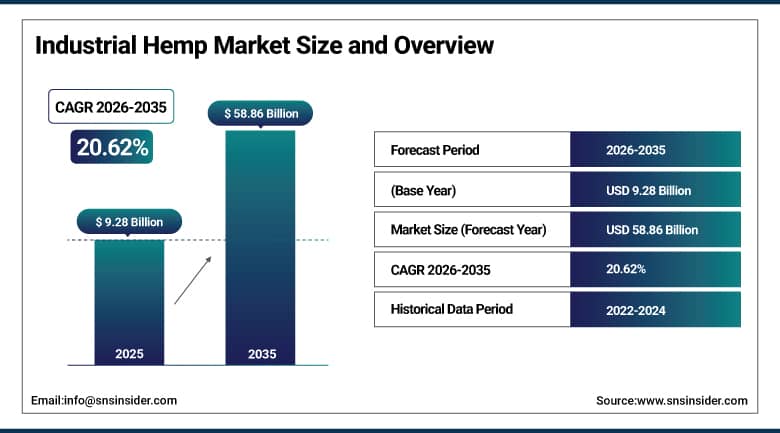
The Industrial Hemp Market was valued at USD 9.28 billion in 2025 and is expected to reach USD 58.86 billion by 2035, growing at a CAGR of 20.62% from 2026-2035.
The Industrial Hemp Market is experiencing rapid growth due to the growing demand for sustainable materials and consumer goods and the increasing popularity of the CBD wellness industry. Advances in bioplastics, hempcrete building material, and natural fabrics are expanding the uses of the material in different industries. The favorable regulatory environment, consumer interest in alternative sources, and sustainability-related investments are propelling the use of industrial hemp in sectors ranging from agriculture to manufacturing.
As a part of this development, the USDA is continuously encouraging the growth of industrial hemp production using government hemp production programs and agricultural research projects that seek to develop robust supply chains and sustainable crops of hemp. The rising interest among consumers in plant-based nutrition, sustainable fabrics, environmentally friendly materials, and wellness products derived from hemp is fueling the commercial adoption of hemp in various industries in the U.S. and other major economies.
To Get More Information On Industrial Hemp Market - Request Free Sample Report
Industrial Hemp Market Trends
-
Growing demand for hemp CBD products in nutraceuticals and other wellness applications
-
Increased innovation in bioplastics made from hemp and hemp-based sustainable packaging
-
Successful improvements in hemp extraction and fiber processing technologies to enhance scalability
-
Continuing legalization and commercialization of industrial hemp in various markets worldwide
-
E-commerce sales channels for hemp-based wellness products and personal care products
-
More hemp seed oil being used in cosmetic products, skincare products, and foods
-
Increasing cooperation between hemp farmers and hemp processing companies
U.S. Industrial Hemp Market Outlook:
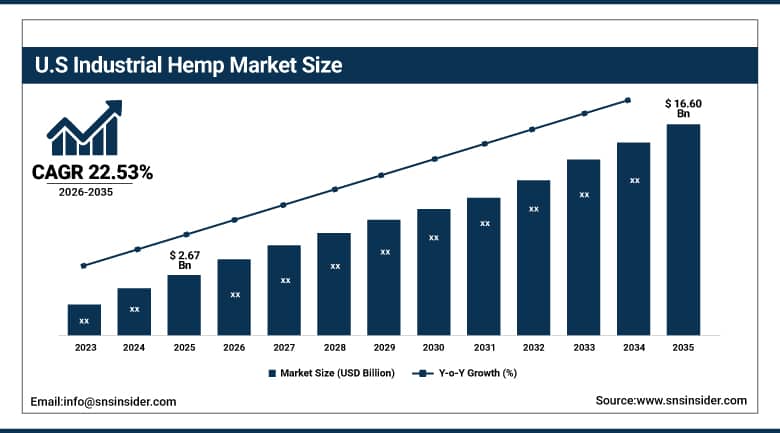
The U.S. Industrial Hemp Market was valued at USD 2.67 billion in 2025 and is expected to reach USD 16.60 billion by 2035, growing at a CAGR of 22.53% from 2026-2035.
U.S. Industrial Hemp Market has emerged as one of the best-developed hemp markets worldwide, powered by an increasingly robust legal environment, significant consumer preference for eco-friendly products, and flourishing hemp-derived wellness products market. The United States possesses a well-established agriculture sector, increased investments in cultivating and manufacturing industrial hemp, and home to prominent hemp, CBD, food products, and sustainable materials manufacturers. Increased usage of hemp-derived products in textiles, nutraceuticals, personal care, bioplastics, and building materials has played an important role in driving its long-term growth prospects.
Moreover, the United States Department of Agriculture (USDA) has been consistently making efforts to promote industrial hemp cultivation through various federal programs for industrial hemp producers, research initiatives, and sustainable farming practices to build domestic hemp value chains. Increasing consumer interest towards plant-based food products, natural wellness products, and sustainable materials has been significantly boosting commercial hemp, hemp seed derivatives, and CBD-based product market demand.
Industrial Hemp Market Segment Highlights
-
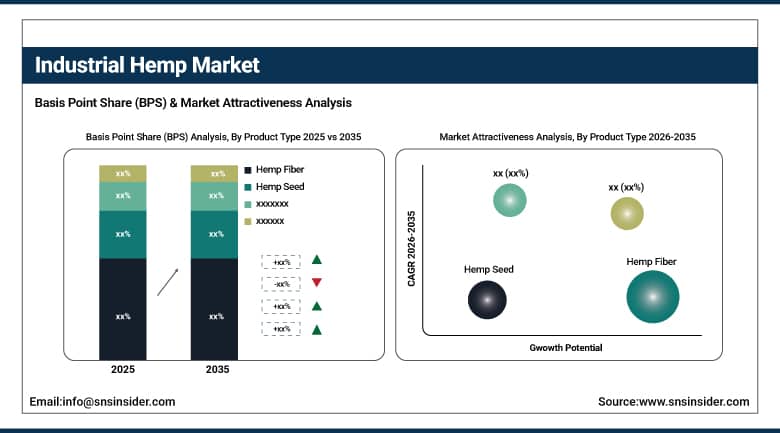
By Product Type, Hemp Fiber dominated the Industrial Hemp Market with 29.56% share in 2025; CBD Hemp Oil fastest growing (CAGR).
-
By Application, Textiles dominated the Industrial Hemp Market with 28.46% share in 2025; Pharmaceuticals & Nutraceuticals fastest growing (CAGR).
-
By Source, Conventional Hemp dominated the Industrial Hemp Market with 68.59% share in 2025; Organic Hemp fastest growing (CAGR).
-
By Distribution Channel, B2B/Industrial Supply dominated the Industrial Hemp Market with 38.76% share in 2025; Online/E-commerce fastest growing (CAGR).
Industrial Hemp Market Segment Analysis
By Product Type, Hemp Fiber Dominated the Industrial Hemp Market, CBD Hemp Oil Expected to Grow Fastest
The Hemp Fiber segment held a dominant share in the Industrial Hemp Market in 2025, with around 29.56% of the overall market value being attributed to this segment. Growth drivers behind the dominance of the segment include high demand for hemp fibers in sustainable clothing, automotive composites, paper goods, insulation material, and eco-friendly industrial products. Hemp fibers offer great durability, tensile strength, lightweight, and sustainability, which make them a preferred choice over traditional raw materials.
Between 2026 and 2035, the CAGR for the CBD Hemp Oil segment is expected to be the fastest. Strong consumer demand for plant-based wellness products, supplements, and personal care products will act as primary catalysts in the growth of the segment. Increasing legalization of cannabis and CBD oil products, research into cannabis health benefits, and growing technological innovations in extraction processes will contribute further to market expansion.
By Application, Textiles Dominated the Industrial Hemp Market, Pharmaceuticals & Nutraceuticals Expected to Grow Fastest
In 2025, the Textiles category accounted for about 28.46% share in the Industrial Hemp Market. The Textiles category's growth is driven by rising demand for eco-friendly fabrics, apparel, and biodegradable textiles used in the fashion industry. Industrial hemp textiles are highly sought after because of their strength, breathability, water-resistance properties, and low carbon footprint than traditional cotton and synthetic fabrics.
The Pharmaceuticals & Nutraceuticals category is anticipated to witness the highest CAGR between 2026 and 2035. The increasing demand for hemp-derived health and wellness products, cannabinoid-based medicines, and hemp-based nutraceutical supplements is driving rapid growth in this category. The rising clinical trials on cannabinoids, rising awareness of alternative medicine, and the expanding application scope of industrial hemp products are contributing to this trend.
By Source, Conventional Hemp Dominated the Industrial Hemp Market, Organic Hemp Expected to Grow Fastest
The Conventional Hemp category dominated the Industrial Hemp Market, with a market share of around 68.59% in 2025. This dominance was attributed to large-scale commercial planting, existing agricultural methods, and high productivity in comparison to organic farming techniques. The conventional hemp crop is used for industrial purposes like textiles, building materials, foods, and industrial fibers, making it easier and cost-effective to manufacture in bulk quantities.
From 2026 to 2035, the Organic Hemp category is anticipated to record the highest CAGR. The growing consumer inclination toward organic, natural, and sustainable farming is expected to drive the demand for organic hemp for use in food items, wellness products, cosmetics, and personal care products. Increasing knowledge about sustainability and regenerative agriculture, along with organic consumer products, will promote the cultivation of organic hemp crops.
By Distribution Channel, B2B/Industrial Supply Dominated the Industrial Hemp Market, Online/E-commerce Expected to Grow Fastest
In the year 2025, the share of the B2B/Industrial Supply sub-segment in the Industrial Hemp Market was about 38.76%. This was due to large purchases of hemp raw material by the manufacturers of textiles, food products, pharmaceutical products, building products, and other industrial products. Growth in the use of hemp in many industries contributed to the success of the sub-segment.
During 2026 to 2035, it is expected that the fastest CAGR will be recorded in the Online/E-commerce sub-segment. Digitalization, increasing awareness among consumers of hemp-based health and lifestyle products, and the increasing direct-to-consumer distribution channel will drive the market through e-commerce. The e-commerce website helps consumers purchase CBD products, hemp supplements, personal care products, and organic hemp foods conveniently.
Industrial Hemp Market Regional Analysis
|
Region |
Major Country |
Share within Region (%) |
|---|---|---|
|
North America |
United States |
34.56% |
|
Europe |
Germany |
28.74% |
|
Asia Pacific |
China |
23.59% |
|
Middle East & Africa |
UAE |
5.65% |
|
Latin America |
Brazil |
7.46% |
North America Industrial Hemp Market Insights
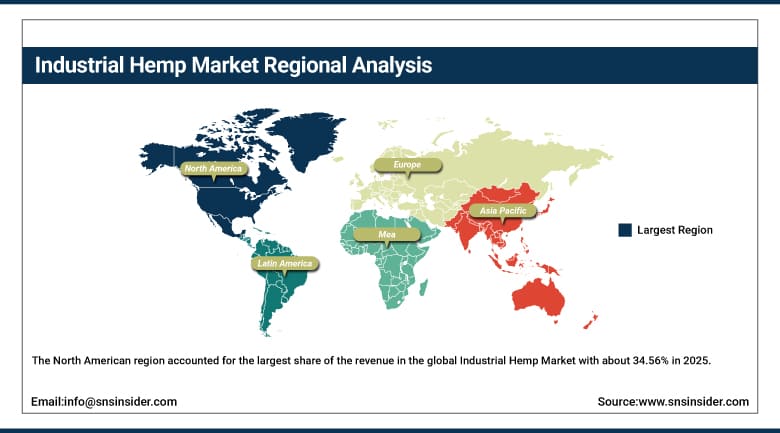
The North American region accounted for the largest share of the revenue in the global Industrial Hemp Market with about 34.56% in 2025 owing to its superior agricultural facilities, growing legal framework, high consumer preference for industrial hemp products, and investments in hemp production and processing technologies. This region also enjoys the advantage of having prominent industrial hemp producers, CBD producers, nutraceuticals producers, and sustainable material makers that make it possible for the region to achieve commercialization of its industrial hemp applications in textiles, food and beverages, wellness products, construction materials, and bioplastics.
This dominance was also fueled by federal support for the growth of industrial hemp in the country provided by the U.S. Department of Agriculture (USDA) through several initiatives such as hemp cultivation programs, agricultural research, and farming policies focused on promoting sustainable agriculture.
Get Customized Report as Per Your Business Requirement - Enquiry Now
Asia Pacific Industrial Hemp Market Insights
Asia-Pacific is projected to witness the highest CAGR of 22.30% during the forecast period 2026-2035 owing to rapid growth in industrial hemp cultivation, rising demand for sustainable materials, increasing consumer preference for hemp-based wellness products, and favorable government initiatives towards diversification of agriculture. Key countries witnessing growth in this region include China, Japan, India, South Korea, and Australia. China is the leading country in this region as far as production and processing of industrial hemp fiber and textile is concerned.
Moreover, regulatory authorities in Japan are becoming increasingly inclined towards the development of hemp-based wellness, nutraceutical, and personal care products, thus leading to an increase in the adoption rate in the region. Furthermore, India and Australia have increased their industrial hemp farms and processing facilities via agricultural policy support and investments in sustainable crops.
Europe Industrial Hemp Market Insights
Europe occupied the steady revenue share in the Global Industrial Hemp Market, contributing significantly to the total market in 2025 (Calculated estimate). This is attributed to regulatory backing for the production of industrial hemp, increasing demands for sustainable sources of raw materials, and growing usage of hemp-based products in textile, food and beverages, personal care, construction, and automotive applications. The major regional markets in Europe include Germany, France, UK, the Netherlands, and Italy, fueled by efficient agricultural practices, sustainable initiatives, and consumer inclination towards eco-friendly and plant-based products.
To back up the above argument, the European Commission has been promoting the concept of sustainable farming, bio-based materials, and circular economy through several regional funding and innovation initiatives to decrease carbon emissions and promote environmentally responsible industrial growth. The initiatives have been fueling the adoption of hemp composite materials, biodegradable packaging solutions, hemp-based insulation materials, and sustainable textile solutions.
Middle East & Africa and Latin America Industrial Hemp Market Insights
The MEA and Latin America markets are showing consistent increments in the Industrial Hemp Market, thanks to the growing demand for sustainable agricultural products, increased investments in hemp cultivation and related infrastructures, and the increasing recognition of various uses of hemp in textiles, foods, health, and industrial applications. For the MEA market, countries such as the UAE, South Africa, and other northern African countries are gradually showing interest in the cultivation of hemp and sustainable bio-industries, while economic diversification efforts from governments are encouraging investments in alternative agriculture and industries.
Encouraging developments are happening in the mentioned markets, including the push for environmentally sustainable industries, modern agricultural practices, and raw materials through Saudi Arabia’s Vision 2030 and sustainability programs.
The Brazilian government is supporting the development of hemp and cannabis-related research in terms of cultivation, manufacturing of wellness products, and industrial applications.
Industrial Hemp Market Growth Drivers:
-
Rising global demand for sustainable raw materials, plant-based products, and eco-friendly industrial solutions driving rapid expansion of the Industrial Hemp Market
The shift in consumer preferences and industry trends towards sustainable, renewable, and low-carbon materials is a strong structural trend that supports the growth of the Industrial Hemp Market. Many industries in textiles, food and beverages, construction, automotive, personal care, and packaging sectors are turning towards sustainable hemp materials and substituting traditional synthetic, petrochemical, and intensive materials with hemp materials. Consumers are also becoming aware of the significance of using sustainable and organic products that are plant-based. As such, manufacturers are increasing investments in hemp production processes and new products that cater to rising global demands.
The United Nations Environment Programme (UNEP) and other global sustainability agencies continue emphasizing the significance of bio-based and renewable materials to minimize the environmental footprint of industries and promote sustainable industrial practices. Moreover, rising consumer demand for CBD wellness products, plant-based protein sources, natural cosmetic formulations, and sustainable textiles are creating long-term growth prospects in the global Industrial Hemp Market.
Industrial Hemp Market Restraints:
-
Regulatory complexity, inconsistent legalization frameworks, and high processing infrastructure costs creating barriers to large-scale Industrial Hemp Market expansion
The key factor that restricts growth in the market for industrial hemp is the inherent uncertainty associated with regulation and the capital required for production processes. Regulations in terms of the allowable levels of THC, licensing, the sale of CBD products, the import/export process, and labeling continue to differ significantly from one country and region to another. This results in compliance issues, restricted international business prospects, and higher risks for those in the business of producing and manufacturing industrial hemp products.
Industrial Hemp Market Opportunities:
-
Accelerating adoption of hemp-based sustainable materials and expansion of hemp-derived wellness products creating new growth pathways for Industrial Hemp Market commercialization across diverse industries
The next generation of Industrial Hemp Market growth opportunities is centered on expanding the commercial utilization of hemp across sustainable manufacturing, bio-based materials, wellness products, and environmentally responsible consumer applications. Companies developing advanced hemp processing technologies, biodegradable hemp composites, hemp-based construction materials, and plant-derived nutritional products are addressing rapidly growing global demand for sustainable alternatives to conventional raw materials. The increasing integration of hemp fiber into textiles, automotive components, packaging materials, and green building solutions is significantly broadening the market’s industrial application base.
Recent Developments:
-
2026: Canopy Growth Corporation improved its global operations in cannabis and industrial hemp by implementing enhanced commercialization strategies for their products in North America and Europe, while also improving efficiency in the supply chain and increasing the capacity for distributing medical cannabis products. The company also worked towards innovations in popular cannabis products and developed advanced vaporization systems using its Storz & Bickel division.
-
2025: Ecofibre Limited was busy expanding its range of hemp wellness and sustainable products, while at the same time working to develop more advanced hemp-based technologies for consumer products. This company was also focusing on enhancing its commercialization efforts in industrial hemp fibers and nutraceuticals internationally in the wellness and industrial sectors.
-
2026: HempFlax BV further solidified its presence in industrial hemp through the joint purchase of a hemp insulation plant in Germany. This company was focused on increasing its business in sustainable biobased materials, especially for use in the construction industry in Europe.
-
2025: Aurora Cannabis Inc. further developed its global business model for medical marijuana and industrial hemp by increasing its capacity for cultivation, processing, and distribution in Europe, Australia, and North America. The corporation has made efforts towards developing pharmaceutical-quality cannabinoids, conducting advanced genetic studies, and implementing advanced cultivation techniques.
Industrial Hemp Market Companies are:
-
Canopy Growth Corporation
-
Ecofibre Limited
-
HempFlax BV
-
Aurora Cannabis Inc.
-
CV Sciences Inc.
-
Manitoba Harvest
-
Hemp Inc.
-
Elixinol Global Limited
-
Canah International SRL
-
Bast Fibre Technologies Inc.
-
Colorado Hemp Works LLC
-
Boring Hemp Company
-
Konoplex Group
-
HemPoland
-
Hemp Oil Canada Inc.
-
Plains Industrial Hemp Processing Ltd.
-
HempMeds
-
Tilray Inc.
-
Nutiva Inc.
-
Charlotte’s Web Holdings Inc.
Industrial Hemp Market Report Scope:
| Report Attributes | Details |
|---|---|
| Market Size in 2025 | USD 9.28 Billion |
| Market Size by 2035 | USD 58.86 Billion |
| CAGR | CAGR of 20.62% From 2026 to 2035 |
| Base Year | 2025 |
| Forecast Period | 2026-2035 |
| Historical Data | 2022-2024 |
| Report Scope & Coverage | Market Size, Segments Analysis, Competitive Landscape, Regional Analysis, DROC & SWOT Analysis, Forecast Outlook |
| Key Segments | • By Product Type (Hemp Fiber, Hemp Seed, Hemp Seed Oil, CBD Hemp Oil, Hemp Hurd/Shives, Others), • By Application (Textiles, Food & Beverages, Personal Care & Cosmetics, Pharmaceuticals & Nutraceuticals, Construction Materials, Automotive, Paper & Pulp, Others), • By Source (Conventional Hemp, Organic Hemp, Others), • By Distribution Channel (B2B/Industrial Supply, Supermarkets & Hypermarkets, Specialty Stores, Online/E-commerce, Others) |
| Regional Analysis/Coverage | North America (US, Canada), Europe (Germany, UK, France, Italy, Spain, Russia, Poland, Rest of Europe), Asia Pacific (China, India, Japan, South Korea, Australia, ASEAN Countries, Rest of Asia Pacific), Middle East & Africa (UAE, Saudi Arabia, Qatar, South Africa, Rest of Middle East & Africa), Latin America (Brazil, Argentina, Mexico, Colombia, Rest of Latin America). |
| Company Profiles | Canopy Growth Corporation, Ecofibre Limited, HempFlax BV, Aurora Cannabis Inc., CV Sciences Inc., Manitoba Harvest, Hemp Inc., Elixinol Global Limited, Canah International SRL, Bast Fibre Technologies Inc., Colorado Hemp Works LLC, Boring Hemp Company, Konoplex Group, HemPoland, Hemp Oil Canada Inc., Plains Industrial Hemp Processing Ltd., HempMeds, Tilray Inc., Nutiva Inc., Charlotte’s Web Holdings Inc. |
Frequently Asked Questions
North America dominated the Industrial Hemp Market in 2025.
The Hemp Fiber segment dominated the Industrial Hemp Market in 2025.
The major growth driver of Market is rising demand for sustainable, eco-friendly products across industries. Hemp’s versatility in textiles, food & beverages, and CBD wellness is fueling adoption.
The Industrial Hemp Market was valued at USD 9.28 billion in 2025.
The Industrial Hemp Market is expected to grow at a CAGR of 20.62% from 2026 to 2035.
