
IVF Devices and Consumables Market Report Scope and Overview:
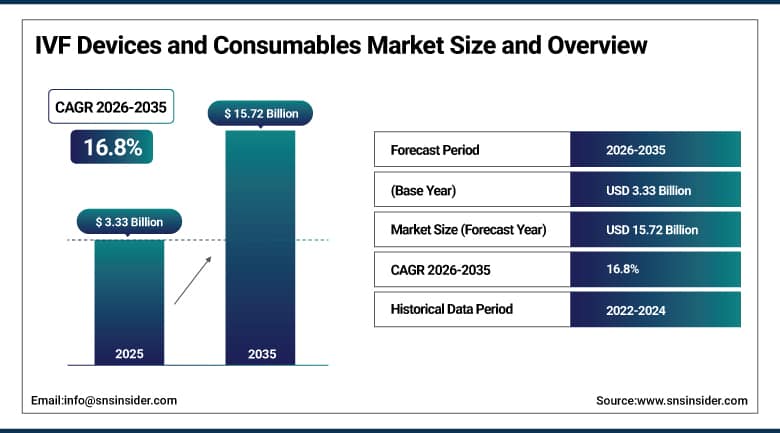
The IVF Devices and Consumables Market was valued at USD 3.33 Billion in 2025 and is projected to reach USD 15.72 Billion by 2035, registering a CAGR of 16.8% from 2026 to 2035.
In Vitro Fertilization (IVF) Devices and Consumables Market is revolutionizing the field of fertility by providing cutting-edge culture media, cryopreservation equipment, time-lapse embryo imaging incubators, and Artificial Intelligence integrated embryo selection solutions which keep on contributing to increased pregnancy success rates. The market is growing at an exponential rate due to the rising number of infertile patients worldwide due to late parenthood and lifestyle problems. In addition, the market is growing due to the application of time-lapse and Artificial Intelligence for assessing the embryo viability and the increase in the number of fertility clinics in both developed and emerging markets.
Vitrolife AB continued expanding its EmbryoScope time-lapse incubation platform throughout 2024, integrating AI-powered embryo selection software designed to improve implantation rate prediction and support embryologists making more consistent, data-driven embryo transfer decisions across fertility clinics worldwide.
To Get More Information On IVF Devices and Consumables Market - Request Free Sample Report
IVF Devices and Consumables Market Trends
-
Rising global infertility rates driven by delayed childbearing continue expanding demand for assisted reproductive technology.
-
Growing clinical adoption of time-lapse imaging incubators continues improving embryo selection accuracy and consistency.
-
Expanding AI-powered embryo viability assessment continues supporting more data-driven embryo transfer decisions.
-
Increasing vitrification-based cryopreservation adoption continues improving egg and embryo survival rates after thawing.
-
Rising fertility preservation demand continues driving elective egg freezing adoption among younger patient populations.
U.S. IVF Devices and Consumables Market Outlook
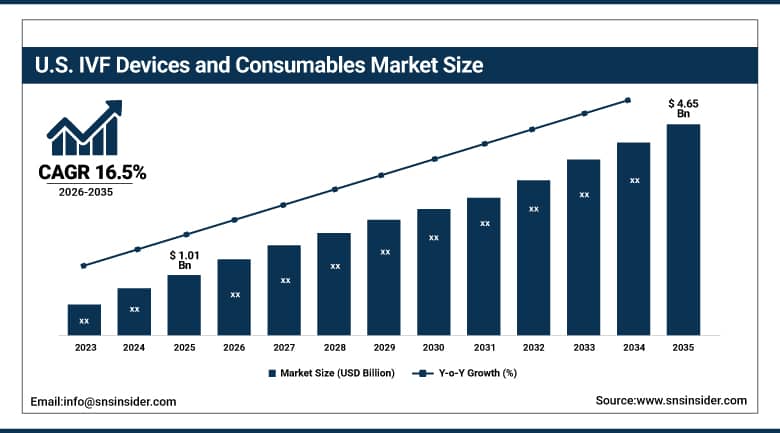
The U.S. IVF Devices and Consumables Market was valued at approximately USD 1.01 Billion in 2025 and is projected to reach approximately USD 4.65 Billion by 2035, registering a CAGR of approximately 16.5% from 2026 to 2035.
Demand across the United States continued to be shaped by a dense concentration of leading fertility clinics, growing employer-sponsored fertility benefit coverage, and rising patient awareness of assisted reproductive technology as a viable family-building option. Rising deployment of time-lapse incubation and AI-powered embryo selection platforms by leading fertility centers continued reinforcing the country's position as both the largest and most technologically advanced IVF devices and consumables market. Growing adoption across cryopreservation centers and fertility preservation clinics added further layers of sustained domestic demand well beyond the technology's traditional infertility-treatment use case, with expanding elective egg freezing programs increasingly relying on advanced vitrification consumables and laboratory equipment.
CooperSurgical, Inc., part of The Cooper Companies, continued expanding its ORIGIO culture media and embryo transfer catheter portfolio throughout the year, reinforcing its position as a leading supplier of IVF laboratory consumables to American fertility clinics.
IVF Devices and Consumables Market Segment Analysis
-
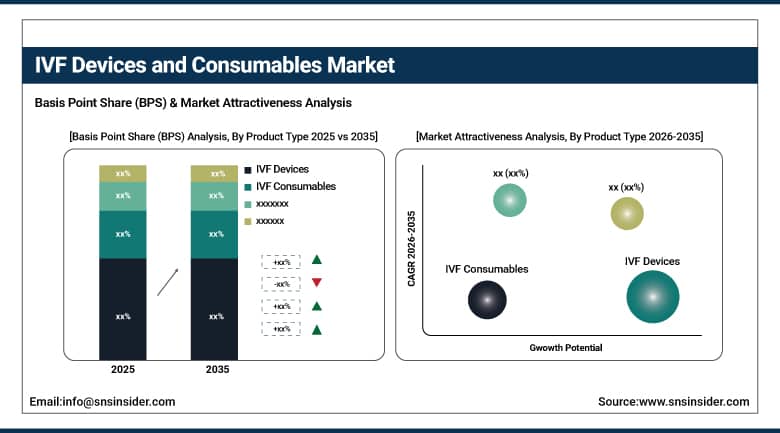
By Product Type, IVF Consumables segment dominated the IVF Devices and Consumables Market in 2025 with 60% share; IVF Devices segment is the fastest growing segment.
-
By Application, Assisted Reproductive Technology (ART) segment dominated the market in 2025 with 75% share; Research & Academic Institutes segment is the fastest growing segment.
-
By Technology, Conventional IVF segment dominated the market in 2025 with 55% share; Time-Lapse Imaging Technology segment is the fastest growing segment.
-
By End-User, Fertility Clinics segment dominated the market in 2025 with 58% share; Cryobanks & Fertility Preservation Centers segment is the fastest growing segment.
By Product Type: IVF Consumables Lead, IVF Devices Emerge as Fastest-Growing Segment
The IVF Consumables segment dominated the IVF Devices and Consumables Market in 2025, due to the indispensable and repetitive requirement for these consumables during each cycle of IVF. The need for consumables, including culture media, embryo transfer catheters, cryopreservation straws, and vitrification kits, is common in every cycle of IVF; therefore, there is always a constant demand for these consumables within fertility clinics. The growing incidence of infertility among patients will cause more procedures and the usage of consumables. Growing use of specialized culture media formulations optimized for extended embryo culture reinforced consumables revenue as the single largest contributor to total market spending throughout the base year.
The IVF Devices segment is the fastest growing in the IVF Devices and Consumables Market owing to rising capital investment in time-lapse incubators, micromanipulation systems, and AI-integrated embryo imaging equipment that fertility clinics increasingly view as essential competitive differentiators. Growing clinical evidence supporting device-driven improvements in implantation rates is driving clinics to prioritize equipment upgrades even amid broader cost pressures. Rising vendor investment in compact, clinic-friendly device platforms continues extending capital equipment adoption across both established fertility centers and newly opening clinics worldwide.
By Technology: Conventional IVF Dominates, Time-Lapse Imaging Grows Fastest
The Conventional IVF segment dominated the IVF Devices and Consumables Market because standard incubation and manual embryo assessment protocols remain the most widely available and cost-accessible technology across fertility clinics globally, particularly in price-sensitive and emerging markets. Established clinical protocols and extensive embryologist familiarity with conventional culture and assessment methods sustained this technology's dominant position throughout the base year. Continued reliance on conventional IVF among smaller and mid-sized fertility clinics without capital budgets for advanced imaging equipment reinforced this segment's leading contribution to total market revenue.
The Time-Lapse Imaging Technology segment is the fastest growing due to rising clinical evidence supporting continuous embryo monitoring without disturbing the culture environment, offering embryologists richer morphokinetic data for embryo selection than periodic manual observation can provide. Growing integration of AI-powered image analysis directly into time-lapse platforms continues improving embryo viability prediction accuracy. Rising adoption among leading fertility clinics seeking to differentiate on reported success rates is accelerating this technology's transition from premium option toward standard-of-care equipment across well-resourced fertility centers worldwide.
By Application: ART Dominates, Research Institutes Grow Fastest
The Assisted Reproductive Technology (ART) segment dominated the IVF Devices and Consumables Market because clinical fertility treatment represents the overwhelming majority of global IVF procedure volume, spanning conventional IVF, intracytoplasmic sperm injection, and related fertility treatment protocols. Rising global infertility rates, combined with growing societal acceptance of assisted reproductive technology as a mainstream family-building option, has sustained overwhelming procedure volume concentration in clinical ART applications. Continued expansion of fertility clinic networks reinforced this segment's dominant position throughout the base year.
The Research & Academic Institutes segment is the fastest growing as reproductive biology research increasingly applies advanced IVF technology to study embryo development, genetic screening methodologies, and fertility preservation techniques beyond direct clinical treatment applications. Rising academic and government funding for reproductive health research continues expanding this segment's addressable institutional customer base. Growing collaboration between academic research programs and commercial fertility clinics is driving faster technology adoption across specialized reproductive research centers worldwide.
By End-User: Fertility Clinics Dominate, Cryobanks Grow Fastest
The Fertility Clinics segment dominated the IVF Devices and Consumables Market due to their position as the primary point of care for the overwhelming majority of IVF procedures, from initial consultation through embryo transfer and pregnancy confirmation. Large fertility clinic networks continue to account for the highest IVF procedure volumes globally, generating sustained demand for specialized devices and consumables. Furthermore, the ongoing expansion of fertility clinic networks across developed and emerging markets strengthened the segment’s leading contribution to overall market revenue during the base year.
The Cryobanks & Fertility Preservation Centers segment is projected to register the fastest growth in the IVF Devices and Consumables Market. Growing numbers of patients pursuing fertility preservation independent of immediate infertility treatment increasingly rely on dedicated cryobanks equipped with advanced vitrification and long-term storage infrastructure. Expanding employer-sponsored fertility preservation benefits continue attracting a broadening base of patients toward proactive fertility preservation services.
Regional Analysis
|
Region |
Major Country |
Share within Region, 2025 (%) |
|---|---|---|
|
North America |
United States |
85.00% |
|
Europe |
Germany |
21.80% |
|
Asia Pacific |
China |
27.20% |
|
Middle East and Africa |
UAE |
24.50% |
|
Latin America |
Brazil |
33.50% |
North America IVF Devices and Consumables Market Insights
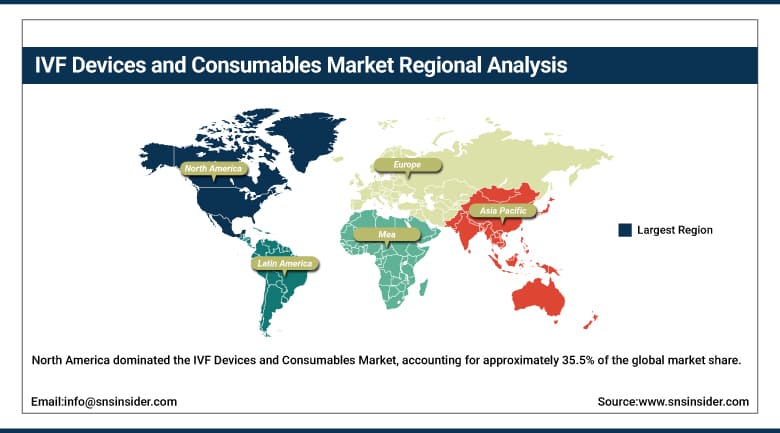
North America dominated the IVF Devices and Consumables Market, accounting for approximately 35.5% of the global market share in 2025.
A dense concentration of leading fertility clinics, growing employer-sponsored fertility benefit coverage, and rising patient awareness of assisted reproductive technology continued reinforcing this dominant regional position. The United States accounted for the substantial majority of regional revenue, anchored by rapid adoption of time-lapse and AI-powered embryo selection platforms and expanding fertility preservation demand, while Canada added further demand through its own growing fertility clinic infrastructure, keeping the continent the largest addressable market for IVF devices and consumables vendors through the forecast period.
Get Customized Report as Per Your Business Requirement - Enquiry Now
Europe IVF Devices and Consumables Market Insights
Europe held a meaningful share of global revenue, supported by rising infertility prevalence, expanding national reimbursement coverage for fertility treatment, and continued growth of specialized fertility clinic networks across the region's major economies. Regulatory harmonization under the EU Medical Device Regulation and continued expansion of academic reproductive medicine research continued lowering historically significant barriers to advanced IVF technology adoption across the continent.
Germany led demand at roughly 21.80% of European revenue, supported by its substantial fertility clinic infrastructure and high per-capita ART procedure volumes among the region's largest economies. The UK and France contributed substantial additional demand through their own expanding fertility treatment programs, and continued European investment in reproductive medicine infrastructure should keep regional demand for IVF devices and consumables climbing through the forecast period.
Asia Pacific IVF Devices and Consumables Market Insights
Asia Pacific is expected to register the fastest regional growth, growing at approximately 20.5% CAGR from 2026 to 2035.
This growth is driven by rising infertility rates, increasing medical tourism, and expanding fertility clinic infrastructure across the region's largest economies. China led the pack, supported by substantial government investment addressing declining birth rates and expanding domestic fertility clinic networks. India and Japan contributed meaningful additional demand, with India's rapidly growing fertility clinic base and medical tourism appeal, and Japan's advanced reproductive medicine infrastructure, both reinforcing the region's position as the fastest-growing market tracked in this report.
MEA and Latin America IVF Devices and Consumables Market Insights
The Middle East and Africa and Latin America both showed steady growth, driven by expanding fertility clinic infrastructure, rising government investment in reproductive health, and growing patient awareness of assisted reproductive technology across both areas. As these markets continued building out modern fertility treatment infrastructure, IVF devices and consumables proved a genuinely efficient way to expand advanced reproductive care capability without the decades-long buildout wealthier nations required.
The UAE led Middle East and Africa demand, supported by the country's position as a leading fertility tourism destination and expanding private fertility clinic network. Saudi Arabia contributed further demand through its own growing reproductive healthcare investment. In Latin America, Brazil accounted for the largest share of regional revenue, with growing fertility clinic adoption and rising ART procedure volumes continuing to anchor regional demand for IVF devices and consumables.
Market Dynamics
Growth Drivers: Rising Global Infertility Rates and Growing Fertility Preservation Demand
The industry is driven by rising global infertility rates attributed to delayed childbearing, lifestyle changes, and conditions such as polycystic ovary syndrome, growing societal acceptance of assisted reproductive technology, expanding employer-sponsored fertility benefit coverage, and increasing elective fertility preservation demand among younger patients. As diagnostic awareness of infertility causes continues improving, the need for advanced IVF laboratory technology continues driving adoption of IVF devices and consumables.
Rising clinical evidence supporting time-lapse imaging and AI-powered embryo selection over conventional assessment methods continues reinforcing this driver, as more fertility clinics adopt advanced technology to differentiate on reported success rates. Growing employer and insurer coverage for fertility treatment continues expanding the addressable patient population beyond those able to pay entirely out of pocket, and that combination of clinical validation and improved access is exactly what keeps demand climbing at such a steady, sustained pace.
Restraints: High Treatment Costs and Regulatory Complexity
The substantial cost of IVF procedures and associated devices and consumables continues posing a genuine restraint on faster market-wide expansion, particularly across emerging healthcare systems and patient populations without insurance coverage for fertility treatment. That cost profile has kept large-scale IVF treatment access concentrated among a comparatively small number of well-resourced fertility clinics and financially prepared patients.
Stringent regulatory frameworks governing assisted reproductive technology across different jurisdictions continue posing a further restraint, as varying embryo research, donor gamete, and cross-border reproductive care regulations complicate market entry and clinical protocol standardization for device and consumable manufacturers. That regulatory complexity keeps some smaller markets reliant on limited treatment options rather than adopting the full range of advanced IVF technology available elsewhere.
Opportunities: AI-Integrated Embryo Selection and Emerging Market Fertility Clinic Expansion
Rising investment in AI-integrated embryo selection systems represents a genuinely significant opportunity, as fertility clinics increasingly seek data-driven tools that improve implantation rate prediction and reduce embryologist subjectivity in embryo grading decisions. Vendors positioned early in AI-powered imaging and analysis technology stand to capture meaningful share as this capability continues expanding from leading academic fertility centers into mainstream clinical practice.
Closing fertility care infrastructure gaps across emerging markets offers a second substantial opportunity, as rising infertility awareness and government initiatives addressing declining birth rates continue creating fresh demand for accessible IVF treatment infrastructure. Vendors with proven, cost-effective device and consumable platforms stand to capture meaningful share as developing economies increasingly view expanded fertility clinic capacity as a genuinely practical way to address both individual family-building needs and broader demographic concerns.
Recent Developments:
-
2024: Vitrolife AB continued expanding its EmbryoScope time-lapse incubation platform with AI-powered embryo selection software, designed to improve implantation rate prediction across fertility clinics worldwide.
-
2024: CooperSurgical, Inc. (The Cooper Companies) continued expanding its ORIGIO culture media and embryo transfer catheter portfolio, reinforcing its position as a leading supplier of IVF laboratory consumables.
-
2025: Esco Medical continued expanding clinical adoption of its Miri Time-Lapse Incubator, integrating AI-based embryo grading software to support fertility clinic embryology workflows.
-
2025: INVO Bioscience, Inc. continued expanding commercial availability of its INVOcell intravaginal culture device, offering a lower-cost, more natural alternative to conventional laboratory-based IVF incubation.
-
2024: Genea Biomedx continued advancing its Geri time-lapse incubator platform with expanded AI-powered embryo viability assessment capabilities for fertility clinics globally.
IVF Devices and Consumables Market key players are:
-
CooperSurgical, Inc. (The Cooper Companies)
-
Thermo Fisher Scientific Inc.
-
FUJIFILM Irvine Scientific (FUJIFILM Holdings Corporation)
-
Hamilton Thorne Ltd.
-
Esco Medical
-
Genea Biomedx
-
INVO Bioscience, Inc.
-
Cook Medical LLC
-
Rocket Medical Plc
-
Nidacon International AB
-
Memmert GmbH + Co. KG
-
KITAZATO Corporation
-
IVFtech ApS
-
BIOPSYBELL Srl
-
Cryo Bio System
-
Shenzhen VitaVitro Biotech Co., Ltd.
-
Progyny, Inc.
-
Ferring Pharmaceuticals A/S
IVF Devices and Consumables Market Report Scope:
| Report Attributes | Details |
|---|---|
| Market Size in 2025 | USD 3.33 Billion |
| Market Size by 2035 | USD 15.72 Billion |
| CAGR | CAGR of 16.8% From 2026 to 2035 |
| Base Year | 2025 |
| Forecast Period | 2026-2035 |
| Historical Data | 2022-2024 |
| Report Scope & Coverage | Market Size, Segments Analysis, Competitive Landscape, Regional Analysis, DROC & SWOT Analysis, Forecast Outlook |
| Key Segments | • By Product Type (IVF Devices, IVF Consumables) • By Application (Assisted Reproductive Technology (ART), Diagnostic Services, Research & Academic Institutes, Others) • By Technology (Conventional IVF, Time-Lapse Imaging Technology, AI-Integrated Embryo Selection Systems, Others) • By End-User (Fertility Clinics, Hospitals, Cryobanks & Fertility Preservation Centers, Others) |
| Regional Analysis/Coverage | North America (US, Canada), Europe (Germany, UK, France, Italy, Spain, Russia, Poland, Rest of Europe), Asia Pacific (China, India, Japan, South Korea, Australia, ASEAN Countries, Rest of Asia Pacific), Middle East & Africa (UAE, Saudi Arabia, Qatar, South Africa, Rest of Middle East & Africa), Latin America (Brazil, Argentina, Mexico, Colombia, Rest of Latin America). |
| Company Profiles | CooperSurgical, Inc. (The Cooper Companies), Vitrolife AB, Merck KGaA, Thermo Fisher Scientific Inc., FUJIFILM Irvine Scientific (FUJIFILM Holdings Corporation), Hamilton Thorne Ltd., Esco Medical, Genea Biomedx, INVO Bioscience, Inc., Cook Medical LLC, Rocket Medical Plc, Nidacon International AB, Memmert GmbH + Co. KG, KITAZATO Corporation, IVFtech ApS, BIOPSYBELL Srl, Cryo Bio System, Shenzhen VitaVitro Biotech Co., Ltd., Progyny, Inc., Ferring Pharmaceuticals A/S. |

Frequently Asked Questions
Key players in the IVF Devices and Consumables Market include CooperSurgical, Inc. (The Cooper Companies), Vitrolife AB, Merck KGaA, Thermo Fisher Scientific Inc., FUJIFILM Irvine Scientific, Hamilton Thorne Ltd., Esco Medical, Genea Biomedx, and INVO Bioscience, Inc., among others.
Key opportunities in the IVF Devices and Consumables Market include increasing adoption of AI-integrated embryo selection systems, expansion of fertility preservation services, and growing fertility clinic infrastructure in emerging markets.
The market is driven by rising global infertility rates, delayed childbearing, growing acceptance of assisted reproductive technology, increasing fertility preservation demand, and expanding adoption of time-lapse imaging and AI-powered embryo selection technologies.
The IVF Consumables segment dominated the IVF Devices and Consumables Market, accounting for approximately 60% market share.
The North America region dominated the IVF Devices and Consumables Market in 2025 with a 35.5% share, driven by a high concentration of fertility clinics, advanced IVF technology adoption, growing fertility preservation demand, and expanding employer-sponsored fertility benefits.
