
Leadless Pacemakers Market Report Scope and Overview:
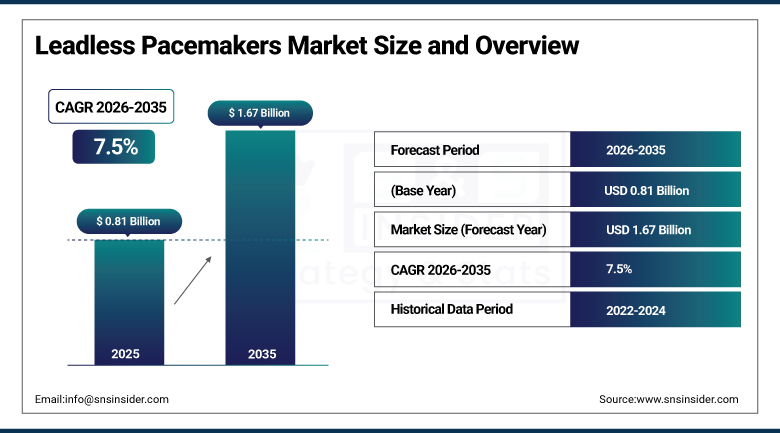
The Leadless Pacemakers Market was valued at USD 0.81 Billion in 2025 and is projected to reach USD 1.67 Billion by 2035, registering a CAGR of 7.5% from 2026 to 2035.
The Leadless Pacemakers Market is revolutionizing bradycardia and conduction disorder care via the removal of transvenous leads and subcutaneous pockets, significantly decreasing the incidence of lead fractures, infections, and complications arising from subcutaneous pockets. Market expansion continues to be fueled by the move towards dual-chamber leadless technologies capable of restoring atrioventricular synchrony, increasing application among geriatric and comorbid populations, and broader clinical indications for bradycardia, AV block, and cardiac resynchronization therapy. Increasing utilization of catheter-based, battery-powered implantable devices, energy-harvesting autonomous pacing systems, and cutting-edge imaging-guided leadless pacemaker implantations continues in hospitals, cardiac centers, and electrophysiology laboratories due to continued heavy investment in minimally invasive pacing systems, expected to reduce complication rates relative to traditional transvenous leads.
In 2025, EBR Systems, Inc. received FDA approval for its WiSE CRT System, the first leadless technology for cardiac resynchronization therapy, delivering pacing pulses directly to the left ventricle without traditional pacing leads and expanding treatment options for heart failure patients unable to receive conventional CRT devices.
To Get more information On Leadless Pacemakers Market - Request Free Sample Report
Leadless Pacemakers Market Trends
-
Rapid migration from single-chamber to dual-chamber leadless systems continues enabling natural atrioventricular synchrony.
-
Growing clinical adoption among elderly and comorbid patients continues expanding the eligible leadless pacing patient pool.
-
Rising interest in energy-harvesting, battery-free pacing technology continues reducing long-term device replacement needs.
-
Expanding cardiac resynchronization therapy indications continue extending leadless technology beyond core bradycardia applications.
-
Increasing imaging-guided implantation technique adoption continues improving procedural precision and reducing complication rates.
U.S. Leadless Pacemakers Market Outlook
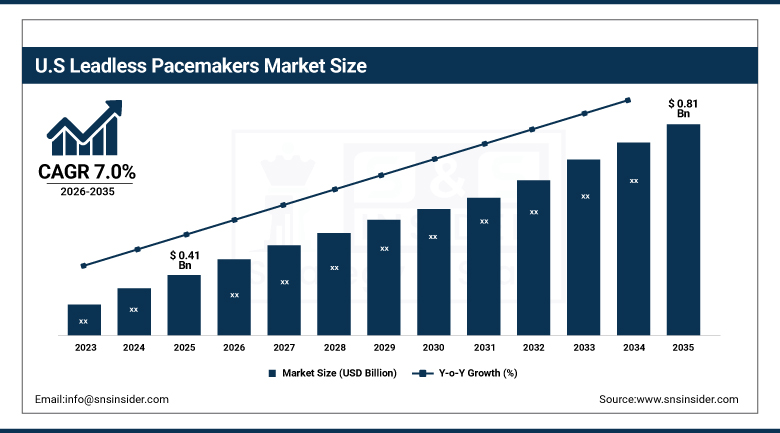
The U.S. Leadless Pacemakers Market was valued at approximately USD 0.41 Billion in 2025 and is projected to reach approximately USD 0.81 Billion by 2035, registering a CAGR of approximately 7.0% from 2026 to 2035.
Demand across the United States continued to be shaped by the country's position as the first commercial market for both single-chamber and dual-chamber leadless pacing systems, favorable FDA regulatory pathways, and a dense concentration of high-volume electrophysiology labs performing cardiac implantation procedures. Rising deployment of dual-chamber leadless systems by leading academic and community cardiology programs continued reinforcing the country's position as both the largest and most technologically advanced leadless pacing market. Growing adoption across cardiac centers and ambulatory surgical centers added further layers of sustained domestic demand well beyond the technology's traditional single-chamber bradycardia use case, with expanding AV block and cardiac resynchronization indications increasingly relying on catheter-delivered leadless pacing technology.
In 2026, Abbott Laboratories continued clinical evaluation of its Aveir AR atrial-only leadless pacemaker, expanding its leadless portfolio beyond the Aveir DR dual-chamber system to address sinus node dysfunction independent of ventricular pacing needs for American electrophysiology programs.
Leadless Pacemakers Market Segment Analysis
-
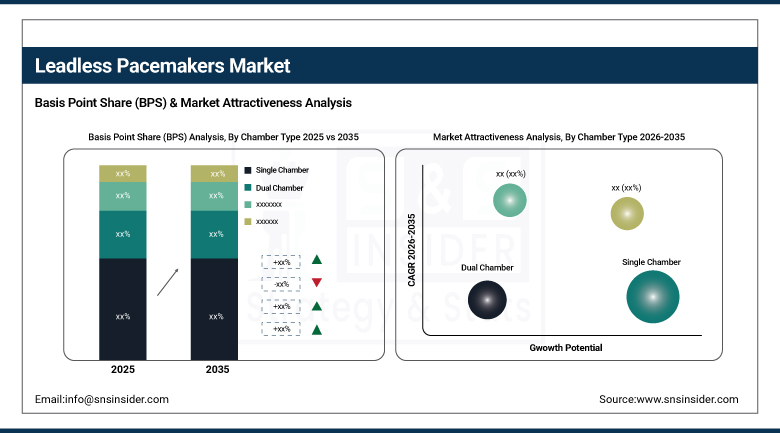
By Chamber Type, Single Chamber segment dominated the Leadless Pacemakers Market in 2025 with 62% share; Dual Chamber segment is the fastest growing segment, registering a CAGR of 8.4% from 2026 to 2035.
-
By Application, Bradycardia Management segment dominated the market in 2025 with 60% share; Atrioventricular (AV) Block segment is the fastest growing segment, registering a CAGR of 8.2% from 2026 to 2035.
-
By End-User, Hospitals segment dominated the market in 2025 with 88% share; Ambulatory Surgical Centers segment is the fastest growing segment, registering a CAGR of 8.0% from 2026 to 2035.
-
By Patient Type, Adult segment dominated the market in 2025 with 96% share; Pediatric segment is the fastest growing segment, registering a CAGR of 9.1% from 2026 to 2035.
By Chamber Type: Single Chamber Leads, Dual Chamber Emerges as Fastest-Growing Segment
Single Chamber segment led the Leadless Pacemakers Market in 2025 due to well-defined clinical practices, wider physician recognition in electrophysiology labs where sinus node dysfunction and permanent atrial fibrillation with slow ventricular rates are treated. High coverage of reimbursements and ample evidence for use of single-chamber pacemakers in real-world clinical settings retained their leading position as the go-to option for simple cases of bradycardia. Constant advancements in technology associated with single-chamber pacemakers in terms of battery life and implantation contributed to that segment's market dominance.
The Dual Chamber segment is the fastest growing in the Leadless Pacemakers Market owing to rising adoption of systems capable of restoring natural atrioventricular synchrony, addressing a substantially larger patient population with AV block than single-chamber devices alone could serve. Growing clinical evidence supporting dual-chamber leadless systems as comparable to transvenous dual-chamber pacemakers in synchrony performance continues expanding adoption among electrophysiologists previously limited to single-chamber leadless options. Rising competitive investment from both Medtronic and Abbott in dual-chamber platform refinement is accelerating clinician transition toward AV-synchronous leadless pacing across leading cardiac centers worldwide.
By Application: Bradycardia Management Dominates, AV Block Gains Fastest Momentum
The Bradycardia Management segment dominated the Leadless Pacemakers Market because leadless pacing was originally developed and remains most extensively validated for treating symptomatic bradycardia and sinus node dysfunction in patients requiring single-chamber ventricular pacing. Rising global prevalence of bradyarrhythmias among an aging population, combined with growing physician confidence in leadless implantation techniques, has sustained high procedure volumes across established and emerging electrophysiology programs. Increased use of leadless systems to avoid the infection and lead-fracture risks associated with transvenous pacemakers contributed to sustained segment dominance throughout the base year.
The Atrioventricular (AV) Block segment is the fastest growing as dual-chamber leadless systems increasingly address a patient population that previously required conventional transvenous dual-chamber pacemakers to maintain atrioventricular synchrony. Rising clinical evidence supporting dual-chamber leadless devices for AV block treatment continues expanding procedure volumes across electrophysiology programs seeking to avoid lead-related complications in this traditionally more complex pacing indication. Growing physician confidence in dual-chamber leadless implantation technique is driving faster adoption across high-volume cardiac centers treating complex conduction disorders worldwide.
By End-User: Hospitals Dominate, Ambulatory Surgical Centers Grow Fastest
Hospitals segment led the market owing to their well-developed electrophysiology and cardiac catheterization laboratories along with the capability of undertaking implantation procedures with fluoroscopy assistance and surgical back-up. Academic hospitals and large tertiary hospitals have been performing maximum number of procedures in one-chamber and two-chamber leadless pacing programs ensuring steady demand for devices. The continuous investment in dedicated hybrid electrophysiology laboratories with imaging facility for leadless implantation guidance further ensured the dominance of hospitals-based segment during the base year.
The Ambulatory Surgical Centers segment is expected to witness the fastest growth in the Leadless Pacemakers Market as more routine single-chamber leadless implantation procedures migrate toward lower-cost, outpatient settings supported by favorable reimbursement changes. Growing numbers of electrophysiologists performing same-day discharge leadless implantation procedures increasingly rely on ambulatory surgical centers equipped with fluoroscopic imaging to deliver hospital-comparable procedural safety in a more cost-efficient setting. Expanding ambulatory surgical center accreditation for cardiac implantation procedures continues attracting a broadening base of cost-conscious health systems.
Regional Analysis
|
Region |
Major Country |
Share within Region, 2025 (%) |
|---|---|---|
|
North America |
United States |
92.00% |
|
Europe |
Germany |
21.80% |
|
Asia Pacific |
China |
27.20% |
|
Middle East and Africa |
Saudi Arabia |
23.60% |
|
Latin America |
Brazil |
33.40% |
North America Leadless Pacemakers Market Insights
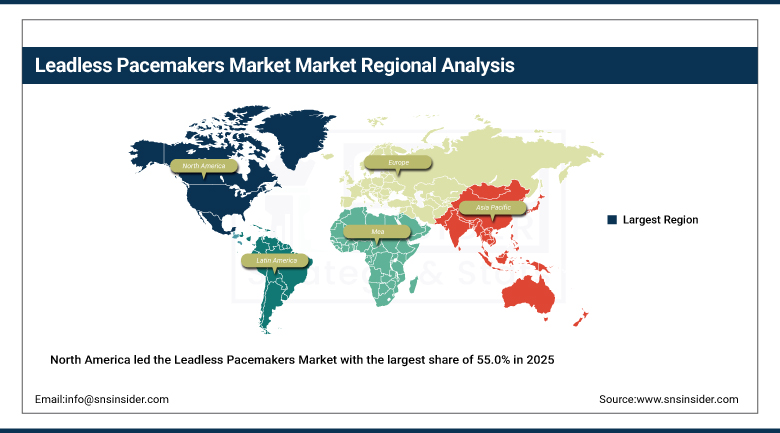
North America led the Leadless Pacemakers Market with the largest share of 55.0% in 2025. The region's position as the first commercial market for both single-chamber and dual-chamber leadless pacing systems, favorable FDA regulatory pathways, and a dense concentration of high-volume electrophysiology labs continued reinforcing this dominant regional position. A deep concentration of leading device manufacturers, academic medical centers, and cardiac implantation programs headquartered across the continent gave regional clinicians early access to next-generation dual-chamber and energy-harvesting leadless pacing platforms well ahead of most other regions.
The United States accounted for highest share of regional revenue, anchored by a dense cluster of high-volume electrophysiology and cardiology programs, rapid dual-chamber system adoption, and expanding same-day discharge protocols across ambulatory surgical centers. Canada added further regional demand through its own growing cardiac implantation volumes and expanding public health system investment in advanced pacing technology, and that combined strength kept the continent the largest addressable market for leadless pacemaker vendors through the forecast period.
Get Customized Report as per Your Business Requirement - Enquiry Now
Europe Leadless Pacemakers Market Insights
Europe held a meaningful share of global revenue, supported by rising prevalence of bradyarrhythmias and conduction disorders, expanding national reimbursement coverage for leadless pacing procedures, and continued growth of electrophysiology programs across the region's major economies. Regulatory harmonization under the EU Medical Device Regulation and continued expansion of high-volume implantation training centers continued lowering historically significant barriers to advanced leadless pacing technology adoption across the continent.
Germany led demand of European revenue, supported by its substantial hospital infrastructure and high per-capita cardiac implantation procedure volumes among the region's largest economies. The UK and France contributed substantial additional demand through their own expanding electrophysiology and cardiac rhythm management programs, and continued European investment in cardiac device infrastructure should keep regional demand for leadless pacemaker technology climbing through the forecast period.
Asia Pacific Leadless Pacemakers Market Insights
Asia Pacific is advancing at the fastest pace among all regions tracked in this report, growing at a CAGR of approximately 10.5% from 2026 to 2035, driven by rising cardiovascular disease burden, expanding electrophysiology training infrastructure, and growing government-backed investment in advanced cardiac care across the region's largest economies. That combination of rising procedure volumes and expanding domestic device manufacturing capacity kept the region's growth trajectory well ahead of every other region tracked in this report.
China led the pack, supported by rapid expansion of cardiac implantation infrastructure and growing domestic leadless pacemaker manufacturing capability from companies such as Lepu Medical Technology. Japan and India contributed meaningful additional demand, with India's fast-growing electrophysiology training base and domestic manufacturers such as Shree Pacetronix, and Japan's advanced cardiac implantation programs, both reinforcing the region's position as the fastest-growing market tracked in this report.
MEA and Latin America Leadless Pacemakers Market Insights
The Middle East and Africa and Latin America both showed steady growth, driven by expanding cardiac catheterization laboratory infrastructure, rising government investment in tertiary cardiac care, and growing clinician training in leadless pacemaker implantation across both areas. As these markets continued building out modern electrophysiology infrastructure, leadless pacing proved a genuinely efficient way to expand advanced procedural capability without the decades-long buildout wealthier nations required.
Saudi Arabia led Middle East and Africa demand, supported by the country's substantial cardiac care investment under its national healthcare transformation programs. The UAE contributed further demand through its own expanding private hospital network and electrophysiology capability. In Latin America, Brazil accounted for the largest share of regional revenue, with growing cardiac implantation adoption and academic electrophysiology training continuing to anchor regional demand for leadless pacemaker technology.
Market Dynamics
Growth Drivers: Rising Cardiovascular Disease Burden and Growing Dual-Chamber System Adoption
The industry is driven by rising global prevalence of bradyarrhythmias and conduction disorders among aging populations, growing clinical adoption of dual-chamber leadless systems capable of restoring atrioventricular synchrony, increasing preference for minimally invasive procedures that avoid transvenous lead-related complications, and expanding indications spanning bradycardia, AV block, and cardiac resynchronization therapy. As electrophysiologist confidence in leadless implantation technique continues rising, the need for reliable, complication-reducing pacing technology continues driving adoption of leadless pacemaker systems.
Rising clinical evidence supporting leadless pacing over conventional transvenous systems continues reinforcing this driver, as more electrophysiology programs adopt leadless-first protocols that reduce infection, lead-fracture, and pocket-related complication risk. Growing competitive investment from both established leaders and emerging challengers continues expanding device availability and clinical indications, and that combination of clinical validation and intensifying competition is exactly what keeps demand climbing at such a steady, sustained pace.
Restraints: High Device Costs and Limited Retrievability Concerns
The substantial per-device cost of leadless pacemakers continues posing a genuine restraint on faster market-wide expansion, particularly across emerging healthcare systems and smaller community hospitals without the procedure volumes needed to justify premium implantable device adoption. That cost profile has kept large-scale leadless pacing procedural capability concentrated among a comparatively small number of well-resourced academic and tertiary care centers.
Ongoing clinical concerns regarding long-term device retrievability and end-of-life management continue posing a further restraint, as physicians in some healthcare systems remain cautious about implanting leadless devices in younger patients who may require multiple device replacements over their lifetime. That caution keeps some smaller healthcare systems reliant on conventional transvenous pacing systems rather than adopting catheter-based leadless technology of their own.
Opportunities: Dual-Chamber Expansion and Emerging Market Cardiac Care Infrastructure
Rising investment in dual-chamber and energy-harvesting leadless platforms represents a genuinely significant opportunity, as electrophysiology programs increasingly seek AV-synchronous pacing capable of addressing a broader patient population without transvenous lead complications. Vendors positioned early in dual-chamber and autonomous pacing technology stand to capture meaningful share as this capability continues expanding from specialized academic centers into mainstream community cardiology practice.
Closing cardiac care infrastructure gaps across emerging markets offers a second substantial opportunity, as government initiatives aimed at expanding tertiary cardiac care capacity continue creating fresh demand for accessible, cost-effective leadless pacing infrastructure. Vendors with proven, affordable device and implantation platforms stand to capture meaningful share as developing economies increasingly view in-house electrophysiology capability as a genuinely practical way to reduce dependency on overseas cardiac care referrals.
Recent Developments:
-
2026: Cardiac Rhythm Management division of MicroPort sustained efforts on development of cardiac devices, which helped in gaining a foothold in new markets.
-
2026: Medtronic plc expanded commercial availability of its Micra AV2 leadless pacemaker across additional international markets, extending AV synchronous pacing capability to patients with atrioventricular block.
-
2026: BIOTRONIK initiated its global pivotal BIO-LivIQ Clinical study evaluating the next-generation LivIQ leadless pacemaker system.
Leadless Pacemakers Market key players are:
-
Medtronic plc
-
Abbott Laboratories
-
Biotronik SE & Co. KG
-
Boston Scientific Corporation
-
EBR Systems, Inc.
-
MicroPort CRM S.p.A.
-
Shree Pacetronix Ltd.
-
Cairdac SAS
-
Lepu Medical Technology (Beijing) Co., Ltd.
-
Osypka Medical GmbH
-
AtriCure, Inc.
-
Neovasc Inc.
-
Cook Medical LLC
-
Terumo Corporation
-
B. Braun Melsungen AG
-
ZOLL Medical Corporation
-
Nihon Kohden Corporation
-
GE HealthCare Technologies Inc.
-
Siemens Healthineers AG
-
Canon Medical Systems Corporation
Leadless Pacemakers Market Report Scope:
| Report Attributes | Details |
|---|---|
| Market Size in 2025 | USD 0.81 Billion |
| Market Size by 2035 | USD 1.67 Billion |
| CAGR | CAGR of 7.5% From 2026 to 2035 |
| Base Year | 2025 |
| Forecast Period | 2026-2035 |
| Historical Data | 2022-2024 |
| Report Scope & Coverage | Market Size, Segments Analysis, Competitive Landscape, Regional Analysis, DROC & SWOT Analysis, Forecast Outlook |
| Key Segments | • By Chamber Type (Single Chamber, Dual Chamber) • By Application (Bradycardia Management, Atrioventricular (AV) Block, Others) • By End-User (Hospitals, Cardiac Centers, Ambulatory Surgical Centers) • By Patient Type (Adult, Pediatric) |
| Regional Analysis/Coverage | North America (US, Canada), Europe (Germany, UK, France, Italy, Spain, Russia, Poland, Rest of Europe), Asia Pacific (China, India, Japan, South Korea, Australia, ASEAN Countries, Rest of Asia Pacific), Middle East & Africa (UAE, Saudi Arabia, Qatar, South Africa, Rest of Middle East & Africa), Latin America (Brazil, Argentina, Mexico, Colombia, Rest of Latin America). |
| Company Profiles | Medtronic plc, Abbott Laboratories, Biotronik SE & Co. KG, Boston Scientific Corporation, EBR Systems, Inc., MicroPort CRM S.p.A., Shree Pacetronix Ltd., Cairdac SAS, Lepu Medical Technology (Beijing) Co., Ltd., Osypka Medical GmbH, AtriCure, Inc., Neovasc Inc., Cook Medical LLC, Terumo Corporation, B. Braun Melsungen AG, ZOLL Medical Corporation, Nihon Kohden Corporation, GE HealthCare Technologies Inc., Siemens Healthineers AG, Canon Medical Systems Corporation. |

Frequently Asked Questions
Key Players include Medtronic plc, Abbott Laboratories, Biotronik SE & Co. KG, Boston Scientific Corporation, and EBR Systems, Inc., among others.
Key opportunities include rising adoption of minimally invasive cardiac pacing, expanding patient eligibility, technological advancements, longer battery life, and increasing preference for leadless pacing systems.
The major growth factor is rising prevalence of bradyarrhythmias and conduction disorders, growing adoption of dual-chamber systems capable of restoring atrioventricular synchrony, and increasing preference for minimally invasive pacing procedures.
The Single Chamber segment dominated the Leadless Pacemakers Market by chamber type, representing the largest share of revenue in 2025.
North America dominated the Leadless Pacemakers Market in 2025, holding an estimated 55.0% share of total global market revenue.
