
Lighting Market Report Scope & Overview:
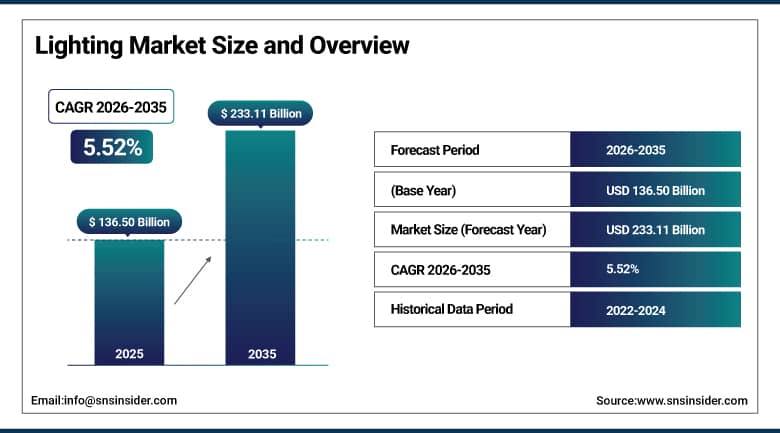
The Lighting Market was valued at USD 136.50 billion in 2025 and is expected to reach USD 233.11 billion by 2035, growing at a CAGR of 5.52% from 2026–2035.
The lighting market is witnessing substantial growth in the global market due to increasing demand for energy-efficient lighting solutions across residential and commercial sectors. Rising adoption of LED lighting systems is accelerating market expansion worldwide. Growing urbanization and infrastructure development are further supporting lighting installations across smart cities and industrial facilities. Expansion of smart lighting and IoT-enabled systems is significantly enhancing energy management capabilities. Government regulations promoting energy conservation and sustainability initiatives are strengthening global lighting demand.
According to the U.S. Department of Energy, LED adoption has already delivered about 1.3 quadrillion Btu energy savings in buildings, reducing electricity use significantly. India’s UJALA program has distributed 37+ crore LED bulbs, saving nearly 48 billion kWh annually. Companies like Signify report rising demand for connected lighting, reflecting strong growth in smart, efficient lighting ecosystems globally.
To Get More Information On Lighting Market - Request Free Sample Report
Lighting market Trends
-
Fast growth in the adoption of LED lighting helps reduce global electricity consumption by around 40 percent.
-
The adoption of smart lighting systems that integrate IoT enables occupancy-based lighting, helping save 35 percent energy consumption in commercial buildings.
-
The adoption of mandatory green building codes increases retrofits, covering almost 60 percent of urban infrastructure projects.
-
The adoption of human-centric lighting solutions boosts productivity gains by 18 percent in hospitals and offices across the globe.
-
The miniaturization of LEDs and innovations in micro-LED technology improve luminance efficiency by 50 percent along with cutting material requirements in displays.
-
The public infrastructure initiatives spend over 12 billion dollars on smart street lighting and adaptive control systems deployment.
U.S. Lighting Market Size Outlook.
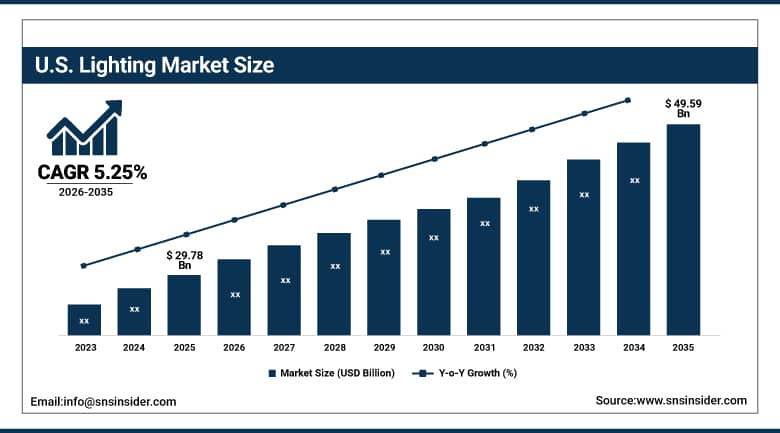
The U.S. Lighting Market was valued at USD 29.78 Billion in 2025 and is expected to reach around USD 49.59 Billion by 2035, growing at a CAGR of 5.25% from 2026–2035.
The U.S. lighting market is experiencing consistent growth owing to the growing demand for energy-efficient lighting systems in all types of infrastructural developments, including residential, commercial, and industrial segments. The swift uptake of LED and smart lighting systems is fueling the growth of this market. Growing government concerns about the energy conservation measures, especially those related to building efficiency, are promoting demand for retrofits and replacements. The increasing application of IoT-enabled lighting solutions and the concept of smart cities will help enhance the adoption of these systems in the future.
According to EIA, lights contribute 6% to the total consumption of electricity in residences (81 billion kWh), whereas in commercial buildings, lights account for 17% (208 billion kWh).
According to DOE’s estimate, the percentage of LED usage in lighting systems has reached around 48% in 2020, which implies savings in energy. The growth is expected due to increasing electrification and record levels of energy usage in the US that exceed 4,200 billion kWh in 2025.
Lighting market Segment Analysis
-
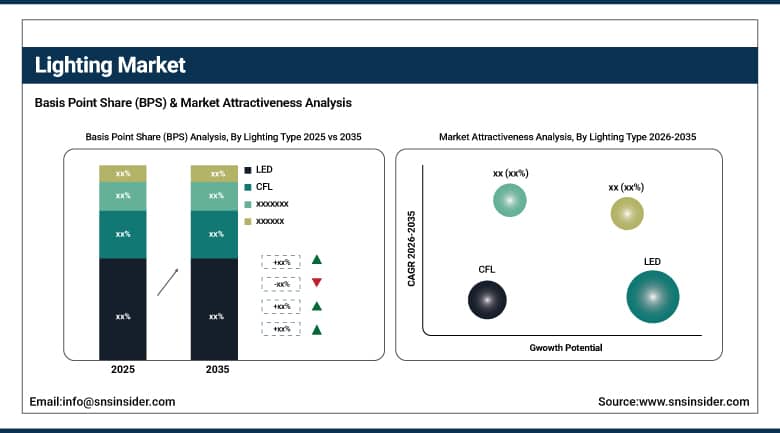
By Lighting Type, LED dominated the lighting market with 72.45% share in 2025 and it is also fastest growing segment with CAGR of 7.84% during 2026 to 2035.
-
By Application, general lighting dominated the lighting market with 54.30% share in 2025; while automotive lighting is the fastest growing segment with CAGR of 10.29% during 2026 to 2035.
-
By End User, commercial dominated the lighting market with 44.85% share in 2025; while industrial is the fastest growing segment with CAGR of 8.33% during 2026 to 2035.
-
By Installation Type, new installations dominated the lighting market with 61.40% share in 2025; while retrofit and replacement are the fastest growing segment with CAGR of 8.35% during 2026 to 2035.
By Lighting Type, LED segment dominates the lighting market and is also the fastest growing segment.
In 2025, the LED segment emerged to be the leading player in the Lighting industry in terms of revenue share owing to energy efficiency, long life, and low maintenance compared to other light bulbs. Adoption of this technology to replace conventional light bulbs for many industries is among the factors that have facilitated the popularity of LEDs. Besides, favorable government policies supporting energy-efficient lighting equipment as well as decline in prices have supported widespread adoption.
LEDs will also experience fastest CAGR from 2026 to 2035 as a result of rising applications of smart lighting technologies and the Internet of Things (IoT). Increasing need for smart lighting in smart cities, automobiles, and automation industries is fueling demand. New developments in mini-LED and micro-LED technologies are improving their efficiency.
By Application, general lighting dominated the lighting market, while automotive lighting is the fastest growing segment.
The General Lighting segment is likely to remain the leading segment with the dominated revenue share in the lighting market in 2025. The reason behind its leading position is the high usage of lights in different infrastructures such as residential, commercial, and industrial facilities. The consistent demand for interior and exterior lights for buildings, streets, and public places ensures high market penetration rate. Urbanization, rapid development of infrastructure, and increased use of energy-efficient LEDs also contribute to the success of this segment.
It is forecasted that the Automotive Lighting segment will witness a faster growth rate in terms of CAGR from 2026–2035. The main reason behind the accelerated growth rate is the increasing production of electric cars and modern lighting systems in cars. The consistent rise in the demand for headlights and advanced lights like energy-efficient LEDs used in vehicles ensures future growth in the Automotive lighting market. Safety regulations in vehicles and enhanced driving experience are also contributing factors.
By End User, commercial dominated the lighting market, while industrial is the fastest growing segment.
Commercial segment held the dominated revenue share of the lighting market in 2025. The demand for lighting solutions for various commercial places such as offices, retail centers, hospitality, and infrastructural development is very high. Urbanization and modernization of commercial spaces are making the implementation of highly efficient LED and smart lighting solutions more common. Long working hours along with high maintenance needs are further reinforcing the replacement needs. An increased emphasis on reducing costs and sustainable practices further helps sustain the dominance in the commercial lighting market.
The industrial segment is likely to record the fastest CAGR during the forecast period owing to growing automation and development of smart factories. Increased installation of energy efficient lighting in manufacturing plants, storage centers, and logistics facilities will boost the demand for such solutions. Development of industry 4.0 technology coupled with the need for meeting safety and environmental regulations is further driving the adoption of advanced lighting solutions. The use of IoT-based smart lighting controls enhances efficiency.
By Installation Type, new installations dominated the lighting market, while retrofit and replacement is the fastest growing segment.
The New Installations segment held the dominated market share in terms of revenue generation for the lighting market in 2025. The growing trend of new constructions in residential, commercial, and industrial infrastructure has led to a higher demand for advanced lighting systems. The development of smart cities and urban infrastructure along with large investments made in real estate are acting as growth factors in favor of modern lighting technology. The growing preference for energy-efficient LED lights in newly constructed buildings is another factor aiding the dominance of the segment.
The Retrofit & Replacement segment will witness the fastest CAGR between 2026 and 2035. The transition of conventional lighting solutions to energy-efficient LED lights is a major driver for this market. The aging infrastructure of lighting in buildings is driving the demand for new replacements on a global level. Sustainability requirements set by governments and the cost saving through energy savings and maintenance have been key factors for the retrofit of lighting solutions.
Regional Analysis
|
Region |
Major Country |
Share within Region, 2025(%) |
|---|---|---|
|
North America |
United States |
81.40% |
|
Europe |
Germany |
27.40% |
|
Asia Pacific |
China |
42.30% |
|
Middle East & Africa |
UAE |
16.80% |
|
Latin America |
Brazil |
45.20% |
North America Lighting Market Insights.
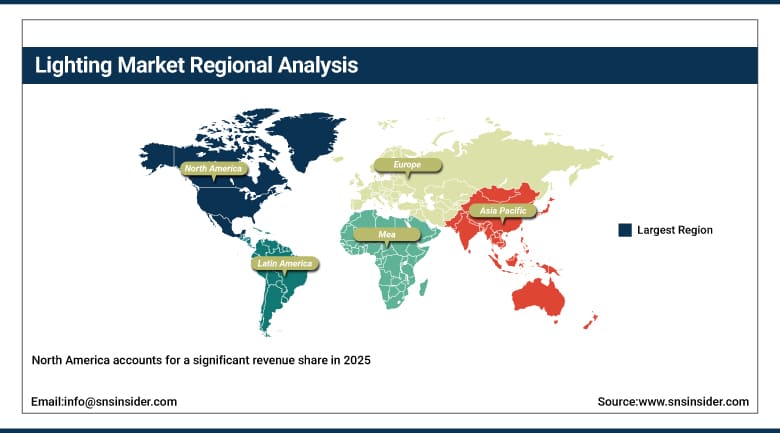
North America accounts for a significant revenue share in 2025 due to strong demand for advanced lighting systems and smart infrastructure development. The region benefits from a mature construction industry along with high adoption of energy efficient LED and intelligent lighting solutions across residential, commercial, and industrial sectors. Increasing penetration of smart city projects and automotive lighting innovations is contributing to steady market expansion in both the U.S. and Canada.
According to the U.S. Department of Energy, LED lighting already accounts for 48% of installed lighting stock in the U.S., significantly reducing electricity demand across residential and commercial sectors. The Environmental Protection Agency reports over 3 billion ENERGY STAR certified bulbs sold, saving more than 1 trillion kWh of electricity.
Get Customized Report as Per Your Business Requirement - Enquiry Now
Europe Lighting Market Insights.
The Europe lighting market leaves a significant impact in the year 2025 because of stringent sustainability regulations and energy efficiency laws prevailing in many countries such as Germany, France, UK, and Italy. The growing concern about carbon neutrality, advanced lighting systems, and sustainable buildings is fostering steady growth in the market. Increased spending on smart city initiatives and energy-efficient retrofitting projects is driving adoption in various applications.
According to the European Commission, the new efficiency standards to be introduced in 2025 will help save an estimated 4 TWh of electricity each year until 2030. The statistics from Eurostat reveal that the share of renewable electricity in the EU increased to 47.3% in 2025.
Asia Pacific Lighting Market Insights.
The Asia Pacific region holds significant potential to record the dominated and fastest CAGR in the global lighting market in 2025. With 43.20% market share and 6.40% CAGR, the growth of this region is mainly attributed to the increase in urbanization and the expansion of manufacturing activities. The main factors contributing to the growth of the region include China, India, Japan, and South Korea. Increased use of consumer electronics, automotive lighting, and intelligent display systems are also driving growth.
According to the U.S. DOE, LED adoption can reduce building electricity use by up to 5% globally. China and India lead demand, driven by UJALA and smart lighting deployments. Japan and South Korea accelerate IoT-enabled lighting growth.
Middle East & Africa and Latin America Lighting Market Insights.
Middle East & Africa and Latin America regions are expected to experience consistent growth in their lighting market till 2025 because of infrastructural developments along with the increase in the number of smart cities. Some of the emerging countries in this segment include UAE, Saudi Arabia, South Africa, Brazil, and Mexico among others. Increased development in urban areas and energy-efficient infrastructure is fueling this growth in demand for lights.
According to the IEA, the proportion of energy consumed globally in lighting is estimated at 8% with the LED lights gaining predominance as the efficient lighting solution around the world. The revenue from MEA lighting was estimated at USD 7.92 billion in 2025 owing to factors like investments in smart cities and efficiency regulation. Latin America is now transitioning towards LED retrofits backed by efficient policies.
Market Dynamics
Growth Drivers: Expansion of automotive lighting and smart display technologies boosting advanced lighting system adoption globally
Rising manufacture of electric cars and autonomous vehicles has created a need for advanced automotive lighting systems that can improve both safety and aesthetics. Adaptive lighting, ambient lighting systems for vehicle interiors, and energy-efficient LED technologies are some of the technological fields that the car manufacturers are working on. Development in display technology like OLED and mini-LED displays has also contributed to increased adoption of LEDs in the field of electronics. Increased need for user interface innovation is also driving product innovations.
According to the U.S. Department of Energy, use of LEDs in transportation and general illumination is on the increase, with LEDs accounting for nearly 48% of installations made as of 2020 and expected dominance in the future until 2035. Adoption of adaptive headlamps, ambient interiors, and smart cockpits inside automobiles increases demand for energy-efficient and connected light sources worldwide.
Restraints: Supply chain disruptions and semiconductor dependency impacting lighting component availability and production stability
The lighting industry relies heavily on semiconductors as well as other special raw materials which are required in making LEDs. Delays in receiving the required components due to disruptions in the international supply chain or political instability may be expected. The absence of certain components required in the manufacturing process causes higher costs associated with manufacturing. In other words, reliance on certain suppliers for certain components poses as an element of risk.
Opportunities: Increasing adoption of OLED and mini-LED technologies in consumer electronics and display applications expanding market scope
Growing demand for high resolution displays in smartphones, televisions, and wearable devices is fostering the growth in the application of OLED and mini-LED technologies. Some of the benefits offered by OLED and mini-LED technologies are increased brightness, better energy consumption, and more accurate color rendering compared to conventional display technologies. The construction of advanced display manufacturing facilities by companies to meet consumer needs is driving industry growth. Additionally, growth in sectors such as gaming, entertainment, and digital media will continue to drive demand for display applications.
The Department of Energy has provided OLED displays that have a very high efficiency when it comes to illumination, offering 60 or even 85 lumens per watt in terms of efficacy. Furthermore, OLED display shipment volume in 2025 rose to 19.2% compared to its shipment volume in the previous year, while there was an increasing use of mini-LED in high-end displays.
Recent Developments
-
2026: Eaton expanded smart lighting and electrical infrastructure solutions supporting grid modernization and intelligent building automation systems across industrial and commercial sectors.
-
2025: LG Electronics expanded OLED lighting and smart home lighting systems integrating energy-efficient display and ambient solutions.
-
2025: Acuity Brands strengthened Atrius smart building platform and AI-driven lighting controls through digital integration and software-enabled energy optimization.
-
2024: Zumtobel Group advanced sustainable lighting solutions focusing on energy-efficient LED systems and circular economy design initiatives across Europe.
Lighting Market Key Players are:
-
Signify
-
ams OSRAM
-
Acuity Brands
-
Zumtobel Group
-
Trilux
-
Legrand
-
Schneider Electric
-
Eaton
-
Hubbell Incorporated
-
Panasonic Holdings Corporation
-
Samsung Electronics
-
LG Electronics
-
Nichia Corporation
-
Opple Lighting
-
NVC Lighting Technology Corporation
-
Foshan Electrical and Lighting Co., Ltd.
-
Havells India Limited
-
Bajaj Electricals Limited
-
IDEAL INDUSTRIES
-
LSI Industries
Lighting Market Report Scope:
| Report Attributes | Details |
|---|---|
| Market Size in 2025 | USD 136.50 Billion |
| Market Size by 2035 | USD 233.11 Billion |
| CAGR | CAGR of 5.52% From 2026 to 2035 |
| Base Year | 2025 |
| Forecast Period | 2026-2035 |
| Historical Data | 2022-2024 |
| Report Scope & Coverage | Market Size, Segments Analysis, Competitive Landscape, Regional Analysis, DROC & SWOT Analysis, Forecast Outlook |
| Key Segments | By Lighting Type (LED, CFL, LFL, HID, Halogen, Incandescent) By Application (General Lighting, Automotive Lighting, Backlighting, Others) By End User (Residential, Commercial, Industrial) By Installation Type (New Installations, Retrofit and Replacement) |
| Regional Analysis/Coverage | North America (US, Canada), Europe (Germany, UK, France, Italy, Spain, Russia, Poland, Rest of Europe), Asia Pacific (China, India, Japan, South Korea, Australia, ASEAN Countries, Rest of Asia Pacific), Middle East & Africa (UAE, Saudi Arabia, Qatar, South Africa, Rest of Middle East & Africa), Latin America (Brazil, Argentina, Mexico, Colombia, Rest of Latin America). |
| Company Profiles | Signify, ams OSRAM, Acuity Brands, Zumtobel Group, Trilux, Legrand, Schneider Electric, Eaton, Hubbell Incorporated, Panasonic Holdings Corporation, Samsung Electronics, LG Electronics, Nichia Corporation, Opple Lighting, NVC Lighting Technology Corporation, Foshan Electrical and Lighting Co., Ltd., Havells India Limited, Bajaj Electricals Limited, IDEAL INDUSTRIES, LSI Industries |
Frequently Asked Questions
The lighting market was valued at USD 136.50 billion in 2025.
Rising demand for energy-efficient lighting, smart infrastructure expansion, and widespread LED adoption are driving global market growth.
