
Microprinting Market Report Scope & Overview:
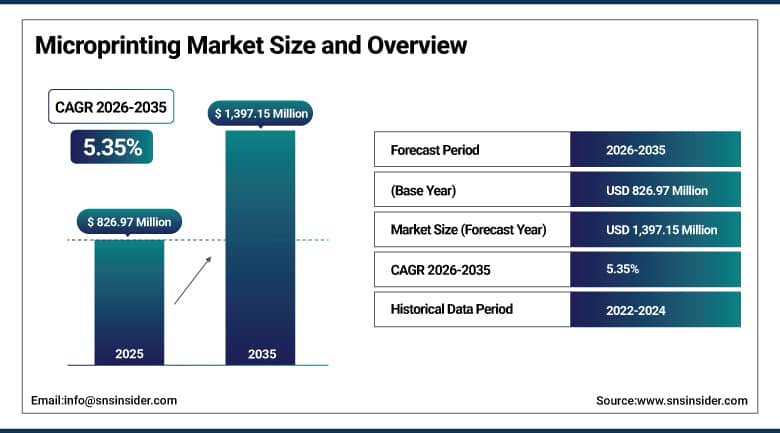
The Microprinting Market was valued at USD 826.97 million in 2025 and is expected to reach USD 1,397.15 million by 2035, growing at a CAGR of 5.35% from 2026–2035.
The microprinting market is witnessing steady growth in the global market owing to rising demand for advanced document security solutions. Increasing counterfeiting incidents across banking, government, and packaging sectors are boosting adoption. Growing investments in secure printing technologies are supporting market expansion. Manufacturers are focusing on high-resolution printing and specialized security inks. Rising demand for authentication features in currency, identity documents, and product labels is driving innovation. Increasing use in pharmaceutical packaging and brand protection applications is further accelerating market adoption.
As per several central bank practices and industry standards, almost all banknotes used worldwide come with many security features such as microprinting, security threads, and intaglio printing to prevent forgery.
According to the European Central Bank and the United States Bureau of Engraving and Printing, all euro and U.S. dollar denominations of banknotes contain microprinted security features that can only be seen under magnification. Furthermore, according to the studies conducted by the Organization for Economic Co-operation and Development and European Union Intellectual Property Office, the amount of counterfeit and pirated goods constitutes about 2.3% of world trade.
To Get More Information On Microprinting Market - Request Free Sample Report
Microprinting Market Trends
-
The combination of microprinting along with QR code technology, RFID tags, and holograms is enhancing multi-level authentication process and enhancing the security of documents and products.
-
Increasing use of secure packaging options is leading to rapid adoption of microprinting technology in pharmaceuticals, food, luxury items, and consumer goods industries.
-
The increasing need to protect brand identity is prompting companies to adopt advanced microprinting solutions to improve product authentication process.
-
Advancements in high-quality print technology are enhancing microprinting accuracy and production efficiencies.
-
Increasing spending on hybrid document security solutions is increasing the adoption of microprinting along with digital authentication technologies around the world.
-
Growing e-commerce business and stringent compliance regulations are increasing the use of microprinting solutions.
The U.S. Microprinting Market Outlook
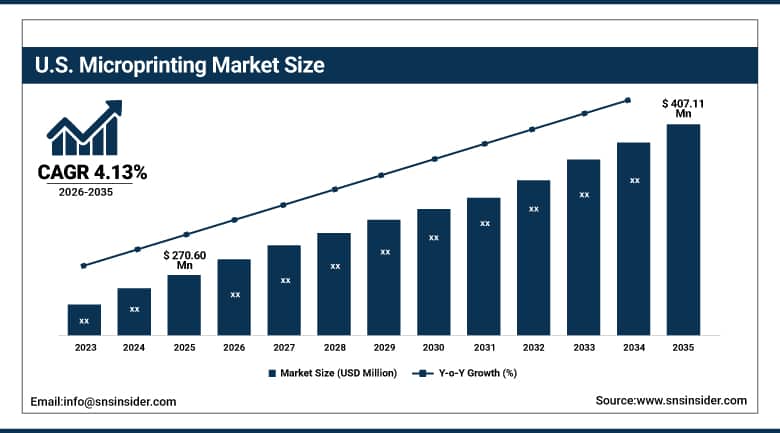
The U.S. Microprinting Market was valued at USD 270.60 million in 2025 and is expected to reach around USD 407.11 million by 2035, growing at a CAGR of 4.13% from 2026–2035.
The U.S. microprinting market is expanding steadily owing to strong demand for advanced document security solutions. Increasing counterfeiting concerns across banking, government, and pharmaceutical sectors are supporting market growth. Rising adoption of secure authentication technologies is driving implementation across organizations. Growth in secure packaging and identity document printing is further accelerating demand. Manufacturers are focusing on high-resolution printing systems and specialized security inks. Increasing use in currency, tax stamps, and brand protection applications is strengthening market penetration.
It is reported by the U.S. Department of the Treasury and the U.S. Secret Service that all Federal Reserve notes used have several security measures, among which microprinting is one of them, to prevent counterfeiting. In accordance with the official figure provided by the Federal Reserve, there are approximately 56.6 billion Federal Reserve notes in circulation as of December 31, 2025. The U.S. Government Publishing Office and the Bureau of Engraving and Printing use microprinting, among other high-resolution security features, on federal passports and identities.
Microprinting Market Segment Analysis
-
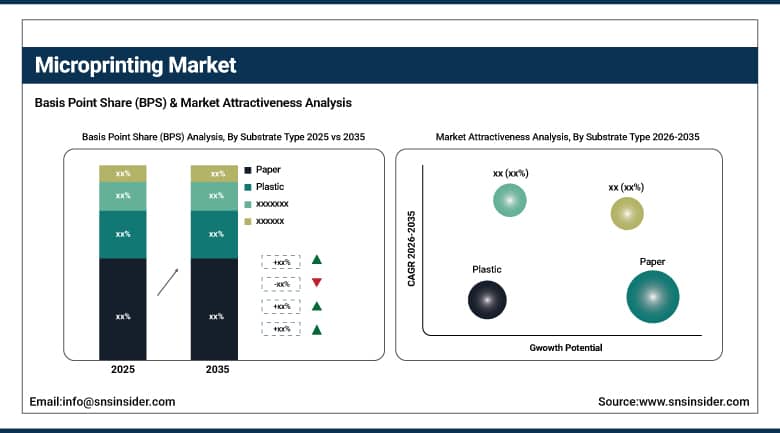
By Substrate Type, paper dominated the market with 52.60% share in 2025; while plastic is the fastest growing segment with CAGR of 7.48% during 2026 to 2035.
-
By Print Type, single-sided dominated the market with 69.45% share in 2025; while double-sided is the fastest growing segment with CAGR of 7.85% during 2026 to 2035.
-
By Type, monochrome dominated the market with 64.80% share in 2025; while color is the fastest growing segment with CAGR of 7.59% during 2026 to 2035.
-
By Application, banking & finance dominated the market with 39.20% share in 2025; while packaging is the fastest growing segment with CAGR of 8.91% during 2026 to 2035.
By Substrate Type, paper dominated the microprinting market, while plastic is the fastest growing segment.
The paper segment is projected to capture the dominated revenue share of the microprinting market in 2025. The high revenue share can be attributed to the wide usage of paper substrates in banknotes, passports, certificates, legal documents, and security labels across the globe. Print clarity, ink adhesion properties, and high-resolution capabilities of paper substrates fuel the growth of the segment in the market. Growing adoption of security documents made of paper substrate from government and financial institutes has propelled the growth of the segment.
The plastic segment is anticipated to record the fastest CAGR between 2026 and 2035. High adoption of plastic substrates in banknotes, identification cards, payment cards, and packaging applications drives the growth of the segment. Plastic substrates exhibit greater durability and moisture resistance properties than the conventional paper substrates. Investment in secure identity and packaging technologies is boosting the demand for plastic substrates.
By Print Type, single-sided dominated the microprinting market, while double-sided is the fastest growing segment.
The single-sided segment captured the dominated market share in terms of revenue in 2025 owing to its extensive application in banknotes, certificates, passports, labels, and financial documents. The segment has become dominant due to cost-efficient manufacturing processes along with stable performance in security. The usage of double-sided microprinting is still limited to government agencies and businesses due to well-established manufacturing processes. There is huge demand for security in document authentication and anti-counterfeiting, which has boosted the segment growth.
The double-sided segment will witness the fastest CAGR from 2026 to 2035 due to the increasing demand for document security. There is an increased adoption of double-sided microprinting due to added levels of authentication that prevent any attempts to forge and copy the printed document. There is a large-scale investment in secure identity cards, tax stamps, and packaging of premium products. There is a constant advancement in the printing technology sector.
By Type, monochrome dominated the microprinting market, while color is the fastest growing segment.
Monochrome segment dominated the Microprinting Market with the highest revenue share in 2025. Its dominance was driven by extensive use in banknotes, passports, government certificates, legal documents, and financial instruments requiring reliable security features. Monochrome microprinting offers exceptional precision, high readability under magnification, and cost-effective production for large print volumes. Strong regulatory requirements for document authentication and counterfeit prevention further strengthened adoption across government and banking sectors worldwide.
Color segment is expected to grow at the fastest CAGR from 2026-2035. Growth is supported by increasing demand for advanced anti-counterfeiting solutions across premium packaging, pharmaceuticals, and identity documents. Color microprinting enables multiple security layers through intricate color combinations, improving authentication and discouraging forgery attempts. Continuous advancements in high-resolution digital printing technologies and specialized security inks are encouraging broader adoption across commercial and government security printing applications.
By Application, banking & finance dominated the microprinting market, while packaging is the fastest growing segment.
The banking & finance segment dominated the microprinting market by accounting for the dominated revenue share in 2025. This dominance resulted due to increased application of microprinting on banknotes, cheques, payments, and financial certificates. There is an increased usage of high security printing techniques by financial companies to curb counterfeiting issues. Moreover, strict regulatory requirements and constant upgrading of currency security have boosted the demand. Increased need for authentication has further led to the dominance.
The packaging segment is projected to register the fastest CAGR during the forecast period, i.e., 2026-2035. It can be attributed to increased usage of microprinting for authenticating products and providing brand protection. The players in the pharmaceutical, food & beverages, and luxury good segments are increasing their investment in anti-counterfeiting packaging solutions. The focus on regulatory compliance in terms of traceability and consumer safety is driving the adoption process.
Regional Analysis
|
Region |
Major Country |
Share within Region, 2025(%) |
|---|---|---|
|
North America |
United States |
86.45% |
|
Europe |
Germany |
24.80% |
|
Asia Pacific |
China |
38.60% |
|
Middle East & Africa |
UAE |
16.40% |
|
Latin America |
Brazil |
43.10% |
North America Microprinting Market Insights.
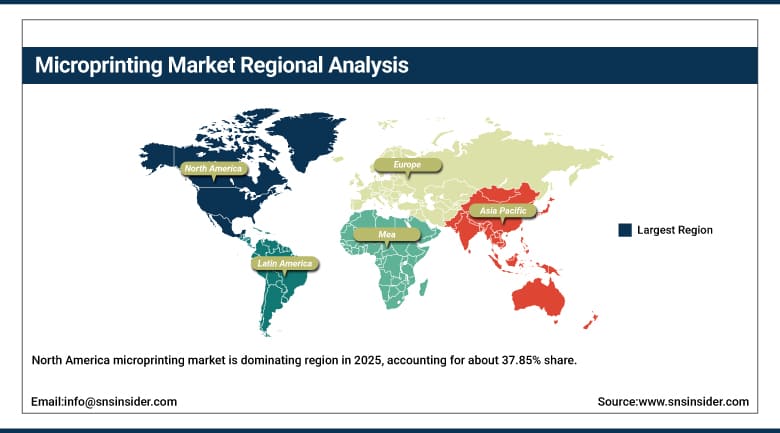
North America microprinting market is dominating region in 2025, accounting for about 37.85% share, driven by strong demand from banking, government, and secure packaging industries. The region benefits from advanced security printing infrastructure and continuous technology innovation. Increasing investments in anti-counterfeiting measures are significantly strengthening product adoption. Expansion of secure identity documentation programs is accelerating demand. A strong focus on document authentication and currency protection further reinforces the region’s dominant position in the market.
The Federal Reserve has authorized printing of the Federal Reserve notes from 2025 in an amount between 4.1 billion and 5.9 billion, all with advanced security features including microprinting. In a similar case, the polymer bills printed by the Bank of Canada incorporate microprinting as one of the advanced security features in addition to others such as transparent windows and holography.
Get Customized Report as Per Your Business Requirement - Enquiry Now
Europe Microprinting Market Insights.
Europe microprinting market is characterized by stable growth in 2025 owing to strong demand for secure printing and authentication technologies. Key countries include Germany, France, United Kingdom, and Italy. Rising investments in document security and brand protection are driving adoption. Increasing focus on anti-counterfeiting regulations is boosting demand. Growth in pharmaceutical packaging and government security printing is further supporting market expansion. Strict regulatory standards are encouraging innovation in advanced microprinting technologies.
In 2025, 444,000 counterfeit euro banknotes were withdrawn from circulation, representing a 20% decrease from the previous year. This corresponds to just 14 counterfeits detected per million genuine notes in circulation, one of the lowest rates recorded since the currency's inception. The €20 and €50 denominations remain the most frequently targeted, accounting for approximately 80% of all recovered counterfeits.
Asia Pacific Microprinting Market Insights.
Asia Pacific is the fastest growing region in the microprinting market, registering a CAGR of about 6.97% during 2026–2035. Rapid industrialization and expanding manufacturing capabilities are driving strong demand across China, India, Japan, South Korea, and Southeast Asia. Increasing production of secure documents and packaging is boosting market growth. Rising counterfeiting concerns are further accelerating adoption. Growth in commercial printing and security printing industries is supporting large scale market expansion.
The Asia-Pacific area, which accounts for about 60% of the world’s population, remains the leader in the innovations related to the delivery of digital financial services. In India, for instance, digital payments have experienced tremendous growth, recording more than 221 billion transactions in FY 2024-25. This has been accompanied by the development of infrastructure in China and other regions. It is clear that in an increasingly digital economy, there is need for the development of strong counterfeiting measures such as microprinting.
Middle East & Africa and Latin America Microprinting Market Insights.
The Middle East & Africa along with Latin America regions are witnessing steady growth due to expanding financial infrastructure and increasing anti-counterfeiting initiatives. Key contributing countries include Brazil, Mexico, UAE, Saudi Arabia, and South Africa. Increasing demand for secure government documents is driving adoption. Growth in pharmaceutical and consumer goods packaging is further supporting market expansion. Rising investments in secure printing technologies are boosting regional demand.
By the year 2025, all 193 member states in ICAO have issued machine readable passports, which comply with international standards and employ highly advanced security elements such as microprinting’s, holograms, and watermarks. However, despite significant achievements on the global level, as per the report by World Bank's 2025 ID4D program, about 800 million people do not possess any identification credentials. It should be noted that such an underrepresentation of identity cards exists mainly in developing nations, especially in Sub-Saharan Africa.
Market Dynamics
Growth Drivers: Growing adoption of secure packaging and brand protection drives microprinting implementation globally.
The growing proliferation of counterfeit drugs, luxury items, and consumer goods is resulting in an ever-increasing need for improved packaging security technologies. Microprinting technology is being incorporated by manufacturers on product labels as an additional measure for authentication and traceability purposes. Growing online transactions are posing greater worries about counterfeit goods being part of the supply chain process. Regulatory bodies are encouraging the use of secure packaging technologies in the pharmaceutical and food industries. This coupled with continuous advances in high resolution printers is making progress towards this end.
According to the OECD-EUIPO Mapping Global Trade in Fakes report for 2025, it is found that counterfeits and piracies account for 2.3% of global trade, which is USD 467 billion each year. With the rise in the use of online portals and small parcel services by counterfeiters, packaging and trademarks have started getting significant attention from the illegal community. This situation has forced the international manufacturing industry, as well as customs, to adopt more effective techniques for anti-counterfeiting, like micro printing.
Restraints: Availability of alternative digital authentication technologies reduces dependence on traditional microprinting solutions.
There is an increasing trend amongst firms to use QR code, RFID, holograms, blockchain authentication, and digital authentication methods in order to improve security. These new technologies offer greater levels of traceability and authentication in real time. Digital methods can be seamlessly integrated into enterprise management software and mobile applications. In some cases, multi-layer digital security systems are preferred over the traditional printing methods. The constant advancement in digital authentication technologies is making it more difficult for competitors.
Opportunities: Increasing integration of microprinting with smart security features boosts global growth prospects.
Microprinting, combined with QR codes, holograms, RFID technologies, and digital authentication systems, is used by manufacturers to provide better security. Multi-level authentication systems help significantly to increase protection against advanced methods of counterfeiting. The rising need for an integrated security ecosystem will drive further integration of technologies. The government organizations and businesses are spending on hybrid document security systems that increase the level of authentication accuracy. Smart packaging trends will offer more chances for implementation of advanced authentication options. Innovations in printing technologies will drive future growth of the market.
ICAO Doc 9303 sets out the fundamental standards for interoperable and secure machine-readable travel documents around the world. Though it outlines a series of layers for physical security, including micro printing, holograms, and UV ink, the basic responsibility of Doc 9303 lies in ensuring standards for data formatting, machine readable zones and digital authentication, such as PKI.
Recent Developments
-
2026: Xerox Corporation completed the integration of Lexmark, expanding its product portfolio, internal manufacturing capabilities, and enterprise market reach.
-
2025: Brady Corporation expanded its security and identification product lineup through updated global industrial printing system compliance certifications.
-
2025: HP Inc. partnered with AMD to launch updated commercial mobile and desktop systems featuring integrated neural processing units.
-
2024: Zebra Technologies Corporation optimized its logistics and manufacturing workflows by integrating advanced tracking systems into global client facilities.
Microprinting Market Key Players are:
-
Xerox Corporation
-
Brady Corporation
-
HP Inc.
-
Zebra Technologies Corporation
-
Videojet Technologies Inc.
-
Canon Inc.
-
Ricoh Company Ltd.
-
Matica Technologies Group S.A.
-
Domino Printing Sciences PLC
-
Epson Corporation
-
Konica Minolta Inc.
-
Mimaki Engineering Co. Ltd.
-
Roland DG Corporation
-
Toppan Holdings Inc.
-
Authentix Inc.
-
Huber Group
-
Komori Corporation
-
Data Carte Concepts
-
Micro Format Inc.
-
William Frick & Company
Microprinting Market Report Scope:
| Report Attributes | Details |
|---|---|
| Market Size in 2025 | USD 826.97 Million |
| Market Size by 2035 | USD 1397.15 Million |
| CAGR | CAGR of 5.35% From 2026 to 2035 |
| Base Year | 2025 |
| Forecast Period | 2026-2035 |
| Historical Data | 2022-2024 |
| Report Scope & Coverage | Market Size, Segments Analysis, Competitive Landscape, Regional Analysis, DROC & SWOT Analysis, Forecast Outlook |
| Key Segments | • By Substrate Type (Plastic, Paper, Metal) • By Print Type (Single-Sided, Double-Sided) • By Type (Monochrome, Color) • By Application (Banking & Finance, Government, Packaging, Healthcare, Education, Corporate) |
| Regional Analysis/Coverage | North America (US, Canada), Europe (Germany, UK, France, Italy, Spain, Russia, Poland, Rest of Europe), Asia Pacific (China, India, Japan, South Korea, Australia, ASEAN Countries, Rest of Asia Pacific), Middle East & Africa (UAE, Saudi Arabia, Qatar, South Africa, Rest of Middle East & Africa), Latin America (Brazil, Argentina, Mexico, Colombia, Rest of Latin America). |
| Company Profiles | Xerox Corporation, Brady Corporation, HP Inc., Zebra Technologies Corporation, Videojet Technologies Inc., Canon Inc., Ricoh Company Ltd., Matica Technologies Group S.A., Brother Industries Ltd., Epson Corporation, Konica Minolta Inc., Mimaki Engineering Co. Ltd., Roland DG Corporation, Toppan Holdings Inc., Authentix Inc., Huber Group, Komori Corporation, Data Carte Concepts, Micro Format Inc., William Frick & Company |

Frequently Asked Questions
The banking & finance segment dominated the market in 2025 due to extensive use in secure banknotes, cheques, payment instruments, financial documents, and authentication applications.
The microprinting market is expected to grow at a CAGR of 5.35% from 2026 to 2035.
The major growth factors include document security demand, counterfeiting rise, authentication adoption, pharmaceutical packaging, brand protection, and advanced high-resolution security ink printing.
