
Mobile Mass Spectrometers Market Report Scope & Overview
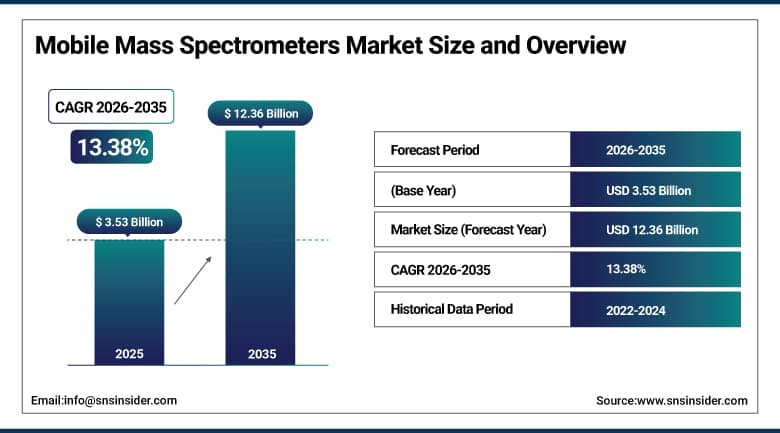
The Mobile Mass Spectrometers Market was valued at USD 3.53 billion in 2025 and is projected to reach USD 12.36 billion by 2035, expanding at a CAGR of 13.38% during the forecast period from 2026 to 2035.
The growth of the market is propelled by increasing demand for portable analytical equipment capable of performing accurate measurements in field conditions at the same level of precision as in laboratory setting. Mass spectrometers are becoming widely employed by governmental bodies, defense forces, environment authorities, and pharmaceutical companies to detect harmful chemicals, drugs, explosives, contaminants and biological agents in a timely manner. The development of ionization techniques, miniaturized vacuum equipment, portable instruments, and artificial intelligence-assisted spectral analysis has greatly facilitated this process. Increased investment in emergency response equipment, environmental monitoring, and decentralization of laboratory tests is further driving adoption in both developed and developing markets.
In May 2026 Agilent Technologies launched the next generation of Dual-Cell System – an automated system that significantly simplifies advanced elemental analysis for environmental, food and contract laboratories. Investments in compact mass analyzers and artificial intelligence-driven platforms are further propelling adoption.
To Get More Information On Mobile Mass Spectrometers Market - Request Free Sample Report
Market Trends
-
Growing adoption of AI-powered spectral analysis for faster and more accurate compound identification across field testing applications.
-
Rising deployment of portable mass spectrometers for real-time environmental monitoring and rapid contamination detection in remote locations.
-
Increasing demand for on-site chemical, narcotics, and hazardous material detection across defense, security, and emergency response sectors.
-
Expanding integration of cloud-based data management and remote diagnostics to improve analytical workflows and collaboration.
-
Growing investment in compact, battery-powered mass spectrometers for rapid field analysis in pharmaceutical, food, and industrial applications.
U.S. Mobile Mass Spectrometers Market Outlook
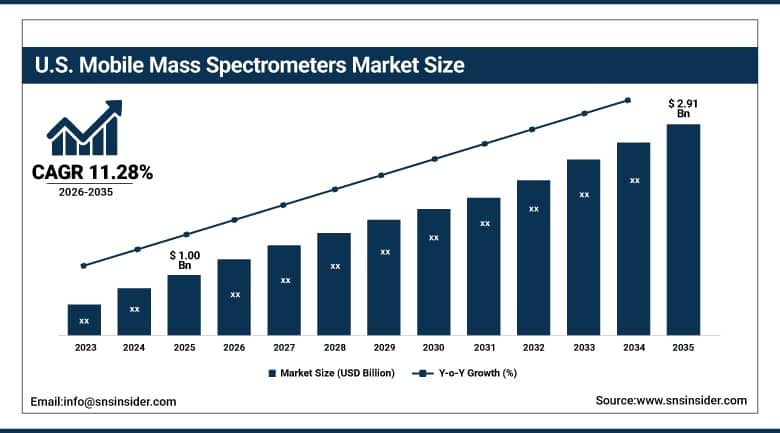
The U.S. Mobile Mass Spectrometers Market was valued at approximately USD 1.00 Billion in 2025 and is expected to reach approximately USD 2.91 Billion by 2035, growing at a CAGR of approximately 11.28% from 2026 to 2035.
The U.S. Mobile Mass Spectrometers Market is experiencing strong growth due to the demand for fast, on-site chemical analysis in homeland security, environmental monitoring, pharmaceutical research, food safety, and forensic investigations. More investment in portable analytical instruments, AI-powered data interpretation and cloud-enabled laboratory workflows is enhancing real-time decision making and operational efficiency. “Compact mass spectrometers are increasingly being used by government agencies, research institutions and industrial users for hazardous material detection, environmental compliance and emergency response applications. Ongoing technological advances in miniaturized systems and battery-powered platforms are also contributing to extended market growth in the U.S.
908 Devices announced in May 2026 the completion of the acquisition of Switzerland-based NIRLAB for an upfront USD 15 million (USD 13 million cash and USD 2 million stock) to integrate cloud-connected AI software directly into its handheld forensic and law enforcement tools, further enhancing rapid field identification and digital analytical capabilities across public safety applications.
Mobile Mass Spectrometers Market Segment Analysis
-
By Product Type, Portable Mass Spectrometers dominated the Mobile Mass Spectrometers Market with 42.00% share in 2025, while Handheld Mass Spectrometers are the fastest-growing product segment from 2026 to 2035.
-
By Application, Environmental Testing dominated the Mobile Mass Spectrometers Market with 27.00% share in 2025, while Homeland Security & Defense is the fastest-growing application segment from 2026 to 2035.
-
By End User, Government & Research Institutions dominated the Mobile Mass Spectrometers Market with 39.00% share in 2025, while Healthcare & Pharmaceutical Companies are the fastest-growing end-user segment from 2026 to 2035.
-
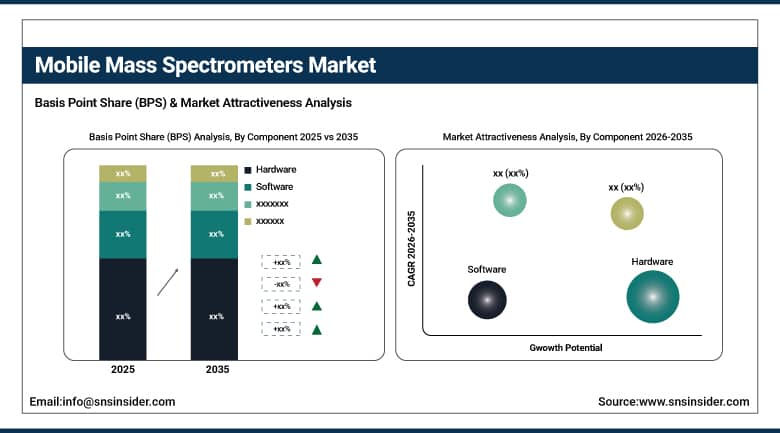
By Component, Hardware dominated the Mobile Mass Spectrometers Market with 61.00% share in 2025, while Software is the fastest-growing component segment from 2026 to 2035.
By Component, Hardware dominates, Software grows fastest
Hardware dominated the Mobile Mass Spectrometers Market with a revenue share of 61.00% in 2025. There is still strong demand for advanced mass analyzers, ion sources, detectors, vacuum systems, and portable instrument platforms that can provide high analytical accuracy under field conditions. Market growth is boosted by continuous innovation in compact hardware design.
Software is expected to grow at the fastest CAGR from 2026 to 2035 due to increasing integration of artificial intelligence, cloud-based analytics, automated spectral interpretation, and remote data management. Government agencies, industrial users and research laboratories are placing an ever-greater value on advanced software platforms that enhance workflow automation, analytical accuracy, collaboration and decision making.
By Product Type, Portable Mass Spectrometers dominate, Handheld Mass Spectrometers grow fastest
Portable Mass Spectrometers dominated the Mobile Mass Spectrometers Market in 2025, accounting for approximately 42.00% of the revenue. Their capacity to provide laboratory-grade analytical performance in field settings has led to their widespread use in environmental monitoring, industrial inspections, pharmaceutical research, and forensic investigations. Their high sensitivity, rugged construction and capability of on-site analysis of complex chemical compounds still support strong market leadership.
Handheld Mass Spectrometers are expected to register the fastest CAGR over the forecast period, due to the growing demand for portable analytical devices in law enforcement, military operations, hazardous material detection, and emergency response. Developments in miniaturized ionization, battery efficiency, and AI assisted analysis are allowing for faster field identification and greater operational flexibility across security and public safety applications.
By Application, Environmental Testing dominates, Homeland Security & Defense grows fastest
The Mobile Mass Spectrometers Market dominated by Environmental Testing in 2025, with approx. 27.00% revenue share. The increasing interest in monitoring of pollution, determination of water quality, studies of soil contamination and testing of industrial emissions has increased the use of portable analytical instruments to a great extent. Government agencies and environmental laboratories are increasing their investments in real-time field analysis for greater monitoring efficiency and regulatory compliance.
The Homeland Security & Defense segment is anticipated to record the fastest CAGR due to increasing investments in chemical threat detection, explosives identification, border security, and counter-terrorism operations. Increasing applications of portable analytical systems by military and public safety agencies for rapid identification of hazardous materials is driving the demand globally.
By End User, Government & Research Institutions dominate, Healthcare & Pharmaceutical Companies grow fastest
Mobile Mass Spectrometers Market was dominated by Government & Research Institutions in 2025, which contributed nearly 39.00% of the overall revenue. Leadership of the segment has been sustained through extensive application in environmental monitoring, forensic science, public safety, defense laboratories and scientific research programmes. Continued government funding for analytical research and emergency preparedness will help to support widespread adoption.
Healthcare & Pharmaceutical Companies are expected to witness the fastest CAGR over the forecast period owing to rising demand for faster drug development, quality control, clinical research, and biopharmaceutical analysis. Healthcare applications are seeing greater use of mobile analytical technologies, driven by rising investment in decentralized lab testing, pharmaceutical manufacturing and precision medicine.
Regional Analysis
|
Region |
Major Country |
Global Market Share (2025 %) |
|---|---|---|
|
North America |
United States |
84.72% |
|
Europe |
Germany |
29.40% |
|
Asia Pacific |
China |
41.20% |
|
Latin America |
Brazil |
39.80% |
|
Middle East & Africa |
UAE |
24.50% |
North America Mobile Mass Spectrometers Market Insights
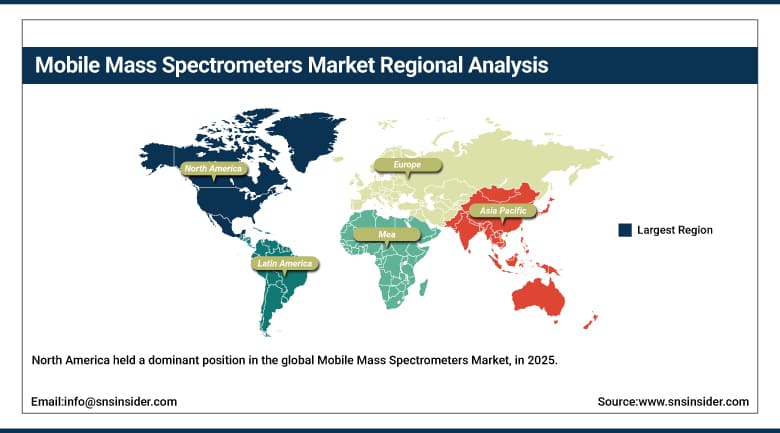
North America held a dominant position in the global Mobile Mass Spectrometers Market, in 2025, contributing around 32.79% of the global revenue. Solid investments in homeland security, pharmaceutical research, environmental monitoring and forensic science help the area. The market leadership is further reinforced by the extensive deployment of portable analytical instruments by government agencies, defense organizations, research laboratories, and industrial users. Continued funding for public safety programmes and scientific innovation also aids in widespread adoption in the United States and Canada.
It also benefits from the early adoption of AI-enabled analytical software, cloud-connected laboratory platforms and next-generation portable mass spectrometry technologies. This is why leading manufacturers continue to invest in compact, high-performance systems able to provide laboratory quality analysis in field environments. Rising demand for rapid hazardous material detection, emergency response capabilities, pharmaceutical quality control, and environmental compliance monitoring continues to drive market growth across North America.
Get Customized Report as Per Your Business Requirement - Enquiry Now
Europe Mobile Mass Spectrometers Market Insights
Europe remains a significant market with a solid pharmaceutical manufacturing base, sophisticated scientific research infrastructure, and stringent environmental regulations. Among others Germany, the United Kingdom, France and the Netherlands are investing into the development of portable analytical technologies for food safety, industrial quality assurance, environmental protection and forensic investigations. Rising emphasis on rapid field testing and regulatory compliance is propelling steady market growth.
The adoption is driven by increasing investments in life sciences research, industrial automation and analytical instrumentation across the region. European organizations are deploying mobile mass spectrometry for pharmaceutical development, environmental surveillance and public safety. The presence of leading analytical instrument companies and continuous innovation in portable laboratory technologies further strengthens the position of Europe’s long-term market.
Asia Pacific Mobile Mass Spectrometers Market Insights
The Asia Pacific is expected to register the fastest CAGR of 19.57% during the forecast period. Rapid industrialization, growing pharmaceutical manufacturing, rising environmental monitoring initiatives, and increased government investment in scientific research in China, Japan, South Korea, and India are driving the demand. The growing awareness of food safety, pollution monitoring, and public health surveillance is also further stimulating the adoption of portable analytical technologies.
To upgrade field diagnostics, manufacturers in the region are ramping up investments in compact lab equipment, AI-driven analytical platforms, and cloud-connected testing systems. China is the growth leader in the region owing to its expanding pharmaceutical, biotechnology and industrial manufacturing sectors. India is emerging as a high-growth market due to rising research expenditure, environmental monitoring programmers and laboratory infrastructure modernization.
Middle East & Africa & Latin America Mobile Mass Spectrometers Market Insights
The Middle East & Africa and Latin America are slowly emerging as promising markets with increasing investments in environmental monitoring, industrial inspection, food safety testing, and border security. Governments are strengthening analytical capabilities to improve detection of hazardous substances, forensic investigation and emergency preparedness. Industrial development and regulatory enforcement are increasing and portable analytical technologies are constantly finding new opportunities.
Demand is also increasing from pharmaceutical companies, research institutions and public safety agencies seeking rapid field-based chemical analysis. The expansion of laboratory modernization programmes, the growing awareness of environmental protection, and the increasing adoption of advanced analytical instrumentation are expected to support steady market growth in both regions throughout the forecast period.
Market Dynamics
Growth Driver: Rising Demand for Rapid On-Site Chemical Analysis Across Multiple Industries
The Mobile Mass Spectrometers Market is growing at a faster pace with substantial growth rates over the last few years and is estimated to grow considerably in the forecast period. Portable mass spectrometers are being increasingly used by environmental monitoring agencies, defense organizations, pharmaceutical companies and food safety authorities for real-time detection of hazardous substances, pollutants, explosives, narcotics and biological contaminants. Miniaturized analytical technologies are enabling laboratory grade performance in small, field deployable instruments, with major improvements in operational efficiencies and response times.
The market demand is underpinned by increasing investments in environmental protection, homeland security and pharmaceutical research. Government agencies are using portable analytical equipment more widely for emergency response and public safety, and pharmaceutical manufacturers are increasingly using mobile systems for decentralized quality control and process monitoring. AI-assisted spectral analysis, improvements in cloud connectivity and battery-powered instrumentation further accelerate adoption across industrial and research applications.
Restraint: High Equipment Costs and Technical Complexity Limit Wider Adoption
The impressive development of the field of technology has not eliminated the problem of high cost and maintenance expenses for mobile mass spectrometers, which hinders their widespread implementation, especially in small laboratories, universities and companies from developing countries. Prices are even higher, due to sophisticated devices such as high-performance mass analyzers, vacuum systems, detectors and calibration tools.
Another obstacle to the widespread diffusion of the technology is the need for specially trained personnel. Modern companies are trying to simplify the process of work with such instruments by means of automation and artificial intelligence, but the correct interpretation of the results of analysis still requires special skills.
Opportunity: Expansion of AI-Enabled and Cloud-Connected Portable Analytical Platforms
The Mobile Mass Spectrometers Market is projected to record major growth opportunities due to rising integration of artificial intelligence, cloud computing and remote analytical platforms. AI-powered spectral interpretation enhances the accuracy of analysis but also reduces the time required for analysis, allowing non-specialists to conduct complex field analysis with greater confidence. Cloud-connected platforms also provide centralized data storage, remote collaboration, and real-time decision making across geographically distributed operations.
As investments in digital laboratories, Industry 4.0 and connected analytical ecosystems increase, new growth opportunities are presented to manufacturers. Healthcare providers, environmental agencies, defense organizations and industrial companies are all adopting intelligent portable mass spectrometry solutions that integrate real-time chemical analysis with automated reporting and predictive analytics. Future market adoption is expected to be significantly boosted by continued innovation in miniaturized instrumentation and digital software platforms.
Recent Developments
-
2026: Bruker Corporation launched the timsMRMS system at the American Society for Mass Spectrometry (ASMS) conference, combining Trapped Ion Mobility Spectrometry (TIMS) with Magnetic Resonance Mass Spectrometry (MRMS) for advanced analysis of complex organic matter, battery materials, and biofuel characterization.
-
2026: SCIEX introduced its next-generation high-speed mass spectrometry platform designed to deliver enhanced quantitative accuracy and throughput for biopharmaceutical development and clinical research workflows.
-
2025: Waters Corporation commercially launched the Xevo CDMS system, advancing Charge Detection Mass Spectrometry (CDMS) capabilities for the characterization of large biomolecules, viral vectors, and complex biotherapeutics.
-
2025: Thermo Fisher Scientific expanded its Ardia™ cloud platform with AI-driven data management capabilities across its compact and routine mass spectrometry portfolio, improving decentralized laboratory collaboration and analytical workflow efficiency.
Key Players
-
Thermo Fisher Scientific Inc.
-
Agilent Technologies, Inc.
-
Bruker Corporation
-
Waters Corporation
-
Shimadzu Corporation
-
JEOL Ltd.
-
Advion Interchim Scientific
-
FLIR Systems (Teledyne FLIR)
-
BaySpec, Inc.
-
908 Devices Inc.
-
PerkinElmer Inc.
-
SCIEX
-
LECO Corporation
-
Hiden Analytical Ltd.
-
Pfeiffer Vacuum Technology AG
-
INFICON Holding AG
-
Extrel CMS, LLC
-
Spectromics GmbH
-
Microsaic Systems plc
-
MassTech Inc.
Mobile Mass Spectrometers Market Report Scope:
| Report Attributes | Details |
|---|---|
| Market Size in 2025 | USD 3.53 Billion |
| Market Size by 2035 | USD 12.36 Billion |
| CAGR | CAGR of 13.38% from 2026 to 2035 |
| Base Year | 2025 |
| Forecast Period | 2026-2035 |
| Historical Data | 2022-2024 |
| Report Scope & Coverage | Market Size, Segments Analysis, Competitive Landscape, Regional Analysis, DROC & SWOT Analysis, Forecast Outlook |
| Key Segments | • By Product Type (Portable Mass Spectrometers, Handheld Mass Spectrometers, Field-Deployable Mass Spectrometers, Benchtop Mobile Mass Spectrometers) • By Application (Environmental Testing, Homeland Security & Defense, Pharmaceutical & Biotechnology, Food & Beverage Testing, Forensics & Disaster Management, Narcotics Detection, Chemical, Biological, Radiological & Nuclear (CBRN) Detection, Others) • By End User (Government & Research Institutions, Industrial, Healthcare & Pharmaceutical Companies, Military & Defense Organizations, Food Testing Laboratories, Others) • By Component (Hardware, Software, Services) |
| Regional Analysis/Coverage | North America (US, Canada, Mexico), Europe (Eastern Europe [Poland, Romania, Hungary, Turkey, Rest of Eastern Europe] Western Europe] Germany, France, UK, Italy, Spain, Netherlands, Switzerland, Austria, Rest of Western Europe]), Asia Pacific (China, India, Japan, South Korea, Vietnam, Singapore, Australia, Rest of Asia Pacific), Middle East & Africa (Middle East [UAE, Egypt, Saudi Arabia, Qatar, Rest of Middle East], Africa [Nigeria, South Africa, Rest of Africa], Latin America (Brazil, Argentina, Colombia, Rest of Latin America) |
| Company Profiles | Thermo Fisher Scientific Inc., Agilent Technologies, Inc., Bruker Corporation, Waters Corporation, Shimadzu Corporation, JEOL Ltd., Advion Interchim Scientific, FLIR Systems (Teledyne FLIR), BaySpec, Inc., 908 Devices Inc., PerkinElmer Inc., SCIEX, LECO Corporation, Hiden Analytical Ltd., Pfeiffer Vacuum Technology AG, INFICON Holding AG, Extrel CMS, LLC, Spectromics GmbH, Microsaic Systems plc, MassTech Inc. |

Frequently Asked Questions
The Mobile Mass Spectrometers Market was valued at USD 3.53 billion in 2025.
Asia Pacific is expected to register the fastest CAGR during the forecast period owing to expanding industrial testing, food safety regulations, and healthcare investments.
North America dominated the market in 2025 due to strong investments in analytical instrumentation, homeland security, environmental monitoring, and pharmaceutical research.
The market is expected to grow at a CAGR of 13.38% during the forecast period of 2026–2035.
The market is primarily driven by the increasing demand for rapid, on-site chemical analysis across environmental monitoring, defense, food safety, pharmaceuticals, and forensic applications.
