
Moisture Analyzer Market Report Scope & Overview:
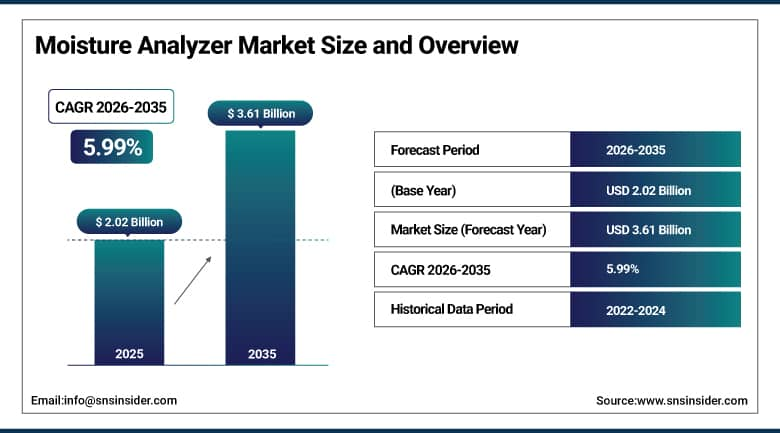
The Moisture Analyzer Market was valued at USD 2.02 Billion in 2025 and is expected to reach USD 3.61 Billion by 2035, growing at a CAGR of 5.99% from 2026-2035.
The Moisture Analyzer Market is expanding steadily as quality control moves from periodic sampling to continuous verification. Pharmaceutical release testing and food safety audits are raising instrument utilization. Manufacturers are replacing aging oven routines with automated halogen, Karl Fischer and near-infrared platforms. Electronic records and audit trails are becoming standard purchase criteria. Battery materials plants and specialty chemical producers are adding new demand. Asia Pacific is building laboratory capacity faster than mature regions. Vendors compete on speed of result, software integration and calibration support. These shifts position the market for stable growth through 2035 across laboratory and process settings. Remote diagnostics and cloud reporting are widening buyer expectations.
⮞In May 2026, ISO approved a project to revise ISO 15512 on the determination of water content in plastics. The revised scope spans six water content methods including oven-vaporization Karl Fischer, which keeps moisture analysis central to polymer quality specifications.
To Get More Information On Moisture Analyzer Market - Request Free Sample Report
Moisture Analyzer Market Trends
- Automated Karl Fischer platforms with electronic record support are replacing manual titration in regulated laboratories.
- Coulometric and oven-based titration systems are gaining traction for trace-level water determination.
- Battery electrode and electrolyte producers are adding moisture control stations across cell manufacturing lines.
- Compact handheld and smart-connected analyzers are extending moisture testing beyond the central laboratory.
- Near-infrared and in-line analyzers are moving into continuous process control in food and polymer plants.
U.S. Moisture Analyzer Market Outlook
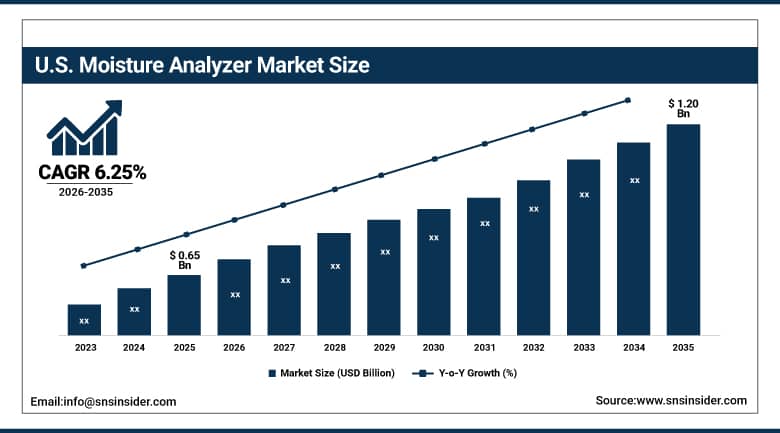
The U.S. Moisture Analyzer Market was valued at USD 0.65 Billion in 2025 and is expected to reach USD 1.20 Billion by 2035, growing at a CAGR of 6.25% from 2026-2035.
The U.S. Moisture Analyzer Market is supported by a large base of pharmaceutical plants, food processors and grain handlers. Federal inspection programs and current good manufacturing practice rules keep moisture testing routine. Laboratories are upgrading to analyzers that link directly to laboratory information systems. Contract testing providers are widening their moisture service menus. Battery and semiconductor projects add precision requirements for water content in materials. Buyers favor suppliers with local calibration and service networks. Replacement of older halogen balances is a steady source of unit demand. These factors support consistent expansion in the U.S. through 2035. Cloud reporting and remote diagnostics are becoming expected features.
⮞In August 2026, the USDA Agricultural Marketing Service listed official moisture calibration updates for the two meter models used in the Federal Grain Inspection Service program. The update cycle shows how official grain moisture measurement depends on regularly maintained instrument calibrations.
Moisture Analyzer Market Segment Analysis
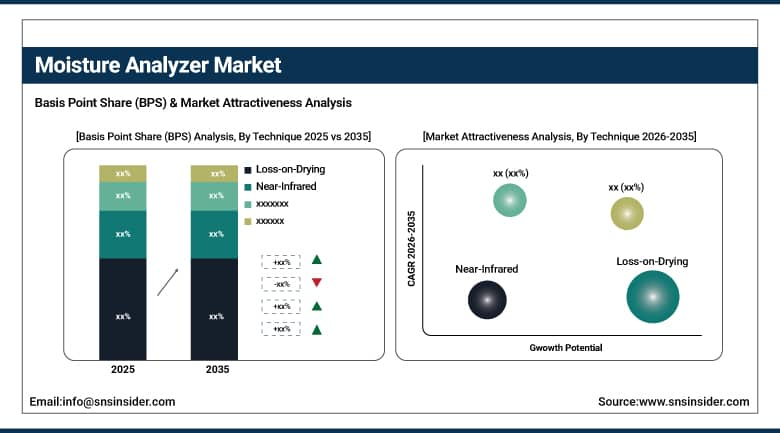
- By Technique, the Loss-on-Drying segment dominated the Moisture Analyzer Market with approximately 36.07% share in 2025, while the Near-Infrared segment is the fastest growing with a CAGR of approximately 7.99%.
- By Equipment Type, the Desktop segment dominated the Moisture Analyzer Market with approximately 52.90% share in 2025, while the In-Line segment is the fastest growing with a CAGR of approximately 7.61%.
- By Application, the Food and Beverage segment dominated the Moisture Analyzer Market with approximately 34.23% share in 2025, while the Pharmaceuticals segment is the fastest growing with a CAGR of approximately 7.39%.
- By Component, the Instruments segment dominated the Moisture Analyzer Market with approximately 68.20% share in 2025, while the Sensors and Probes segment is the fastest growing with a CAGR of approximately 7.49%.
By Technique, Loss-on-Drying Dominates the Moisture Analyzer Market and Near-Infrared Grows Fastest
Loss-on-drying remains the reference technique for routine moisture determination because it is simple, inexpensive per test and accepted in pharmacopeial and food standards. Halogen heating has shortened drying cycles from hours to minutes while preserving the gravimetric principle that auditors trust. Quality laboratories value the direct link to compendial procedures and the ease of method transfer between sites. Procurement teams also prefer the low consumable cost when daily sample volumes are high. These attributes keep loss-on-drying analyzers at the center of incoming inspection and batch release. Familiarity among analysts also keeps training requirements low across plants.
Near-infrared analyzers are gaining ground where speed and non-destructive testing matter more than gravimetric tradition. Plants use them to read moisture in seconds without solvents or heat, which suits grain intake lines, powder blending and polymer drying. Calibration models built for specific products now transfer more easily across instruments. Integration with process control systems allows operators to adjust dryers in real time. Waste reduction and energy savings strengthen the business case. Adoption is rising as manufacturers shift from end-of-line checks toward continuous measurement. Suppliers are also developing hybrid configurations that pair spectroscopy with reference drying to simplify method validation.
By Equipment Type, Desktop Dominates the Moisture Analyzer Market and In-Line Grows Fastest
Desktop analyzers anchor the market because laboratories need controlled heating chambers, precision balances and validated software in a single bench footprint. Quality teams in pharmaceuticals and food rely on them for repeatable results that withstand audits. Vendors are adding touchscreens, automatic sample detection and data export to laboratory information systems to cut operator error. Replacement cycles for aging units and the expansion of contract laboratories provide a steady order pipeline. The category also benefits from broad technique coverage across halogen, infrared and titration formats. Compact footprints and bench-level safety features suit shared laboratory spaces where several analysts work.
The development of in-line analyzers is proceeding as manufacturers are embedding moisture control into their process stream. The sensors which are installed on dryers, conveyors, and pipelines provide continuous measurements and thus minimize the occurrences of batches and reworking. The gas and liquid trace moisture analyzers are used for chemical and energy applications while the near infrared analyzers are used in the food and polymer lines. The high initial investment cost of such technology is compensated by lower labor costs and closer process tolerances. Digitalization and remote monitoring capabilities make these systems more user-friendly in managing several factories. Demand is strongest where continuous production justifies automated measurement. Vendors increasingly bundle installation, commissioning and validation support to ease adoption in regulated plants.
⮞In September 2025, Wagner Meters introduced the L5300 industrial hand-held wood moisture meter as a replacement for its L622 model. The IP67-rated unit stores readings in organized groups and connects by USB to desktop software, which reflects demand for rugged portable instruments with data traceability.
By Application, Food and Beverage Dominates the Moisture Analyzer Market and Pharmaceuticals Grows Fastest
Food and beverage processors depend on moisture data to control shelf life, texture, yield and regulatory compliance. Bakery, dairy, confectionery, grain and meat producers test raw materials at intake and finished goods before shipment. Moisture limits written into national grain and starch rules make testing mandatory across supply chains. Rapid analyzers enable quality control groups to distribute large quantities of products at a faster rate and minimize the chances of product deterioration. Large volumes of production together with high-frequency sampling constitute the largest source of demand for the equipment. The development of private labels as well as the need for exporting documents contributes more test points in the chain.
Pharmaceutical and biotechnology producers are raising moisture testing intensity as stability programs and biologic formulations demand tight water control. Residual moisture in lyophilized products and excipients influences shelf life and potency. Karl Fischer titrators and validated moisture balances with electronic records support data integrity expectations. Contract development and manufacturing organizations are adding capacity in India and China. Updates to national pharmacopeias keep method requirements active and encourage equipment refresh. These dynamics place pharmaceutical users at the front of spending growth. Quality managers also use moisture results to qualify suppliers of active ingredients and packaging inputs.
⮞China's National Health Commission and State Administration for Market Regulation released the GB 31637-2025 edible starch standard in March 2025 with effect from March 2026. The standard sets water content limits by starch type that producers must verify through routine moisture testing.
By Component, Instruments Dominates the Moisture Analyzer Market and Sensors and Probes Grows Fastest
Complete instruments account for the bulk of spending because the purchase of an analyzer is the main budget event for laboratories and plants. Buyers evaluate heating systems, balances, titration cells and software as one package. Manufacturers differentiate through measurement speed, repeatability and compliance features rather than hardware alone. Service contracts and calibration visits extend the revenue linked to each installed unit. Standardized method libraries reduce training time for operators. This structure keeps finished instruments as the principal revenue pool for suppliers. Bundled accessories such as sample pans, calibration weights and software licenses add to the average order value.
Sensors and probes are expanding as process industries embed measurement into existing equipment. Capacitance and near-infrared probes together with quartz crystal and optical sensors allow moisture readings inside reactors, dryers and gas lines. Replacement demand grows because probes need periodic calibration and exchange. Miniaturization and digital outputs ease integration with programmable controllers. Suppliers of trace moisture sensors benefit from ultra-dry gas requirements in electronics and energy applications. The shift toward continuous monitoring will sustain rapid expansion of this component group. Original equipment manufacturers are also embedding sensors into dryers and ovens as standard features.
⮞The International Group of P&I Clubs reported in June 2026 through Circular 11/26 that nickel ore cargoes require a moisture certificate issued no more than seven days before loading. The circular also notes that moisture can vary within a single consignment, which sustains demand for reliable measurement at ports and mines.
Regional Analysis
|
Region |
Major Country |
Share within Region, 2025 (%) |
|---|---|---|
|
North America |
United States |
87.06% |
|
Europe |
Germany |
24.86% |
|
Asia Pacific |
China |
33.60% |
|
Latin America |
Brazil |
44.19% |
|
Middle East & Africa |
Saudi Arabia |
29.47% |
North America Moisture Analyzer Market Insights
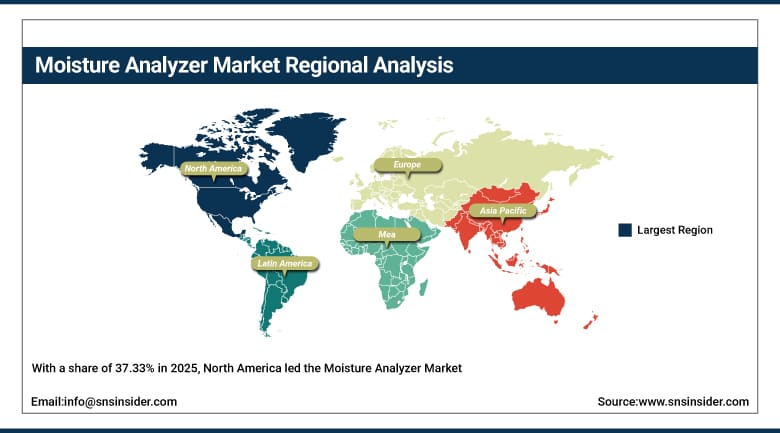
With a share of 37.33% in 2025, North America led the Moisture Analyzer Market on the strength of its pharmaceutical manufacturing base, mature food processing sector and strict quality documentation requirements. The United States contributes most regional demand while Canada adds spending through grain handling and specialty chemicals. Laboratories in the region upgrade frequently to analyzers that offer electronic signatures and audit trails. Service networks of leading suppliers are dense, which shortens downtime and supports replacement of the installed base. Replacement activity remains steady as older benchtop units reach the end of their validated lifecycle.
Grain elevators, ethanol plants and feed mills use moisture testing at every intake point. Battery and semiconductor investments are creating new requirements for dry materials control. Contract research laboratories and food safety service providers are widening their analytical menus to win outsourced testing. Procurement favors suppliers with validation documentation and local application support. These conditions keep demand resilient even when capital budgets tighten because moisture testing is embedded in release procedures. Distributors and application specialists provide on-site method training that shortens deployment time for new users. Nutraceutical and supplement producers add a growing group of buyers seeking validated methods.
Get Customized Report as Per Your Business Requirement - Enquiry Now
Europe Moisture Analyzer Market Insights
Europe occupied the second largest market position in 2025 owing to its laboratory instrument sector in Germany along with pharmaceuticals and chemicals clusters. Requirements of pharmacopoeias and stringent food safety regulations ensure that moisture testing is conducted regularly. Environmental restrictions on the use of solvents result in laboratories testing methods to reduce usage of reagents and alternatives to methanol-based titration. The instrument producers in the region also export their products and define the product standards. The replacement of old instruments is steady in Western Europe whereas Central and Eastern Europe manufactures are increasing their production capacities.
Apart from the use of specialty chemicals, plastic compounding and papermaking are other sources of industrial applications that demand analysis of water content. There are many battery gigafactory projects underway in Germany, Poland, and Hungary, where dry room management and electrode material analysis for water content are required. Laboratory digital workflow demands are driving customers to seek premium analyzers with embedded software. Price pressure from Asian competitors is forcing the locals to provide a services-based proposition. The need for sustainability will drive the demand for energy-saving drying techniques and quick analysis cycles. The food industry needs moisture analysis for labeling.
Asia Pacific Moisture Analyzer Market Insights
Asia Pacific is projected to expand at a CAGR of 7.69% during 2026-2035 and is the fastest growing region as laboratory capacity and manufacturing output rise together. China leads regional demand through its pharmaceutical, food and battery materials industries. India is scaling contract research and generic drug exports. Japan and South Korea contribute demand for high-precision instruments in electronics and chemicals. Local instrument makers are broadening portfolios and pressing prices in mid-range segments. Industrial parks and pharmaceutical clusters in Gujarat, Hyderabad and Jiangsu keep generating new laboratory installations. Taiwan and Singapore contribute demand for semiconductor-grade materials testing.
Food safety and pharmacopoeia updates are increasing mandatory testing across the region. Grain trading in Australia and Southeast Asia depends on moisture verification at ports and silos. Mineral exports require moisture certification for safe sea transport. Rising private investment in testing laboratories supports instrument imports and local assembly. Government programs that strengthen food and drug quality systems add a further layer of equipment spending. Rapid growth in packaged food and dairy output increases incoming ingredient checks. Distributors play a vital role in reaching smaller laboratories outside major cities.
⮞In April 2026, the Japanese Pharmaceuticals and Medical Devices Agency announced the 19th Edition of the Japanese Pharmacopoeia effective immediately, with a transition period expiring on 30 September 2027. The new edition provides a set time period for manufacturers to conform to revised standards.
MEA & Latin America Moisture Analyzer Market Insights
Latin America benefits from large grain, oilseed, coffee and sugar industries where moisture determines grading and price. Brazil and Argentina lead demand while Mexico adds spending through food processing and automotive supply chains. Cooperatives and exporters buy portable meters and benchtop analyzers to certify cargo before shipment. There is a growing production of pharmaceuticals, which results in increased sales of titration devices and halogen analyzers. Fluctuations in currency rates and high import prices hamper purchases, but local delivery channels ensure that vendors stay covered. Exporters of coffee and cocoa from Colombia and Ecuador purchase devices for measuring moisture rapidly.
Middle East and Africa remains the smallest region but offers steady growth from food import inspection, petrochemical quality control and mining. Gulf countries are investing in laboratory infrastructure to support local pharmaceutical and food manufacturing. Saudi Arabia and the United Arab Emirates lead purchases of advanced analyzers. In Africa grain storage and cocoa and coffee exports create demand for rugged portable instruments. Limited technical service coverage still restrains faster uptake. Government food security programs and grain reserve management add to institutional purchasing. Training and calibration partners remain important for sustained use of imported instruments.
⮞Argentina's Resolución 189/2025 replaced the 1994 Norma XVIII on sorghum quality and sets a maximum moisture level of 15%, as reported in October 2025. The updated standard keeps moisture testing at the center of grain commercialization.
Market Dynamics
Growth Drivers: Regulated Quality Testing Requirements Drive Growth in the Moisture Analyzer Market
Pharmacopeial water determination requirements and electronic record rules make moisture analyzers a mandatory part of pharmaceutical quality systems. Plants replace manual or analog units with systems that offer audit trails and electronic signatures. Food safety programs extend the same discipline to ingredients and finished goods. Automation in sample handling and software integration shortens release times and lowers operator error. Laboratories that standardize on connected analyzers also gain faster investigations when results fall outside limits. Corrective and preventive action requirements push quality units to document every excursion with traceable data. Audit readiness has therefore become a daily operating priority rather than an annual exercise.
Asia Pacific capital spending adds a second layer of demand. Battery producers need strict control of water in electrolyte and electrode materials. Contract research and manufacturing organizations in India and China are adding laboratories. Semiconductor and specialty chemical expansion adds further instrument orders. Each new plant typically buys several analyzers together with calibration and service agreements, which compounds growth in the installed base. Government incentives for pharmaceutical and electronics manufacturing in several Asian economies reinforce this pipeline. Local calibration laboratories are also multiplying, which lowers ownership risk for buyers. Training programs for analysts further support steady adoption.
⮞In January 2026, the Indian Pharmacopoeia Commission released the 10th edition of the Indian Pharmacopoeia with 121 new monographs. Each added monograph widens the quality tests that Indian laboratories must perform and supports demand for compendial moisture methods.
Restraints: Method Substitution and Calibration Costs Restrain Growth in the Moisture Analyzer Market
Near-infrared and other solvent-free techniques are displacing traditional approaches in high-throughput food and polymer testing. Plants that adopt them can reduce reagent purchases and operator time. Where compendial rules allow alternatives buyers may hold back on replacing older titration or oven equipment. Divergence between pharmacopeias in different regions also complicates procurement for multinational manufacturers that want one platform across sites. Handheld and in-line formats weaken the case for premium benchtop purchases in some applications. Procurement committees therefore demand a documented payback case before approving new titration systems. Price sensitivity is highest among small laboratories and contract testers in emerging markets.
Lifecycle costs weigh on smaller laboratories. Reagents, electrodes, waste disposal and periodic calibration add recurring expense. Matrix interference and sample preparation affect repeatability for complex materials. A shortage of trained analysts limits proper method validation. Methanol handling rules in Europe raise compliance costs. Supply constraints on electrodes can extend lead times and delay installations. Training costs and downtime during method transfer add hidden expense for operators. Smaller buyers sometimes postpone upgrades and continue using older instruments beyond recommended service intervals. These factors temper the pace of expansion in cost-sensitive end uses. Currency movements also raise landed prices of imported instruments.
⮞Grain Trade Australia's Maize Trading Standards 2026/27 took effect in August 2026 and specify that moisture is reported by fan-forced oven or near-infrared. The acceptance of two measurement routes illustrates how oven and spectroscopic methods compete in grain testing.
Opportunities: Emerging Markets and Battery Materials Testing Create Opportunities in the Moisture Analyzer Market
Latin America, the Middle East and Southeast Asia are formalizing grain, food and pharmaceutical quality systems. Export-oriented producers need verified moisture data to meet buyer specifications. Affordable portable and compact benchtop analyzers suit these buyers and local service partnerships can unlock volume. Governments are also updating national standards, which creates replacement demand for outdated instruments. Distributors able to bundle instruments with training and consumables gain an advantage with first-time buyers. Government laboratory modernization programs and public procurement tenders add institutional demand. Local assembly and regional service hubs further reduce delivery times and total cost.
Battery research and gigafactory construction open a technically demanding segment that requires ultra-low water measurement. Biologics and specialty formulations increase residual moisture testing. Smart analyzers with cloud connectivity, assisted method setup and remote diagnostics allow vendors to sell software subscriptions and service contracts. Portable designs extend testing to field sites in agriculture, construction and environmental monitoring. Environmental testing and construction materials laboratories extend the addressable base for handheld meters. Suppliers that bundle analytics with instruments can raise recurring revenue and customer retention. Partnerships with software firms strengthen these offers. Pharmaceutical contract laboratories are adopting such tools first.
⮞For instance, in November 2023 the grain commission of Brazil's agriculture confederation CNA rejected a ministry proposal to lower the standard soybean moisture level from 14% to 13%. The debate shows the economic weight of moisture thresholds in grain trade and the value of accurate measurement.
Recent Developments:
- 2024: OHAUS released a next-generation MB Series of moisture analyzers including the MB32, MB62 and MB92 with carbon fiber heating, upgraded load cells and capacitive touchscreens. The MB92 adds a tool-free chamber and a full glass panel. The range targets laboratories that want faster drying and easier cleaning.
- 2026: AMETEK Process Instruments announced two new quartz crystal microbalance moisture analyzers, the 3050-SLR and 3050-DO, for ultra-low-moisture applications. They carry an integrated Zero Module, an advanced purge system and built-in NIST-traceable self-verification. The models target in-line trace moisture measurement in chemical and gas processing.
Moisture Analyzer Market Key Players are:
- METTLER TOLEDO
- Sartorius AG
- A&D Company, Limited
- Shimadzu Corporation
- OHAUS Corporation
- Metrohm AG
- Kett Electric Laboratory
- RADWAG Balances and Scales
- KERN & SOHN GmbH
- Precisa Gravimetrics AG
- CEM Corporation
- AMETEK Brookfield
- Anton Paar GmbH
- Hanna Instruments
- Michell Instruments
- Panametrics
- Process Insights
Moisture Analyzer Market Report Scope:
| Report Attributes | Details |
|---|---|
| Market Size in 2025 | USD 2.02 Billion |
| Market Size by 2035 | USD 3.61 Billion |
| CAGR | CAGR of 5.99% From 2026 to 2035 |
| Base Year | 2025 |
| Forecast Period | 2026-2035 |
| Historical Data | 2022-2024 |
| Report Scope & Coverage | Market Size, Segments Analysis, Competitive Landscape, Regional Analysis, DROC & SWOT Analysis, Forecast Outlook |
| Key Segments | • By Technique (Loss-on-Drying, Karl Fischer Titration, Near-Infrared, Microwave, Capacitance, and Others) • By Equipment Type (Desktop, Handheld, and In-Line) • By Application (Food and Beverage, Pharmaceuticals, Chemical and Petroleum, Plastic and Polymer, Metal and Mining, Wood, Paper and Pulp, Semiconductor, Research and Academics, and Others) • By Component (Instruments, Sensors and Probes, and Consumables) |
| Regional Analysis/Coverage | North America (US, Canada), Europe (Germany, UK, France, Italy, Spain, Russia, Poland, Rest of Europe), Asia Pacific (China, India, Japan, South Korea, Australia, ASEAN Countries, Rest of Asia Pacific), Middle East & Africa (UAE, Saudi Arabia, Qatar, South Africa, Rest of Middle East & Africa), Latin America (Brazil, Argentina, Mexico, Colombia, Rest of Latin America). |
| Company Profiles | METTLER TOLEDO, Sartorius AG, A&D Company, Limited, Shimadzu Corporation, OHAUS Corporation, Metrohm AG, Kett Electric Laboratory, RADWAG Balances and Scales, KERN & SOHN GmbH, Precisa Gravimetrics AG, CEM Corporation, AMETEK Brookfield, Anton Paar GmbH, Hanna Instruments, Michell Instruments, Panametrics, Process Insights |

Frequently Asked Questions
The key players in the Moisture Analyzer Market include METTLER TOLEDO, Sartorius AG, A&D Company, Limited, Shimadzu Corporation, OHAUS Corporation, among others.
Key opportunities include the formalization of grain, food and pharmaceutical quality systems in emerging markets, rising moisture control requirements in battery materials manufacturing, and the shift toward smart and portable analyzers with cloud connectivity and remote diagnostics.
The major growth factor is the tightening of pharmaceutical and food quality testing requirements, including pharmacopeial water determination rules and electronic record expectations, which is pushing laboratories toward automated and connected analyzers.
The Loss-on-Drying segment dominated the Moisture Analyzer Market with approximately 36.07% share in 2025, supported by its simplicity, low cost per test and acceptance in pharmacopeial and food standards.
North America dominated the Moisture Analyzer Market with a 37.33% share in 2025, driven by its pharmaceutical manufacturing base, mature food processing sector and strict quality documentation requirements.
