
Smart Adaptive Elevator Algorithm Market Report Scope & Overview:
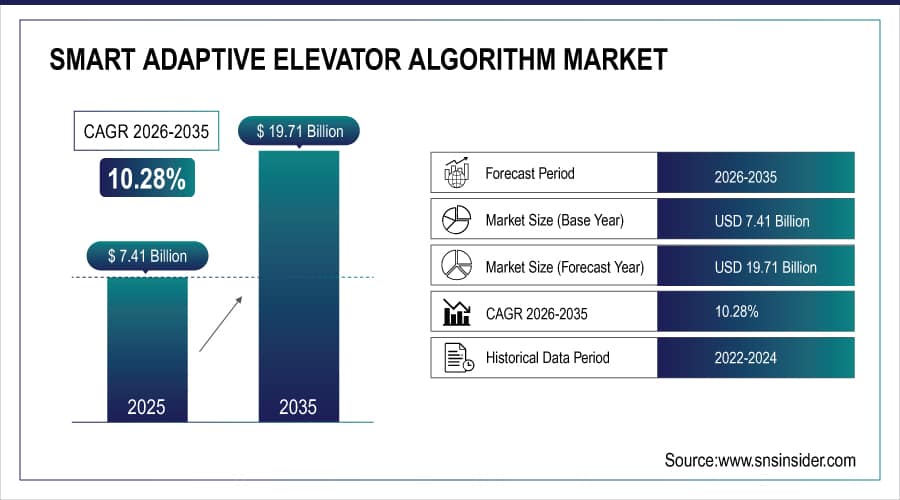
The Smart Adaptive Elevator Algorithm Market size was valued at USD 7.41 Billion in 2025 and is projected to reach USD 19.71 Billion by 2035, growing at a CAGR of 10.28% during 2026-2035.
The Smart Adaptive Elevator Algorithm Market is expanding due to the increasing use of AI, IoT, and predictive analytics to deploy the solution is fostering adoption, supporting energy-saving and increased efficiency. Rising urbanization and space's optimization in both commercial and residential towers also support deployment. Moreover, retrofitting old elevators systems with the use of adaptive algorithms results in enhanced reliability, safety, and usability.
Smart elevators with adaptive control systems can achieve energy savings of 20–40% compared to conventional systems, especially when integrated with regenerative drives and IoT monitoring.
To Get More Information On Smart Adaptive Elevator Algorithm Market - Request Free Sample Report
Key Smart Adaptive Elevator Algorithm Market Trends
-
Increased use of adaptive elevator algorithms because of smart city infrastructure.
-
Predictive maintenance is being facilitated through IoT-enabled platforms and is minimizing downtime and maximizing resource usage.
-
Rising emphasis on energy-saving algorithms & green-certified building norms is stimulating the product demand.
-
Replacement of old elevators in the residential and commercial sector is further driving the market.
-
Rising focus passenger comfort and safety to accelerate market acceptance across the globe.
U.S. Smart Adaptive Elevator Algorithm Market Size Outlook:
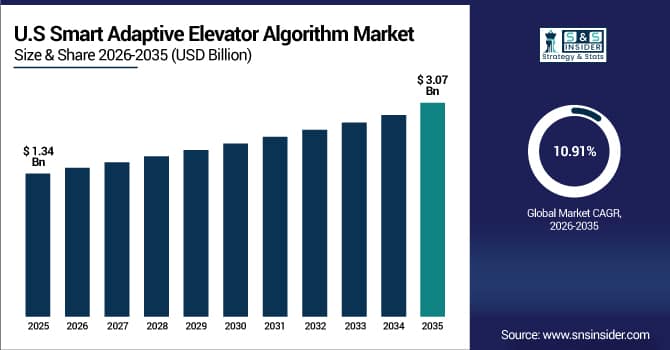
The U.S. Smart Adaptive Elevator Algorithm Market was valued at USD 1.34 Billion in 2025E and is projected to reach USD 3.07 Billion by 2033, growing at a CAGR of 10.91% during 2026-2033. Smart Adaptive Elevator Algorithm Market growth is driven by rise in requirement of efficient vertical transportation in high rise urban structures. New algorithms process dispatches through a more advanced logic to minimize time riders spend waiting and traveling. AI and machine learning integration predict traffic and assign the best car. Real-time IoT and cloud connectivity provides remote monitoring and enablement for remote systems management.
Growing demand for upgrading old elevator systems in commercials and residential buildings drive the market. Improved passenger experience, safety, and reliability add to the business case for implementation. In summary, urbanization and smart city initiatives are driving global market growth.
Market Growth Drivers: Rising urbanization, energy efficiency needs, AI integration, and modernization demand fuel adaptive elevator adoption
The Market of Smart Adaptive Elevator Algorithm is widely driven by the rapid urbanization and the expansion of high-rise construction in need of efficient passenger flow. AI, machine learning combines to ensure traffic flows smoothly with less waiting and travel times. Energy-saving algorithms reduce operation costs and fit well to green objectives. Rising investments for upgrading the outdated elevator systems from commercial and residential sectors also drives the market growth. Increased passenger safety and comfort are driving market acceptance worldwide.
Asia-Pacific accounts for over 55% of new elevator installations in 2025, driven by rapid urbanization in China, India, and Southeast Asia.
Market Restraints: High implementation cost, system integration complexity, cybersecurity risks, and regulatory compliance hinder market expansion
Due to high cost of advanced technology systems in-stalled and maintenance, there are a number of barriers to the market, although it has a good potential. Integration on existing elevators and building management solutions can be a technical challenge. Operational concerns due to cybersecurity risks associated with IoT and cloud connectivity. Compliance and certifications stall deployment. Restricted knowledge in emerging areas also slows down widespread take-up.
Market Opportunities: Smart city initiatives, IoT-enabled modernization, predictive analytics, and green building demand create strong growth potential
The development of smart cities around the world also opens up huge opportunities for adaptive elevator algorithm in the modern infrastructure. Predictive analytics can be done through IoT-enabled platforms, which will provide for reduced downtime and optimum utilization of resources. Access control and energy management system interfaces integrate building intelligence. Increase in the Requirement of Sustainable, Green Certified Buildings Propels the Growth of Energy Efficient Elevator Technologies. Fast-growing urbanizing cities in emerging markets are a huge, untapped area for growth.
There are over 300 active smart city initiatives globally in 2025, with more than 120 cities implementing integrated building automation systems — including smart elevators.
Smart Adaptive Elevator Algorithm Market Segment Analysis
-
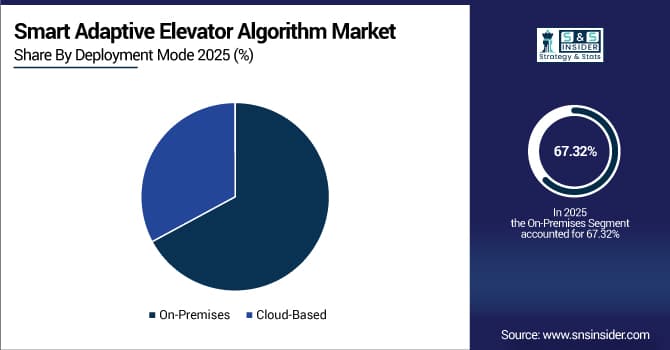
By deployment mode, on-premises solutions led with 67.32% share in 2025, while cloud-based deployment was the fastest-growing segment with a CAGR of 10.61%.
-
By component, software led the market with approximately 46.32% share in 2025, while hardware was the fastest-growing segment with a CAGR of 10.80%.
-
By application, commercial buildings dominated with around 35.23% share in 2025, and residential buildings were the fastest-growing segment with a CAGR of 11.05%.
-
By end-user, real estate developers held approximately 45.63% share in 2025, whereas facility management companies were the fastest-growing segment with a CAGR of 10.86%.
By Deployment Mode, On-Premises Lead While Cloud-Based Registers Fastest Growth
By deployment mode, on-premises segment holds the largest share as the former has a proven track record of the devices installed in the deployed elevator systems. Demand for cloud-based deployment is increasing rapidly, with remote monitoring and real-time data analytics being its key drivers. Seamless IoT and building management system connectivity optimize operations and enable predictive maintenance. Rising demand for smart buildings and digital solutions is leading to the deployment of cloud based solutions.
By Component, Software Leads Market While Hardware Registers Fastest Growth
In 2025, by component, the software segment is expected to dominate the market in terms of share as it has been extensively used in elevator control system. The hardware segment is growing the fastest, due to rising need for emerging sensors, and smart sensing devices. The integration of hardware and software leads to improved system performance and operation efficiency. R&D and upgrading works in the current elevator systems is another factor, which strengthen the market. Increasing demand for energy-efficient and smart elevator systems drive the market growth in both hardware and software segments.
By Application, Commercial Buildings Dominate While Residential Buildings Shows Rapid Growth
In 2025, by application, the market has been segmented into commercial and residential buildings owing to high rise office towers and infrastructure projects. The residential sector is experiencing fast growth enabled by urbanization and the emergence of high-rise apartments. “Both segments are increasingly looking for efficient passenger flow and smart elevator systems.” The retrofitting of already existing buildings, also favors uptake across applications. In general, the importance of convenience, security, and energy efficiency are driving the commercial and residential markets.
By End-User, Real Estate Developers Lead While Facility Management Companies Grow Fastest
In 2025, by end-users, the real estate developer segment is dominating the market as it invests in new high-rise buildings and commercial buildings. The second highest growth is in the facility management companies, for whom the driver is the modernization and maintenance of the existing elevator systems. Growing emphasis on fuel efficiency, safety, and passenger comfort drive adoption across all end-users. Smart, adaptative elevator systems add value to operations for developers and managers.
Smart Adaptive Elevator Algorithm Market Regional Analysis:
Asia-pacific Smart Adaptive Elevator Algorithm Market Insights
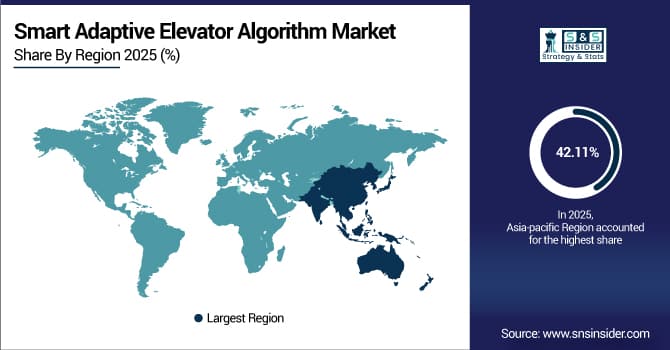
In 2025 Asia-Pacific dominated the Smart Adaptive Elevator Algorithm Market and accounted for 42.11% of revenue share, this leadership is due to the urbanization and erection of high-rise commercial and residential structures. Increase in smart city projects and infrastructure development investments contributes toward market expanding. Growing demand for smart and energy-efficient elevator systems promotes growth within the region.
Get Customized Report as Per Your Business Requirement - Enquiry Now
China Smart Adaptive Elevator Algorithm Market Insights
China is the global leader in the smart adaptive elevator algorithm. The explanation for this dominance lies in the rapid urbanization and high-rising construction in mega metropolitan centers such as Beijing, Shanghai, and Shenzhen. Government initiatives introduced for smart city projects and energy efficient infrastructures will also spur the demand for smart elevator systems.
North America Smart Adaptive Elevator Algorithm Market Insights
North America is expected to witness the fastest growth in the Smart Adaptive Elevator Algorithm Market over 2026-2033, with a projected CAGR of 11.02% due to swift urbanisation and the development of high rise buildings, which call for efficient and effective vertical transportation. AI, IoT, machine learning have made it possible to develop smart elevator algorithms that help in reducing energy consumption by optimising traffic flow. Government programs, which push energy efficiency and green building standards are also helping to drive market penetration.
U.S. Smart Adaptive Elevator Algorithm Market Insights
U.S. in Smart Adaptive Elevator Algorithm growth is fueled by the accelerated urbanization and growing demand for tall buildings in cities such as New York and Chicago that require high-speed vertical transport ion products. Recent advances in AI and IoT technology have empowered elevators to automatically respond to evolving passenger flow -improving efficiency and reducing power consumption.
Europe Smart Adaptive Elevator Algorithm Market Insights
In 2025, Europe emerged as a promising region in the Smart Adaptive Elevator Algorithm Market, due to growing investments towards smart building infrastructure and urban modernization. Integration of AI and IoT based elevator systems to improve efficiency, safety, comfort in commercial and residential high rise buildings. Tight regulations from the energy efficiency and green building movements continue to spur market growth. Growing need to upgrade old elevator systems is aiding in the adoption of flexible algorithms.
Germany Smart Adaptive Elevator Algorithm Market Insights
Germany is expected to grow due to the growing need for energy-saving and intelligent vertical transports in cities. Artificial intelligence (AI) and Internet of Things (IoT) can now allow for elevators to respond in real time to passenger flow, improving efficiency and reducing energy use.
Latin America (LATAM) and Middle East & Africa (MEA) Smart Adaptive Elevator Algorithm Market Insights
The Smart Adaptive Elevator Algorithm Market is experiencing moderate growth in the Latin America (LATAM) and Middle East & Africa (MEA) regions, due to the growing urbanization and infrastructure facilities. Increasing investments in commercial and residential high rise projects is spurring vertical transportation requirements. Use of AI and Internet-of-Things (IoT) based elevators systems are on the rise, which will in turn improve passenger movement and productivity.
Smart Adaptive Elevator Algorithm Market for Competitive Landscape:
Otis is the world’s largest manufacturer and maintainer of elevators, escalators and moving walkways. The company has an extensive range of units operating internationally, particularly within the area of services. Service is a large portion of its sales and operating profit. Otis remains at the forefront of intelligent elevator technology, with a focus on digital transformation and sustainability.
-
In December 2024, Otis introduced new exterior glass elevators at Seattle’s Space Needle as part of a major renovation. These elevators include double-decker versions with glass walls to offer panoramic views. The advanced elevators use energy-efficient motors, reducing power consumption compared to previous models.
KONE is a Finnish company that makes and services elevators and escalators. It works in lots of countries, and focuses on digitization and sustainability. KONE is all about urban mobility that makes the user experience u2013 that little bit better. Its services business is a very important part of its overall business. KONE – a Century of Thinking AheadKONE has been in the business of elevators, escalators and automatic building doors for 100 years.
-
In February 2025, KONE published its Annual Review for 2025, highlighting key achievements and strategic initiatives. The report emphasized innovation, customer-centricity, and sustainability. KONE continues to invest in digital solutions to improve service delivery and operational performance.
Schindler is a Swiss-based global elevator and escalator company. The organisation has operations in multiple countries and concentrates on growth and service operations. Its service business contributes a big chunk of revenue, providing reliable cash flow. Sustainability and innovation are an integral part of Schindler's offering. The firm plans to increase efficiency, safety and passenger experience in its systems.
-
In July 2024, Schindler reported a revenue drop primarily due to currency exchange effects. Despite this, the company exceeded market forecasts. Schindler highlighted strong growth in its modernization business and steady growth in its service unit, improving customer retention.
Thyssenkrupp is a German multinational conglomerate, whose portfolio includes elevator technology. The firm operates around the world, offering products and services across multiple industries. Its elevator part is a large part of its business. The company specializes in techniques of transformation and performance enhancement of business.
-
In May 2024, Thyssenkrupp reported positive performance despite challenging market conditions. The company maintained a stable financial position. Thyssenkrupp continues to focus on its transformation strategy and operational improvements across its business units.
Smart Adaptive Elevator Algorithm Companies are:
-
KONE Corporation
-
Schindler Group
-
Thyssenkrupp AG
-
Mitsubishi Electric Corporation
-
Hitachi Ltd.
-
Fujitec Co. Ltd
-
Hyundai Elevator Co. Ltd.
-
Toshiba Elevator and Building Systems Corporation
-
Sigma Elevator Company
-
Orona Group
-
Express Lifts Ltd.
-
Shanghai Mechanical & Electrical Industry Co. Ltd. (SMEC)
-
Sicher Elevator Co. Ltd.
-
Avire (Halma plc)
-
Motion Control Engineering (MCE)
-
Wittur Group
-
Dover Elevator (now part of Thyssenkrupp)
-
Kleemann Hellas SA
| Report Attributes | Details |
|---|---|
| Market Size in 2025 | USD 7.41 Billion |
| Market Size by 2035 | USD 19.71 Billion |
| CAGR | CAGR of 10.28% From 2026 to 2035 |
| Base Year | 2025 |
| Forecast Period | 2026-2035 |
| Historical Data | 2022-2024 |
| Report Scope & Coverage | Market Size, Segments Analysis, Competitive Landscape, Regional Analysis, DROC & SWOT Analysis, Forecast Outlook |
| Key Segments | • By Component (Software, Hardware, Services) • By Application (Commercial Buildings, Residential Buildings, Industrial Facilities, Hospitals, Airports, and Others) • By Deployment Mode (On-Premises, Cloud-Based) • By End-User (Real Estate Developers, Facility Management Companies, Transportation Hubs, and Others) |
| Regional Analysis/Coverage | North America (US, Canada), Europe (Germany, UK, France, Italy, Spain, Russia, Poland, Rest of Europe), Asia Pacific (China, India, Japan, South Korea, Australia, ASEAN Countries, Rest of Asia Pacific), Middle East & Africa (UAE, Saudi Arabia, Qatar, South Africa, Rest of Middle East & Africa), Latin America (Brazil, Argentina, Mexico, Colombia, Rest of Latin America). |
| Company Profiles | Otis Elevator Company, KONE Corporation, Schindler Group, Thyssenkrupp AG, Mitsubishi Electric Corporation, Hitachi Ltd., Fujitec Co. Ltd., Hyundai Elevator Co. Ltd., Toshiba Elevator and Building Systems Corporation, Johnson Lifts Pvt. Ltd., Sigma Elevator Company, Orona Group, Express Lifts Ltd., Shanghai Mechanical & Electrical Industry Co. Ltd. (SMEC), Sicher Elevator Co. Ltd., Avire (Halma plc), Motion Control Engineering (MCE), Wittur Group, Dover Elevator (now part of Thyssenkrupp), Kleemann Hellas SA. |

Frequently Asked Questions
The Software segment dominated during the projected period.
Asia-Pacific dominated the Smart Adaptive Elevator Algorithm Market in 2025.
Growth is driven by rapid urbanization, high-rise construction, AI and IoT integration, energy efficiency, and modernization of existing elevator systems.
The market was valued at USD 7.41 Billion in 2025 and is projected to reach USD 19.71 Billion by 2035.
The Smart Adaptive Elevator Algorithm Market is expected to grow at a CAGR of 10.28% during 2026–2035.
