
Oil Spill Management Market Report Scope & Overview:
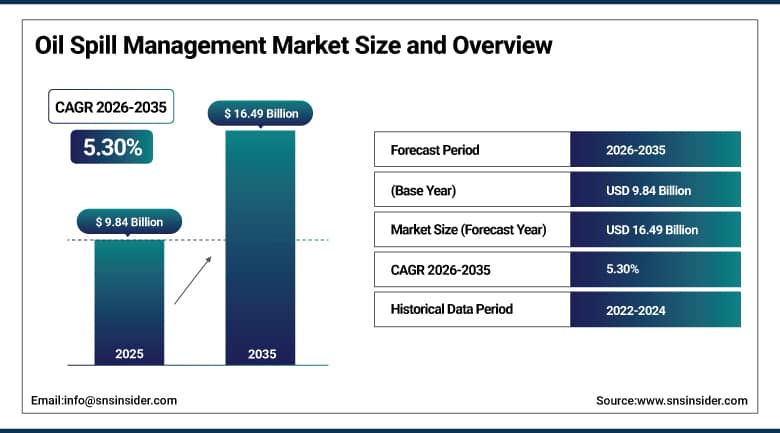
The Oil Spill Management Market was valued at USD 151.95 Billion in 2025 and is expected to reach USD 238.47 Billion by 2035, growing at a CAGR of 4.61% from 2026 to 2035.
The Oil Spill Management Market continues to witness continuous and consistent growth due to increased cases of offshore drilling, increased marine shipping traffic, and more stringent environmental policies requiring quick containment and clean-up of hydrocarbon leaks. Oil spill management technology finds extensive use in offshore rigs, coastal refineries, ports, and maritime traffic routes; this includes preventive technology like double hull vessel construction, hydrocarbon leak sensors, and blowout prevention technology, together with oil containment booms, oil recovery skimmers, sorbents, and chemical dispersants to contain and neutralize hydrocarbon spills. The growth of the market is further catalyzed by increased liability costs due to hydrocarbon spills, increased government spending on national contingency plan infrastructure, and innovation in biodegradation technology.
In 2026, Oil Spill Response Limited (OSRL) and Elastec both expanded their rapid-deployment containment boom and skimmer production capacity to meet growing demand from offshore operators and national response agencies amid tightening spill-liability regulation across North America, Europe, and Asia Pacific shipping corridors.
To Get More Information On Oil Spill Management Market - Request Free Sample Report
Oil Spill Management Market Trends:
-
Rising adoption of autonomous and remotely operated skimming vessels is streamlining offshore spill response operations.
-
Growing use of AI-enabled satellite and drone surveillance is improving early spill detection and containment speed.
-
Increasing preference for biodegradable dispersants and sorbents is reducing the secondary ecological impact of cleanup operations.
-
Expanding national and regional spill contingency stockpiling programs is strengthening rapid-response readiness across major shipping corridors.
-
Strategic collaborations between response organizations and oil & gas operators are accelerating deployment of next-generation containment technologies.
U.S. Oil Spill Management Market Outlook:
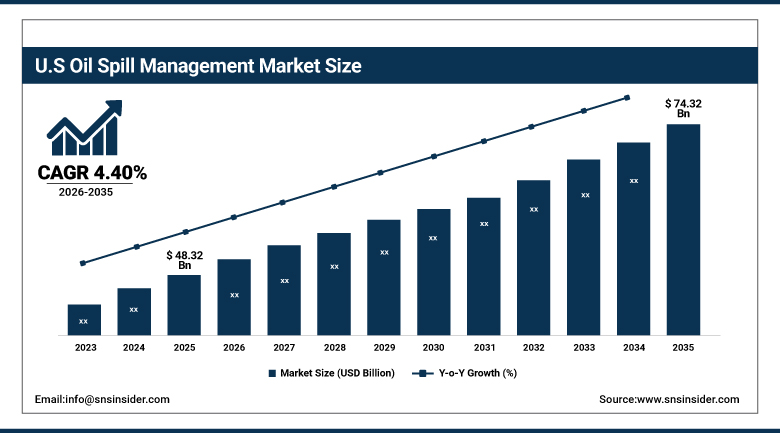
The U.S. Oil Spill Management Market was valued at USD 48.32 Billion in 2025 and is projected to reach USD 74.32 Billion by 2035, growing at a CAGR of 4.40% during 2026-2035.
The leading oil & gas operators, marine terminal authorities, and coast guard agencies within the country continue to strengthen their spill response readiness due to stringent Oil Pollution Act compliance requirements, growing offshore drilling activity in the Gulf of Mexico, and increased frequency of tanker and pipeline transport across domestic waterways.The ability of deploying containment and recovery devices with increasing area contingency plans and regional response team cooperation between the federal and state government agencies guarantees continuous demand for the most advanced spill management technology solutions. Increasing involvement of the private sector in the creation of oil spill response cooperatives on the Gulf Coast and Atlantic Coast also assures the leading role of the United States in the North America Oil Spill Management Market.
In 2026, Elastec expanded its U.S. manufacturing capacity for high-speed offshore skimmers through installation of additional production lines, strengthening its ability to supply rapid-deployment recovery equipment to Gulf Coast operators and national response cooperatives.
Oil Spill Management Market Segment Analysis:
-
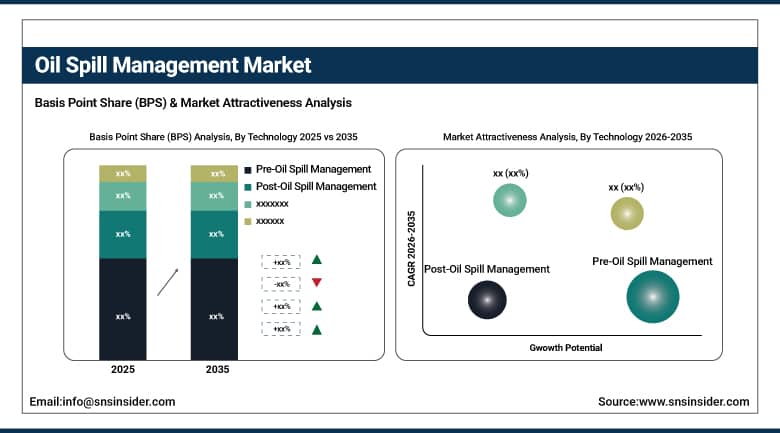
By Technology, Pre-Oil Spill Management dominated the Oil Spill Management Market with a 68.50% share in 2025, while Post-Oil Spill Management is the fastest-growing technology segment with a CAGR of 6.60% from 2026-2035.
-
By Product, Booms dominated the Oil Spill Management Market with a 29.40% share in 2025, while Skimmers is the fastest-growing product segment with a CAGR of 6.80% from 2026-2035.
-
By Application, Offshore dominated the Oil Spill Management Market with a 63.20% share in 2025, while Onshore is the fastest-growing application segment with a CAGR of 6.40% from 2026-2035.
-
By End-Use, Oil & Gas dominated the Oil Spill Management Market with a 47.60% share in 2025, while Marine & Shipping is the fastest-growing end-use segment with a CAGR of 6.30% from 2026-2035.
By Technology, Pre-Oil Spill Management led the market, while Post-Oil Spill Management is the fastest-growing segment.
The Pre-Oil Spill Management segment was the leading contributor in the Oil Spill Management Market. These technologies make up the largest proportion of this technology group because of their wide use on offshore rigs, tankers, and pipelines, whereby double hulls in ships, leak sensors, blowout prevention, and constant pipeline integrity testing drastically decrease the likelihood of hydrocarbon discharge into marine/coastal ecosystems. The history of their reliability in meeting regulatory requirements and the requirement for their use by international marine/offshore drilling conventions, including MARPOL, have maintained their dominant position in preventive technologies in both existing and developing oil producing regions around the world.
The Post-Oil Spill Management segment is expected to witness the highest CAGR during the forecast period 2026-2035. Increasing incidences of accidents such as tankers crashes, pipe bursts and offshore well blowouts are driving the need for quick-response oil booms, powerful oil skimmers, sorbent materials and dispersants that are able to minimize the environmental impact during any spills. The growing regulation of mandatory oil spill preparedness along with the development of contingency supply programs is also fueling the uptake of reactive cleanup technologies.Continuous innovation in bioremediation agents and autonomous recovery vessels is driving the above-average growth rate of this segment relative to the broader oil spill management category.
By Product, Booms led the market, while Skimmers is the fastest-growing segment.
The Booms category held a dominant market share in the Oil Spill Management Market in 2025. Containment booms will still maintain dominance since they are part of the first line of defense in almost all cases involving oil spills because they are effective and quick to deploy. The versatility of containment booms when it comes to different vessel types and equipment in addition to constant developments in terms of the manufacture of booms that can endure harsh weather conditions have made containment booms the ideal first line of defense equipment used by response cooperatives, ports, and offshore companies.
The Skimmers segment is anticipated to grow at the fastest rate during the forecast period 2026-2035. Rising demand for mechanical skimmers that have high recovery rates and can operate under severe marine conditions as well as variable oil viscosity is one of the key factors fueling segment growth among offshore players and response fleets of various countries. Increasing deployment of autonomous and remote-operated skimmers, which not only ensure higher recovery rates but also prevent exposure of responders to harsh environments, is expected to continue to propel segment growth going forward.
By Application, Offshore led the market, while Onshore is the fastest-growing segment.
The Offshore segment dominated the Oil Spill Management Market in 2025. Offshore applications remain the largest category owing to the substantially higher spill volumes and environmental risk associated with deepwater drilling platforms, tanker routes, and subsea pipeline networks, which require specialized vessel-mounted containment and recovery equipment capable of operating in open-water and rough-sea conditions, driving sustained procurement of high-capacity booms, skimmers, and dispersant application systems by offshore operators and marine response cooperatives across major oil-producing basins including the Gulf of Mexico, North Sea, and Persian Gulf.
The Onshore segment is expected to register the fastest CAGR during the forecast period 2026-2035. Growing pipeline network density, rising refinery and storage terminal expansion, and increasing rail and tanker-truck transport of crude oil across inland and coastal regions are driving strong demand for onshore containment barriers, sorbent materials, and soil and groundwater remediation solutions, which help operators and municipal authorities minimize contamination of freshwater bodies, wetlands, and agricultural land following inland pipeline or storage-related spill incidents across expanding oil transportation infrastructure worldwide.
By End-Use, Oil & Gas led the market, while Marine & Shipping is the fastest-growing segment.
The Oil & Gas segment dominated the Oil Spill Management Market in 2025. Upstream and midstream oil & gas operators remain the largest end-use category owing to their direct regulatory obligation to maintain certified spill prevention and response capability across offshore platforms, onshore wells, storage terminals, and pipeline networks, driving sustained procurement of both preventive monitoring systems and reactive containment and recovery equipment across exploration, production, and transportation operations spanning established and emerging hydrocarbon-producing regions worldwide.
The Marine & Shipping segment is expected to register the fastest CAGR during the forecast period 2026-2035. The increase in tanker traffic around the world, expansion of ports and bunkering facilities, and the increasing regulatory pressure on vessels to reduce pollution according to international maritime regulations have increased the demand for spill control kits onboard ships, port facilities for spill containment, and quick response recovery boats as shippers and port authorities strive to be in compliance to avoid any liability and environmental damage resulting from vessel collision and ballasting operations.
Regional Analysis:
|
Region |
Major Country |
Share within Region, 2025 (%) |
|---|---|---|
|
North America |
United States |
86.40% |
|
Europe |
United Kingdom |
26.40% |
|
Asia Pacific |
China |
38.60% |
|
Middle East & Africa |
UAE |
29.80% |
|
Latin America |
Brazil |
41.20% |
North America Oil Spill Management Market Insights
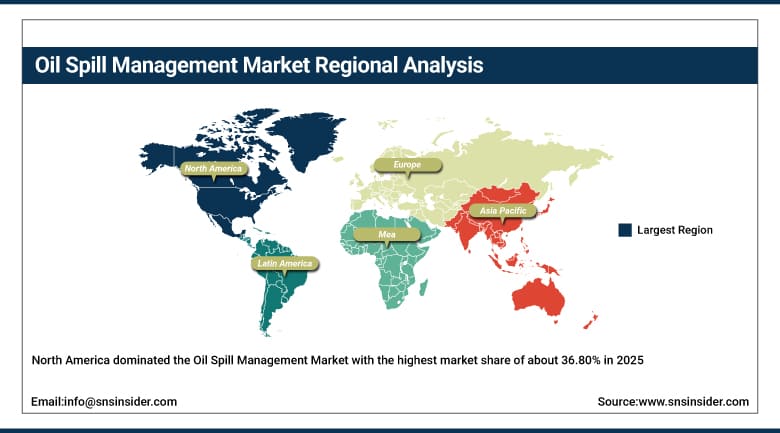
North America dominated the Oil Spill Management Market with the highest market share of about 36.80% in 2025, owing to the region's extensive offshore drilling activity across the Gulf of Mexico, stringent Oil Pollution Act and Clean Water Act compliance requirements, and a well-established network of certified oil spill response cooperatives and Regional Response Teams capable of rapid, large-scale deployment. The region's advanced regulatory framework mandating operator-funded contingency planning, combined with substantial private and federal investment in response vessel fleets, containment equipment stockpiles, and coastal monitoring infrastructure, continues to support strong adoption of both preventive and reactive spill management technologies across offshore and onshore operations.
The US was the leading country within the North America Oil Spill Management Market in 2025 of the regional market, driven by extensive Gulf Coast offshore drilling infrastructure, dense pipeline and tanker transport networks, and strong Coast Guard-coordinated response capability. Canada is contributing to regional growth through its own expanding offshore exploration activity off the Atlantic coast and growing federal investment in Arctic and coastal spill preparedness programs supporting national environmental protection objectives.
Get Customized Report as Per Your Business Requirement - Enquiry Now
Europe Oil Spill Management Market Insights
The Europe region was a major contributor to the Oil Spill Management Market in 2025, expected to register comparatively higher demand for compliance-driven preventive and reactive spill technologies during the forecast period. This is attributed to the region's strong regulatory emphasis on marine environmental protection under EU directives, a well-established North Sea offshore production base, and dense commercial shipping and port activity across member states pursuing stringent vessel-sourced pollution control and coastal ecosystem preservation objectives.
The United Kingdom is one of the major markets in Europe owing to its extensive North Sea offshore production base, along with the presence of leading spill response cooperatives and equipment manufacturers serving both domestic and international operators. Other countries such as Norway, the Netherlands, and Germany, home to significant offshore and port infrastructure, are also contributing to market growth through continued investment in national contingency planning and response fleet modernization.
Asia Pacific Oil Spill Management Market Insights
The Asia Pacific Oil Spill Management Market is expected to witness the fastest growth rate during the forecast period 2026-2035, registering a CAGR of 6.90%. The market growth is driven by rapidly expanding offshore exploration and production activity, growing crude oil import volumes and tanker traffic across major regional ports, and increasing government investment in national spill contingency capability as the region's major and emerging economies pursue stricter marine pollution control standards alongside continued industrialization and energy infrastructure expansion.
China is one of the main growth drivers in the Asia Pacific Oil Spill Management Market, owing to its extensive coastal refining and port infrastructure and rapidly growing domestic response equipment manufacturing capability supporting both local and export-oriented customers. India and South Korea, both major crude oil importers with expanding refining capacity, are also contributing to regional growth through rising investment in port-based containment infrastructure and growing adoption of advanced skimming and dispersant technologies.
Middle East & Africa and Latin America Oil Spill Management Market Insights
Middle East & Africa and Latin American regions are gradually expanding oil spill management adoption as offshore exploration and port infrastructure investment grows across both regions, supported by increasing regional tanker traffic and growing government focus on strengthening national marine pollution contingency standards.
Brazil is set to be a prominent Latin American market fueled by its substantial pre-salt offshore production activity requiring extensive containment and recovery capability and growing domestic response fleet investment. The Middle East & Africa region has the UAE and Saudi Arabia investing in modern port and offshore response infrastructure that is gradually increasing demand for oil spill management solutions across their expanding crude export and refining operations.
Market Dynamics:
Growth Drivers: Rising offshore drilling activity and tightening marine pollution regulation driving market growth
The rising frequency of offshore drilling activity, expanding global tanker and pipeline transport of crude oil, and growing regulatory enforcement of marine and coastal pollution control standards are among the primary drivers of the Oil Spill Management Market. Oil spill management solutions provide operators with the preventive and reactive capability required to minimize environmental damage, regulatory penalties, and reputational risk associated with hydrocarbon discharge incidents, improving compliance and operational resilience across virtually every major offshore drilling, refining, storage, and marine transportation application requiring certified spill response capability, from platform-level leak detection through large-scale coastal remediation operations.
Technological advancements in containment and recovery equipment have significantly increased response efficiency, with recent innovations improving skimmer recovery rates and dispersant biodegradability across commercial response operations. Rising private-sector investment in dedicated response cooperatives, growing integration of autonomous and remotely operated recovery vessels into national contingency fleets, and continued government funding of coastal monitoring and early-detection infrastructure are further supporting demand across the forecast period, as operators and response agencies continue strengthening capability against increasingly stringent liability and environmental compliance requirements.
Restraints: High equipment costs and stringent certification requirements limiting market expansion
One of the most critical obstacles in terms of market growth comes in the form of substantial capital investment required for large-scale containment, recovery, and response fleet infrastructure as compared to the relatively infrequent occurrence of major spill incidents in mature markets. This comes down to the fact that response equipment must remain certified, maintained, and readily deployable despite extended periods of inactivity, which limits smaller operators and response organizations from expanding their equipment stockpiles and readiness capability without substantial ongoing financial commitment.
Moreover, stringent certification, training, and regulatory compliance requirements across different jurisdictions directly impact the pace of equipment deployment and cause procurement delays for both manufacturers and response cooperatives operating across multiple regions. Besides, the high technical requirements in terms of maintaining effective recovery performance across varying oil viscosities, sea states, and environmental conditions, including extreme temperature and weather variability, require considerable ongoing research and development investment from equipment manufacturers.
Opportunities: Expansion of autonomous response technology and bioremediation innovation creating new growth avenues
The increasing need for rapid, large-scale containment and recovery capability across expanding offshore and coastal operations, the rise of autonomous and remotely operated response vessels, and greater emphasis on bioremediation and biodegradable dispersant innovation due to increased funding in environmental biotechnology will provide ample growth opportunities in the Oil Spill Management Market. The need for compliance-driven contingency capability across offshore drilling, refining, and marine transportation operations will ensure future growth due to strict environmental policies worldwide.
There is immense potential for growth in the area of AI-enabled satellite and drone-based early detection systems that reduce response time and containment cost for operators and response agencies. The increase in offshore exploration and port infrastructure investment across emerging economies of Asia Pacific and Latin America, along with government efforts toward strengthening national marine pollution contingency standards, will drive growth in demand for advanced spill management technologies.
Recent Developments:
-
2025: Lamor Corporation introduced its LORI Mini brush skimmer system, designed for rapid deployment in shallow coastal and harbor environments requiring compact, easily transportable recovery equipment.
-
2026: DESMI expanded its RO-BOOM containment boom production line, strengthening its ability to supply rapid-deployment offshore containment systems to national response fleets and marine terminal operators.
-
2026: Oil Spill Response Limited (OSRL) partnered with a leading satellite monitoring provider to integrate AI-based spill detection analytics into its global contingency response network, improving early-warning capability for member operators.
Oil Spill Management Market Key Players are:
-
Oil Spill Response Limited (OSRL)
-
Elastec, Inc.
-
Lamor Corporation Ab
-
DESMI A/S
-
Vikoma International Ltd.
-
Ecolab Inc.
-
Fugro N.V.
-
Clean Harbors, Inc.
-
TETRA Technologies, Inc.
-
Adler and Allan Group
-
National Oilwell Varco Inc. (NOV Inc.)
-
Kemira Oyj
-
New Pig Corporation
-
Brady Corporation
-
3M Company
-
Applied Fabric Technologies, Inc.
-
Slickbar Products Corporation
-
Marine Pollution Control Corporation
-
Global Diving & Salvage, Inc.
-
Veolia Environnement S.A.
Oil Spill Management Market Report Scope:
| Report Attributes | Details |
|---|---|
| Market Size in 2025 | USD 151.95 Billion |
| Market Size by 2035 | USD 238.47 Billion |
| CAGR | CAGR of 4.61% From 2026 to 2035 |
| Base Year | 2025 |
| Forecast Period | 2026-2035 |
| Historical Data | 2022-2024 |
| Report Scope & Coverage | Market Size, Segments Analysis, Competitive Landscape, Regional Analysis, DROC & SWOT Analysis, Forecast Outlook |
| Key Segments | • By Technology (Pre-Oil Spill Management, Post-Oil Spill Management) • By Product (Booms, Skimmers, Dispersants & Sorbents) • By Application (Offshore, Onshore) • By End-Use (Oil & Gas, Marine & Shipping, Government & Municipal Bodies & Others) |
| Regional Analysis/Coverage | North America (US, Canada), Europe (Germany, UK, France, Italy, Spain, Russia, Poland, Rest of Europe), Asia Pacific (China, India, Japan, South Korea, Australia, ASEAN Countries, Rest of Asia Pacific), Middle East & Africa (UAE, Saudi Arabia, Qatar, South Africa, Rest of Middle East & Africa), Latin America (Brazil, Argentina, Mexico, Colombia, Rest of Latin America). |
| Company Profiles | Oil Spill Response Limited (OSRL), Elastec, Inc., Lamor Corporation Ab, DESMI A/S, Vikoma International Ltd., Ecolab Inc., Fugro N.V., Clean Harbors, Inc., TETRA Technologies, Inc., Adler and Allan Group, National Oilwell Varco Inc. (NOV Inc.), Kemira Oyj, New Pig Corporation, Brady Corporation, 3M Company, Applied Fabric Technologies, Inc., Slickbar Products Corporation, Marine Pollution Control Corporation, Global Diving & Salvage, Inc., Veolia Environnement S.A. |

Frequently Asked Questions
Key players include Oil Spill Response Limited (OSRL), Elastec, Inc., Lamor Corporation Ab, DESMI A/S, and Vikoma International Ltd., among others.
Key opportunities include increasing offshore exploration, stringent environmental regulations, rising maritime trade, advancements in oil spill response technologies, and growing demand for rapid containment and remediation solutions.
The market is driven by rising offshore drilling activity, expanding global maritime traffic, tightening marine pollution regulation, and continued innovation in containment and recovery technology.
The Pre-Oil Spill Management segment dominated the Oil Spill Management Market in 2025, accounting for approximately 68.50% market share.
The North America region dominated the Oil Spill Management Market in 2025, holding a market share of 36.80%, driven by extensive offshore drilling activity and stringent marine pollution regulation.
