
Outdoor Lighting Controller Market Report Scope and Overview:
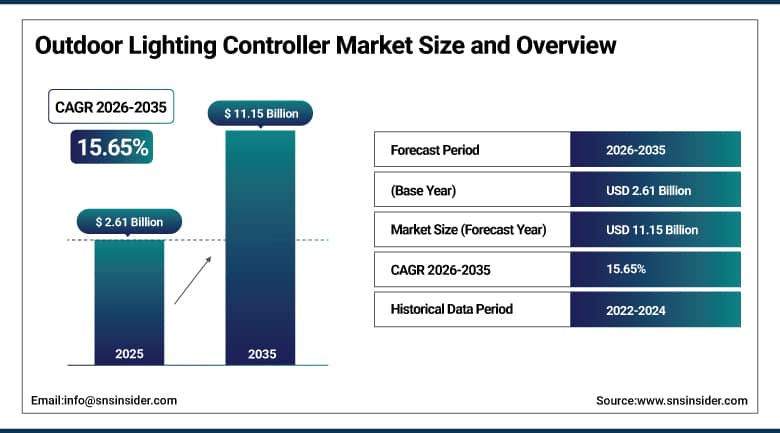
The Outdoor Lighting Controller Market size was valued at USD 2.61 Billion in 2025 and is expected to reach USD 11.15 Billion by 2035, growing at a CAGR of 15.65% from 2026-2035.
Municipalities and commercial property operators are replacing manually switched outdoor fixtures with networked controller systems that can dim, schedule and monitor lighting remotely across entire districts. Hardware remains the largest offering category because every deployment requires physical dimmers, relay units, gateways and sensors regardless of the software layer running on top, while software is the fastest-growing category as cities and campuses shift toward cloud-based centralized management platforms. Wired communication protocols remain favored for new, large installations, while retrofit projects lean on wireless connectivity. North America holds 34.58% share in 2025, while Asia Pacific expands fastest at a CAGR near 18.26% from 2026 to 2035 as regional smart-city programs accelerate deployment.
⮞In August 2026, Acuity Brands' SensorSwitch TLS ODP twist-to-lock outdoor sensor, a photocell and motion-detection control device for outdoor luminaires, was selected for the 2026 IES Progress Report. Recognition of that kind for one of the category's largest controller manufacturers illustrates how directly networked platform investment continues reshaping competitive strategy across the broader outdoor lighting controller industry.
To Get More Information On Outdoor Lighting Controller Market - Request Free Sample Report
Outdoor Lighting Controller Market Trends:
-
Integration of artificial intelligence and predictive analytics into outdoor lighting control platforms is accelerating rapidly.
-
Cloud-based centralized lighting management platforms are increasingly displacing standalone, site-level control systems.
-
Municipal customers are increasingly bundling lighting controllers with broader smart-city sensor and data platforms.
-
Wireless retrofit solutions are gaining share as cities seek to modernize aging infrastructure without extensive rewiring.
-
Component manufacturers are expanding dedicated outdoor-rated controller lines to meet rising demand from large-scale municipal projects.
U.S. Outdoor Lighting Controller Market Size Outlook:
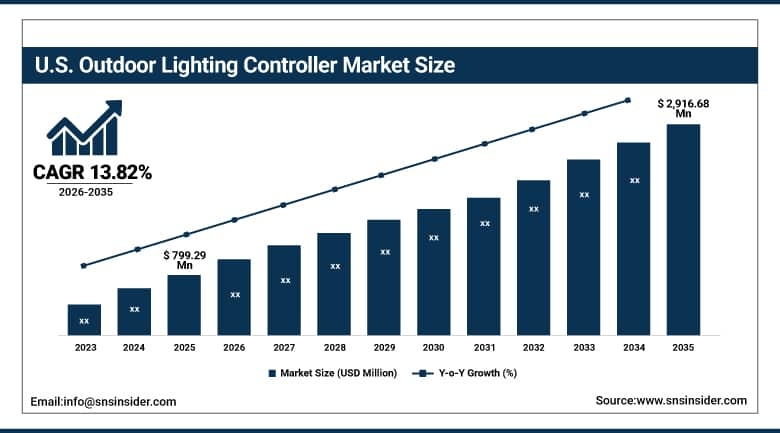
The U.S. Outdoor Lighting Controller Market was valued at USD 799.29 Million in 2025 and is expected to reach USD 2,916.68 Million by 2035, growing at a CAGR of 13.82% from 2026-2035.
U.S. demand is anchored by a large base of municipalities and commercial property operators already committed to multi-year smart-city and energy-efficiency modernization programs. State and local energy codes increasingly require networked lighting controls for new municipal and commercial construction, expanding the addressable base that controller manufacturers can sell into. Utility rebate programs across many states continue subsidizing a meaningful share of retrofit project costs, encouraging faster adoption among budget-constrained municipalities. Controller manufacturers across the country continue expanding dedicated wireless retrofit product lines to meet this shift, keeping the United States the largest single market within North America through the forecast period.
⮞In August 2025, Leviton launched its GreenConnect wireless lighting control system, extending networked dimming and scheduling capability across its outdoor and area lighting controller portfolio for U.S. municipal and commercial customers. A launch of that kind from a leading U.S. electrical and lighting control manufacturer illustrates how directly U.S. product investment continues shaping demand within the United States.
Outdoor Lighting Controller Market Segment Analysis:
-
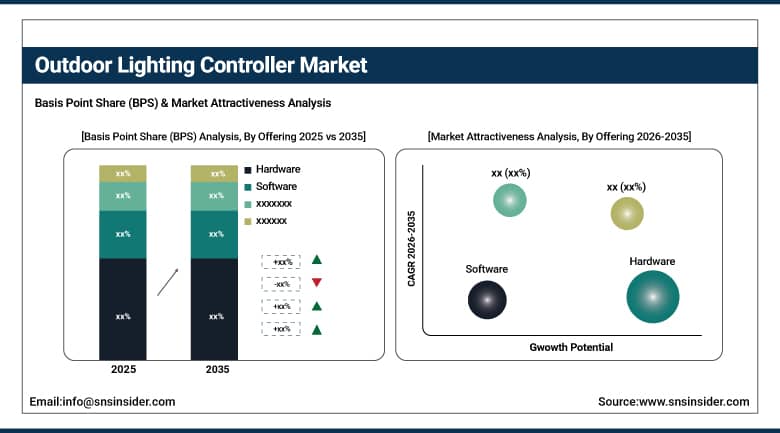
By Offering, the Hardware segment dominated the Outdoor Lighting Controller Market with approximately 64.87% share in 2025, while the Software segment is the fastest growing with a CAGR of approximately 17.92%.
-
By Communication Protocol, the Wired segment dominated the Outdoor Lighting Controller Market with approximately 52.34% share in 2025, while the Wireless segment is the fastest growing with a CAGR of approximately 19.47%.
-
By Installation Type, the Retrofit segment dominated the Outdoor Lighting Controller Market with approximately 61.28% share in 2025, while the New Installation segment is the fastest growing with a CAGR of approximately 16.74%.
-
By End Use, the Street Lighting segment dominated the Outdoor Lighting Controller Market with approximately 33.56% share in 2025, while the Smart Emergency Lighting segment is the fastest growing with a CAGR of approximately 20.13%.
By Offering, Hardware Dominates the Outdoor Lighting Controller Market and Software Grows Fastest
Hardware holds the largest offering share because every outdoor lighting controller deployment, regardless of software sophistication, requires physical dimmers, relay units, gateways and sensors installed at the fixture or distribution level. Municipalities and property operators favor established hardware suppliers specifically for their proven durability in outdoor, weather-exposed environments where equipment failure carries significant replacement and liability cost. Manufacturers continue expanding ruggedized hardware product lines engineered for extreme temperature and moisture conditions across varied geographic deployment sites. Installation necessity and durability requirements are why hardware remains the offering category used across the broadest range of outdoor lighting applications available today.
Software is growing fastest as cities and campuses shift toward cloud-based centralized management platforms that let operators monitor and adjust entire lighting networks remotely rather than visiting individual fixtures. Municipal customers are increasingly bundling software subscriptions with hardware purchases to access predictive maintenance alerts and energy-usage analytics. Software vendors continue expanding platform capabilities to integrate directly with broader smart-city data systems, reducing the need for separate standalone monitoring tools. As centralized management continues displacing standalone site-level control, software is expected to keep growing faster than the broader offering category through 2035.
⮞In June 2026, Legrand launched its Wattstopper FSP-600 Series wireless in-fixture lighting control solution, featuring integrated motion sensing, daylight harvesting, and 0–10V dimming for outdoor and indoor applications.
By Communication Protocol, Wired Dominates the Outdoor Lighting Controller Market and Wireless Grows Fastest
Wired communication protocols hold the largest share because large-scale new installations, particularly municipal street-lighting networks, favor the reliability and interference resistance that hardwired connections provide over extended distances. Engineers specifying new infrastructure projects favor wired systems specifically to avoid the signal interference and battery-maintenance burden that wireless networks can introduce across sprawling sites. Manufacturers continue refining wired protocol standards to simplify installation across large municipal and commercial lighting networks. Reliability and installation simplicity are why wired protocols remain the communication category used across the broadest range of new-build outdoor lighting applications today.
Wireless protocols are growing fastest as retrofit projects, which still represent the largest share of total deployments, increasingly favor connectivity that avoids the cost and disruption of running new cabling through existing infrastructure. Municipalities retrofitting aging street-lighting networks favor wireless controllers specifically to avoid the trenching and rewiring cost that wired upgrades would otherwise require. Technology providers continue expanding mesh-network wireless protocols engineered specifically for sprawling, geographically dispersed municipal lighting networks. As retrofit's large installed base continues favoring easier wireless upgrades, wireless protocols are expected to keep growing faster than the broader communication category through 2035.
By Installation Type, Retrofit Dominates the Outdoor Lighting Controller Market and New Installation Grows Fastest
Retrofit projects hold the largest installation-type share because most municipalities and commercial property operators already have extensive outdoor lighting infrastructure in place that predates modern networked controller technology. Municipal budget cycles favor retrofit projects specifically because they can be phased incrementally across multiple fiscal years rather than requiring a single large capital outlay. Controller manufacturers continue expanding retrofit-specific product lines engineered to integrate with legacy fixture wiring and mounting hardware. Existing infrastructure and budget flexibility are why retrofit projects remain the installation-type category used across the broadest range of outdoor lighting applications today.
New installation projects are growing fastest as expanding urban development and greenfield smart-city programs increasingly specify networked controllers from the outset rather than retrofitting conventional fixtures later. Developers building new commercial and residential districts increasingly specify networked lighting controllers as a standard infrastructure requirement rather than an optional upgrade. Government smart-city programs in several countries are mandating networked lighting controls for all new public infrastructure projects. As greenfield development and smart-city mandates continue expanding, new installation is expected to keep growing faster than the broader installation-type category through 2035.
By End Use, Street Lighting Dominates the Outdoor Lighting Controller Market and Smart Emergency Lighting Grows Fastest
Street lighting holds the largest end-use share because municipal road networks represent the single largest, most standardized application for networked outdoor lighting controllers across nearly every country and city government. Municipal governments favor networked street-lighting controllers specifically for the energy savings and maintenance-cost reduction that centralized dimming and fault detection deliver across large fixture counts. Controller manufacturers continue expanding dedicated street-lighting product lines engineered for pole-mounted, high-fixture-count deployments. Standardization and energy-saving incentive are why street lighting remains the end-use category used across the broadest range of outdoor lighting applications today.
Smart emergency lighting is growing fastest as municipalities and campus operators increasingly integrate automated emergency-response lighting behavior into broader networked control platforms rather than maintaining separate standalone emergency systems. Public safety officials increasingly specify networked emergency lighting that can automatically brighten or redirect illumination during security incidents or natural disasters. Technology providers are expanding dedicated emergency-lighting integration modules specifically to meet rising demand from campus and municipal safety programs. As integrated emergency-response lighting continues gaining specification priority, this end-use category is expected to keep growing faster than the broader category through 2035.
⮞In March 2025, Itron partnered with the City of Helsingborg, Sweden, to deploy its CityEdge platform and networked lighting controllers as part of an initial upgrade covering the city's 30,000 streetlights.
Regional Analysis:
|
Region |
Major Country |
Share within Region, 2025 (%) |
|---|---|---|
|
North America |
United States |
88.73 |
|
Europe |
United Kingdom |
24.18 |
|
Asia Pacific |
China |
31.57 |
|
Latin America |
Brazil |
42.39 |
|
Middle East and Africa |
Saudi Arabia |
26.74 |
North America Outdoor Lighting Controller Market Insights
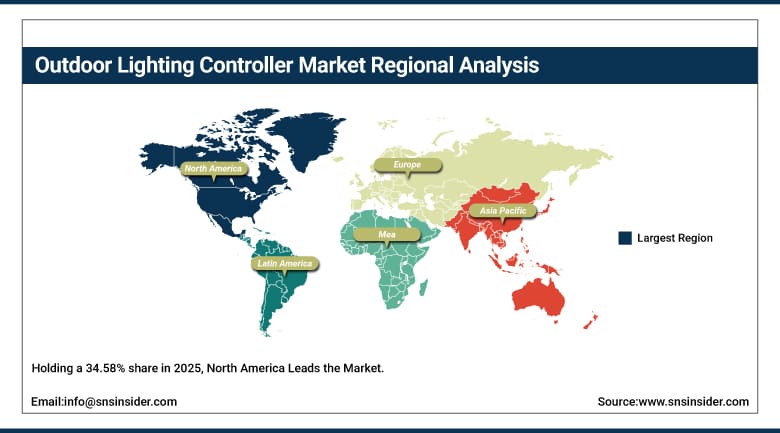
Holding a 34.58% share in 2025, North America leads the market on the strength of its technologically advanced deployment base spanning highways, commercial districts and residential developments across the United States and Canada. The United States supplies 88.73% of regional output, anchored by major controller manufacturers and a dense network of municipal smart-city programs. Canada contributes a smaller but steady share, supported by provincial energy-efficiency mandates closely integrated with the broader North American regulatory framework. Technological maturity and manufacturer concentration are why North America remains the largest region, despite faster percentage growth concentrating in newer markets elsewhere.
State and local governments continue expanding energy-code requirements mandating networked lighting controls for new commercial and municipal construction projects. Utility rebate programs throughout the United States and Canada continue subsidizing retrofit project costs, reinforcing regional adoption beyond new-construction mandates alone. Component and semiconductor supply availability continues shaping how quickly manufacturers can fulfill rising controller demand across large municipal contracts. As energy-code expansion and rebate availability continue reinforcing each other, North America is expected to remain a leading market through most of the forecast period to 2035.
⮞On September 23, 2025, Signify's Genlyte Solutions business completed an upgrade of nearly 52,000 streetlights across Washington, D.C. under the city's Smart Street Lighting Project, installing connectable Lumec RoadFocus Plus LED luminaires with DALI-2 drivers for remote monitoring and control.
Get Customized Report as Per Your Business Requirement - Enquiry Now
Europe Outdoor Lighting Controller Market Insights
Europe's market is anchored by a cluster of established lighting control manufacturers headquartered in the United Kingdom, Germany and France that have driven early networked outdoor lighting adoption across Western Europe. The United Kingdom anchors regional demand through its large municipal infrastructure base and strong government funding for energy-efficiency modernization programs. Germany and France contribute substantial additional demand, supported by dense manufacturing clusters and established smart-city pilot programs. Manufacturing density and government funding are why Europe remains an important region, relative to its moderate percentage growth outlook through the forecast period.
The European Union continues tightening energy-efficiency requirements for public lighting infrastructure, a steady pressure that shapes how municipalities specify new and retrofit controller projects across multiple national programs, while cross-border collaboration among European lighting manufacturers and standards bodies accelerates shared interoperability protocol development. Even with slower funding growth relative to Asia Pacific, Europe's manufacturing leadership is expected to keep the region an influential market through most of the forecast period to 2035.
⮞In July 2026, Schréder secured a five-year, USD 663,829 (GBP 496,469) contract with the London Borough of Haringey to provide its EXEDRA central management system for monitoring and controlling streetlights, highways, parks, and other external lighting assets.
Asia Pacific Outdoor Lighting Controller Market Insights
Asia Pacific is the fastest-growing region, projected to expand at a CAGR of approximately 18.26% from 2026 to 2035, as China, Japan, India and South Korea accelerate smart-city infrastructure investment across rapidly urbanizing metropolitan areas. China anchors regional demand, supported by large-scale government smart-city funding programs and a rapidly expanding base of local controller manufacturers. India contributes rising demand tied to expanding municipal infrastructure budgets and government-led street-lighting modernization initiatives. Government funding and rapid urbanization give Asia Pacific the fastest expansion trajectory among all regions today.
Controller manufacturers across China, India and South Korea are extending established manufacturing expertise into new international markets, producing for both local smart-city programs and growing export demand. Government infrastructure agencies across several Asia Pacific markets continue updating technical standards to accommodate networked lighting control technology, while local system integrators expand dedicated installation and maintenance service capacity to support rising municipal project volume. As government funding and manufacturing capacity continue expanding together, Asia Pacific's share of global outdoor lighting controller demand is expected to keep increasing through 2035 at a pace other regions are unlikely to match.
⮞On September 1, 2025, Wipro Lighting introduced Voyage, India's first Dark Sky-cleared streetlight, extending precise outdoor lighting control technology to municipal customers across India and broader Asia Pacific markets. A launch of that kind from a leading Asia-Pacific lighting control manufacturer illustrates how directly regional manufacturing investment continues driving new deployment capacity.
MEA & Latin America Outdoor Lighting Controller Market Insights
The Middle East and Africa region remains a comparatively small but steadily growing outdoor lighting controller market, with Saudi Arabia accounting for the largest regional share on the strength of its large-scale smart-city infrastructure investment and government-funded urban development initiatives. The United Arab Emirates contributes additional demand as rising smart-city investment broadens access to networked lighting infrastructure. South Africa anchors demand across the African continent, supported by an established municipal infrastructure base more developed than most neighboring markets. Most remaining markets across the region continue to rely on imported controller hardware, since few have begun developing local manufacturing capacity of their own.
⮞In November 2024, FLASHNET partnered with Saudi Delta Group to deploy 5,700 inteliLIGHT smart street-lighting controllers across Jeddah, Saudi Arabia, combining individual-lamp and cabinet-level control over a LoRaWAN network.
Latin America's outdoor lighting controller demand is tied closely to expanding municipal infrastructure investment, with Brazil accounting for the largest regional share on the strength of its large municipal base and well-developed local electrical manufacturing industry. Argentina and Chile contribute additional demand tied to expanding municipal modernization programs and growing smart-city pilot projects. Several Latin American currencies have remained volatile enough to complicate long-term pricing and import planning for international manufacturers operating on thin margins, yet the region's expanding municipal infrastructure base is still expected to support steady outdoor lighting controller demand growth through most of the forecast period to 2035.
Market Dynamics:
Growth Drivers: Energy regulation and smart-city investment are lifting global demand
Government regulations and incentive programs promoting LED adoption and energy efficiency continue expanding the addressable base of municipalities and property operators willing to invest in networked lighting controllers. Municipalities are increasingly treating networked controllers as a standard requirement for new infrastructure projects rather than an optional energy-saving upgrade. Technology providers continue publishing new platform capabilities that expand what municipal customers can monitor and control without adding proportional staffing. Together these forces are expanding the addressable outdoor lighting controller market across a broader range of municipal and commercial applications than in prior years.
A second driver is the broader smart-city investment movement, as municipal governments increasingly bundle lighting controller deployment with wider sensor and data-infrastructure programs rather than treating lighting as a standalone upgrade. Cities are responding by issuing larger, multi-year infrastructure contracts that favor established controller manufacturers with proven smart-city integration experience. Technology providers are expanding dedicated smart-city integration teams specifically to support these larger, more complex municipal contracts. As smart-city investment continues broadening beyond lighting alone, this trend is expected to keep expanding outdoor lighting controller demand through 2035.
⮞In March 2026, ABB expanded its EH3 outdoor enclosure line, adding GRP cabinets built to house the communication modules and energy-management systems used in networked outdoor lighting control installations. Portfolio investment of that scale from one of the category's largest industrial automation manufacturers illustrates how directly energy-regulation-driven demand continues shaping category-wide growth.
Restraints: Component supply constraints and installation cost slow broader category expansion
Semiconductor and electronic component supply constraints continue limiting how quickly manufacturers can fulfill rising controller demand, particularly during periods of broader industry-wide chip shortages affecting multiple end markets simultaneously. Manufacturers without diversified component sourcing must either absorb longer lead times or pay premium pricing to secure priority chip allocation, and smaller manufacturers in particular struggle to secure the component volumes that larger, better-capitalized competitors can readily negotiate through long-term supplier contracts. These pressures weigh most heavily on companies without the purchasing leverage to absorb a costly component-driven production delay.
High upfront installation cost also constrains broader category expansion, since networked controller systems typically carry higher initial capital expenditure than the manually switched fixtures they are replacing across most municipal budgets. Municipalities without dedicated energy-efficiency financing must either delay modernization projects or secure external financing that adds long-term repayment obligations, a choice that is sharpest for budget-constrained municipalities in developing regions balancing lighting modernization against competing infrastructure spending needs. Combined, component supply constraints and installation cost represent the category's most persistent restraint on broader municipal expansion.
Opportunities: AI integration and cloud platforms open new revenue paths
Investment in artificial intelligence and predictive analytics integration is accelerating as municipalities seek to extract more operational value from lighting networks than manual monitoring alone could provide across increasingly complex deployments. Companies that successfully combine networked hardware with predictive maintenance software are positioned to capture share from competitors still reliant entirely on reactive, fault-driven service models. Technology providers are expanding dedicated analytics platforms specifically to meet rising municipal demand for these efficient tools. Technical advantage and sustained provider investment give well-capitalized companies a credible path toward meaningful, lasting long-term share across this category over the next decade.
A second opportunity lies in cloud-based centralized management platforms, as municipalities increasingly seek to consolidate lighting control with broader smart-city data infrastructure rather than maintaining separate standalone systems. Companies offering unified cloud platforms benefit from municipal customers' growing preference for single-vendor relationships across multiple infrastructure categories. Technology providers pursuing this strategy are capturing established municipal relationships faster than competitors building cloud capability through acquisition alone. Companies continuing this unified-platform strategy are positioned to capture growth that standalone lighting-only platforms will likely cede more slowly across the broader category over the coming decade.
Recent Developments:
-
In January 2026, Legrand's Wattstopper brand and Visionaire Lighting announced a unified approach to networked lighting controls for outdoor lighting applications.
-
In May 2026, ST Engineering Telematics Wireless was selected by Georgia Power to deploy 50,000 T-Light cellular NB-IoT lighting control units across multiple Georgia counties, integrating its BrightCity platform with Georgia Power's TerraGo operations software.
-
In April 2025, MinebeaMitsumi deployed its Smart Streetlight and Smart Gateway units across the Expo 2025 Osaka, Kansai, Japan site, connecting fixtures over a proprietary mesh network to a central management system for wireless lighting control, remote monitoring and scheduling.
Outdoor Lighting Controller Companies are:
-
Acuity Brands, Inc.
-
Schréder Group
-
Signify (Interact City)
-
Wipro Lighting
-
FLASHNET (Lucy Group)
-
ABB Ltd.
-
Dimonoff Inc.
-
Leviton Manufacturing Co., Inc.
-
Legrand SA
-
HLI Solutions (Current Lighting)
-
Itron, Inc.
-
Paradox Engineering (MinebeaMitsumi)
-
Tvilight
-
ST Engineering Telematics Wireless
Outdoor Lighting Controller Market Report Scope:
| Report Attributes | Details |
|---|---|
| Market Size in 2025 | USD 2.61 Billion |
| Market Size by 2035 | USD 11.15 Billion |
| CAGR | CAGR of 15.65% From 2026 to 2035 |
| Base Year | 2025 |
| Forecast Period | 2026-2035 |
| Historical Data | 2022-2024 |
| Report Scope & Coverage | Market Size, Segments Analysis, Competitive Landscape, Regional Analysis, DROC & SWOT Analysis, Forecast Outlook |
| Key Segments | • By Offering (Hardware, Software, and Services) • By Communication Protocol (Wired, Wireless, and Hybrid) • By Installation Type (Retrofit and New Installation) • By End Use (Street Lighting, Highways & Roadways, Architectural Lighting, and Smart Emergency Lighting) |
| Regional Analysis/Coverage | North America (US, Canada), Europe (Germany, UK, France, Italy, Spain, Russia, Poland, Rest of Europe), Asia Pacific (China, India, Japan, South Korea, Australia, ASEAN Countries, Rest of Asia Pacific), Middle East & Africa (UAE, Saudi Arabia, Qatar, South Africa, Rest of Middle East & Africa), Latin America (Brazil, Argentina, Mexico, Colombia, Rest of Latin America). |
| Company Profiles | Acuity Brands, Inc., Schréder Group, Signify (Interact City), Wipro Lighting, FLASHNET (Lucy Group), ABB Ltd., Dimonoff Inc., Leviton Manufacturing Co., Inc., Legrand SA, HLI Solutions (Current Lighting), Itron, Inc., Paradox Engineering (MinebeaMitsumi), Tvilight, ST Engineering Telematics Wireless. |

Frequently Asked Questions
The market includes Acuity Brands, Schréder, Signify (Interact City), Wipro Lighting, FLASHNET, ABB, Dimonoff, Leviton, Legrand, HLI Solutions, Itron, Paradox Engineering (MinebeaMitsumi), Tvilight and ST Engineering Telematics Wireless, among others.
The main opportunities lie in artificial intelligence and predictive analytics integration for operational efficiency, and in cloud-based centralized management platforms consolidating lighting with broader smart-city infrastructure.
The key growth factor is government regulations and incentives promoting LED adoption and energy efficiency, combined with expanding smart-city infrastructure investment.
By offering, the Hardware segment dominated the market with approximately 64.87% share in 2025, supported by its role as a foundational requirement across every deployment.
North America dominated the market with approximately 34.58% share in 2025, supported by its technologically advanced deployment base. Asia Pacific is the fastest-growing region with a projected CAGR of approximately 18.26% from 2026 to 2035.
