
Pediatric Wheelchair Market Report Scope & Overview:
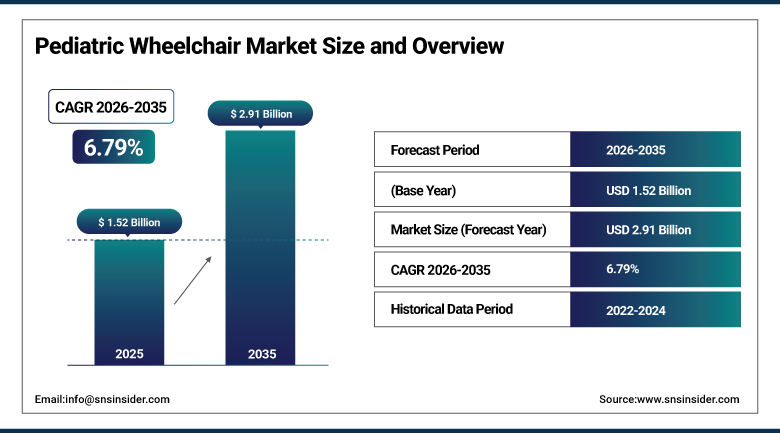
The Pediatric Wheelchair Market was valued at USD 1.52 Billion in 2025 and is expected to reach USD 2.91 Billion by 2035, growing at a CAGR of 6.79% from 2026 to 2035.
The pediatric wheelchair market holds a highly significant place in the worldwide field of assistive technologies and pediatric medical devices by addressing the developmental and independent movement needs of pediatric patients with a variety of disabilities, neuromuscular diseases, and congenital issues which impair their ability to move around independently and participate fully in all the activities of daily life. The market's business environment can be traced back to a rise in the prevalence of disabilities amongst children throughout the world, increased awareness among healthcare practitioners and carers about the key role that early mobility intervention plays, and a greater level of public health care funding for pediatric rehabilitation services and assistive technologies.
According to the World Health Organization (WHO), an estimated 95 million children globally live with a disability, with 13 million experiencing severe functional difficulties, reinforcing the growing need for pediatric mobility and rehabilitation solutions worldwide.
To Get more information Pediatric Wheelchair Market - Request Free Sample Report
Pediatric Wheelchair Market Trends
-
Early-age power mobility prescriptions are increasing demand for powered pediatric wheelchairs.
-
Lightweight carbon fiber and titanium frames are enhancing wheelchair performance and user independence.
-
Expanding reimbursement coverage is improving access to advanced pediatric mobility solutions.
-
Smart wheelchairs with pressure monitoring and remote configuration features are gaining adoption.
-
Growing focus on inclusive education is driving pediatric wheelchair procurement in schools and rehabilitation facilities.
The U.S. Pediatric Wheelchair Market Outlook
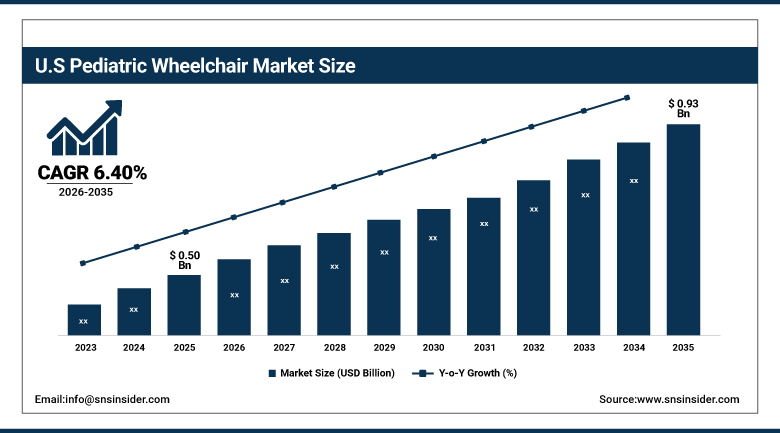
The U.S. Pediatric Wheelchair Market was valued at USD 0.50 Billion in 2025 and is expected to reach USD 0.93 Billion by 2035, growing at a CAGR of 6.40%.
The United States stands out as the most mature and technologically advanced market for pediatric wheelchairs in the world due to the presence of a very developed and clinically advanced rehabilitation framework, fully developed insurance systems both public and private, and a very well-developed medical technology supply chain. The strength of demand for advanced pediatric mobility solutions in the U.S. market arises from the advanced clinical experience and knowledge of the pediatric physiatrists, occupational therapists, and rehabilitation engineers, who prescribe highly customized pediatric wheelchair platforms based on high clinical standards.
Sunrise Medical LLC, a leading global manufacturer of manual and power wheelchairs, reported continued strong U.S. demand for its pediatric wheelchair product lines, noting that growing clinical emphasis on early mobility intervention, expanding therapist education programs focused on pediatric seating and positioning, and increasing insurance recognition of complex rehabilitation technology as medically necessary are collectively supporting favorable growth dynamics across its U.S. pediatric mobility product portfolio.
Pediatric Wheelchair Market Segment Analysis
-
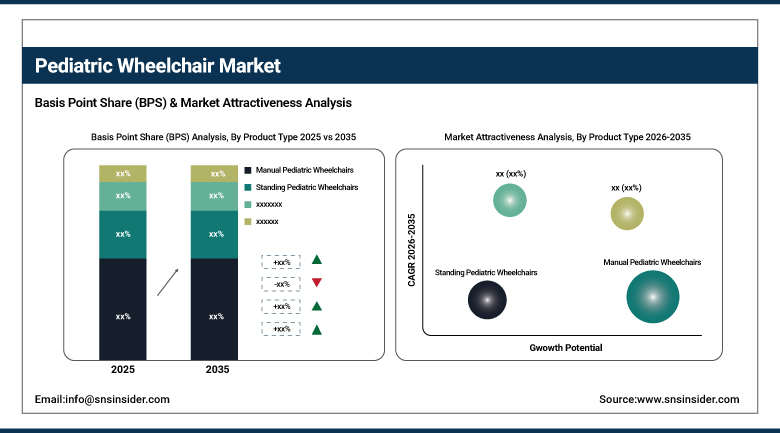
By Product Type, manual pediatric wheelchairs dominated the market with 36.15% share in 2025, while powered/electric pediatric wheelchairs are the fastest growing product type with the highest CAGR of 7.49% from 2026 to 2035.
-
By Application, cerebral palsy dominated the market with 42.05% share in 2025, while muscular dystrophy is the fastest growing application with the highest CAGR of 8.13% from 2026 to 2035.
-
By End User, hospitals & pediatric clinics dominated the market with 38.06% share in 2025, while home care settings are the fastest growing end user segment with the highest CAGR of 7.59% from 2026 to 2035.
-
By Distribution Channel, direct sales dominated the market with 32.19% share in 2025, while online sales channels are the fastest growing distribution channel with the highest CAGR of 8.41% from 2026 to 2035.
By Product Type, Manual pediatric wheelchairs dominate the pediatric wheelchair market, while powered/electric pediatric wheelchairs are the fastest-growing segment.
Manual Pediatric Wheelchairs segment dominated the market with the highest revenue share of 36.15% in 2025 owing to their broad clinical applicability across ambulatory assistance, temporary mobility support, and active independent use applications, their lower acquisition cost relative to powered alternatives that supports higher prescription volumes across diverse healthcare and insurance funding environments, and the established clinical familiarity of therapists and prescribers with manual wheelchair assessment and fitting protocols that sustains consistent prescription practices across the global pediatric rehabilitation community.
Powered/Electric Pediatric Wheelchairs segment is estimated to register the highest CAGR during the forecast period of 2026–2035, driven by the growing clinical consensus supporting early power mobility prescription for young children with neuromuscular conditions and limited upper extremity function, including cerebral palsy, spinal muscular atrophy, and Duchenne muscular dystrophy, where independent powered mobility has been demonstrated to deliver significant cognitive, social, and developmental benefits beyond the primary functional mobility advantage.
By Application, Cerebral palsy dominates the pediatric wheelchair market, while muscular dystrophy is the fastest-growing segment.
Cerebral Palsy segment dominated the pediatric wheelchair market with the highest revenue share of 42.05% in 2025 due to the condition's status as the most prevalent cause of childhood physical disability globally, affecting 2–3 per 1,000 live births and generating substantial and consistent demand for the full spectrum of pediatric wheelchair product categories from active manual chairs for ambulatory cerebral palsy through highly configurable tilt-in-space and standing systems for more involved presentations.
Muscular Dystrophy segment is anticipated to record the fastest CAGR throughout the forecast period of 2026–2035 driven by the progressive nature of Duchenne and Becker muscular dystrophy disease courses that typically require multiple wheelchair system transitions from initial manual chairs in early ambulatory decline phases through full-time power wheelchair dependence in later disease progression, generating recurring device replacement and upgrade procurement demand across affected patients' clinical journeys.
By End User, Hospitals & pediatric clinics dominate the pediatric wheelchair market, while home care settings are the fastest-growing segment.
Hospitals & Pediatric Clinics segment dominated the pediatric wheelchair market with the highest revenue share of 38.06% in 2025. Owing to their role as the primary clinical setting for pediatric wheelchair assessment, prescription, and fitting, particularly for complex rehabilitation technology cases requiring multidisciplinary seating and mobility evaluation by physiatrists, occupational therapists, physical therapists, and rehabilitation engineers working collaboratively to specify individually appropriate wheelchair systems for pediatric patients with complex positioning and mobility needs.
Home Care Settings segment is projected to witness the fastest CAGR during 2026–2035 reflecting the broader global healthcare trend toward home-based care delivery and community integration for children with disabilities, supported by expanding home nursing and therapy programs, growing caregiver education and training resources, and increasing recognition among families and healthcare payers of the developmental, psychological, and quality-of-life benefits of maintaining pediatric wheelchair users in home and community settings rather than institutional care environments.
By Distribution Channel, specialty mobility equipment dealers dominate the pediatric wheelchair market, while online sales channels are the fastest-growing segment.
Direct Sales dominated the pediatric wheelchair market with a 32.19% share in 2025, primarily due to the specialized and highly customized nature of pediatric mobility solutions. Most pediatric wheelchair purchases require professional assessment, seating evaluation, fitting services, and ongoing clinical support, making direct engagement between manufacturers, rehabilitation centers, hospitals, therapists, and caregivers essential. Direct sales channels also facilitate customization of seating systems, postural support components, growth-adjustable features, and powered mobility configurations, contributing significantly to their market leadership across developed healthcare systems.
Online Sales Channels segment is projected to register the highest CAGR during the forecast period of 2026–2035. It is driven by expanding e-commerce adoption across medical device procurement, growing availability of standardized pediatric wheelchair products and accessories through online retail platforms, and increasing caregiver comfort with direct online procurement for replacement components, accessories, and standard equipment items that do not require complex clinical assessment or custom fitting.
Regional Analysis
|
Region |
Major Country |
Share within Region, 2025 (%) |
|---|---|---|
|
North America |
United States |
87.54% |
|
Europe |
Germany |
31.39% |
|
Asia Pacific |
China |
39.11% |
|
Middle East & Africa |
UAE |
29.71% |
|
Latin America |
Brazil |
37.43% |
North America Pediatric Wheelchair Market Insights
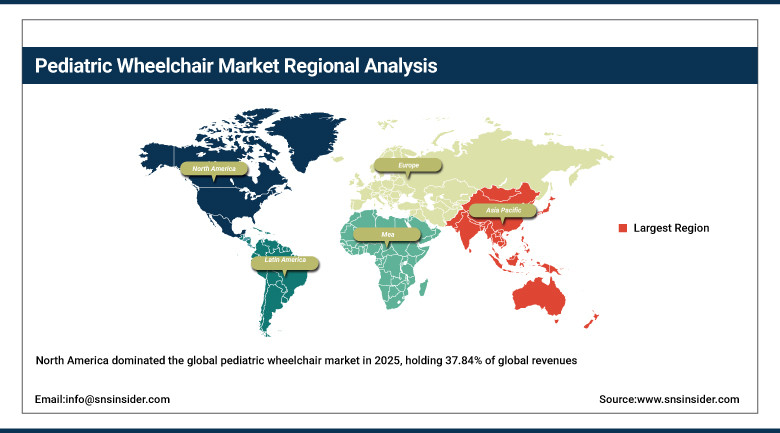
North America dominated the global pediatric wheelchair market in 2025, holding 37.84% of global revenues, given that the US accounts for 87.54% of the revenue generated by the region. This dominant presence is characterized by a remarkable combination of state-of-the-art clinical facilities, wide-ranging access to insurance as well as public funding for assistive technologies for pediatric patients, a highly developed rehabilitation technology supply chain, and significant awareness among families, clinicians, and policymakers about the developmental importance of early childhood mobility interventions. Canada contributes significantly to the regional market through universal healthcare coverage for pediatric mobility devices and a strong network of pediatric rehabilitation centers and children's hospitals.
The Assistive Technology Industry Association estimates that the North American rehabilitation technology market, of which pediatric mobility equipment represents a growing segment, generates over USD 4 billion annually, with sustained growth driven by demographic trends, evolving clinical standards, and expanding public and private insurance coverage of medically necessary assistive technology devices for pediatric patients with qualifying conditions.
Get Customized Report as per Your Business Requirement - Enquiry Now
Europe Pediatric Wheelchair Market Insights
European pediatric wheelchair market represents the second-largest regional market globally, characterized by a sophisticated clinical rehabilitation ecosystem, comprehensive national healthcare system coverage of pediatric assistive technology in most major markets, and a strong domestic manufacturing and innovation base that includes several globally significant pediatric wheelchair brands headquartered in Germany, Sweden, Italy, and the United Kingdom. Germany leads European revenues as the region's largest economy and a historically important center of rehabilitation technology development, with its statutory health insurance system providing broad coverage for medically indicated pediatric wheelchair equipment and its well-organized rehabilitation technology dealer network supporting high-quality clinical provision pathways for pediatric patients requiring mobility assistance.
The European medical device market for rehabilitation and assistive technology generates over EUR 8 billion annually, with pediatric mobility equipment representing a strategically growing segment supported by demographic trends, evolving disability policy frameworks, and the continued development of sophisticated clinical pathways for pediatric wheelchair assessment and provision across major EU healthcare systems.
Asia Pacific Pediatric Wheelchair Market Insights
Asia Pacific is the fastest-growing regional pediatric wheelchair market, projected to expand at a CAGR of 7.67% through 2035.It is driven by rapidly expanding healthcare infrastructure, growing awareness of pediatric disability rehabilitation needs, and increasing government investment in assistive technology access programs across China, India, Japan, South Korea, and Southeast Asian economies. China represents the dominant national market within Asia Pacific, with its vast pediatric population, expanding network of children's hospitals and rehabilitation centers, and growing government recognition of the importance of assistive technology access for children with disabilities driving accelerating demand for pediatric wheelchair equipment across both public healthcare procurement channels and private specialty retail markets.
China's assistive technology market for children with disabilities is estimated to serve over 7 million pediatric users, supported by national disability assistance programs and expanding provincial healthcare investment in pediatric rehabilitation services. India's pediatric rehabilitation sector is growing rapidly, with government-led assistive device distribution programs targeting rural and underserved communities increasingly incorporating mobility equipment including pediatric wheelchairs as core program components.
MEA & Latin America Pediatric Wheelchair Market Insights
Middle East & Africa and Latin America regions emerge as commercial pediatric wheelchair markets, which hold tremendous growth potential with the improvement of healthcare infrastructures and increasing awareness about disabilities and associated government investments in the field of rehabilitation helping in developing the necessary ecosystem for pediatric wheelchairs. UAE tops the list for pediatric wheelchair revenues among Middle Eastern nations due to its well-structured private healthcare infrastructure along with an increasing network of pediatric rehabilitation centers and favorable government disability inclusion policies, making them essential in the country’s health market. Latin America, comprising Brazilian pediatric wheelchair revenue of region revenues, is seeing a surge in demand for pediatric wheelchairs due to its healthcare coverage, rehabilitation infrastructure, and assistive mobility solutions for physically challenged kids.
In Brazil, the public healthcare system supports over 210 rehabilitation centers nationwide, while assistive technology procurement programs have expanded coverage by 25% over the past five years, improving access to pediatric wheelchairs.
Growth Drivers: Rising pediatric disability prevalence and expanding clinical access to rehabilitation technology
The main reason behind the market growth of pediatric wheelchairs is the increase in the global number of disabled pediatric population, attributed to enhanced survival rates of prematurely born babies and pediatric patients having complex diseases, increased occurrence of neurodevelopmental disorders, including cerebral palsy and autism spectrum disorder with difficulties in movement, and higher longevity of pediatric patients suffering from progressive neuromuscular diseases like Duchenne muscular dystrophy and spinal muscular atrophy resulting in prolonged wheelchair usage periods. Increased awareness of the role of early interventions in the rehabilitation process for pediatric patients due to mounting scientific evidence regarding the advantages of early movement accessibility for children with physical disabilities.
Restraints: Reimbursement complexity and clinical workforce shortages in pediatric rehabilitation
The complexities and diversities associated with reimbursement procedures for pediatric complex rehabilitation technology, especially in the U.S. market where the prior authorization requirement, medical necessity documentation guidelines. Also varying coverage policies across thousands of health plans have contributed to significant paperwork challenges for healthcare providers and patients in the process of purchasing wheelchairs, serve as an important constraint on growth in relation to patient need. Insufficient numbers of licensed assistive technology practitioners, pediatric physiatrists, and OTs trained in pediatric seating and mobility assessment represent capacity constraints in the assessment process that may cause delays in securing a wheelchair and restrict geographical availability of these services.
Opportunities: Digital health integration and global disability inclusion policy expansion
The incorporation of smart technologies and sensors into pediatric wheelchair designs presents an exciting opportunity that offers greater clinical benefits, advanced monitoring capabilities, and service model possibilities for both the manufacturers and distributors of pediatric wheelchairs. Pressure monitoring using sensors, GPS tracking during outdoor activities to ensure safety, activity tracking for assessing clinical improvement, and remote configurability and troubleshooting are among the digital health features that can be incorporated into pediatric wheelchairs to offer greater clinical benefits in addition to facilitating mobility in addition to providing opportunities for offering higher-end products and services.
Recent Developments:
-
2026: Ki Mobility LLC launched its expanded pediatric product portfolio including a new growth-adaptive manual tilt-in-space system designed for young children with complex postural support requirements, incorporating clinical feedback from pediatric occupational therapists and incorporating material advances targeting durability and caregiving ergonomics in home and school environments.
-
2026: Invacare Corporation expanded its pediatric power wheelchair lineup with the introduction of an updated pediatric-specific power base platform incorporating improved turning radius performance, enhanced outdoor terrain capability, and a next-generation drive control system with expanded alternative input compatibility supporting pediatric users with diverse motor control capabilities
-
2025: Permobil AB launched its updated M3 Corpus VS pediatric power wheelchair system featuring an enhanced modular growth-accommodating frame architecture, improved joystick control sensitivity for young users with limited fine motor function, and integrated connectivity supporting remote configuration and clinical performance monitoring by prescribing therapists.
-
2025: Sunrise Medical LLC introduced the new Quickie Nitrum pediatric ultralight manual wheelchair platform featuring an advanced carbon fiber main frame delivering exceptional strength-to-weight performance, an expanded adjustability range accommodating pediatric growth across multiple years, and modular seating interface compatibility supporting integration with leading pediatric positioning systems.
Pediatric Wheelchair Market Key Players are:
-
Permobil AB
-
Sunrise Medical LLC
-
Invacare Corporation
-
Ottobock SE & Co. KGaA
-
Pride Mobility Products Corporation
-
Ki Mobility LLC
-
R82 A/S (Etac Group)
-
Meyra GmbH
-
Leckey (Sunrise Medical)
-
Convaid Products LLC
-
Quantum Rehab (Pride Mobility Products)
-
Panthera AB
-
Karma Medical Products Co. Ltd.
-
Magic Mobility Pty Ltd.
-
Motion Composites Inc.
-
Hoggi GmbH
-
Ormesa S.r.l.
-
Adapted Design Corporation
-
Confort Mobility S.L.
-
Besco Medical Ltd.
Pediatric Wheelchair Market Report Scope:
| Report Attributes | Details |
|---|---|
| Market Size in 2025 | USD 1.52 Billion |
| Market Size by 2035 | USD 2.91 Billion |
| CAGR | CAGR of 6.79% From 2026 to 2035 |
| Base Year | 2025 |
| Forecast Period | 2026-2035 |
| Historical Data | 2022-2024 |
| Report Scope & Coverage | Market Size, Segments Analysis, Competitive Landscape, Regional Analysis, DROC & SWOT Analysis, Forecast Outlook |
| Key Segments | • By Product Type (Manual Pediatric Wheelchairs, Powered/Electric Pediatric Wheelchairs, Sports & Recreational Pediatric Wheelchairs, Standing Pediatric Wheelchairs, Tilt-in-Space & Reclining Pediatric Wheelchairs, Others) • By Application (Cerebral Palsy, Muscular Dystrophy, Spinal Cord Injuries, Others) • By End User (Hospitals & Pediatric Clinics, Rehabilitation Centers, Home Care Settings, Special Education Schools) • By Distribution Channel (Direct Sales, Medical Device Distributors, Specialty Mobility Equipment Dealers, Online Sales Channels, Others) |
| Regional Analysis/Coverage | North America (US, Canada), Europe (Germany, UK, France, Italy, Spain, Russia, Poland, Rest of Europe), Asia Pacific (China, India, Japan, South Korea, Australia, ASEAN Countries, Rest of Asia Pacific), Middle East & Africa (UAE, Saudi Arabia, Qatar, South Africa, Rest of Middle East & Africa), Latin America (Brazil, Argentina, Mexico, Colombia, Rest of Latin America). |
| Company Profiles | Permobil AB, Sunrise Medical LLC, Invacare Corporation, Ottobock SE & Co. KGaA, Pride Mobility Products Corporation, Ki Mobility LLC, R82 A/S (Etac Group), Meyra GmbH, Leckey (Sunrise Medical), Convaid Products LLC, Quantum Rehab (Pride Mobility Products), Panthera AB, Karma Medical Products Co. Ltd., Magic Mobility Pty Ltd., Motion Composites Inc., Hoggi GmbH, Ormesa S.r.l., Adapted Design Corporation, Confort Mobility S.L., and Besco Medical Ltd. |

Frequently Asked Questions
The pediatric wheelchair market is expected to grow at a CAGR of 6.79% from 2026 to 2035.
The pediatric wheelchair market was valued at USD 1.52 Billion in 2025.
The pediatric wheelchair market is driven by the rising prevalence of mobility-related disabilities among children, improving survival rates for pediatric patients with complex conditions, and growing adoption of early mobility intervention.
Muscular Dystrophy is the fastest-growing application segment in the pediatric wheelchair market, with a CAGR of 8.13% from 2026 to 2035.
North America dominated the pediatric wheelchair market in 2025, holding 37.84% of global revenues, with the United States accounting for 87.54% of North American revenues.
