
Phased Array Beamforming ICs Market Report Scope & Overview:
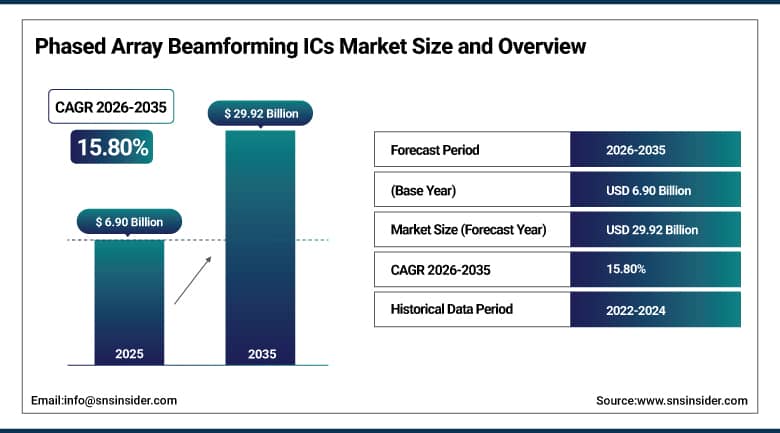
The Phased Array Beamforming ICs Market was valued at USD 6.90 Billion in 2025 and is expected to reach USD 29.92 Billion by 2035, growing at a CAGR of 15.80% from 2026 to 2035.
Phased array beamforming ICs have become genuinely foundational to how modern wireless, radar, and satellite systems achieve the precise, real-time beam control that next-generation communications and defense applications now demand. The market is gaining momentum as intelligent signal processing and edge-level computing become essential across wireless communication, satellite, defense, and industrial IoT systems, and the integration of low-power processing, AI acceleration, and secure architectures is enhancing real-time beam steering, adaptive interference management, and latency-sensitive applications across the board.
Growing deployment of smart antennas, 5G/6G networks, satellite constellations, and connected edge devices is increasing demand for compact, energy-efficient, and highly integrated beamforming ICs, and these technologies enable improved coverage, higher data throughput, and system reliability while supporting scalable, secure, and cost-effective next-generation communication infrastructure.
Market Size and Forecast
-
Market Size in 2026E: USD 7.99 Billion
-
Market Size by 2035: USD 29.92 Billion
-
CAGR: 15.80% from 2026 to 2035
-
Fastest Growing Region: Asia Pacific
-
Largest Region: North America
To Get More Information On Phased Array Beamforming ICs Market - Request Free Sample Report
Phased Array Beamforming ICs Market Trends
-
Rapid innovation in phased array beamforming ICs is driving market growth by enabling high-precision signal control, improved beam steering, and enhanced system efficiency.
-
Growing deployment of smart antennas, 5G/6G networks, and satellite constellations keeps expanding demand for compact, energy-efficient beamforming ICs.
-
Increasing adoption of electronically steered antennas continues replacing mechanically scanned systems across defense and commercial radar applications.
-
Growing LEO satellite deployments are creating substantial new demand for beamforming ICs supporting inter-satellite links and ground terminal arrays.
-
Integration of AI acceleration and secure architectures keeps enhancing adaptive interference management for increasingly latency-sensitive applications.
The U.S. Phased Array Beamforming ICs Market Outlook
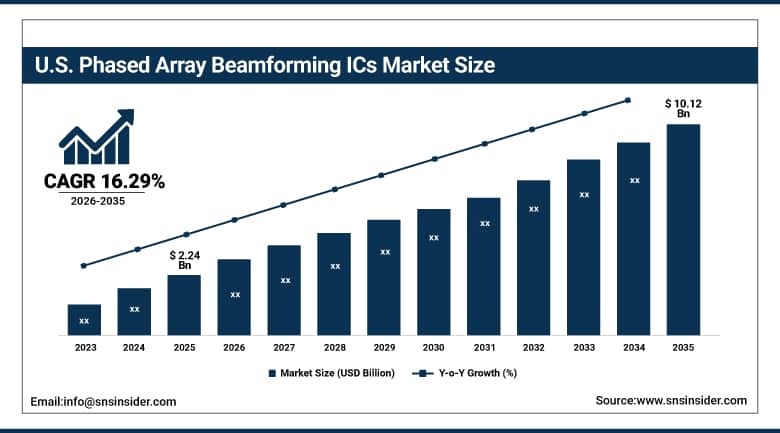
The U.S. Phased Array Beamforming ICs Market is estimated to be USD 2.24 Billion in 2025 and is projected to reach USD 10.12 Billion by 2035, growing at a CAGR of 16.29% during 2026–2035.
The market growth in the U.S. market is fuelled by high demand from the military, aerospace, and satellite communication segments due to growing investments in cutting-edge radar systems, 5G technology, and wireless network systems. High usage of electronically scanned antenna arrays, increase in number of LEO satellites, and constant innovations in semiconductor integration and beamforming technologies via AI further fuel market growth. Ongoing investment by the U.S. Department of Defense in next-generation radar and electronic warfare systems ensures innovation centers and resilient supply chains in the domestic beamforming ICs industry.
STMicroelectronics partnered with Samsung Electronics in May 2024 to develop radar beamforming ICs and front-end modules for automotive use. This will ensure faster adoption of phased array radar systems operating at 77 GHz frequency for advanced driver assistance systems in the U.S. and other parts of the world.
Phased Array Beamforming ICs Market Segment Analysis
-
By Component, the Beamforming ICs segment dominated the Phased Array Beamforming ICs Market with approximately 38.00% share in 2025, while the Beamforming Networks segment is the fastest growing.
-
By Frequency Band, the Ku Band segment dominated the Phased Array Beamforming ICs Market with approximately 34.00% share in 2025 and continues to maintain its leadership due to widespread adoption in satellite communications and broadcasting applications.
-
By Application, the Wireless Communications segment dominated the Phased Array Beamforming ICs Market with approximately 36.00% share in 2025 and remains the fastest-growing application segment.
-
By End User, the Defense segment dominated the Phased Array Beamforming ICs Market with approximately 42.00% share in 2025, while the Aerospace segment is the fastest growing.
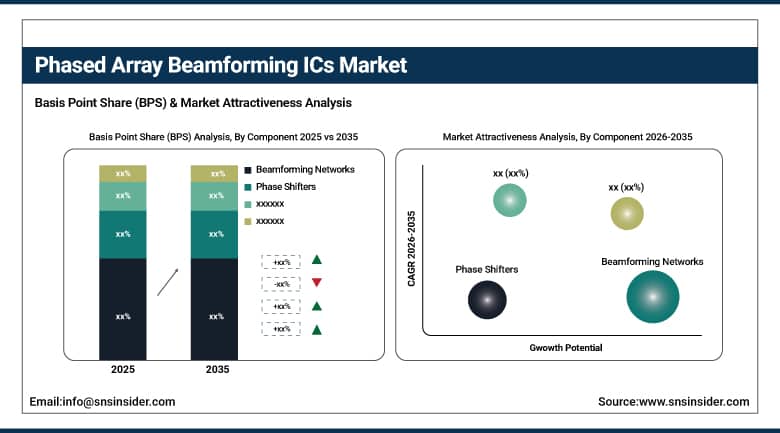
By Component, Beamforming Networks grows fastest
Beamforming Networks emerge as the fastest-growing component segment, driven by increasing demand for high-precision beam steering and advanced phased array technologies across both commercial and defense applications. As systems keep requiring more sophisticated real-time beam control, the network components that coordinate phase and amplitude adjustments across large antenna arrays are seeing particularly rapid investment relative to other component categories like discrete amplifiers or phase shifters.
Phase shifters and amplifiers continue representing substantial, foundational components of the broader beamforming IC market, given their essential role in every phased array system regardless of application. As beamforming networks keep growing more sophisticated and increasingly incorporate AI-driven adaptive control, that growing complexity is what's pulling network component investment ahead of the more mature, commoditized discrete component categories.
By Frequency Band, Ku Band dominates the market
Ku Band maintained its dominance in both 2025, due to its extensive use across satellite communication and broadcast applications where this frequency range offers a genuinely favorable balance of bandwidth, atmospheric penetration, and antenna size requirements. That established position across commercial satellite communications, VSAT terminals, and broadcast infrastructure has kept Ku Band the largest single frequency category for beamforming ICs.
Ka Band and X Band applications continue growing steadily as well, particularly across higher-throughput satellite systems and military radar applications respectively, where their specific frequency characteristics offer genuine advantages for bandwidth-intensive or precision-tracking use cases. As satellite constellation deployments keep diversifying across different frequency bands to manage spectrum congestion, that broadening frequency mix should keep supporting demand growth across the full range of bands this market covers.
By Application, Wireless Communications leads and grows fastest
Wireless Communications remained the dominant application segment, driven by widespread adoption in mobile, satellite, and broadband networks. That breadth of application, spanning everything from cellular base stations to satellite ground terminals, has kept wireless communications the largest single application category for phased array beamforming ICs.
This segment also emerges as the fastest-growing application, an unusual dual-leadership pattern fueled by increasing demand for high-speed connectivity, next-generation 5G/6G deployment, and advanced phased array systems across both commercial and defense sectors. As 5G networks keep densifying and 6G research keeps accelerating globally, that expanding infrastructure buildout is what's kept wireless communications extending its lead on both dominance and growth simultaneously.
By End-User, Defense leads, Aerospace grows fastest
Defense remained the dominant end-user segment, accounting for the largest share of phased array beamforming IC deployments in radar and surveillance systems. Active electronically scanned array radar implementations have become the dominant radar architecture across military platforms due to superior performance characteristics, including simultaneous multi-target tracking and enhanced electronic warfare resistance, and that entrenched military reliance on phased array radar has kept defense the largest single end-user category.
Aerospace emerges as the fastest-growing segment, driven by increased satellite, space exploration, and next-generation aircraft radar applications demanding advanced phased array technologies. As commercial space activity keeps accelerating alongside growing LEO satellite constellation deployment, that expanding aerospace application base is what's pushing this end-user category's growth rate ahead of the already well-established defense segment.
Regional Analysis
|
Region |
Major Country |
Share within Region, 2025 (%) |
|---|---|---|
|
North America |
United States |
80.90% |
|
Europe |
Germany |
24.60% |
|
Asia Pacific |
China |
33.45% |
|
Latin America |
Brazil |
36.10% |
|
Middle East & Africa |
UAE |
25.35% |
North America Phased Array Beamforming ICs Market Insights
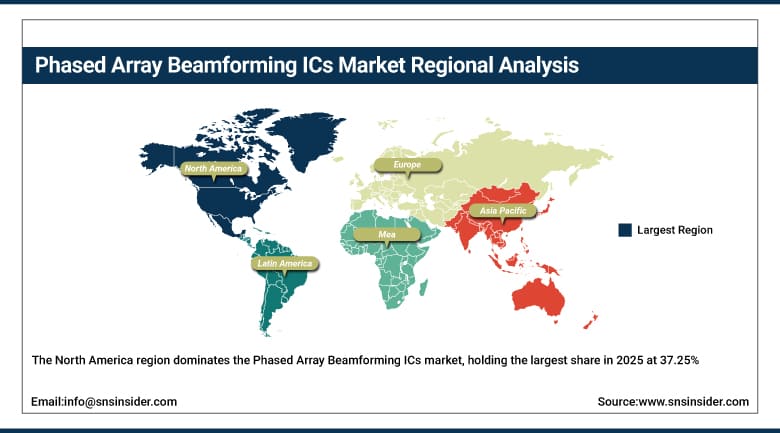
The North America region dominates the Phased Array Beamforming ICs market, holding the largest share in 2025 at 37.25%, projected to moderate to 32.75% by 2035 as other regions grow faster, at a CAGR of about 13.93% through the forecast period. The region's leadership is driven by the presence of major semiconductor manufacturers, advanced defense infrastructure, and early adoption of satellite and radar systems that depend on cutting-edge beamforming technology.
The United States accounts for roughly 80.90% of regional revenue, anchored by strong demand from defense, aerospace, and satellite communication sectors, supported by rising investment in advanced radar systems and 5G infrastructure. Canada adds further regional demand as its own defense and telecommunications sectors continue investing in phased array technology, and that combined regional strength should keep North America the largest addressable market for beamforming IC vendors through the forecast period, even as its share of the global total gradually moderates.
Get Customized Report as Per Your Business Requirement - Enquiry Now
Europe Phased Array Beamforming ICs Market Insights
Europe held a 23.75% share of the Phased Array Beamforming ICs market in 2025, projected to moderate slightly to 22.25% by 2035 at a CAGR of about 14.85% through the forecast period. The Europe market is witnessing emerging trends, including increased adoption of advanced radar systems, satellite communications, and defense applications across the region's major industrial economies.
Germany leads regional demand at roughly 24.60% of European revenue, supported by its strong automotive and defense electronics manufacturing base. The UK and France contribute substantial additional demand, and continued European defense modernization programs should keep regional demand for phased array beamforming ICs climbing steadily through the forecast period.
Asia Pacific Phased Array Beamforming ICs Market Insights
Asia-Pacific is the fastest-growing region in terms of sales shares in Phased Array Beamforming ICs Market, with a regional sales market share in 2025 of 29.00% growing to 35.00% in 2035 at a CAGR of around 18.52% during the forecast period due to rising investments in satellite communications, 5G/6G, and radar technology in the defense sector.
China dominates the region with regional revenue market share in 2025 estimated to be about 33.45% due to significant investments in defense, satellite communications, and 5G infrastructure along with semiconductor manufacturing and technology advancements in the region. South Korea and Japan contribute significantly to additional demand in the region through their satellite communication infrastructure and developments in automotive radar technologies. India emerges as an important growth market in the region due to development in 5G infrastructure backed by government support.
MEA & Latin America Phased Array Beamforming ICs Market Insights
The Latin America region had a market share of 5.88% of the global Phased Array Beamforming ICs market in 2025, which is expected to moderate to 5.13% in 2035 at a CAGR of around 13.82%, mainly due to increased investments in telecoms and infrastructural projects in the major economies of Latin America. In 2025, the Middle East & Africa accounted for 4.13% of the global market and will have a market share of 4.88% in 2035 at a CAGR of around 18.21% mainly owing to continuous adoption of technology due to government-led initiatives to modernize their military forces and communication systems.
Brazil is the key driver of demand in the Latin American region for Phased Array Beamforming ICs, accounting for around 36.10% of regional revenue. The UAE is the key demand center in the Middle East & Africa region, accounting for around 25.35% of the total regional revenue.
Market Dynamics
Growth Drivers: 5G/6G infrastructure and LEO satellite deployment
Rapid innovations in phased array beamforming ICs are driving market growth by enabling high-precision signal control, improved beam steering, and enhanced system efficiency across wireless, radar, and satellite applications. Growing deployment of smart antennas, 5G/6G networks, satellite constellations, and connected edge devices is increasing demand for compact, energy-efficient, and highly integrated beamforming ICs, and these technologies enable improved coverage, higher data throughput, and system reliability while supporting scalable, secure, next-generation communication infrastructure.
The rapid expansion of low-earth orbit satellite constellations operated by major commercial satellite operators is creating unprecedented demand for satellite communication ICs with beamforming functionality to support inter-satellite links and ground terminal arrays. Military modernization programs across NATO and allied countries are fueling parallel demand for advanced radar systems featuring integrated beamforming solutions with enhanced electronic warfare resistance, and that combination of commercial satellite growth and defense modernization keeps the market's growth rate running well ahead of the broader semiconductor industry.
Restraints: Design complexity and semiconductor supply chain constraints
Phased array beamforming ICs require genuinely sophisticated RF design expertise and advanced semiconductor fabrication capability, and that combination of technical complexity keeps the supplier base concentrated among a relatively small number of specialized manufacturers. Smaller system integrators and emerging market entrants can find it genuinely difficult to source competitively priced, high-performance beamforming ICs without established relationships with these concentrated suppliers.
Global semiconductor supply chain constraints, including advanced packaging and specialized RF fabrication capacity limitations, can meaningfully affect beamforming IC availability and lead times, particularly during periods of broader semiconductor industry demand surges. That supply chain sensitivity remains a genuine restraint on faster market growth, especially for defense and aerospace customers operating under strict program timelines that can't easily absorb component delivery delays.
Opportunities: Automotive radar expansion and AI-enabled beamforming
The rapid growth of automotive radar applications represents a genuinely significant opportunity for phased array beamforming IC vendors, as advanced driver-assistance systems and autonomous vehicle programs increasingly depend on 77 GHz phased-array radar solutions for object detection and collision avoidance. As automotive radar adoption keeps expanding beyond premium vehicles into mainstream models, that broadening automotive application base gives beamforming IC vendors a substantial new growth runway beyond the market's traditional defense and telecommunications strongholds.
Continued integration of AI acceleration into beamforming architectures represents a second meaningful opportunity, as adaptive, self-optimizing beam control increasingly differentiates next-generation systems from legacy fixed-configuration alternatives. Vendors that can successfully combine beamforming IC hardware with genuinely intelligent, AI-driven control software stand to capture disproportionate share as customers across defense, telecommunications, and automotive increasingly prioritize adaptive, software-defined system architectures over static designs.
Recent Developments:
-
2024: STMicroelectronics announced a strategic collaboration with Samsung Electronics to co-develop automotive radar beamforming ICs and front-end modules, targeting 77 GHz phased-array solutions for ADAS applications.
-
2024: Multiple defense contractors continued upgrading radar system portfolios with integrated beamforming IC solutions supporting improved multi-target tracking and electronic warfare resistance.
Phased Array Beamforming ICs Market key players are:
-
Analog Devices, Inc.
-
Qorvo, Inc.
-
Texas Instruments Incorporated
-
NXP Semiconductors N.V.
-
Anokiwave, Inc. (Qorvo)
-
Renesas Electronics Corporation
-
Sivers Semiconductors AB
-
RFcore Co., Ltd.
-
OMMIC SAS
-
Broadcom Inc.
-
STMicroelectronics N.V.
-
Raytheon Technologies Corporation
-
Northrop Grumman Corporation
-
Lockheed Martin Corporation
-
Infineon Technologies AG
-
IDT (Renesas)
-
Skyworks Solutions, Inc.
-
Murata Manufacturing Co., Ltd.
-
MACOM Technology Solutions Holdings, Inc.
-
pSemi Corporation
Phased Array Beamforming ICs Market Report Scope:
| Report Attributes | Details |
|---|---|
| Market Size in 2025 | USD 6.90 Billion |
| Market Size by 2035 | USD 29.92 Billion |
| CAGR | CAGR of 15.80% From 2026 to 2035 |
| Base Year | 2025 |
| Forecast Period | 2026-2035 |
| Historical Data | 2022-2024 |
| Report Scope & Coverage | Market Size, Segments Analysis, Competitive Landscape, Regional Analysis, DROC & SWOT Analysis, Forecast Outlook |
| Key Segments | • by Component (Beamforming Networks, Phase Shifters, Amplifiers) • by Frequency Band (Ku Band, Ka Band, X Band, C Band) • by Application (Wireless Communications, Radar Systems, Satellite Communications) • by End-User (Defense, Aerospace, Telecommunications) |
| Regional Analysis/Coverage | North America (US, Canada, Mexico), Europe (Eastern Europe [Poland, Romania, Hungary, Turkey, Rest of Eastern Europe] Western Europe] Germany, France, UK, Italy, Spain, Netherlands, Switzerland, Austria, Rest of Western Europe]), Asia Pacific (China, India, Japan, South Korea, Vietnam, Singapore, Australia, Rest of Asia Pacific), Middle East & Africa (Middle East [UAE, Egypt, Saudi Arabia, Qatar, Rest of Middle East], Africa [Nigeria, South Africa, Rest of Africa], Latin America (Brazil, Argentina, Colombia, Rest of Latin America) |
| Company Profiles | Analog Devices, Inc., Qorvo, Inc., Texas Instruments Incorporated, NXP Semiconductors N.V., Anokiwave, Inc. (Qorvo), Renesas Electronics Corporation, Sivers Semiconductors AB, RFcore Co., Ltd., OMMIC SAS, Broadcom Inc., STMicroelectronics N.V., Raytheon Technologies Corporation, Northrop Grumman Corporation, Lockheed Martin Corporation, Infineon Technologies AG, IDT , Skyworks Solutions, Inc., Murata Manufacturing Co., Ltd., MACOM Technology Solutions Holdings, Inc., pSemi Corporation |

Frequently Asked Questions
The Phased Array Beamforming ICs Market is expected to grow at a CAGR of 15.80% from 2026 to 2035.
The Phased Array Beamforming ICs Market was valued at USD 6.90 Billion in 2025.
The major growth factor is growing deployment of smart antennas, 5G/6G networks, satellite constellations, and connected edge devices requiring compact, energy-efficient beamforming ICs.
The Wireless Communications segment dominated the Phased Array Beamforming ICs Market by application from 2025 to 2035.
North America dominated the Phased Array Beamforming ICs Market in 2025 with a 37.25% share of total global market revenue.
