
Polyvinyl Chloride (PVC) Market Report Scope & Overview:
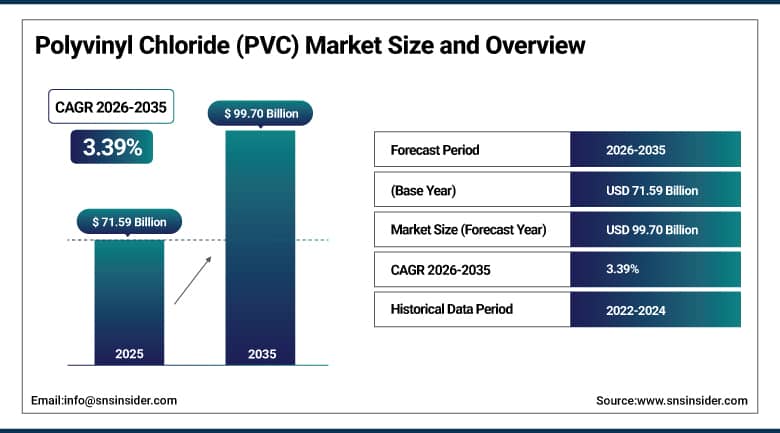
The Polyvinyl Chloride (PVC) Market was valued at USD 71.59 billion in 2025 and is expected to reach USD 99.70 billion by 2035, growing at a CAGR of 3.39% from 2026–2035.
The polyvinyl chloride (PVC) market is witnessing steady growth in the global market due to increasing construction activities and infrastructure development. Rising demand for durable, cost-effective, and versatile plastic materials is driving strong market expansion across multiple industries. Expanding usage of PVC in pipes, fittings, and building materials is significantly supporting market growth. Growing adoption in packaging, automotive components, and electrical applications is further strengthening demand. Increasing urbanization and industrialization are boosting consumption of PVC-based products worldwide.
The PVC market is driven by strong demand from construction, piping, and infrastructure applications. Westlake Corporation reports PVC production capacity of around 5.5 billion pounds annually across its operations. In 2025, the company also rationalized nearly 1 billion pounds of chlorovinyl capacity to improve supply balance. The U.S. EPA has increased scrutiny on vinyl chloride due to health risks, strengthening regulatory pressure on PVC production and safety standards.
Market Size and Forecast
-
Market Size 2026E: USD 73.88 Billion
-
Market Size 2035: USD 99.70 Billion
-
CAGR (2026 - 2035): 3.39%
-
Fastest Growing Region: Asia Pacific
-
Largest Region: North America
To Get More Information On Polyvinyl Chloride (PVC) Market - Request Free Sample Report
Polyvinyl Chloride (PVC) Market Trends
-
Increasing shift toward eco-friendly PVC production using calcium-zinc stabilizers is driven by strict environmental regulations. This is reducing reliance on lead-based stabilizers globally across manufacturing industries.
-
Growing demand for PVC pipes and fittings in construction and infrastructure projects is driving strong market consumption. This is supporting water supply, drainage, and sanitation system development worldwide.
-
Rising adoption of flexible PVC in films and sheets is increasing usage in packaging and healthcare applications. This is enhancing demand for protective and hygiene-based materials.
-
Expansion of Asia-Pacific (APAC) PVC consumption is driven by rapid urbanization and industrial growth. This is strengthening demand from China, India, and Southeast Asian countries.
-
Advancements in polymerization technologies are improving production efficiency and reducing energy consumption. This is supporting cost optimization and sustainable PVC manufacturing processes globally.
U.S. Polyvinyl Chloride (PVC) Market Size Outlook.
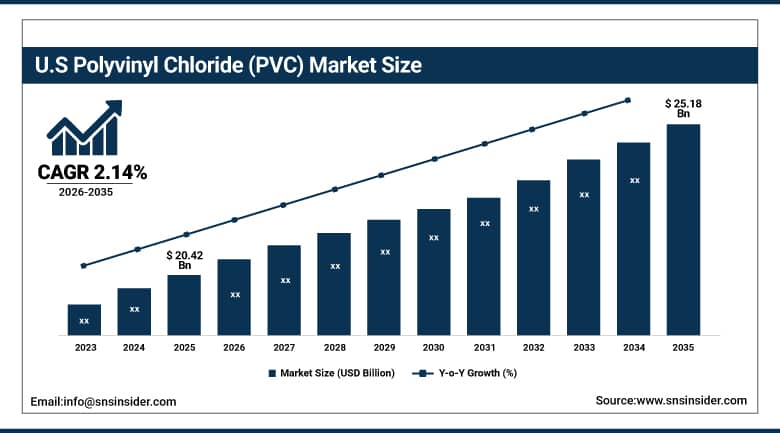
The U.S. Polyvinyl Chloride (PVC) Market was valued at USD 20.42 billion in 2025 and is expected to reach around USD 25.18 billion by 2035, growing at a CAGR of 2.14% from 2026–2035.
The U.S. polyvinyl chloride (PVC) market is experiencing steady growth driven by high demands in the construction, infrastructure, and industrial sectors of the nation. The application of polyvinyl chloride in the production of pipes, fittings, profiles, and construction materials is contributing to the constant growth of the market. Growing investments in constructions of buildings is fueling the consumption of these products.
The regulation of the U.S. PVC industry comes with heavy regulations under the Environmental Protection Agency's National Emission Standards for Hazardous Air Pollutants that govern emissions of pollutants from PVC plants and chemical reactions. The feedstock for producing PVC is vinyl chloride and its annual production volume in the U.S. is between 10 billion pounds to below 20 billion pounds, whereby more than 95-99 percent goes into the manufacture of PVC. Recently, the EPA has taken steps under TSCA to do risk evaluations on vinyl chloride owing to its carcinogenic properties.
Polyvinyl Chloride (PVC) Market Segment Analysis
-
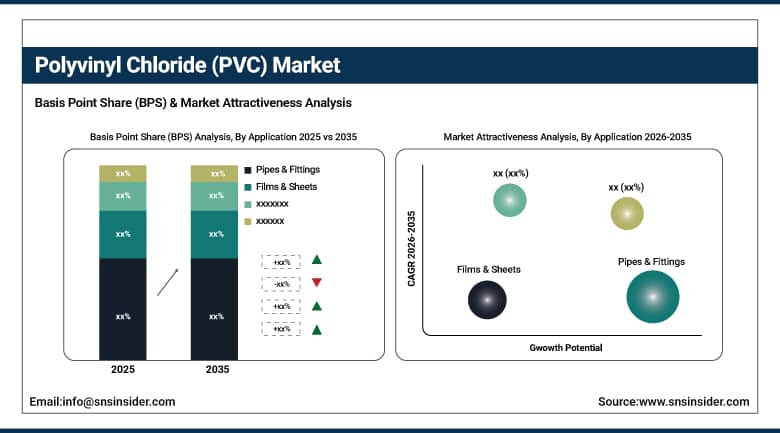
By Application, pipes & fittings dominated the polyvinyl chloride (PVC) market with 44.80% share in 2025; while films & sheets are the fastest growing segment with CAGR of 5.57% during 2026 to 2035.
-
By End-Use Industry, construction dominated the polyvinyl chloride (PVC) market with 52.60% share in 2025; while packaging is the fastest growing segment with CAGR of 7.85% during 2026 to 2035.
-
By Manufacturing Process, suspension PVC (S-PVC) dominated the polyvinyl chloride (PVC) market with 82.10% share in 2025; while emulsion PVC (E-PVC) are the fastest growing segment with CAGR of 5.50% during 2026 to 2035.
-
By Stabilizer Type, calcium-zinc (Ca-Zn) stabilizers dominated the polyvinyl chloride (PVC) market with a 46.20% share in 2025, and it is also the fastest-growing segment with a CAGR of 6.61% during 2026–2035.
By Application, pipes & fittings dominated the polyvinyl chloride (PVC) market, while films & sheets is the fastest growing segment.
Pipes & Fittings segment held the dominated market share for the polyvinyl chloride (PVC) market during 2025. The segment is dominated because of their broad usage in water supply lines, sewage systems, irrigation, and construction projects. PVC material has high durability, resistance to corrosion, economy, and longevity, which makes them suitable for pipe manufacturing.
Films & Sheets segment is projected to have the fastest CAGR from 2026 to 2035 because of increasing demand in various sectors such as packaging industry, healthcare products, and consumer goods. The increasing use of flexible PVC in health care products, packaging, and coverings is driving the segment's growth. Increasing e-commerce and hygiene consciousness along with demand for light materials is driving the growth of this segment significantly.
By End-Use Industry, construction dominated the polyvinyl chloride (PVC) market, while packaging is the fastest growing segment.
Construction segment led the polyvinyl chloride (PVC) market in 2025 because of heavy application in pipes, fittings, profiles, and building materials. Urbanization, infrastructural development, and requirement for long lasting materials are factors contributing to the dominance. The increasing construction activities and investments in water supply and sanitation will add value to steady demand in the Polyvinyl Chloride (PVC) Market.
Packaging segment is forecasted to experience the fastest growth CAGR from 2026 to 2035 owing to increasing demand for flexible PVC sheets and containers in the food, pharmaceutical, and medical industries. Growing popularity for flexible, durable, and moisture resistant packaging is a key reason. Growth in e-commerce and retail sales and consumer trends towards health and hygiene boost demand, providing the impetus for growth in the Polyvinyl Chloride (PVC) Market.
By Manufacturing Process, suspension PVC (S-PVC) dominated the polyvinyl chloride (PVC) market, while emulsion PVC (E-PVC) is the fastest growing segment.
Suspension PVC (S-PVC) segment held the dominated share of the revenue of the Polyvinyl Chloride (PVC) Market in 2025. S-PVC is the dominant material as it is largely used in applications like pipes, fittings, profiles, and construction. The material offers durability, cost-effectiveness, and ease of processing, which makes it preferable in large-scale construction projects and infrastructure. In addition, increasing demand for the material from the construction industry and water management systems is fueling its leading market position.
Emulsion PVC (E-PVC) segment is anticipated to witness the fastest growth in terms of CAGR during the forecast period due to increased demand for flexible and specialty uses. The E-PVC finds application in applications such as coatings, flooring, artificial leather, gloves, and healthcare. The growing demand from segments such as packaging, healthcare, and consumer goods industries is fueling the demand for the material.
By Stabilizer Type, calcium-zinc (Ca-Zn) stabilizers segment dominates the industrial noise control market and is also the fastest growing segment.
Calcium-Zinc (Ca-Zn) Stabilizers segment was dominant in the polyvinyl chloride (PVC) market in 2025. The key reasons behind its dominance include stringent environmental regulations, which have limited the usage of lead-based stabilizers. In addition, the growing requirement for environmentally friendly, safe, and sustainable PVC materials in various applications including construction, packaging, and consumer goods is enhancing their adoption within the global manufacturing industry.
Also, this segment is predicted to witness the fastest CAGR during the forecast period of 2026 to 2035. The reasons include increasing environmental consciousness and ban on lead stabilizers. Moreover, the rapid expansion in infrastructural developments, along with the high demand for sustainable PVC materials for pipelines, profiles, and medical applications, are positively impacting the segment’s growth.
Regional Analysis
|
Region |
Major Country |
Share within Region, 2025(%) |
|---|---|---|
|
North America |
United States |
83.40% |
|
Europe |
Germany |
24.30% |
|
Asia Pacific |
China |
35.75% |
|
Middle East & Africa |
UAE |
9.40% |
|
Latin America |
Brazil |
12.65% |
North America Polyvinyl Chloride (PVC) Market Insights.
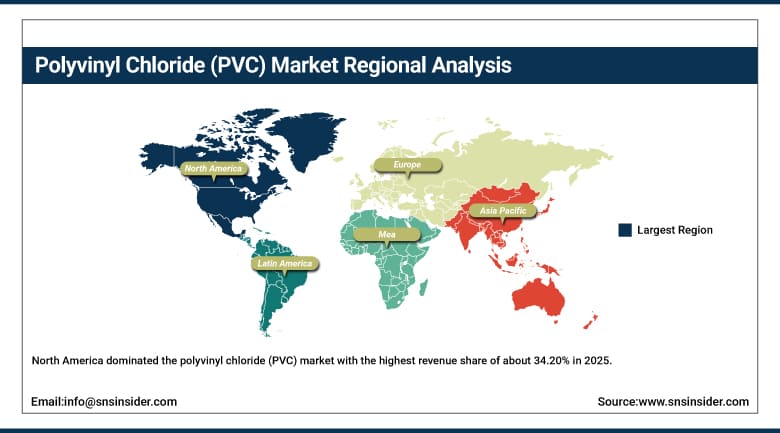
North America dominated the polyvinyl chloride (PVC) market with the highest revenue share of about 34.20% in 2025 due to strong construction activity and infrastructure modernization. The region benefits from advanced manufacturing facilities, high demand for PVC pipes, fittings, and building materials. Well established supply chains and strong regulatory standards further support steady market expansion across the United States and Canada. Rising investments in residential housing and public infrastructure projects are accelerating PVC consumption across multiple end use industries.
In the North American region, the situation for PVC was tough in 2025 because of low demand due to weak residential construction and high interest rates. Manufacturers complained about lower production rates and lower margins. American Chemistry Council says that consumption of PVC will be directly related to housing cycles and construction cycles in infrastructures. The infrastructure investments in Canada have brought some stability.
Get Customized Report as Per Your Business Requirement - Enquiry Now
Europe Polyvinyl Chloride (PVC) Market Insights.
Europe accounts for a considerable share in the polyvinyl chloride (PVC) market 2025 owing to stringent environmental policies and advanced industrial facilities. Some of the countries that are responsible for driving market demand in the region include Germany, France, and the UK. Growing consumption of PVC in applications like construction, automobile, and electrical appliances is helping the market grow at a stable pace.
The European PVC market continues to play an important role in the circular plastic economy. The production rate is around 4-6 million tonnes per year, with the main demand coming from construction and infrastructure usage. The European PVC industry, represented by ECVM members, employs more than 179,000 people and generates €45 billion revenue per year, recycling 730,000 tonnes of PVC yearly through the VinylPlus scheme.
Asia Pacific Polyvinyl Chloride (PVC) Market Insights.
Asia Pacific holds a strong growth position in the polyvinyl chloride (PVC) market in 2025 with a regional share of about 4.94% due to rapid urbanization and industrial expansion. Countries such as China, India, Japan, and Southeast Asia are major demand centers. Increasing infrastructure development, housing projects, and manufacturing activities are driving large scale consumption of PVC products across the region. Strong presence of local producers is improving affordability and availability in emerging economies.
Asia Pacific holds over 50% of global PVC demand, led by China as the largest producer and consumer. India’s PVC demand is in multi-million tonnes, driven by water supply pipelines under Jal Jeevan Mission and housing growth. Japan and South Korea focus on high-grade PVC applications in automotive and electronics industries, supported by industrial manufacturing statistics from national ministries data.
Middle East & Africa and Latin America Polyvinyl Chloride (PVC) Market Insights.
Middle East & Africa region and Latin America region will be experiencing consistent growth in the market for polyvinyl chloride (PVC) in 2025, as a result of urbanization and infrastructure. Countries including UAE, Saudi Arabia, South Africa, Brazil, and Mexico will be key players in boosting the demand in the regions. Growth in construction activities, as well as water management and industrial sectors, will aid in increasing the demand for PVC.
Market for Middle East & Africa PVC is influenced by construction and water infrastructure, where according to SABIC, there is considerable growth in petrochemicals in Saudi Arabia benefiting vinyls. In Latin America, Braskem increased its production capacity for PVC in Brazil to 200,000 tons per annum in Alagoas. Urbanization and developments in infrastructure are continuing to fuel demand in the region.
Market Dynamics
Growth Drivers: Rising demand for PVC in construction and infrastructure development across global markets
Strong growth in construction activities and infrastructure modernization is increasing demand for PVC pipes fittings and profiles. Expanding urbanization and housing projects are driving large scale consumption of durable cost-effective materials. Government investments in water supply drainage and sanitation systems are further strengthening adoption. PVC remains preferred due to its corrosion resistance low cost and long service life supporting consistent demand across residential commercial and industrial construction applications globally. Rising renovation activities in developed economies are also boosting replacement demand for existing piping systems.
The main factor contributing to the high demand for PVC globally is construction and infrastructural developments, whereby most applications are related to pipes, window profiles, and cables. PlasticsEurope notes that around 70% of the total PVC consumed in Europe is associated with construction applications. EPA notes the widespread use of PVC piping in potable and wastewater systems for extensive infrastructure projects.
Restraints: Environmental regulations restricting lead-based stabilizers and PVC production emissions
The strict environmental laws and policies concerning the use of lead-stabilizing additives are posing difficulties for PVC producers. The increased attention towards chlorinated manufacturing processes is making operations more expensive. Investments need to be made towards adopting greener production processes. Issues such as waste management also affect the production process in this industry. Such concerns are inhibiting its adoption in some areas, while others are encountering increased transition costs in switching to ecofriendly alternatives in the production of PVC.
Opportunities: Rising opportunities from sustainable PVC recycling and circular economy adoption
Increasing attention toward sustainability and circular economy trends is offering great opportunities for utilizing recycled PVC in construction and packaging industries. Investments made to enhance recycling processes such as mechanical and chemical recycling will help increase recycling efficiency. Policies made by governments for supporting environment-friendly building materials will promote the use of reprocessed PVC in construction projects. Growing demand for green construction will increase global demand for sustainable building materials.
The growing prospects of sustainable recycling and integration of circular economy practices in PVC are spreading on a global scale. According to the report provided by VinylPlus, there have been recycled over 9.5 million tonnes of PVC since 2000, with around 35% recycling rates at the moment, facilitated by mechanical recycling technologies allowing keeping high-quality of PVC suitable for use in pipes, windows, and building applications. The BASF circular economy plans for 2025 include further development of chemical recycling, thus improving the closed-loop recycling system of PVC and reducing dependence on virgin fossil materials.
Recent Developments
-
2026: PetroChina increased downstream petrochemical integration, supporting PVC raw material supply stability and improving vinyl chloride production efficiency across major refining complexes.
-
2026: Shin-Etsu reported continued global PVC demand strength, supported by infrastructure growth and expansion of high-capacity Shintech operations in the U.S.
-
2025: INEOS expanded its vinyl chloride and PVC production efficiency initiatives in Europe, focusing on decarbonization of chlor-alkali operations and improved energy integration.
-
2024: Orbia expanded its Building & Infrastructure segment (Wavin), increasing PVC pipe system production capacity in Europe to meet rising demand for water management infrastructure.
Polyvinyl Chloride (PVC) Market Key Players are:
-
Shin-Etsu Chemical Co. Ltd.
-
Westlake Corporation
-
Formosa Plastics Corporation
-
INEOS Group
-
Orbia Advance Corporation
-
LG Chem
-
Hanwha Solutions
-
Occidental Petroleum Corporation (OxyChem)
-
Kem One
-
Vynova Group
-
SABIC
-
Braskem
-
Ercros S.A.
-
Taiyo Vinyl Corporation
-
China National Petroleum Corporation (CNPC)
-
Sinopec
-
PetroChina Company Limited
-
Shandong Shenghua Group
-
Xinjiang Tianye Group
-
Tianjin Dagu Chemical Co. Ltd.
Polyvinyl Chloride (PVC) Market Report Scope:
| Report Attributes | Details |
|---|---|
| Market Size in 2025 | USD 71.59 Billion |
| Market Size by 2035 | USD 99.70 Billion |
| CAGR | CAGR of 3.39% From 2026 to 2035 |
| Base Year | 2025 |
| Forecast Period | 2026-2035 |
| Historical Data | 2022-2024 |
| Report Scope & Coverage | Market Size, Segments Analysis, Competitive Landscape, Regional Analysis, DROC & SWOT Analysis, Forecast Outlook |
| Key Segments | • By Application (Pipes & Fittings, Films & Sheets, Profiles & Tubes, Cables & Wires, Bottles & Containers, Other Applications) • By End-Use Industry (Construction, Automotive, Packaging, Consumer Goods, Other End-Use Industries) • By Manufacturing Process (Suspension PVC (S-PVC), Emulsion PVC (E-PVC), Bulk / Mass Polymerized PVC) • By Stabilizer Type (Calcium-Zinc (Ca-Zn) Stabilizers, Lead-Based (Pb) Stabilizers, Tin / Organotin (Sn) Stabilizers, Barium / Other Mixed Metal Stabilizers) |
| Regional Analysis/Coverage | North America (US, Canada), Europe (Germany, UK, France, Italy, Spain, Russia, Poland, Rest of Europe), Asia Pacific (China, India, Japan, South Korea, Australia, ASEAN Countries, Rest of Asia Pacific), Middle East & Africa (UAE, Saudi Arabia, Qatar, South Africa, Rest of Middle East & Africa), Latin America (Brazil, Argentina, Mexico, Colombia, Rest of Latin America). |
| Company Profiles | Shin-Etsu Chemical Co. Ltd., Westlake Corporation, Formosa Plastics Corporation, INEOS Group, Orbia Advance Corporation, LG Chem, Hanwha Solutions, Occidental Petroleum Corporation (OxyChem), Kem One, Vynova Group, SABIC, Braskem, Ercros S.A., Taiyo Vinyl Corporation, China National Petroleum Corporation (CNPC), Sinopec, PetroChina Company Limited, Shandong Shenghua Group, Xinjiang Tianye Group, Tianjin Dagu Chemical Co. Ltd. |
Frequently Asked Questions
The polyvinyl chloride (PVC) market is expected to grow at a CAGR of 3.39% from 2026 to 2035.
The polyvinyl chloride (PVC) market was valued at USD 71.59 billion in 2025.
Rising demand from construction activities, infrastructure development, and increasing use of PVC in pipes, fittings, and building materials are driving market growth. Growing urbanization and industrial expansion further support global demand.
The Pipes & Fittings segment dominated the market in 2025 due to high use in water supply, drainage, irrigation, and construction infrastructure.
North America dominated the market in 2025 due to strong construction, infrastructure upgrades, and high PVC pipe demand.
Get in Touch
