
Post-Quantum Network Security Market Report Scope & Overview:
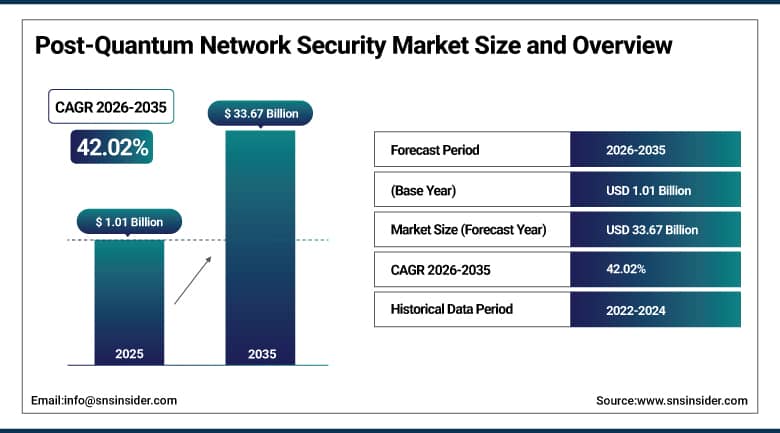
Post-Quantum Network Security Market was valued at USD 1.01 Billion in 2025 and is expected to reach USD 33.67 Billion by 2035, growing at a CAGR of 42.02% from 2026–2035.
The post-quantum network security market is experiencing consistent growth due to the increasing need to protect digital infrastructure against emerging quantum computing threats. The development of quantum computers capable of potentially breaking widely used public-key cryptographic algorithms is encouraging organizations to adopt post-quantum cryptography and quantum-resistant network security solutions.
Investments in quantum-safe technologies are increasing as enterprises and governments strengthen cybersecurity frameworks and prepare for the transition from conventional cryptographic systems to post-quantum standards. Companies are focusing on lattice-based, code-based, hash-based, and other quantum-resistant cryptographic approaches to secure sensitive data, communications, networks, and authentication systems. The growing emphasis on long-term data protection, regulatory compliance, cryptographic agility, and secure migration is driving technological advancements. Furthermore, the adoption of quantum-safe VPNs, cryptographic libraries, quantum-resistant encryption products, and risk-assessment and migration services is further supporting market growth.
In March 2025, the National Institute of Standards and Technology (NIST) selected HQC as an additional post-quantum key-encapsulation mechanism for standardization, providing a backup to ML-KEM and strengthening the development of quantum-resistant encryption for internet traffic and stored data. The development supports broader migration toward post-quantum cryptography and encourages organizations to adopt quantum-safe encryption, authentication, network security, and cryptographic migration solutions.
To Get More Information On Post-Quantum Network Security Market - Request Free Sample Report
Post-Quantum Network Security Market Trends
-
Growing adoption of post-quantum cryptography is driving demand for advanced quantum-resistant network security solutions to protect digital infrastructure against emerging quantum computing threats.
-
Rising investments in quantum-safe cybersecurity are increasing demand for post-quantum encryption, authentication, secure VPNs, and cryptographic libraries across enterprises and government organizations.
-
Increasing need to protect sensitive data, communications, and critical infrastructure from future quantum attacks is supporting the adoption of lattice-based, code-based, hash-based, and other post-quantum cryptographic solutions.
-
Growing focus on cryptographic agility, secure migration, regulatory compliance, and long-term data protection is creating opportunities for post-quantum network security solution and service providers.
-
Advancements in post-quantum cryptography, quantum-resistant encryption, secure network architectures, cryptographic libraries, migration services, and quantum risk assessment are improving cybersecurity preparedness and supporting market adoption.
The U.S. Post-Quantum Network Security Market Outlook
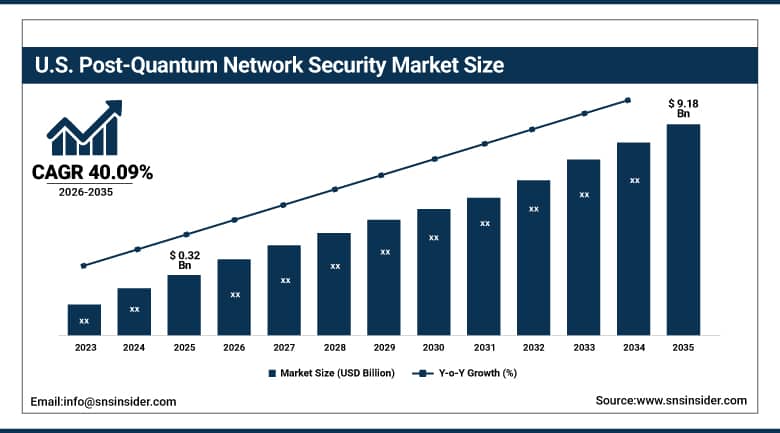
The U.S. Post-Quantum Network Security Market was valued at USD 0.32 Billion in 2025 and is expected to reach around USD 9.18 Billion by 2035, growing at a CAGR of 40.09% from 2026–2035.
The U.S. market for post-quantum network security is growing steadily due to increasing concerns about the potential impact of quantum computing on conventional encryption technologies and the need to strengthen long-term cybersecurity resilience. The expansion of digital infrastructure, cloud services, financial systems, government networks, and critical infrastructure is increasing demand for quantum-resistant security solutions. Growing investments in post-quantum cryptography, cryptographic migration, and quantum-safe network architectures are supporting market development across the country. U.S. government initiatives and cybersecurity organizations are also encouraging enterprises to assess quantum-related risks and prepare for the transition toward standardized post-quantum cryptographic algorithms.
As organizations modernize their security infrastructure, demand is increasing for quantum-resistant encryption products, cryptographic libraries, quantum-safe VPNs, authentication solutions, and migration services. Companies are increasingly focusing on cryptographic agility, secure implementation, interoperability, and protection of sensitive data against future quantum-enabled attacks.
August 24, 2026, Correct and highly relevant. GSA announced actions supporting the federal transition to quantum-resistant technology, including quantum-resistant algorithms in security product testing. This directly supports demand for post-quantum security solutions.
Post-Quantum Network Security Market Segment Analysis
-
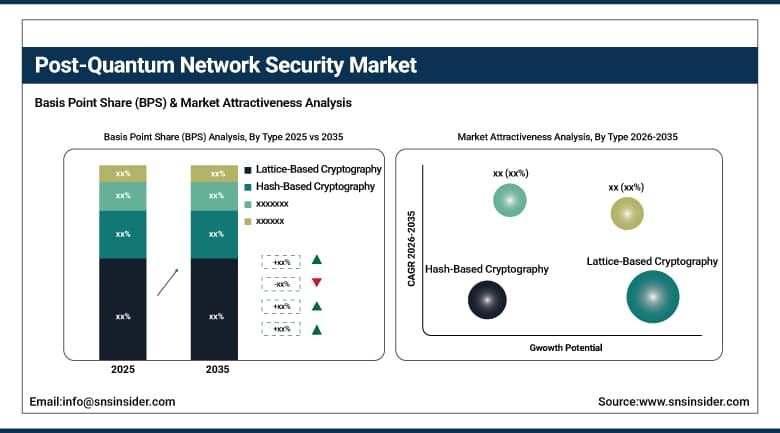
By Type, lattice-based cryptography dominated the post-quantum network security market with a 50.30% share in 2025, while hash-based cryptography is projected to be the fastest-growing segment, registering a 52.50% CAGR during 2026–2035.
-
By Solution, quantum-resistant encryption products dominated the post-quantum network security market with a 28.50% share in 2025, while quantum-safe authentication is projected to be the fastest-growing segment, registering a 47.76% CAGR during 2026–2035.
-
By Services, design, implementation & consulting dominated the post-quantum network security market with a 51.40% share in 2025, while migration services are projected to be the fastest-growing segment, registering a 45.68% CAGR during 2026–2035.
-
By Enterprise Size, large enterprises dominated the post-quantum network security market with a 72.00% share in 2025, while small & medium enterprises (SMEs) are projected to be the fastest-growing segment, registering a 45.24% CAGR during 2026–2035.
-
By Vertical, Government & Defense dominated the post-quantum network security market with a 22.50% share in 2025, while BFSI is projected to be the fastest-growing segment, registering a 46.28% CAGR during 2026–2035.
By Type, lattice-based cryptography dominated the post-quantum network security market, while hash-based cryptography is expected to grow fastest.
Lattice-based cryptography held a dominant position in the market in 2025 due to its strong resistance to quantum attacks and broad applicability across encryption, key establishment, digital signatures, and secure communications. The increasing adoption of post-quantum cryptographic standards and the need to protect enterprise networks, government systems, cloud infrastructure, and sensitive data are supporting demand for lattice-based approaches. Continued investments in quantum-safe cybersecurity and cryptographic migration are expected to strengthen the adoption of lattice-based cryptography across network security applications.
Hash-based cryptography is anticipated to register the highest CAGR during the forecast period of 2026 to 2035. Its strong security characteristics and reliance on well-established cryptographic principles are supporting adoption for quantum-resistant digital signatures and authentication. Growing requirements for secure identity management, software authentication, and long-term protection against quantum-enabled attacks are encouraging organizations to evaluate hash-based solutions as part of broader post-quantum security strategies.
By Solution, quantum-resistant encryption products dominated the post-quantum network security market, while quantum-safe authentication is expected to grow fastest.
Quantum-resistant encryption products held the leading position in the market in 2025 due to the increasing need to protect sensitive communications, stored information, and network traffic from future quantum attacks. Organizations across financial services, government, healthcare, telecommunications, and technology are investing in encryption technologies designed to withstand quantum-enabled threats. The transition from conventional cryptographic algorithms toward quantum-resistant alternatives is further supporting demand for advanced encryption products.
Quantum-safe authentication is projected to exhibit the highest CAGR during the forecast period of 2026 to 2035. The growing need to secure digital identities, user access, connected devices, and network endpoints is encouraging organizations to implement authentication mechanisms designed to remain resilient against quantum threats. Increasing adoption of zero-trust security architectures, cloud services, digital identities, and cryptographic modernization is expected to further accelerate demand for quantum-safe authentication solutions.
By Services, design, implementation & consulting dominated the post-quantum network security market, while migration services are expected to grow fastest.
Design, implementation & consulting services held the dominant position in the market in 2025 as organizations require specialized expertise to assess existing cryptographic infrastructure, identify quantum-vulnerable systems, and design appropriate post-quantum security architectures. The complexity of enterprise networks and the need to integrate quantum-resistant algorithms with existing security environments are increasing demand for professional consulting and implementation capabilities.
Migration services are projected to register the highest CAGR during the forecast period of 2026 to 2035. Organizations are increasingly preparing to transition from conventional cryptographic algorithms toward standardized post-quantum alternatives. The need to inventory cryptographic assets, prioritize vulnerable systems, replace legacy algorithms, test interoperability, and maintain business continuity is creating substantial demand for specialized migration services.
Regional Analysis
|
Region |
Major Country |
Share within Region, 2025(%) |
|---|---|---|
|
North America |
United States |
82.40% |
|
Europe |
Germany |
34.30% |
|
Asia Pacific |
China |
48.54% |
|
Middle East & Africa |
Saudi Arabia |
23.50% |
|
Latin America |
Brazil |
23.00% |
North America post-quantum network security market insights
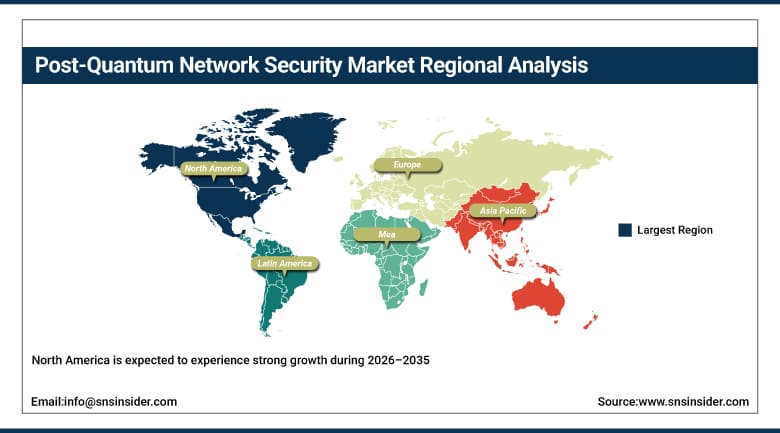
North America is dominating region with share of around 38.27%, driven by increasing concerns regarding quantum computing threats, growing investments in cybersecurity modernization, and the adoption of post-quantum cryptographic standards. The region benefits from a mature cybersecurity ecosystem, extensive cloud and digital infrastructure, and significant investments in quantum computing research and quantum-safe technologies. Financial institutions, government agencies, technology companies, telecommunications providers, and critical infrastructure operators are increasingly assessing cryptographic vulnerabilities and preparing for migration toward quantum-resistant security architectures.
The United States is expected to dominate the North American market, accounting for 82.40% of the regional market share in 2025. Its leadership is supported by federal initiatives related to post-quantum cryptography, substantial cybersecurity spending, advanced technology capabilities, and the presence of major cybersecurity and technology companies. Increasing efforts to identify quantum-vulnerable systems and transition critical networks toward quantum-resistant encryption are expected to further support market growth.
Get Customized Report as Per Your Business Requirement - Enquiry Now
Europe post-quantum network security market insights
Europe is expected to witness substantial growth in the post-quantum network security market during 2026–2035, supported by increasing cybersecurity requirements, regulatory initiatives, digital transformation, and growing awareness of quantum-related risks. Financial services, government institutions, telecommunications, healthcare, and critical infrastructure operators are increasingly evaluating post-quantum cryptography to protect sensitive information and long-term data. The region's focus on cybersecurity resilience and technological sovereignty is also encouraging investments in quantum-safe security solutions.
Germany is anticipated to remain a key national market in Europe, supported by its strong industrial base, advanced information technology infrastructure, cybersecurity investments, and increasing adoption of secure digital systems. The UK, France, Italy, and other European countries are also contributing to regional demand through investments in cybersecurity modernization, quantum research, cryptographic migration, and protection of critical digital infrastructure.
Asia Pacific post-quantum network security market insights
Asia Pacific is expected to be the fastest-growing region in the post-quantum network security market during 2026–2035, with a CAGR of 46.52%, supported by rapid digitalization, expanding cloud infrastructure, increasing cybersecurity investments, and growing development of quantum computing capabilities. The region's large technology ecosystem, extensive telecommunications networks, expanding financial services sector, and increasing deployment of connected systems are creating greater requirements for quantum-resistant cybersecurity. Governments and enterprises are increasingly preparing their digital infrastructure for the transition toward post-quantum cryptographic standards.
China is expected to remain a major market in Asia Pacific, supported by significant investments in quantum technology, cybersecurity infrastructure, telecommunications, and digital systems. Japan and South Korea are also expected to maintain strong positions due to their advanced technology, electronics, telecommunications, and automotive industries. India is likely to experience increasing demand as digital services, cloud adoption, financial technology, telecommunications infrastructure, and government digitalization continue to expand.
Middle East & Africa and Latin America post-quantum network security market insights
The Middle East & Africa and Latin America regions are expected to experience steady growth in the post-quantum network security market from 2026 to 2035, supported by increasing digital transformation, cloud adoption, cybersecurity investments, and modernization of critical infrastructure. Financial institutions, telecommunications operators, government organizations, energy companies, and other enterprises are increasingly strengthening their cybersecurity capabilities and evaluating emerging quantum-related risks. These developments are creating opportunities for quantum-resistant encryption, secure authentication, cryptographic libraries, and migration services.
Saudi Arabia is expected to remain an important market in the Middle East & Africa, supported by digital transformation initiatives, cybersecurity investments, smart infrastructure development, and modernization of government and enterprise systems. In Latin America, Brazil is expected to remain a key country-level market, supported by growing digital banking, cloud services, telecommunications, and cybersecurity modernization. Other Latin American countries are also expected to contribute to regional growth as organizations increasingly adopt quantum-resistant security solutions.
Market Dynamics
Growth Driver: Increasing adoption of quantum-resistant cybersecurity solutions is driving market growth
One of the key factors driving the growth of the global post-quantum network security market is the increasing need to protect digital infrastructure against emerging quantum computing threats. As quantum computing capabilities advance, conventional public-key cryptographic algorithms used to secure communications, financial transactions, cloud environments, government systems, and critical infrastructure may become vulnerable. This is encouraging organizations to begin transitioning toward quantum-resistant cryptographic technologies and strengthening their long-term cybersecurity strategies.
In addition, the development and standardization of post-quantum cryptographic algorithms, growing investments in quantum-safe cybersecurity, and increasing awareness of cryptographic migration are supporting market expansion. Organizations are increasingly assessing cryptographic inventories, implementing quantum-resistant encryption, and adopting secure authentication and network protection technologies to improve resilience against future quantum-enabled attacks.
Restraint: Complexity of cryptographic migration and integration challenges can limit market adoption
The complexity associated with transitioning from conventional cryptographic systems to post-quantum security technologies presents a significant challenge to market adoption. Large organizations often operate extensive IT environments containing legacy applications, network infrastructure, devices, and cryptographic protocols that may be difficult to identify, assess, and replace. Ensuring compatibility between post-quantum algorithms and existing systems can also increase implementation complexity.
Moreover, organizations require comprehensive cryptographic inventories, specialized expertise, interoperability testing, and careful migration planning to prevent operational disruptions. The cost of upgrading hardware and software, integrating quantum-resistant algorithms into existing security architectures, and training cybersecurity personnel can create additional barriers, particularly for smaller organizations with limited cybersecurity resources.
Opportunity: Growing need for cryptographic migration and quantum-safe infrastructure creates new market opportunities
The increasing urgency to prepare digital infrastructure for future quantum threats presents significant opportunities for post-quantum network security solution providers. Organizations across BFSI, government and defense, healthcare, telecommunications, IT, and critical infrastructure are increasingly evaluating their exposure to quantum-related cybersecurity risks and developing migration strategies. This is creating demand for quantum-resistant encryption products, cryptographic libraries, quantum-safe VPNs, authentication solutions, and specialized migration services.
Furthermore, growing adoption of cloud computing, connected devices, digital identities, and zero-trust security architectures is creating additional opportunities for quantum-safe technologies. Increasing investments in quantum computing research, cybersecurity modernization, and cryptographic agility are expected to encourage the development of scalable solutions that can be integrated into existing networks while supporting long-term protection against quantum-enabled cyber threats.
Recent Developments
-
2026: Cloudflare expanded post-quantum encryption support across Cloudflare One, strengthening quantum-safe protection for enterprise Zero Trust and WAN environments.
-
2026: Cloudflare announced plans to achieve full post-quantum security across its product suite by 2029, including quantum-safe authentication.
-
2026: Cloudflare made post-quantum encryption for its IPsec service generally available, supporting protection against harvest-now, decrypt-later attacks.
-
2026: Thales launched Luna 8, a next-generation hardware security module featuring quantum-resistant protection and crypto-agile architecture for enterprise and cloud environments.
Post-Quantum Network Security Market key players are:
-
IBM
-
Thales
-
Cloudflare
-
Microsoft
-
Cisco Systems
-
Fortinet
-
Palo Alto Networks
-
Entrust
-
PQShield
-
QuSecure
-
SandboxAQ
-
ISARA Corporation
-
Crypto4A Technologies
-
Utimaco
-
SEALSQ
-
ID Quantique
-
Keyfactor
-
Ciena
-
DigiCert
-
Toshiba
Post-Quantum Network Security Market Report Scope:
| Report Attributes | Details |
|---|---|
| Market Size in 2025 | USD 1.01 Billion |
| Market Size by 2035 | USD 33.67 Billion |
| CAGR | CAGR of 42.02% From 2026 to 2035 |
| Base Year | 2025 |
| Forecast Period | 2026-2035 |
| Historical Data | 2022-2024 |
| Report Scope & Coverage | Market Size, Segments Analysis, Competitive Landscape, Regional Analysis, DROC & SWOT Analysis, Forecast Outlook |
| Key Segments | • By Type (Lattice-Based Cryptography, Code-Based Cryptography, Multivariate Cryptography, Hash-Based Cryptography, Others) • By Solution (Quantum-Safe Hardware, Quantum-Resistant Encryption Products, Cryptographic Libraries, Quantum-Safe VPN, Quantum-Safe Authentication, Others) • By Services (Design, Implementation & Consulting, Migration Services, Quantum Risk Assessment) • By Enterprise Size (Large Enterprises, Small & Medium Enterprises (SMEs)) • By Vertical (BFSI, Healthcare, Government & Defense, IT & ITES, Retail & E-commerce, Automotive, Telecom, Energy & Utilities, Media & Entertainment, Transportation & Logistics, Education, Others) |
| Regional Analysis/Coverage | North America (US, Canada), Europe (Germany, UK, France, Italy, Spain, Russia, Poland, Rest of Europe), Asia Pacific (China, India, Japan, South Korea, Australia, ASEAN Countries, Rest of Asia Pacific), Middle East & Africa (UAE, Saudi Arabia, Qatar, South Africa, Rest of Middle East & Africa), Latin America (Brazil, Argentina, Mexico, Colombia, Rest of Latin America) |
| Company Profiles | IBM, Thales, Cloudflare, Microsoft, Cisco Systems, Fortinet, Palo Alto Networks, Entrust, PQShield, QuSecure, SandboxAQ, ISARA Corporation, Crypto4A Technologies, Utimaco, SEALSQ, ID Quantique, key Factor, Ciena, DigiCert, Toshiba |

Frequently Asked Questions
The post-quantum network security market is expected to grow at a CAGR of 42.02% from 2026 to 2035.
The post-quantum network security market was valued at approximately USD 1.01 billion in 2025.
The market is primarily driven by increasing concerns over quantum-enabled cyber threats, growing adoption of post-quantum cryptography standards, cryptographic modernization, and rising investments in quantum-safe network security solutions.
Lattice-based cryptography dominated the post-quantum network security market in 2025, accounting for a 50.30% share.
North America dominated the post-quantum network security market in 2025, accounting for a 38.00% share.
