
Proton Therapy Systems Market Report Scope and Overview:
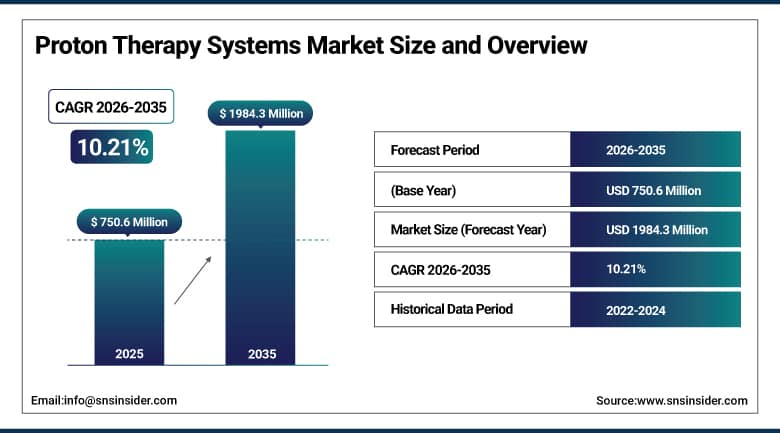
The Proton Therapy Systems Market was valued at USD 750.6 Million in 2025 and is projected to reach USD 1984.3 Million by 2035, registering a CAGR of 10.21% from 2026 to 2035.
The Proton Therapy Systems Market is transforming cancer treatment by delivering protons that target malignant tumors while minimizing radiation exposure beyond the treatment area, making it valuable for pediatric cancers and tumors near critical structures such as the brain, spinal cord, and eye. This market is characterized by quick adoption of small and single-room proton systems which have cut down capital expenses and space requirements. The transition from passive scattering to pencil beam scanning, as well as increased investment in hospitals due to favorable reimbursement policies, can be noted. There is notable momentum in the areas of synchrotron-based accelerators and adaptive planning software since cancer clinics attach much importance to precise cancer treatment with fewer side effects than photon radiotherapy.
IBA (Ion Beam Applications) continued expanding global installations of its Proteus ONE compact single-room proton therapy system throughout 2024, reinforcing its position as a leading supplier of space-efficient proton therapy infrastructure for mid-sized cancer centers.
To Get More Information On Proton Therapy Systems Market - Request Free Sample Report
Proton Therapy Systems Market Trends
-
Rapid adoption of compact single-room proton systems continues lowering capital barriers for mid-sized hospitals.
-
Growing migration from passive scattering toward pencil beam scanning continues improving treatment planning precision.
-
Expanding synchrotron-based accelerator adoption continues offering greater energy flexibility for complex treatment plans.
-
Rising pediatric cancer treatment adoption continues leveraging proton therapy's reduced long-term radiation exposure.
-
Increasing public-private partnership investment continues accelerating proton center deployment in emerging markets.
U.S. Proton Therapy Systems Market Outlook
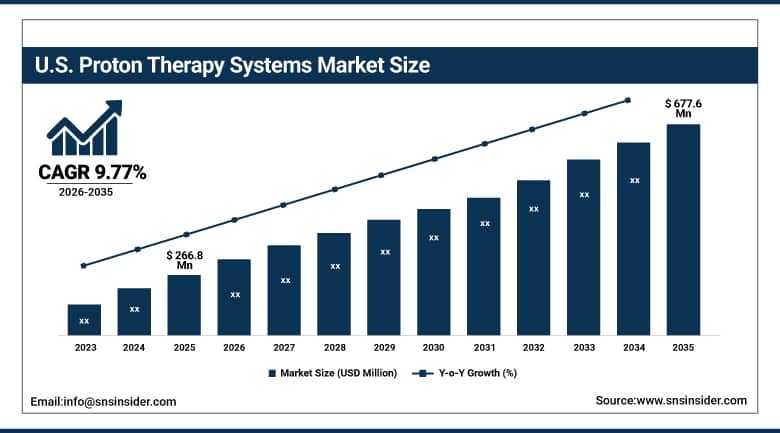
The U.S. Proton Therapy Systems Market was valued at approximately USD 266.8 Million in 2025 and is projected to reach approximately USD 677.6 Million by 2035, registering a CAGR of approximately 9.77% from 2026 to 2035.
Demand across the United States continued to be shaped by a dense concentration of leading academic cancer centers, favorable Medicare and private insurance reimbursement policies for proton therapy, and sustained investment in compact single-room systems by mid-sized regional hospitals seeking to offer advanced radiotherapy without cost of legacy multi-room facilities. Rising deployment of pencil beam scanning and adaptive treatment planning technology by leading academic medical centers continued reinforcing the country's position as both the largest and most clinically advanced proton therapy systems market. Growing adoption across regional cancer centers added further layers of sustained domestic demand well beyond the technology's traditional large-academic-center use case, with expanding pediatric and CNS cancer treatment programs increasingly relying on proton therapy's precision targeting capability.
Mevion Medical Systems continued expanding clinical adoption of its MEVION S250i system with HYPERSCAN pencil beam scanning technology throughout the year, designed to enable adaptive proton therapy treatment planning for American cancer centers seeking compact, single-room proton infrastructure.
Proton Therapy Systems Market Segment Analysis
-
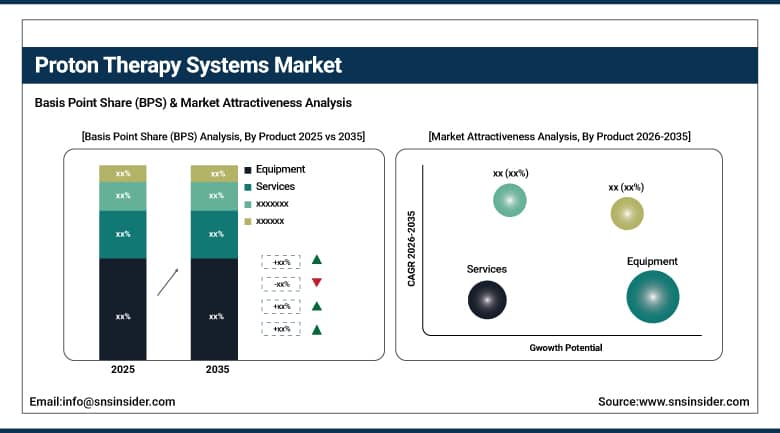
By Product, Equipment segment dominated the Proton Therapy Systems Market in 2025 with 78% share; Services segment is the fastest growing segment.
-
By System Setup Type, Single-Room Systems segment dominated the market in 2025 with 42% share and is also the fastest growing segment, driven by declining system costs and shorter deployment timelines.
-
By Accelerator Type, Cyclotron-Based Systems segment dominated the market in 2025 with 58% share; Synchrotron-Based Systems segment is the fastest growing segment.
-
By Application, Prostate Cancer segment dominated the market in 2025 with 42.5% share; Pediatric Cancers segment is the fastest growing segment.
By Product: Equipment Leads, Services Emerge as Fastest-Growing Segment
The Equipment segment dominated the Proton Therapy Systems Market in 2025, driven by the substantial upfront capital cost of accelerators, gantries, beam delivery systems, and patient positioning infrastructure required for every new proton therapy center, whether single-room or multi-room configuration. Rising global installation of new proton therapy facilities across both established and emerging markets sustained steady demand for core equipment purchases. Growing hospital investment in advanced beam delivery and imaging integration technology reinforced equipment revenues as the single largest contributor to total market spending throughout the base year.
The Services segment is the fastest growing in the Proton Therapy Systems Market owing to the expanding global installed base of proton therapy systems requiring ongoing maintenance, calibration, software upgrades, and technical support contracts. As more proton centers move beyond initial installation into multi-year operational phases, recurring service revenue continues growing faster than new equipment sales. Growing vendor emphasis on remote monitoring, preventive maintenance programs, and treatment planning software subscriptions continues extending the value captured from existing equipment installations across operating proton therapy centers worldwide.
By Accelerator Type: Cyclotron-Based Systems Dominate, Synchrotron-Based Systems Grow Fastest
The Cyclotron-Based Systems segment dominated the Proton Therapy Systems Market due to the availability of relatively simple and compact accelerators, which have emerged as a favorable option for compact proton systems for smaller hospitals. Clinical history and significant experience of vendors working with cyclotron-based accelerators like IBA’s Proteus ONE and Mevion’s compact accelerators maintained the dominance of this accelerator technology in the base year. Continued refinement of cyclotron-based compact system designs reinforced this segment's leading contribution to total market revenue.
The Synchrotron-Based Systems segment is the fastest growing due to its ability to deliver variable-energy proton beams without the energy degraders required by cyclotron systems, offering greater treatment flexibility and reduced secondary radiation for complex, multi-room treatment centers. Growing clinical evidence supporting synchrotron-based systems for advanced pencil beam scanning applications continues expanding adoption among academic centers seeking maximum treatment flexibility. Rising vendor investment in synchrotron accelerator refinement is accelerating this technology's adoption across leading multi-room proton therapy centers worldwide.
By Application: Prostate Cancer Leads, Pediatric Cancers Grow Fastest
The Prostate Cancer segment dominated the Proton Therapy Systems Market because prostate cancer represents one of the most common malignancies treated with proton therapy, with a large and growing patient population and well-established clinical protocols demonstrating reduced rectal and bladder toxicity compared with conventional radiotherapy. Rising global prostate cancer incidence, combined with growing patient preference for treatments offering fewer long-term side effects, has sustained high treatment volumes across established proton therapy centers. Continued clinical evidence supporting proton therapy's toxicity-reduction benefits reinforced this segment's dominant position throughout the base year.
The Pediatric Cancers segment is the fastest growing as proton therapy's precise dose targeting and minimal radiation exposure beyond the tumor site make it particularly valuable for treating growing children, where reducing radiation-induced secondary cancers and developmental complications is critically important. Rising clinical guideline recommendations favoring proton therapy for eligible pediatric cancer cases continue expanding this application's addressable patient population. Growing specialized pediatric proton treatment center development is driving faster adoption across leading children's cancer treatment programs worldwide.
Regional Analysis
|
Region |
Major Country |
Share within Region, 2025 (%) |
|---|---|---|
|
North America |
United States |
88.00% |
|
Europe |
Germany |
22.50% |
|
Asia Pacific |
Japan |
26.50% |
|
Middle East and Africa |
Saudi Arabia |
23.00% |
|
Latin America |
Brazil |
32.50% |
North America Proton Therapy Systems Market Insights
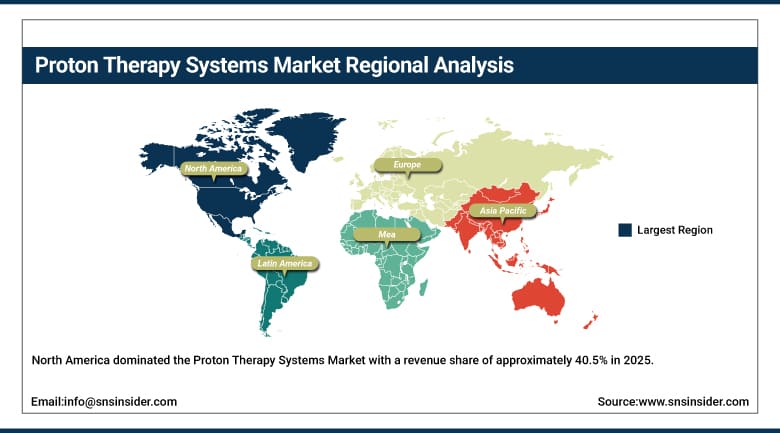
North America dominated the Proton Therapy Systems Market with a revenue share of approximately 40.5% in 2025.
A dense concentration of leading academic cancer centers, favorable Medicare and private insurance reimbursement policies, and sustained investment in compact single-room systems by mid-sized regional hospitals continued reinforcing this dominant regional position. The United States accounted for the substantial majority of regional revenue, anchored by rapid adoption of pencil beam scanning technology and expanding regional cancer center installations, while Canada added further demand through its own growing academic proton therapy research infrastructure, keeping the continent the largest addressable market for proton therapy systems vendors through the forecast period.
Get Customized Report as Per Your Business Requirement - Enquiry Now
Europe Proton Therapy Systems Market Insights
Europe held a meaningful share of global revenue, supported by rising cancer incidence, expanding national reimbursement coverage for proton therapy, and continued growth of specialized oncology treatment programs across the region's major economies. Regulatory harmonization under the EU Medical Device Regulation and continued expansion of academic proton therapy research centers continued lowering historically significant barriers to advanced proton therapy technology adoption across the continent.
Germany led demand at roughly 22.50% of European revenue, supported by its substantial academic and hospital infrastructure among the region's largest economies. The UK and France contributed substantial additional demand through their own expanding proton therapy center programs, and continued European investment in oncology treatment infrastructure should keep regional demand for proton therapy systems climbing through the forecast period.
Asia Pacific Proton Therapy Systems Market Insights
Asia Pacific is expected to grow at the fastest CAGR in the Proton Therapy Systems Market, growing at approximately 13.5% from 2026 to 2035.
This growth is driven by improving healthcare access, rising cancer awareness, and accelerating investments in proton therapy centers across the region's largest economies. Japan led the pack, supported by its long-established proton therapy manufacturing base, including Hitachi, Mitsubishi Electric, and Sumitomo Heavy Industries, alongside decades of clinical experience. China and South Korea contributed meaningful additional demand, with China's rapidly expanding hospital infrastructure investment and South Korea's growing academic oncology programs both reinforcing the region's position as the fastest-growing market tracked in this report.
MEA and Latin America Proton Therapy Systems Market Insights
The Middle East and Africa and Latin America both showed steady growth, driven by expanding oncology treatment infrastructure, rising government investment in tertiary cancer care, and growing clinician training in proton therapy treatment planning across both areas. As these markets continued building out modern oncology infrastructure, proton therapy systems proved a genuinely efficient way to expand advanced cancer treatment capability without the decades-long buildout wealthier nations required.
Saudi Arabia led Middle East and Africa demand, supported by the country's substantial healthcare investment under its national healthcare transformation programs. The UAE contributed further demand through its own expanding private hospital network and oncology treatment capability. In Latin America, Brazil accounted for the largest share of regional revenue, with growing cancer treatment adoption and academic oncology training continuing to anchor regional demand for proton therapy systems.
Market Dynamics
Growth Drivers: Rising Cancer Incidence and Growing Compact System Adoption
The industry is driven by the increasing global burden of cancer, rising demand for highly precise and less invasive treatment options, growing adoption of compact single-room proton systems that lower capital barriers for mid-sized hospitals, and expanding pediatric cancer treatment programs benefiting from proton therapy's reduced long-term radiation exposure. As diagnostic capability for identifying eligible proton therapy candidates continues improving, the need for precision radiotherapy technology continues driving adoption of proton therapy systems.
Rising government initiatives and favorable reimbursement policies continue reinforcing this driver, as more healthcare systems recognize proton therapy's long-term value in reducing secondary cancer risk and treatment-related complications compared with conventional photon-based radiotherapy. Growing technological advancement in system design, including pencil beam scanning and synchrotron-based accelerators, continues expanding clinical capability, and that combination of clinical validation and declining system costs is exactly what keeps demand climbing at such a steady, sustained pace.
Restraints: High Capital Costs and Limited Reimbursement in Emerging Markets
The substantial capital cost of proton therapy systems, often exceeding $100 million for traditional multi-room centers, continues posing a genuine restraint on faster market-wide expansion, particularly across emerging healthcare systems and smaller hospitals without the capital budgets that leading academic medical centers can commit. That cost profile has kept large-scale proton therapy capability concentrated among a comparatively small number of well-resourced cancer centers.
Limited or inconsistent reimbursement coverage for proton therapy procedures across several emerging markets continues posing a further restraint, as healthcare systems in cost-constrained regions often default to lower-cost conventional photon radiotherapy rather than investing in dedicated proton therapy infrastructure. That reimbursement gap keeps some healthcare systems reliant on conventional radiotherapy technology rather than adopting proton-based treatment capability of their own.
Opportunities: Compact System Expansion and Emerging Market Oncology Infrastructure
Rising investment in compact single-room proton systems represents a genuinely significant opportunity, as newer systems costing $30 to $50 million make proton therapy feasible for mid-sized hospitals and urban cancer centers that could not previously justify traditional multi-room facility investment. Vendors positioned early in compact system technology stand to capture meaningful share as this capability continues expanding from large academic centers into mainstream regional hospital adoption.
Closing oncology infrastructure gaps across emerging cancer care markets offers a second substantial opportunity, as government initiatives and public-private partnerships aimed at expanding advanced cancer treatment capacity continue creating fresh demand for accessible proton therapy infrastructure. Vendors with proven, cost-effective compact system platforms stand to capture meaningful share as developing economies increasingly view in-house proton therapy capability as a genuinely practical way to reduce dependency on overseas cancer treatment referrals.
Recent Developments:
-
2024: IBA (Ion Beam Applications) continued expanding global installations of its Proteus ONE compact single-room proton therapy system, reinforcing its position as a leading supplier of space-efficient proton therapy infrastructure for mid-sized cancer centers.
-
2024: Varian, a Siemens Healthineers company, continued advancing its ProBeam 360° proton therapy system, integrating pencil beam scanning technology designed to improve treatment planning flexibility across multiple gantry angles.
-
2025: Mevion Medical Systems continued expanding clinical adoption of its MEVION S250i system with HYPERSCAN pencil beam scanning technology, designed to enable adaptive proton therapy treatment planning.
-
2025: Hitachi, Ltd. continued advancing its proton beam therapy system portfolio, supporting expanding proton therapy center deployments across Japan and international markets.
-
2025: Sumitomo Heavy Industries continued expanding its compact proton therapy system offerings, targeting mid-sized hospitals seeking cost-effective single-room proton therapy infrastructure.
Proton Therapy Systems Market key players are:
-
Varian Medical Systems (Siemens Healthineers)
-
Sumitomo Heavy Industries, Ltd.
-
Mevion Medical Systems, Inc.
-
ProTom International, Inc.
-
ProNova Solutions, LLC
-
Optivus Proton Therapy, Inc.
-
Provision Healthcare, LLC
-
P-Cure Ltd.
-
Advanced Oncotherapy plc
-
RaySearch Laboratories AB
-
Elekta AB
-
Accuray Incorporated
-
C-RAD AB
-
Canon Medical Systems Corporation
-
Koninklijke Philips N.V.
-
Siemens Healthineers AG
-
GE HealthCare Technologies Inc.
Proton Therapy Systems Market Report Scope:
| Report Attributes | Details |
|---|---|
| Market Size in 2025 | USD 750.6 Million |
| Market Size by 2035 | USD 1984.3 Million |
| CAGR | CAGR of 10.21% From 2026 to 2035 |
| Base Year | 2025 |
| Forecast Period | 2026-2035 |
| Historical Data | 2022-2024 |
| Report Scope & Coverage | Market Size, Segments Analysis, Competitive Landscape, Regional Analysis, DROC & SWOT Analysis, Forecast Outlook |
| Key Segments | • By Product (Equipment, Services) • By System Setup Type (Single-Room Systems, Multi-Room Systems) • By Accelerator Type (Cyclotron-Based Systems, Synchrotron-Based Systems) • By Application (Prostate Cancer, Pediatric Cancers, CNS Cancer, Head & Neck Cancer, Others) |
| Regional Analysis/Coverage | North America (US, Canada), Europe (Germany, UK, France, Italy, Spain, Russia, Poland, Rest of Europe), Asia Pacific (China, India, Japan, South Korea, Australia, ASEAN Countries, Rest of Asia Pacific), Middle East & Africa (UAE, Saudi Arabia, Qatar, South Africa, Rest of Middle East & Africa), Latin America (Brazil, Argentina, Mexico, Colombia, Rest of Latin America). |
| Company Profiles | Ion Beam Applications SA (IBA), Varian Medical Systems (Siemens Healthineers), Hitachi, Ltd., Mitsubishi Electric Corporation, Sumitomo Heavy Industries, Ltd., Mevion Medical Systems, Inc., ProTom International, Inc., ProNova Solutions, LLC, Optivus Proton Therapy, Inc., Provision Healthcare, LLC, P-Cure Ltd., Advanced Oncotherapy plc, RaySearch Laboratories AB, Elekta AB, Accuray Incorporated, C-RAD AB, Canon Medical Systems Corporation, Koninklijke Philips N.V., Siemens Healthineers AG, GE HealthCare Technologies Inc. |

Frequently Asked Questions
Key players in the Proton Therapy Systems Market include Ion Beam Applications SA (IBA), Varian Medical Systems (Siemens Healthineers), Hitachi, Ltd., Mitsubishi Electric Corporation, Sumitomo Heavy Industries, Ltd., and Mevion Medical Systems, Inc., among others.
Key opportunities in the proton therapy systems market include expansion of compact single-room proton systems and development of oncology treatment infrastructure in emerging markets.
The market is driven by increasing cancer incidence, rising demand for precision radiotherapy, growing adoption of compact single-room proton systems, and expanding pediatric cancer treatment programs.
The Equipment segment dominated the Proton Therapy Systems Market, accounting for approximately 78% market share.
The North America region dominated the Proton Therapy Systems Market in 2025 with a 40.5% share, driven by a high concentration of academic cancer centers, favorable reimbursement policies, and investment in compact proton therapy systems.
