
Quantum-Safe Network Infrastructure Market Report Scope & Overview:
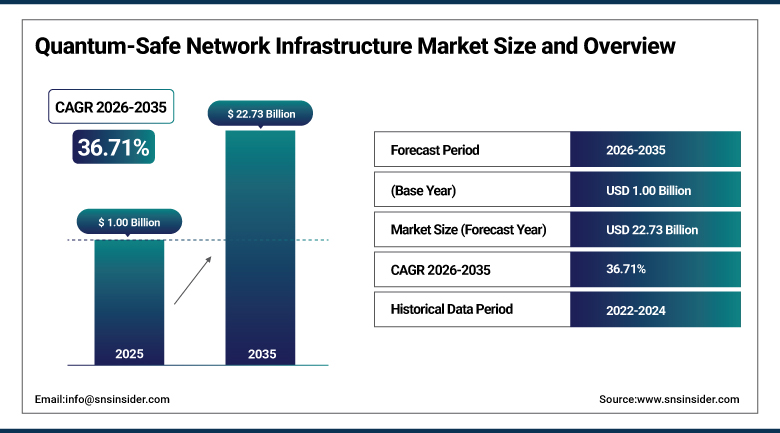
The Quantum-Safe Network Infrastructure Market was valued at USD 1.00 billion in 2025 and is expected to reach USD 22.73 billion by 2035, growing at a CAGR of 36.71% from 2026-2035.
The Quantum-Safe Network Infrastructure Market is witnessing rapid growth owing to mounting apprehensions regarding the possible implications of quantum computers for the safety of classical encryption and networking. Companies are making use of post-quantum cryptography, quantum key distribution, and quantum-safe security systems for ensuring their secure communication and data. Digitalization, cloud computing, and networked environment have further increased the demands for cybersecurity. Furthermore, the government efforts and investments being made in quantum computing as well as the standardization of post-quantum cryptography have fueled the growth of the market. Moreover, the growing realization of “harvest now, decrypt later” threats is also contributing toward market investments.
NIST finalized its first three post-quantum cryptography standards: FIPS 203, FIPS 204, and FIPS 205, providing standardized algorithms for quantum-resistant encryption and digital signatures.
To Get more information Quantum-Safe Network Infrastructure Market - Request Free Sample Report
Quantum-Safe Network Infrastructure Market Trends
-
Rising concerns about quantum computing threats to conventional encryption are driving demand for quantum-safe network infrastructure and security solutions.
-
Increasing adoption of post-quantum cryptography is encouraging organizations to upgrade network systems with quantum-resistant encryption and secure communication technologies.
-
Growing government initiatives and national cybersecurity programs are accelerating investments in quantum-safe infrastructure to protect critical communications and sensitive data.
-
Increasing deployment of quantum key distribution technologies is creating opportunities for secure optical networks supporting highly sensitive government, financial, and enterprise communications.
U.S. Quantum-Safe Network Infrastructure Market Outlook
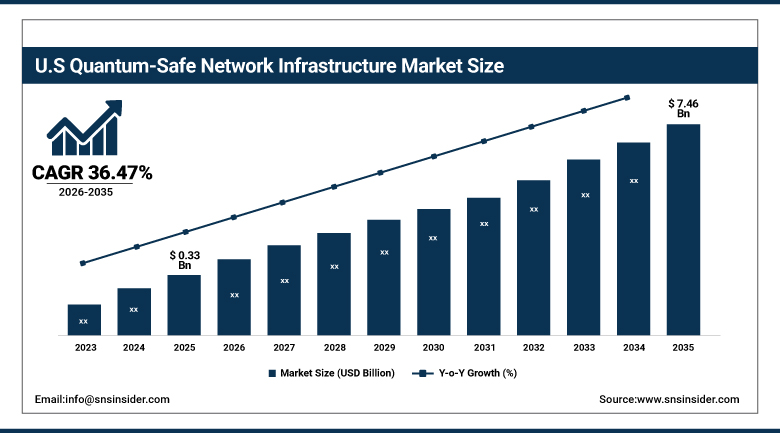
U.S. Quantum-Safe Network Infrastructure Market was valued at USD 0.33 billion in 2025 and is expected to reach USD 7.46 billion by 2035, growing at a CAGR of 36.47% from 2026-2035.
The U.S. Quantum-Safe Network Infrastructure Market is witnessing rapid growth Due to growing concerns regarding quantum computing risks for traditional encryption systems and digital communications security. Governments and businesses are relying more on post-quantum cryptography, quantum key distribution, and quantum-resistant network security systems to ensure their long-term data security. Increased digitalization, use of cloud computing, and interconnectivity have increased the need for cybersecurity. Moreover, efforts from the governments and investment in quantum computing research, along with the implementation of post-quantum cryptographic standards, have led to increased adoption. The growing awareness of the risk of “harvest now, decrypt later” approach is encouraging businesses to deploy quantum-safe security systems within their network infrastructure.
A June 2026 U.S. Executive Order directs an accelerated, government-wide migration to NIST-approved PQC standards and requires federal agencies to transition specified high-value assets to PQC by 2030/2031.
Quantum-Safe Network Infrastructure Market Segment Analysis
-
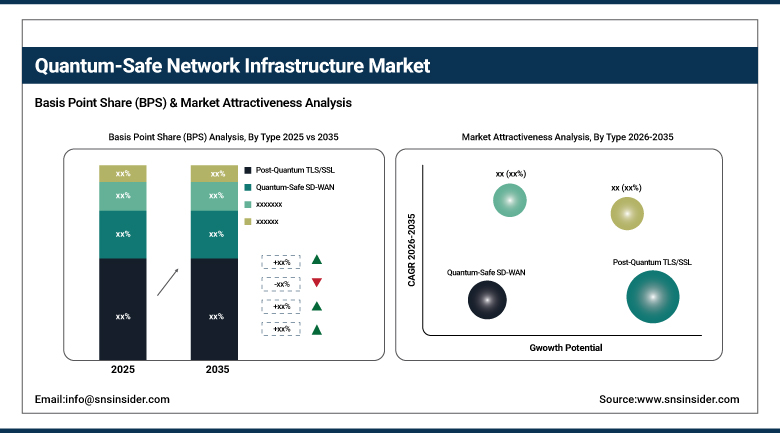
By Type, Post-Quantum TLS/SSL dominates the Quantum-Safe Network Infrastructure Market with 33% share in 2025; Quantum-Safe SD-WAN is expected to grow at the fastest CAGR of 38.59% from 2026–2035.
-
By Component, Quantum-Safe Routers & Switches dominate the Quantum-Safe Network Infrastructure Market with 30% share in 2025; PQC Integration Middleware is expected to grow at the fastest CAGR of 38.70% from 2026–2035.
-
By Application, Government & Defense Communications dominate the Quantum-Safe Network Infrastructure Market with 25% share in 2025; Healthcare Data Networks are expected to grow at the fastest CAGR of 38.70% from 2026–2035.
-
By End User, Federal & Defense Agencies dominate the Quantum-Safe Network Infrastructure Market with 27% share in 2025; Healthcare Networks are expected to grow at the fastest CAGR of 39.33% from 2026–2035.
By Type, Post-Quantum TLS/SSL dominates the quantum-safe network infrastructure market, Quantum-Safe SD-WAN grows fastest.
Post-Quantum TLS/SSL segment dominated the Quantum-Safe Network Infrastructure Market with the highest revenue share of about 33% in 2025 because of its significance in safeguarding online transactions from any potential quantum-based attacks in the future. Post-Quantum Cryptography techniques may be deployed within the current TLS/SSL protocols to enable safe transfer of information without necessarily upgrading the whole network infrastructure.
Quantum-Safe SD-WAN segment is expected to grow at the fastest CAGR of 38.59% from 2026-2035 as a result of rising usage of software-defined networking, cloud connectivity, and distributed enterprise infrastructure. It is imperative that companies have the ability to implement networks which would help in securing their network traffic from the threats of quantum computers regardless of whether it is in the branch office, remote user environment, or cloud environment.
By Component, Quantum-Safe Routers & Switches dominate the quantum-safe network infrastructure market, PQC Integration Middleware grows fastest.
Quantum-Safe Routers & Switches segment dominated the Quantum-Safe Network Infrastructure Market with the highest revenue share of about 30% in 2025 owing to the necessity of protection that network communications require and the quantum-proof communications possible because of them. The appliances offer security features in conjunction with fast data transfer capability. Increased network modernization and quantum readiness initiatives further enhance their uptake worldwide.
PQC Integration Middleware segment is expected to grow at the fastest CAGR of 38.70% from 2026-2035 due to the rising need for the inclusion of PQC into existing systems. Middleware makes this possible without having to change the entire infrastructure. Rising concerns about cryptographic vulnerabilities, hybrid encryption requirements, and quantum readiness programs within organizations will drive the use of PQC middleware.
By Application, Government & Defense Communications dominates the quantum-safe network infrastructure market, Healthcare Data Networks grows fastest.
Government & Defense Communications segment dominated the Quantum-Safe Network Infrastructure Market with the highest revenue share of about 25% in 2025 Because of the urgent requirement to safeguard classified and confidential information against newly developing cyber threats. Governmental networks need security in the long run since classified information can be vital for many years. Growing concerns about national security have led to greater implementation of quantum-safe infrastructures.
Healthcare Data Networks segment is expected to grow at the fastest CAGR of 38.70% from 2026-2035 as a result of increased digitization, interconnected healthcare networks, and growing amounts of confidential data. Healthcare companies need quantum-resistant encryption to ensure confidentiality of their data in the long term. Growing use of telemedicine, EHR, and cybersecurity concerns are likely to expedite the global roll-out of quantum-resistant networks.
By End User, Federal & Defense Agencies dominates the quantum-safe network infrastructure market, Healthcare Networks grows fastest.
Federal & Defense Agencies segment dominated the Quantum-Safe Network Infrastructure Market with the highest revenue share of about 27% in 2025 because of strict demands for protecting classified communications, sensitive government information, and important national infrastructure. Such agencies are vulnerable to many cyberattacks and need long-term cryptographic protection. Investments by governments in programs related to quantum readiness, secure communications, and cyber security have bolstered adoption worldwide.
Healthcare Networks segment is expected to grow at the fastest CAGR of 39.33% from 2026-2035 due to rising digitalization in the healthcare sector and rising amounts of sensitive patient information, genomics, and clinical data. Healthcare networks must be protected for the future against any attacks from quantum computers. Growth in connected healthcare systems, telemedicine, cloud healthcare services, and stricter privacy regulations will promote the use of quantum-safe networks.
Regional Analysis
|
Region |
Major Country |
Share within Region, 2025 (%) |
|---|---|---|
|
North America |
United States |
92.0% |
|
Europe |
Germany |
24.0% |
|
Asia Pacific |
China |
43.0% |
|
Middle East & Africa |
UAE |
18.0% |
|
Latin America |
Brazil |
35.0% |
North America Quantum-Safe Network Infrastructure Market Insights
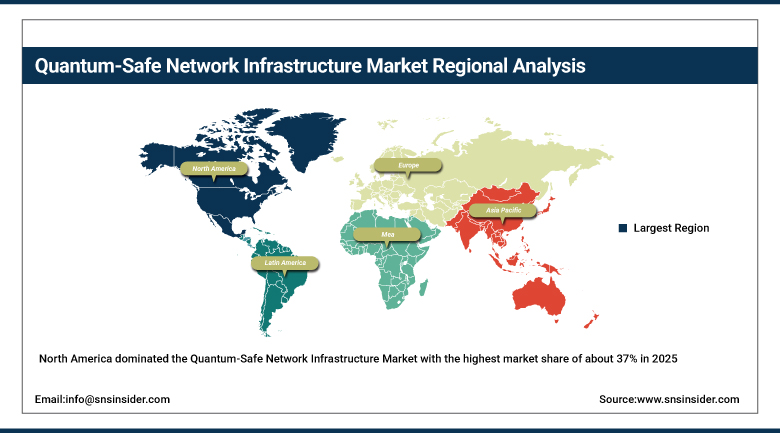
North America dominated the Quantum-Safe Network Infrastructure Market with the highest market share of about 37% in 2025, Driven by strong investments in cybersecurity, robust digital infrastructure, and increased fear of quantum attacks on traditional encryption systems. Government initiatives, early deployment of post-quantum cryptography, strong cloud infrastructure, and having prominent cybersecurity and networking technology vendors add to the dominance of the region in the market.
The U.S. Quantum-Safe Network Infrastructure Market accounted for a market share of 92.0%, With help from an enhanced security infrastructure, a robust government program, and substantial investment in post-quantum cryptography. Worry over cyber threats due to quantum, high-level cloud use, and critical infrastructure protection is fueling the demand. The availability of leading cybersecurity technology firms helps the market in the U.S. to thrive.
Get Customized Report as per Your Business Requirement - Enquiry Now
Europe Quantum-Safe Network Infrastructure Market Insights
Europe Quantum-Safe Network Infrastructure Market is observing consistent growth, aided by growing concerns about cybersecurity, strict data security requirements, and awareness regarding the dangers of quantum computers. Investments in post-quantum cryptography and secure networking technologies are being made to ensure that critical data remains protected. Increased adoption of cloud computing, development of digital infrastructure, quantum initiatives, and cyber security regulations are aiding the growth of the regional market.
The Germany Quantum-Safe Network Infrastructure Market accounted for a market share of 24.0%, due to tough requirements for cybersecurity, state-of-the-art infrastructure, and rising concerns about quantum computers. Rising adoption of post-quantum cryptography and cybersecurity solutions helps drive demand. Various programs related to cybersecurity conducted by governments, quantum computing research funding, cloud infrastructure construction, and rising security needs of systems are contributing to market growth.
Asia Pacific Quantum-Safe Network Infrastructure Market Insights
Asia Pacific is expected to grow at the fastest CAGR of about 38.07% from 2026–2035, backed by the quick digitalization process, growing critical infrastructure, and rising need for cyber security. The growing government efforts towards post-quantum security, increasing investments in quantum computing technology, and building secure communication networks in China, Japan, South Korea, India, and Singapore are contributing further to market growth in the region.
The China Quantum-Safe Network Infrastructure Market accounted for a market share of 43.0%, backed by significant investments in quantum technology, cybersecurity and secure communication systems. With growing worries about quantum-related threats, there has been increased interest in post-quantum security measures. Government programs, growing digital infrastructure, greater use of cloud computing, and quantum-proof networks/communications are also playing an important role in developing the Chinese market.
Middle East & Africa and Latin America Quantum-Safe Network Infrastructure Market Insights
The Middle East & Africa and Latin America Quantum-Safe Network Infrastructure Market is expanding progressively due to rising digitalization, cybersecurity spending, and rising concerns regarding quantum cybersecurity threats. There are chances that arise from the need for robust network security in government, financial, telecommunication, and critical infrastructure sectors. The creation of digital infrastructure, post-quantum cryptography, the use of clouds, and cybersecurity upgrades is contributing to regional market growth.
The UAE Quantum-Safe Network Infrastructure Market accounted for a market share of 18.0%, backed by increased investments in cybersecurity, digitalization, and realization of security threats associated with quantum. The need for secure communication systems in the government sector, financial industry, and critical infrastructure is fueling the adoption rate. Government-backed cybersecurity programs, investments in quantum technologies, cloud infrastructure development, and digital network modernization will boost the market further in UAE.
Market Dynamics
Growth Drivers: Growing threat of quantum attacks on conventional encryption is accelerating demand for quantum-safe network infrastructure globally
The increasing risk that future quantum computers could compromise widely used public-key cryptographic systems is significantly driving demand for quantum-safe network infrastructure. he quantum-safe technology is created to ensure safety of communication and confidential data not only from classical but quantum-powered attacks as well. The problem of "harvest now, decrypt later" attack is especially pushing organizations to secure their sensitive information before quantum-powered computers become accessible for cryptographic computations. NIST encourages organizations to start implementing post-quantum cryptography right now and has developed ML-KEM, ML-DSA and SLH-DSA standards. It is encouraging enterprises, governmental organizations, telecommunications companies, banks, and other critical infrastructure to upgrade their network architecture by using quantum-resistant cryptography and key management systems.
Restraints: High migration costs and complex legacy infrastructure can limit adoption of quantum-safe network technologies
High migration costs remain a significant restraint for organizations transitioning from conventional cryptography to quantum-resistant network infrastructure. Businesses commonly have many legacy systems that include applications, networking components, certificates, protocols, and cryptography which were not built with quantum-resistant mechanisms in mind. It can cost a lot of money to detect vulnerable cryptography elements and then replace or upgrade them. The NIST migration guidance stresses the importance of developing an exhaustive inventory of the existing cryptography and prioritizing the vulnerable elements during the transition. As a result, a migration process can take a lot of time and be rather costly, especially for those businesses that have a complex distributed network structure.
Opportunities: Accelerating enterprise migration to post-quantum cryptography creates significant opportunities for quantum-safe network infrastructure providers globally
The transition toward standardized post-quantum cryptography is creating substantial opportunities for network security vendors. Organizations require tools that can help to detect vulnerable cryptographic assets, adopt quantum-resistant cryptography, manage certificates and keys, and ensure secure communications. The final NIST standards provide an excellent basis for such a migration, while the institute continues its research to develop tools for migration, testing, benchmarking, and interoperability. There are many possibilities for vendors to use PQC technology in their TLS, VPN, IPsec, gateways, routers, switches, firewalls, network management systems, and enterprise security solutions. Another area of opportunity is crypto-agility that helps to quickly update cryptographic algorithms based on new standards.
Recent Developments:
-
2026 : IBM continued expanding its quantum-safe security portfolio, helping enterprises discover cryptographic vulnerabilities, prioritize migration, and deploy post-quantum cryptography across hybrid-cloud and enterprise environments.
-
2026 : Thales continued strengthening quantum-resistant cybersecurity capabilities through its SafeNet and cryptographic security portfolio, supporting organizations in protecting sensitive data and preparing infrastructure for post-quantum threats.
-
2026 : Cloudflare continued advancing post-quantum cryptography across its network, expanding quantum-resistant encryption support for websites, APIs, and communications to protect against future quantum-enabled attacks.
-
2026 : Cisco continued integrating post-quantum cryptography into its security and networking portfolio, supporting organizations in preparing network infrastructure, identities, and encrypted communications for emerging quantum-computing threats.
Quantum-Safe Network Infrastructure Market key players are:
-
IBM Corporation
-
Thales Group
-
Cloudflare, Inc.
-
Cisco Systems, Inc.
-
Nokia Corporation
-
Microsoft Corporation
-
Google LLC
-
Amazon Web Services, Inc.
-
Palo Alto Networks, Inc.
-
Fortinet, Inc.
-
PQShield Ltd.
-
Quantinuum Ltd.
-
Entrust Corporation
-
DigiCert, Inc.
-
ID Quantique SA
-
Toshiba Corporation
-
QuintessenceLabs Pty Ltd.
-
Arqit Quantum Inc.
-
SandboxAQ
-
BT Group plc
Quantum-Safe Network Infrastructure Market Report Scope:
| Report Attributes | Details |
|---|---|
| Market Size in 2025 | USD 1.00 Billion |
| Market Size by 2035 | USD 22.73 Billion |
| CAGR | CAGR of 36.71% From 2026 to 2035 |
| Base Year | 2025 |
| Forecast Period | 2026-2035 |
| Historical Data | 2022-2024 |
| Report Scope & Coverage | Market Size, Segments Analysis, Competitive Landscape, Regional Analysis, DROC & SWOT Analysis, Forecast Outlook |
| Key Segments | • By Type (Quantum Key Distribution (QKD) Networks, Post-Quantum TLS/SSL, Quantum-Safe SD-WAN, Quantum-Resistant Firewalls) • By Component (QKD Hardware, Quantum-Safe Routers & Switches, PQC Integration Middleware, Security Operations Tools) • By Application (Government & Defense Communication, Financial Transaction Networks, Healthcare Data Networks, Telecom Backbone Infrastructure, Cloud Provider Security) • By End User (Telecom Operators, Federal & Defense Agencies, Banking & Capital Markets, Healthcare Networks, Energy & Utilities) |
| Regional Analysis/Coverage | North America (US, Canada), Europe (Germany, UK, France, Italy, Spain, Russia, Poland, Rest of Europe), Asia Pacific (China, India, Japan, South Korea, Australia, ASEAN Countries, Rest of Asia Pacific), Middle East & Africa (UAE, Saudi Arabia, Qatar, South Africa, Rest of Middle East & Africa), Latin America (Brazil, Argentina, Mexico, Colombia, Rest of Latin America). |
| Company Profiles | IBM Corporation, Thales Group, Cloudflare, Inc., Cisco Systems, Inc., Nokia Corporation, Microsoft Corporation, Google LLC, Amazon Web Services, Inc., Palo Alto Networks, Inc., Fortinet, Inc., PQShield Ltd., Quantinuum Ltd., Entrust Corporation, DigiCert, Inc., ID Quantique SA, Toshiba Corporation, QuintessenceLabs Pty Ltd., Arqit Quantum Inc., SandboxAQ, and BT Group plc. |

Frequently Asked Questions
The Quantum-Safe Network Infrastructure Market was valued at USD 1.00 billion in 2025.
The major growth factor is rising cybersecurity threats and growing concerns over quantum attacks, driving adoption of post-quantum cryptography and quantum-resistant network infrastructure.
North America dominated the Quantum-Safe Network Infrastructure Market in 2025.
