
Quick Commerce Market Report Scope & Overview:
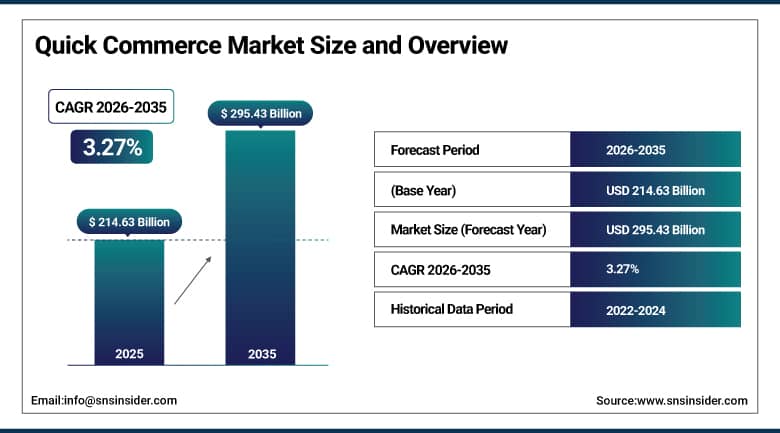
Quick Commerce Market was valued at USD 214.63 Billion in 2025 and is expected to reach USD 295.43 Billion by 2035, growing at a CAGR of 3.27% from 2026–2035.
There are various factors that will drive the growth of the global Quick Commerce Market during the forecast period. Some of these factors are growing demand for ultrafast delivery service among consumers, increasing usage of smartphones and the internet, rapid urbanization, development of digital payment systems, and increasing preference for convenience-based shopping solutions. Growing presence of dark stores, micro-fulfillment centers, and AI-powered logistic solutions is boosting the growth of the market by helping in faster order fulfillment.
The rising popularity of quick commerce services can be attributed to the demand from consumers to have instant access to their groceries, fresh food, personal care products, household essentials, and other items. There is continuous innovation in route optimization, real-time inventory management, predictive analysis, and warehouse automation.
Major companies operating in the Quick Commerce Market are investing heavily in expanding dark store networks, strengthening hyperlocal delivery infrastructure, integrating artificial intelligence into supply chain operations, and enhancing mobile commerce platforms. Strategic partnerships, technology investments, and service expansion into new urban and semi-urban markets are helping market participants improve delivery efficiency, strengthen customer retention, and expand their presence across the groceries, fresh food & beverages, beauty & personal care, electronics, and household essentials categories.
To Get More Information On Quick Commerce Market - Request Free Sample Report
Quick Commerce Market Trends
-
Increasing consumer demand for ultra-fast delivery, convenience-based shopping, and on-demand access to everyday essentials is driving the growth of the Quick Commerce Market.
-
Growing adoption of quick commerce platforms for groceries, fresh food & beverages, beauty & personal care products, household essentials, and electronics is accelerating market expansion.
-
Advancements in artificial intelligence, route optimization, real-time inventory management, warehouse automation, and hyperlocal logistics are improving delivery efficiency and enhancing customer experience.
-
Increasing investments in dark stores, micro-fulfillment centers, digital payment infrastructure, and last-mile delivery networks are supporting market innovation and scalability.
-
Growing adoption among urban consumers, busy professionals, and digitally connected households, along with expanding partnerships between retailers, logistics providers, and technology companies, is supporting sustained market growth.
U.S. Quick Commerce Market Outlook
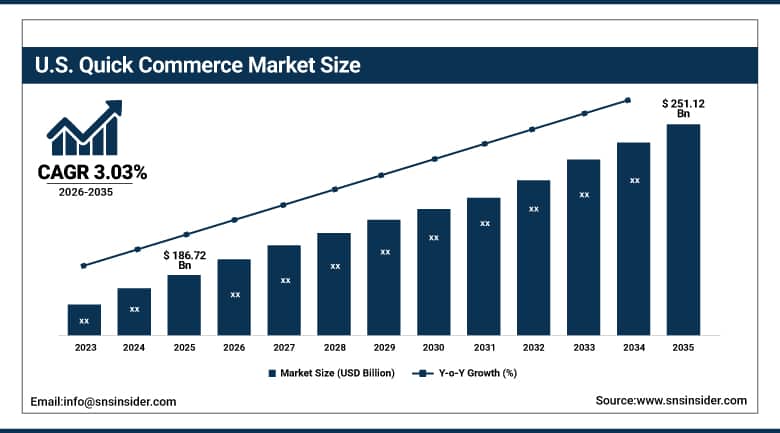
The U.S. Quick Commerce Market was valued at USD 186.72 Billion in 2025 and is expected to reach around USD 251.12 Billion by 2035, growing at a CAGR of 3.03% from 2026–2035.
The surge in consumer interest for faster deliveries, smartphone usage, and digital payment solutions is expected to boost the Quick Commerce Market in the U.S. As consumers are increasingly using quick commerce websites to procure groceries, fresh food and beverages, beauty and personal care products, household items, and others daily items due to the desire for convenience.
Furthermore, innovations in technologies like artificial intelligence, routes optimization, warehouse management systems, inventory tracking, and hyper-local delivery networks are aiding the growth of the Quick Commerce Market in the U.S. The firms are investing in dark stores, micro fulfillment centers, delivery infrastructure, and working in collaboration with retailers and brands to gain operational efficiencies and to provide enhanced customer experience.
During 2026, the top players in quick commerce and retail tech segment continued to invest in AI-powered logistics, automated fulfillment solutions, and delivery solutions to secure their market presence. The market players have been emphasizing on expansion of dark store networks, optimization of supply chain, improving their digital commerce platforms, and speed of delivery.
Quick Commerce Market Segment Analysis
-
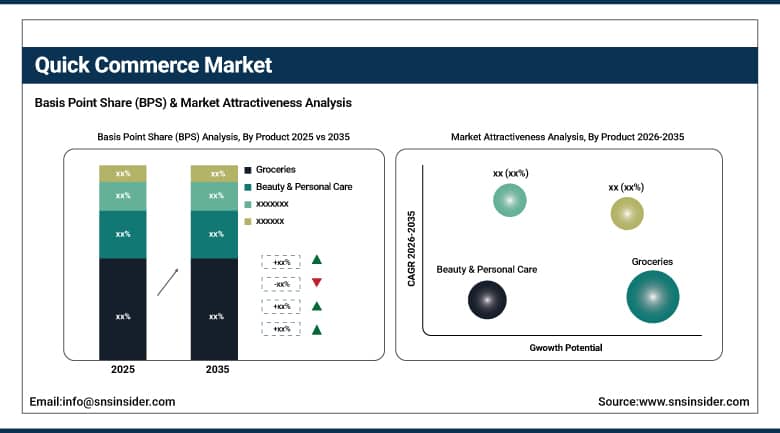
By product, groceries dominated the quick commerce market with a 40.00% share in 2025, while beauty & personal care is projected to be the fastest-growing segment, reaching a 6.28% share by 2035.
-
By channel, mobile application dominated the quick commerce market with a 93.00% share in 2025, while web portal is projected to be the fastest-growing segment, reaching a 4.24% share by 2035.
-
By mode of payment, online/cashless payments dominated the quick commerce market with a 79.70% share in 2025, while cash on delivery is projected to be the fastest-growing segment, reaching a 8.12% share by 2035.
-
By delivery, instant delivery dominated the quick commerce market with a 82.00% share in 2025, while scheduled delivery is projected to be the fastest-growing segment, reaching a 7.03% share by 2035.
By product, groceries dominated the quick commerce market, while beauty & personal care is expected to grow fastest.
Groceries were the dominant quick commerce segment in 2025 owing to high consumer demand for daily essentials, convenience foods, and household goods via ultra-fast delivery platforms. The rapid growth of dark stores, efficient inventory management practices, and growing consumer preference for doorstep grocery delivery services have been contributing factors to the dominance of this market segment. The high purchase frequency of items along with high accessibility of the items has been adding to the market dominance of the segment.
It is anticipated that the groceries segment will continue to maintain their market dominance over the entire forecast period as customers seek convenience and same-day delivery services for essential goods. On the other hand, the beauty & personal care segment is expected to grow at the highest CAGR throughout the forecast period on the back of high online sales of skincare, cosmetics, and personal hygiene products.
By channel, mobile application dominated the quick commerce market, while web portal is expected to grow fastest.
The mobile applications category held the largest share of the quick commerce market in 2025 due to the wide use of smartphones, increased internet penetration through mobile phones, and the trend of shopping through apps. The various functionalities in the mobile applications, including personalized offers, real-time order tracking, digital payment, loyalty program, and push notification, have contributed to customer engagement and repeat purchase behavior. The consistent development of the user interface and mobile commerce has made this category more dominant.
The web portal category is projected to experience the fastest growth in the forecast period since retailers keep improving their browser shopping experience.
By delivery, instant delivery dominated the quick commerce market, while scheduled delivery is expected to grow fastest.
The instant delivery category was dominant in the quick commerce market during the year 2025 owing to the increasing demand from customers for delivery within a minute’s notice, especially of grocery, fresh food and beverages, medicines, and household items. Companies have made huge investments in hyperlocal logistics, dark stores, artificial intelligence for optimal routes, and efficient last mile delivery networks, which have enabled firms to deliver orders within minutes while enhancing customer satisfaction. Convenience and on-demand shopping continue to fuel the dominance of this category.
The scheduled delivery category will experience the highest growth rate in the forecast period owing to the increasing demand from consumers for flexible time slots for purchasing planned products, large basket size, and for household replenishment.Retailers are offering scheduled delivery options for optimizing logistics expenses and adapting to changing consumer preferences.
Regional Insights
|
Region |
Major Country |
Share within Region, 2025(%) |
|---|---|---|
|
North America |
United States |
89.40% |
|
Europe |
Germany |
24.50% |
|
Asia Pacific |
China |
42.00% |
|
Middle East & Africa |
Saudi Arabia |
29.50% |
|
Latin America |
Brazil |
46.00% |
Asia-Pacific Quick Commerce Market Insights
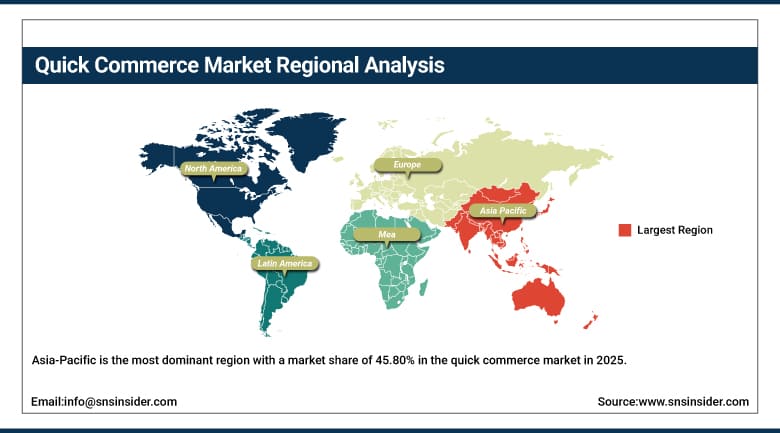
Asia-Pacific is the most dominant region with a market share of 45.80% in the quick commerce market in 2025. Asia-Pacific's dominance is attributed to urbanization, increasing penetration of smartphones, a substantial number of digital consumers, and rising need for same-day deliveries. China held the leading market share owing to its established e-commerce ecosystem, high urban population base, and significant investments in logistics and digital commerce infrastructure. Other factors that continue to boost the market growth in the region include an increase in dark stores, improvement in last-mile delivery solutions, and AI-based inventory management and route optimization.
Get Customized Report as Per Your Business Requirement - Enquiry Now
North America Quick Commerce Market Insights
In 2025, the North America market held a share of 25.50% in the global quick commerce market. Growth in the regional market can be attributed to the use of digital commerce, consumer spending, logistics infrastructure, and growing demand for ultra-fast delivery services. The availability of quick commerce firms, logistics networks, and digital payment services continues to boost the growth of the market. The United States contributed 87.00% to the North America quick commerce market in 2025 because of the country’s large number of urban population, e-commerce environment, and the adoption of app-based grocery and convenience shopping. The region also enjoys regular investment in dark stores, micro-fulfillment centers, artificial intelligence logistics, and last-mile delivery solutions.
Europe Quick Commerce Market Insights
In 2025, Europe was one of the leading markets of quick commerce accounting for 18.20% of the world market share. Some factors driving the growth of the market include rising consumer preference for convenient shopping, growing popularity of online grocery shopping, and continuous investment in the development of digital retail infrastructure. In Europe, Germany had a prominent market share owing to its well-developed retail industry, internet penetration rate, and the adoption of e-commerce technologies. Rising investments in automation of warehouses, sustainable deliveries, and hyper-local delivery facilities will continue driving the market growth.
Middle East & Africa and Latin America Quick Commerce Market Insights
In 2025, the Middle East & Africa contributed 5.10% of the total global market for quick commerce. Some of the factors supporting the growth of the market include higher penetration of the internet, higher use of smartphones, adoption of digital payment methods, and higher investments in advanced retailing and logistics infrastructure. Countries like Saudi Arabia and the UAE have been witnessing high adoption of the quick commerce services owing to continuous development of digital capacity on the part of retailers. In 2025, Latin America accounted for 5.40% of the total global market of quick commerce. Brazil was leading in terms of regional market share due to its large number of consumers, rapid growth of online grocery stores, and higher investment in hyper-local delivery services.
Growth Driver: Rising consumer demand for ultra-fast delivery and digital commerce accelerating quick commerce market growth
The fast-moving trend towards convenience-based shopping and the growing preference for very fast delivery services are among the main reasons for the market's growth in the area of quick commerce. Customers rely more on quick commerce platforms for purchasing groceries, fresh food & beverages, beauty & personal care items, household goods, and many other everyday needs, receiving deliveries within 10-30 minutes. Smartphones' growing penetration rates, cheap internet access, and wide acceptance of digital payments have increased the usage of apps for online shopping in urban and semi-urban locations greatly.
Dark stores, micro-fulfillment centers, and hyperlocal delivery systems helped organizations to speed up delivery processes, increasing the availability of inventory and operational efficiency. Moreover, technological innovations such as the use of artificial intelligence, predictive analysis, demand forecasting, route optimization, and warehouse automation assist quick commerce providers in reducing operating costs and enhancing customer experience. Additional investments made by leading retailers, e-commerce firms, and delivery services in logistics infrastructure and technology integration are expected to increase market growth further during the forecast period.
Restraints: High operational costs and complex last-mile logistics may restrict quick commerce market growth
While there are clear growth prospects in the market, quick commerce businesses are subject to several challenges in terms of business operations and finances. The need to keep dark stores, micro-fulfillment centers, delivery fleets, and inventory management technology in place calls for a large amount of funding and ongoing operational spending. The concept of providing products at lightning speed puts companies under pressure to create dense fulfillment networks that come with high costs in terms of infrastructure, staffing, and transportation.
Furthermore, issues like high fuel costs, higher wages for delivery drivers, inventory shrinkage, product waste, and variable consumer demand can be problematic in the achievement of profitability. It is also difficult for businesses to achieve optimal inventory management across different fulfillment locations without running into issues like shortages. Other challenges include high compliance costs due to labor, transportation, privacy, and environmental regulations. High competition in quick commerce businesses, combined with pricing and customer acquisition pressures, poses more challenges.
Opportunities: AI-driven logistics, hyperlocal expansion, and retail partnerships creating new growth opportunities
There are significant opportunities for growth in the quick commerce market through further technological advancements and geographical expansion. Artificial intelligence, machine learning, predictive demand forecasting, warehouse robots, automated inventory management, and intelligent route optimization have changed the way that supply chains operate. Companies are able to offer better service at reduced cost. Over the next several years, these technological advancements will continue to help companies improve their services and customer satisfaction.
Entering tier-2 and tier-3 markets, an increased number of smartphone users, improving payments infrastructure, and an increase in internet users are all providing new avenues through which quick commerce players can reach customers who were previously untapped. Through strategic alliances with retailers, grocery stores, consumer goods brands, logistics partners, and technology companies, companies will be expanding their range of products and improving their ability to fulfill orders. In addition, efforts towards developing sustainable delivery methods, using electric delivery vehicles and recyclable packaging, and investing in energy-efficient fulfillment centers will contribute to market growth in the future and help companies to meet their sustainability goals and comply with regulations.
Recent Developments
-
2026: Swiggy Instamart expanded its dark store network and strengthened its AI-enabled logistics capabilities to improve delivery efficiency, reduce fulfillment time, and support rapid expansion across Indian cities.
-
2026: Zepto continued investing in dark stores, warehouse automation, and supply chain optimization while expanding its quick commerce network to strengthen its competitive position in the market.
-
2026: Blinkit accelerated investments in hyperlocal fulfillment infrastructure, last-mile delivery optimization, and technology-driven inventory management to enhance customer experience and operational efficiency.
-
2025: Flipkart Minutes expanded its quick commerce operations through investments in fulfillment infrastructure, digital commerce capabilities, and strategic partnerships to strengthen its presence in the ultra-fast delivery segment.
Quick Commerce Market Key Players
-
Blinkit
-
Zepto
-
Swiggy Instamart
-
DoorDash, Inc.
-
Uber Technologies, Inc. (Uber Eats)
-
Delivery Hero SE
-
Getir
-
Flink SE
-
Gopuff
-
Zapp
-
Glovo
-
Talabat
-
Rappi Inc.
-
Amazon.com, Inc. (Amazon Fresh)
-
Flipkart Minutes
-
Meituan
-
JD.com, Inc. (JD Daojia)
-
Alibaba Group Holding Limited (Taoxianda)
Frequently Asked Questions
The quick commerce market is expected to grow at a CAGR of 3.27% from 2026 to 2035.
The market is driven by rising consumer demand for ultra-fast delivery, increasing smartphone and internet penetration, expanding digital payment adoption, and continuous investments in dark stores and hyperlocal logistics infrastructure.
Asia-Pacific dominated the quick commerce market in 2025 with a 45.80% share.
