
Renal Denervation Devices Market Report Scope and Overview:
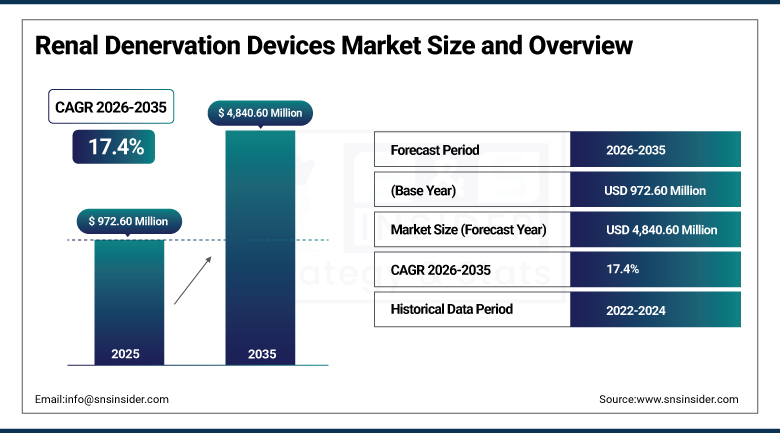
The Renal Denervation Devices Market was valued at USD 972.60 Million in 2025 and is projected to reach USD 4,840.60 Million by 2035, registering a CAGR of 17.4% from 2026 to 2035.
The Renal Denervation Devices Market is revolutionizing the treatment of resistant and uncontrolled hypertension with the emergence of a less-invasive solution that is based on catheter interventions as opposed to life-long drug therapy. This market is defined by a growing prevalence of hypertension globally, the increase in confidence of physicians after undergoing sham-controlled pivotal trials, the growing number of regulatory approvals by the FDA and CE Mark, as well as the increasing use of radiofrequency, ultrasound and chemical ablation techniques in interventional cardiology and hypertension clinics. Important developments in the field include the development of multi-electrode catheters, artificial intelligence procedures and expansion in indications from resistant hypertension to chronic kidney disease and heart failure.
In 2025, ReCor Medical, a subsidiary of Otsuka Medical Devices, continued expanding commercial rollout of its Paradise Ultrasound Renal Denervation System, following CMS initiation of a National Coverage Analysis aimed at establishing nationwide Medicare coverage for renal denervation procedures in patients with hypertension.
To Get more information On Renal Denervation Devices Market - Request Free Sample Report
Renal Denervation Devices Market Trends
-
Rising adoption of ultrasound-based renal denervation systems continues improving procedural consistency and shortening treatment times versus first-generation radiofrequency catheters.
-
Growing integration of AI-assisted imaging and intravascular navigation continues improving catheter positioning accuracy and reducing procedural variability.
-
Expanding clinical evidence from sham-controlled pivotal trials continues strengthening physician confidence and broadening treatment guideline recommendations.
-
Increasing development of multi-electrode catheter platforms continues enabling faster, more uniform circumferential nerve ablation in a single procedure.
-
Rising expansion of renal denervation indications into chronic kidney disease and heart failure continues broadening the addressable patient population.
U.S. Renal Denervation Devices Market Outlook
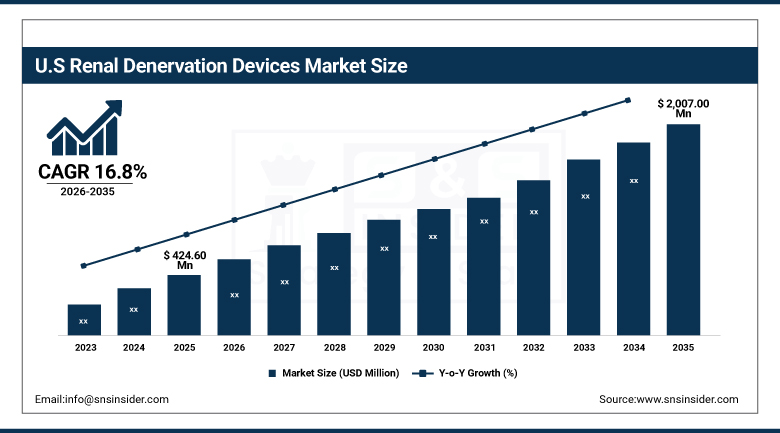
The U.S. Renal Denervation Devices Market was valued at approximately USD 424.60 Million in 2025 and is projected to reach approximately USD 2,007.00 Million by 2035, registering a CAGR of approximately 16.8% from 2026 to 2035.
Demand across the United States continued to be shaped by favorable FDA regulatory approvals, an expanding base of trained interventional cardiologists, and active CMS engagement toward establishing a nationwide Medicare coverage policy for renal denervation procedures. Rising prevalence of resistant hypertension among an aging population, combined with growing physician familiarity following pivotal sham-controlled trial results, continued reinforcing the country's position as both the largest and most clinically advanced market for renal denervation technology. Expanding cath lab program onboarding, physician training initiatives, and real-world outcomes registries added further layers of sustained domestic demand extending well beyond early adopter academic medical centers into community hospital settings nationwide.
In 2025, Medtronic expanded U.S. cath lab program onboarding and physician training throughput for its Symplicity Spyral renal denervation catheter system, building on the device's 2023 FDA marketing authorization as the first renal denervation system approved for treating uncontrolled hypertension.
Renal Denervation Devices Market Segment Analysis
-
By Technology, Radiofrequency Renal Denervation Systems segment dominated the Renal Denervation Devices Market in 2025 with 61.40% share; Ultrasound Renal Denervation Systems segment is the fastest growing segment, registering a CAGR of 19.1% during 2026–2035.
-
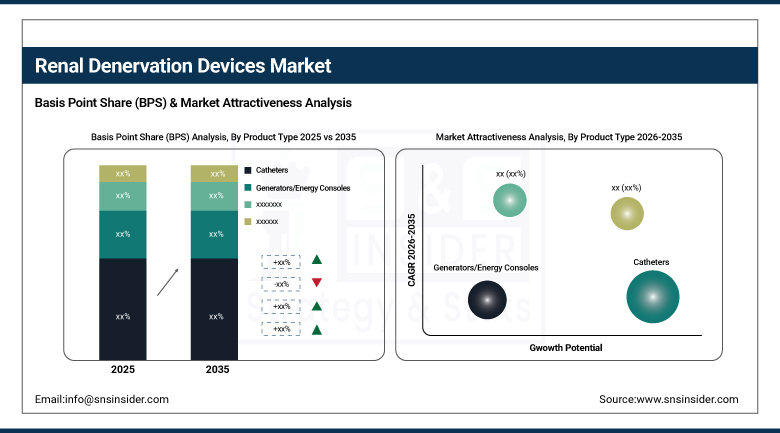
By Product Type, Catheters segment dominated the market in 2025 with 57.80% share; Generators/Energy Consoles segment is the fastest growing segment, registering a CAGR of 18.8% during 2026–2035.
-
By Application, Resistant Hypertension segment dominated the market in 2025 with 58.60% share; Chronic Kidney Disease with Hypertension segment is the fastest growing segment, registering a CAGR of 19.3% during 2026–2035.
-
By End User, Hospitals segment dominated the market in 2025 with 63.50% share; Cardiac Catheterization Laboratories segment is the fastest growing segment, registering a CAGR of 18.6% during 2026–2035.
By Technology, Radiofrequency Renal Denervation Systems Lead the Market While Ultrasound Renal Denervation Systems Grows Fastest
The Radiofrequency Renal Denervation Systems segment dominated the Renal Denervation Devices Market in 2025, supported by its status as the first and most clinically validated ablation modality, with an established track record across multiple sham-controlled pivotal trials and the earliest regulatory approvals in major markets. Physician familiarity built over more than a decade of clinical use, combined with proven catheter designs capable of multi-electrode circumferential ablation, has reinforced radiofrequency technology as the default choice across hospital cath labs. Continued device refinement, including improved electrode spacing and real-time impedance monitoring, has further extended radiofrequency's dominant position across both academic and community hospital renal denervation programs.
The ultrasound renal denervation systems market segment holds the top position amongst all other segments in terms of growth in the renal denervation devices market due to their capability of delivering circumferential energy in one go using a balloon method rather than a sequential radiofrequency ablation technique. Increasing physician preference towards operator independent energy delivery and increasing commercialization post recent FDA approvals have been driving ultrasound devices uptake in major hospital chains. Clinical data in support of reducing blood pressure through ultrasound devices keeps on motivating cath labs to integrate them along with radiofrequency devices.
By Product Type, Catheters Dominate While Generators and Energy Consoles Grows Fastest
The Catheters segment dominated the Renal Denervation Devices Market in 2025, reflecting the single-use, per-procedure nature of renal denervation catheters and their status as the primary revenue-generating component of every ablation procedure. Rising procedure volumes across expanding hospital and cath lab networks have directly translated into sustained catheter demand, reinforced by manufacturers' focus on disposable, infection-control-friendly single-use designs. Continued innovation in multi-electrode and balloon-based catheter architecture has further cemented this segment's position as the largest product category by revenue across the global market.
The Generators and Energy Consoles segment is the fastest growing in the Renal Denervation Devices Market as expanding cath lab capacity drives fresh capital equipment purchases alongside rising procedure volumes. Growing hospital investment in next-generation consoles featuring AI-assisted procedural guidance, real-time impedance monitoring, and improved user interfaces continues outpacing catheter segment growth on a percentage basis, particularly as newly onboarded cath labs and community hospitals build out initial renal denervation program capacity from a comparatively low equipment base.
By Application, Resistant Hypertension Dominates While Chronic Kidney Disease Grows Fastest
The Resistant Hypertension segment dominated the Renal Denervation Devices Market in 2025, reflecting the original and most clinically validated indication for renal denervation therapy, supported by the bulk of completed pivotal trials and current regulatory approvals. Patients who remain uncontrolled despite three or more antihypertensive medications represent the largest identified addressable population for catheter-based intervention. Continued guideline recognition of renal denervation as a viable treatment option for this population has reinforced resistant hypertension as the dominant application driving current device demand.
The Chronic Kidney Disease with Hypertension segment is the fastest growing in the Renal Denervation Devices Market, supported by emerging clinical evidence that sympathetic nerve overactivity accelerates renal function decline in patients with concurrent hypertension and reduced kidney function. Growing investigator interest in exploring renal denervation as a nephroprotective intervention alongside blood pressure control continues expanding clinical trial activity in this population, positioning it as a meaningful future growth driver as evidence matures toward broader guideline adoption.
By End User, Hospitals Dominate the Market While Cardiac Catheterization Laboratories Grows Fastest
The Hospitals segment dominated the Renal Denervation Devices Market in 2025 due to the concentration of interventional cardiology programs, cath lab infrastructure, and multidisciplinary hypertension specialist teams required to evaluate, treat, and follow up renal denervation patients. Renal denervation systems remain the focus of investment by major academic health centers and hospital networks, which continue to invest in programs, education, and registries in order to drive adoption. Investment by hospitals in capital expenditures for expanding cardiovascular services has made this sector the biggest end-user for renal denervation products.
The Cardiac Catheterization Laboratories segment is the fastest growing in the Renal Denervation Devices Market as dedicated, high-throughput cath lab facilities increasingly specialize in structural heart and peripheral vascular interventions alongside renal denervation procedures. Growing standalone and hospital-affiliated cath lab investment in dedicated renal denervation program capacity, supported by expanding physician training pipelines, continues driving procedure volume growth outside traditional general hospital settings.
Regional Analysis
|
Region |
Major Country |
Share within Region, 2025 (%) |
|
North America |
United States |
83.00% |
|
Europe |
Germany |
22.80% |
|
Asia Pacific |
China |
31.20% |
|
Middle East and Africa |
UAE |
26.50% |
|
Latin America |
Brazil |
34.60% |
North America Renal Denervation Devices Market Insights
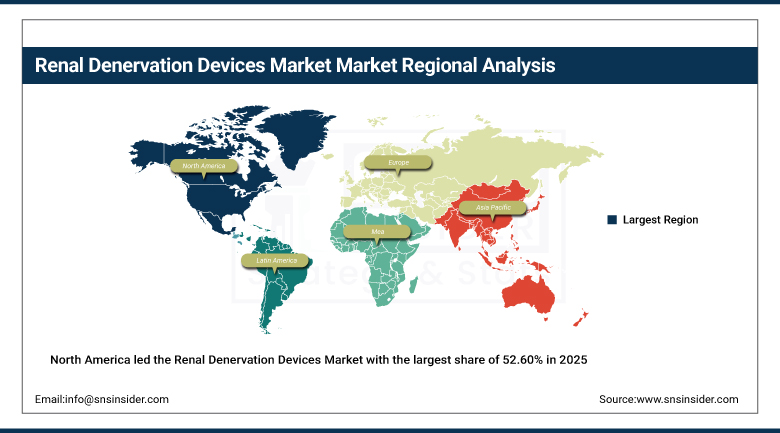
North America led the Renal Denervation Devices Market with the largest share of 52.60% in 2025. Highly developed healthcare infrastructure, a strong reimbursement framework, and rapid adoption of innovative cardiovascular technologies continued reinforcing this dominant regional position. Extensive clinical research activity, favorable regulatory approvals from the FDA, widespread availability of advanced catheterization laboratories, and the concentration of major medical device manufacturers investing heavily in next-generation renal denervation systems further supported sustained regional demand throughout the current forecast period.
The United States accounted for highest share of regional revenue, anchored by its large population of resistant hypertension patients, extensive interventional cardiology infrastructure, and active CMS engagement toward establishing nationwide Medicare coverage for renal denervation procedures. Canada added further regional demand through steady public healthcare system investment in cardiovascular program expansion, and that combined strength kept the continent the largest addressable market for renal denervation device vendors through the forecast period.
Get Customized Report as per Your Business Requirement - Enquiry Now
Europe Renal Denervation Devices Market Insights
Europe held a meaningful share of global revenue, supported by early regulatory approval history, well-established public healthcare systems, and strong interventional cardiology infrastructure across the region's major economies. Ongoing registry activity in clinical trials along with the growing acknowledgment of reimbursement by hospitals for renal denervation treatment ensured a stable demand for radiofrequency and ultrasound ablation devices.
Germany led demand of European revenue, supported by its dense concentration of interventional cardiology centers and strong participation in international renal denervation clinical trials. The United Kingdom and France contributed substantial additional demand through national health system investment in cardiovascular disease management, and continued European clinical registry expansion should keep regional demand for renal denervation technology climbing through the forecast period.
Asia Pacific Renal Denervation Devices Market Insights
Asia Pacific is advancing at the fastest pace among all regions tracked in this report, growing at a CAGR of 21.40% through 2035, driven by rapidly increasing hypertension prevalence, an expanding elderly population, and improving cardiovascular treatment infrastructure across the region's largest economies. The rising awareness amongst physicians, higher spending on health care, and government efforts to prevent heart diseases have helped the region maintain its pace of growth ahead of all other regions analyzed in this study.
China dominated the regional revenue, supported by substantial government investment in hospital infrastructure and rapidly expanding interventional cardiology capacity. Japan and India contributed meaningful additional demand, with India's rapidly growing catheterization laboratory network and Japan's advanced healthcare infrastructure both reinforcing the region's position as the fastest-growing market tracked in this report.
MEA and Latin America Renal Denervation Devices Market Insights
The Middle East and Africa and Latin America both showed steady growth, driven by expanding hospital infrastructure investment, growing government focus on cardiovascular disease management, and rising demand for advanced interventional cardiology capacity across both areas. As these markets continued building out modern healthcare infrastructure, renal denervation offered a genuinely efficient way to expand hypertension treatment capacity beyond conventional pharmacological management alone.
The UAE led Middle East and Africa demand of regional revenue, supported by the country's advanced private hospital infrastructure and substantial cardiovascular care investment. Saudi Arabia contributed further demand through its own hospital modernization programs. In Latin America, Brazil accounted for roughly 34.60% of regional revenue, with growing public and private hospital cath lab investment continuing to anchor regional demand for renal denervation technology.
Market Dynamics
Growth Drivers: Rising Hypertension Burden and Expanding Regulatory Approvals
The industry is driven by the rising global prevalence of resistant and uncontrolled hypertension, growing cardiovascular disease burden, and expanding regulatory approvals that continue validating renal denervation as a legitimate device-based treatment alternative to lifelong pharmacotherapy. As millions of patients worldwide continue experiencing inadequate blood pressure control despite multi-drug regimens, the clinical need for durable, procedure-based intervention continues driving adoption across interventional cardiology and hypertension specialty programs globally.
Growing clinical evidence from sham-controlled pivotal trials continues reinforcing this driver, as consistent, statistically significant blood pressure reduction data strengthens physician confidence and expands treatment guideline recommendations. Rising integration of AI-assisted imaging and next-generation multi-electrode catheter platforms continues improving procedural precision and reducing treatment variability, and that combination of clinical validation and technological refinement is exactly what keeps hospital and cath lab demand climbing at such a sustained, steady pace.
Restraints: Reimbursement Uncertainty and High Procedural Costs
Ongoing reimbursement uncertainty continues posing a genuine restraint on faster market-wide expansion, particularly in healthcare systems where national coverage policies for renal denervation procedures remain under review or have not yet been finalized. That reimbursement gap has kept broader adoption concentrated among academic medical centers and well-resourced hospital networks willing to absorb near-term financial uncertainty ahead of definitive coverage decisions.
High per-procedure device and capital equipment costs continue posing a further restraint, as single-use catheters combined with dedicated generator and console investment require substantial upfront hospital commitment before a renal denervation program can achieve meaningful procedure volume. That cost profile keeps some smaller hospitals and cost-constrained healthcare systems reliant on pharmacological management alone rather than committing to in-house interventional capability.
Opportunities: Expanding Clinical Indications and Emerging Market Cath Lab Growth
Expanding clinical indications beyond resistant hypertension into chronic kidney disease and heart failure represent a genuinely significant opportunity, as emerging trial data continues exploring renal denervation's nephroprotective and cardioprotective potential in broader patient populations. Vendors positioned early with strong clinical trial pipelines in these emerging indications stand to capture meaningful share as treatment guidelines gradually expand beyond the original hypertension-only indication.
Expansion of the catheterization lab infrastructure at a rapid pace in the emerging economies represents the second major opportunity for growth since government healthcare funding schemes in the Asia Pacific, Latin America, and Middle East regions are creating new demand for interventional cardiology infrastructure in these markets. The vendors who have reliable and economically efficient radiofrequency solutions can gain significant traction because of the nascent infrastructure in these regions.
Recent Developments:
-
2026: Terumo remained among the leading companies advancing renal denervation technologies, with competition increasingly focused on catheter design, procedural efficiency, clinical evidence, and treatment safety.
-
2025: The American College of Cardiology and the Smith Center launched a joint renal denervation registry module linking real-world RDN outcomes data across the ACC CathPCI Registry to expand post-market clinical evidence.
-
2024: Ablative Solutions advanced pivotal clinical development of its Peregrine System Infusion Catheter, a chemical renal denervation platform using targeted alcohol-mediated nerve ablation as an alternative to energy-based technologies.
Renal Denervation Devices Market key players are:
-
Medtronic plc
-
ReCor Medical, Inc. (Otsuka Holdings Co., Ltd.)
-
Boston Scientific Corporation
-
Johnson & Johnson MedTech
-
Abbott Laboratories
-
Terumo Corporation
-
Cordis
-
B. Braun Melsungen AG
-
Biotronik SE & Co. KG
-
Ablative Solutions, Inc.
-
MicroPort Scientific Corporation
-
Mercator MedSystems, Inc.
-
Symple Surgical, Inc.
-
AngioDynamics, Inc.
-
Lepu Medical Technology Co., Ltd.
-
Balton Sp. z o.o.
-
Acotec Scientific Holdings Limited
-
Merit Medical Systems, Inc.
-
Cook Medical
-
SoniVie Ltd.
Renal Denervation Devices Market Report Scope:
| Report Attributes | Details |
|---|---|
| Market Size in 2025 | USD 972.60 Million |
| Market Size by 2035 | USD 4,840.6 Billion |
| CAGR | CAGR of 17.4% From 2026 to 2035 |
| Base Year | 2025 |
| Forecast Period | 2026-2035 |
| Historical Data | 2022-2024 |
| Report Scope & Coverage | Market Size, Segments Analysis, Competitive Landscape, Regional Analysis, DROC & SWOT Analysis, Forecast Outlook |
| Key Segments | • By Technology (Radiofrequency Renal Denervation Systems, Ultrasound Renal Denervation Systems, Chemical Renal Denervation Systems, Others) • By Product Type (Catheters, Generators/Energy Consoles, Accessories, Disposable Components) • By Application (Resistant Hypertension, Uncontrolled Hypertension, Chronic Kidney Disease with Hypertension, Clinical Research) • By End User (Hospitals, Cardiac Catheterization Laboratories, Ambulatory Surgical Centers, Specialty Cardiovascular Clinics) |
| Regional Analysis/Coverage | North America (US, Canada), Europe (Germany, UK, France, Italy, Spain, Russia, Poland, Rest of Europe), Asia Pacific (China, India, Japan, South Korea, Australia, ASEAN Countries, Rest of Asia Pacific), Middle East & Africa (UAE, Saudi Arabia, Qatar, South Africa, Rest of Middle East & Africa), Latin America (Brazil, Argentina, Mexico, Colombia, Rest of Latin America). |
| Company Profiles | Medtronic plc, ReCor Medical, Inc. (Otsuka Holdings Co., Ltd.), Boston Scientific Corporation, Johnson & Johnson MedTech, Abbott Laboratories, Terumo Corporation, Cordis, B. Braun Melsungen AG, Biotronik SE & Co. KG, Ablative Solutions, Inc., MicroPort Scientific Corporation, Mercator MedSystems, Inc., Symple Surgical, Inc., AngioDynamics, Inc., Lepu Medical Technology Co., Ltd., Balton Sp. z o.o., Acotec Scientific Holdings Limited, Merit Medical Systems, Inc., Cook Medical, SoniVie Ltd. |

Frequently Asked Questions
Key Palyers include Medtronic plc, ReCor Medical, Inc. (Otsuka Holdings Co., Ltd.), Boston Scientific Corporation, Johnson & Johnson MedTech, and Abbott Laboratories, among others.
The major growth factor is rising resistant hypertension prevalence, expanding regulatory approvals, and growing clinical evidence supporting durable blood pressure reduction from catheter-based ablation.
The Radiofrequency Renal Denervation Systems segment dominated the Renal Denervation Devices Market by technology, representing the largest share of revenue in 2025.
North America dominated the Renal Denervation Devices Market in 2025, holding an estimated 52.60% share of total global market revenue.
