
Rare Disease Genome Editing Market Report Scope & Overview:
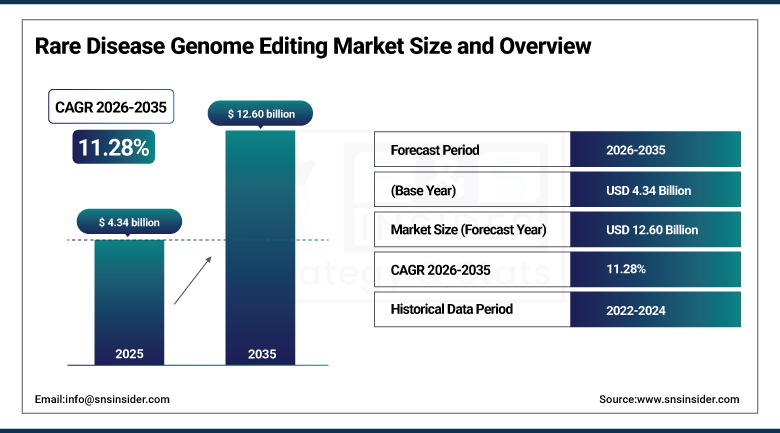
The Rare Disease Genome Editing Market was valued at USD 4.34 billion in 2025. It is expected to reach USD 12.60 billion by 2035, growing at a CAGR of 11.28% from 2026–2035.
The rare disease genome editing market is witnessing strong growth in the global market owing to rising prevalence of genetic disorders. Increasing adoption of CRISPR based therapies is supporting market expansion. Growing investments in gene therapy research are accelerating clinical development pipelines. Expanding applications in rare disease treatment are driving demand. Pharmaceutical companies are actively advancing genome editing platforms. Rising focus on precision medicine and targeted therapeutics is further accelerating market adoption.
According to the U.S. National Institutes of Health and National Center for Advancing Translational Sciences, more than 7,000 rare diseases affect an estimated 300 million people globally, with about 80% of these conditions having a genetic origin. As per the U.S. Food and Drug Administration 2025 biologics and gene therapy approvals framework, over 30 gene and cell therapies have received regulatory authorization for rare disease indications. The European Medicines Agency also reports that orphan drug designations account for over 50% of all new advanced therapy medicinal product developments, reflecting accelerating adoption of genome editing technologies in rare disease treatment pathways.
To Get more information on Rare Disease Genome Editing Market - Request Free Sample Report
Rare Disease Genome Editing Market Trends
-
Rapid adoption of CRISPR-Cas9 technology is transforming rare disease treatment development through highly precise gene correction approaches globally.
-
Increasing clinical trials for gene editing therapies are accelerating development timelines and improving success rates in rare disease treatments.
-
Integration of AI and bioinformatics is enhancing gene discovery, enabling faster identification of therapeutic targets in rare diseases.
-
Rising investments in precision medicine are supporting innovation in personalized genome editing therapies across biotechnology and pharmaceutical sectors.
-
Expanding use of genetic profiling is enabling patient specific treatment approaches, improving outcomes in rare disease management globally.
-
Growing regulatory approvals for gene therapies are encouraging wider adoption of advanced genome editing technologies in healthcare systems.
U.S. Rare Disease Genome Editing Market Outlook.
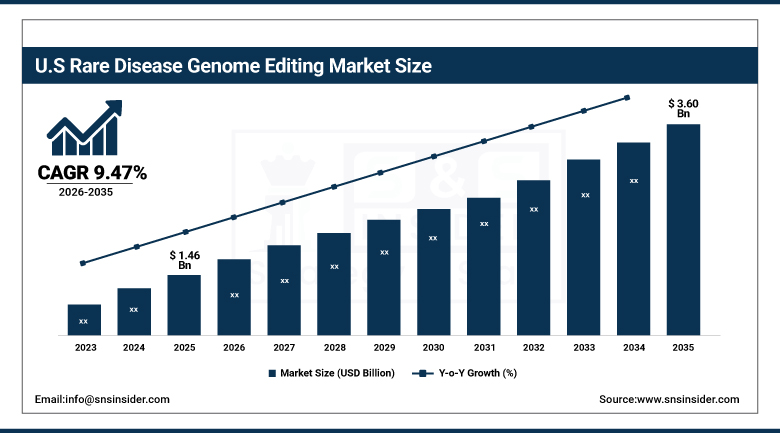
The U.S. Rare Disease Genome Editing Market was valued at USD 1.46 billion in 2025. It is expected to reach around USD 3.60 billion by 2035, growing at a CAGR of 9.47% from 2026–2035.
The U.S. rare disease genome editing market is growing steadily owing to strong biotechnology research infrastructure. Increasing adoption of CRISPR based therapies is supporting market expansion. Rising prevalence of rare genetic disorders is driving treatment demand. Growing clinical trials in gene therapy are accelerating market development. Strong funding from pharmaceutical companies is boosting innovation. Advancements in precision medicine are further supporting consistent market adoption.
According to the U.S. National Institutes of Health and the National Human Genome Research Institute 2025, over 10,000 rare diseases collectively affect approximately 25–30 million Americans, with about 80% having a genetic origin. As per the U.S. Food and Drug Administration 2025 orphan drug designation program statistics, more than 60% of newly designated gene and cell therapies target rare genetic conditions. NIH-funded genomic research initiatives report that over 3.2 million human genomes have been sequenced in the U.S.-linked programs, supporting expanded application of CRISPR and other genome editing technologies for rare disease treatment development.
Rare Disease Genome Editing Market Segment Analysis
-
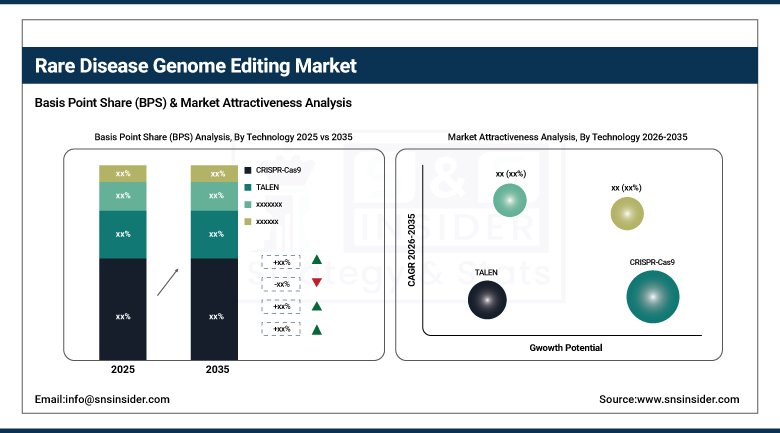
By Technology, CRISPR-Cas9 dominated the market with 61.84% share in 2025; while TALEN is the fastest growing segment with CAGR of 12.74% during 2026 to 2035.
-
By Application, gene therapy dominated the market with 54.33% share in 2025; while cell therapy is the fastest growing segment with CAGR of 13.83% during 2026 to 2035.
-
By End-Use, pharmaceutical dominated the market with 57.61% share in 2025; while research institutions are the fastest growing segment with CAGR of 13.96% during 2026 to 2035.
-
By Target Rare Diseases, cystic fibrosis dominated the market with 38.92% share in 2025; while sickle cell disease is the fastest growing segment with CAGR of 13.04% during 2026 to 2035.
By Technology, CRISPR-Cas9 dominated the rare disease genome editing market, while TALEN is the fastest growing segment.
CRISPR-Cas9 segment accounted for the dominated share of rare disease genome editing market revenue in 2025, owing to its highly precise gene editing ability and clinical validation. It allows the modification of genetic mutations in an effective manner with low costs and quick turnaround time. It has been widely used in various clinical trial programs and received strong pharmaceutical support, which enhances its leadership in the field of rare diseases.
TALEN segment is projected to register the fastest CAGR during 2026-2035, on account of its high specificity, low off-target effect than that of its previous genome editing technologies. It has found wide acceptance in highly specific therapeutic applications. Increasing research funding along with the rising use of TALEN technology in rare disease studies is boosting the market demand. Developments in delivery technology and innovations in engineered nucleases are propelling the market growth.
By Application, gene therapy dominated the rare disease genome editing market, while cell therapy is the fastest growing segment.
The gene therapy segment held the dominated revenue share in the rare disease genome editing market in 2025 due to its capability to directly fix or edit the faulty genes causing rare genetic diseases. It provides long-term results in terms of treatment. Increasing successful results in clinical trials and regulatory approval are helping in boosting its adoption rate. Higher investments from pharmaceutical firms along with growing pipelines of CRISPR-based therapies are aiding in maintaining its dominant market position.
The cell therapy segment will witness fastest CAGR during the forecast period from 2026 to 2035 because of the increasing usage of engineered cells for the treatment of rare diseases. It allows for regenerative and targeted therapies. Development in stem cell and immune cell engineering is making treatment more efficient. Increasing investments in research and development and widening clinical applications are driving the growth. Increasing demands for personalized treatment is further driving adoption.
By End-Use, pharmaceutical companies dominated the rare disease genome editing market, while research institutions are the fastest growing segment.
Pharmaceutical Companies segment held the dominated revenue share in the rare disease genome editing market in 2025. The dominance of this segment can be credited to huge investments and robust clinical pipelines in research and development. These companies have sufficient financial muscle to conduct costly genome editing experiments. Additionally, they are leading commercialization efforts for gene therapies. Growing trend toward precision medicines and regulatory approval further help them hold their dominant market position.
Research Institutions segment is projected to register the fastest CAGR from 2026 to 2035 owing to increasing support in terms of government and academia funding. Increasing collaboration efforts with biotechnology companies are driving innovation in genome editing technologies. These organizations are actively involved in early-stage research and preclinical studies. Growing emphasis on rare disease research and genetics is further driving their growth. Easy availability of state-of-the-art laboratory facilities further helps them enhance their research capabilities.
By Target Rare Diseases, cystic fibrosis dominated the rare disease genome editing market, while sickle cell disease is the fastest growing segment.
The cystic fibrosis segment accounted for the dominated revenue share in the rare disease genome editing market in 2025 owing to the rising global prevalence rate and intense clinical studies being conducted for this disease. The rising availability of genetic screening tests will contribute towards the early detection of the condition. The rising acceptance of CRISPR based treatments will help in speeding up the process of treatment development. Pharmaceutical investments in cystic fibrosis drug pipelines are further aiding market dominance.
The sickle cell disease segment is projected to register the fastest CAGR from 2026 to 2035 due to the rising prevalence rates in both developing and developed countries. The rising awareness regarding gene editing based treatment methods for curing sickle cell disease is further driving its adoption. Growing clinical trials and approvals are driving the growth of the market in this segment. Government support along with patient advocacy efforts have aided research advancements.
Regional Analysis
|
Region |
Major Country |
Share within Region, 2025(%) |
|---|---|---|
|
North America |
United States |
78.45% |
|
Europe |
Germany |
29.10% |
|
Asia Pacific |
China |
44.20% |
|
Middle East & Africa |
UAE |
19.30% |
|
Latin America |
Brazil |
48.10% |
North America Rare Disease Genome Editing Market Insights.
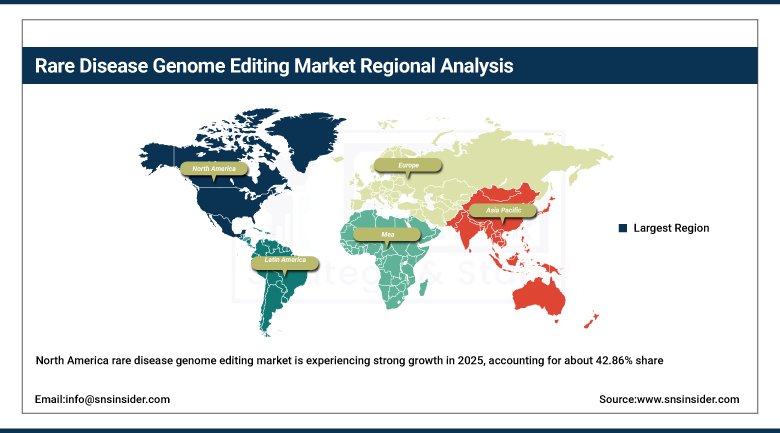
North America rare disease genome editing market is experiencing strong growth in 2025, accounting for about 42.86% share of the global market, owing to advanced biotechnology infrastructure. The region benefits from strong pharmaceutical R&D investments and early adoption of CRISPR technologies. Increasing prevalence of rare genetic disorders is supporting clinical demand. Expansion of gene therapy trials is driving innovation. Strong regulatory framework and funding support are further accelerating market growth.
According to the FDA’s advanced therapy approval guidance in 2025, over 30 therapies involving genes and cells have been approved for use, with an increasing number of gene therapies focusing on single-gene rare diseases. There is also a trend of growing involvement in the CRISPR and genome editing studies within the NIH’s clinical trial registry, where North America has over 45% of all gene therapy trials globally.
Get Customized Report as per Your Business Requirement - Enquiry Now
Europe Rare Disease Genome Editing Market Insights.
Europe rare disease genome editing market is characterized by stable growth in 2025 owing to strong regulatory frameworks and increasing rare disease research initiatives. Key countries include Germany, France, United Kingdom, and Italy. Rising adoption of precision medicine is driving demand for genome editing solutions. Increasing focus on orphan drug development is supporting clinical expansion. Growth in biotechnology research centers is further strengthening market development.
According to the Eurostat health statistics, the prevalence of rare diseases is estimated at 6 to 8% of the EU population, which equates to around 30 million people. According to the European Commission Horizon Europe programme, more than 40% of all biomedical research projects supported by funds contain genomics or advanced therapies.
Asia Pacific Rare Disease Genome Editing Market Insights.
Asia Pacific is the fastest growing region in the rare disease genome editing market, registering a CAGR of about 13.39% during 2026–2035. Rapid expansion of biotechnology infrastructure and increasing healthcare investments are driving strong demand across China, India, Japan, South Korea, and Southeast Asia. Rising prevalence of genetic disorders is further accelerating market growth. Expanding clinical trials and research collaborations are boosting innovation.
As per the WHO Global Genomics and Rare Diseases Initiative Updates and UNESCO Bioethics for the year 2025, 80% of rare diseases can be attributed to a genetic cause and hence have resulted in increased usage of genome therapies in healthcare across the Asia Pacific. Based on OECD Health Statistics of the year 2025 and genomics initiatives of Japan, China, and Australia, 60% of developed countries in the region have included genomic sequencing in their public health research pipelines. In addition to that, over 35% of the clinical trials conducted in Asia Pacific for rare diseases have involved gene editing or gene therapy technology.
Middle East & Africa and Latin America Rare Disease Genome Editing Market Insights.
The Middle East & Africa along with Latin America regions are witnessing steady growth due to improving healthcare infrastructure and rising awareness of rare genetic diseases. Key contributing countries include Brazil, Mexico, UAE, Saudi Arabia, and South Africa. Increasing adoption of advanced diagnostic technologies is driving market expansion. Growth in biotechnology collaborations is supporting research development. Rising investment in healthcare modernization is further boosting regional adoption.
As per the Pan American Health Organization and WHO Regional Office for Africa genetic services assessments, less than 20% of countries in Latin America and under 10% in Sub-Saharan Africa have established national genomic medicine programs. The World Bank health systems indicators also show that fewer than 30% of hospitals in these regions have integrated molecular diagnostics, highlighting limited but expanding adoption of genome editing and precision medicine infrastructure.
Market Dynamics
Growth Drivers: Increasing Adoption of CRISPR Based Gene Editing in Rare Disease Therapeutics Accelerating Clinical Pipeline Expansion
The rapid deployment of CRISPR-Cas9 technology has changed the approach to treatment methods of rare genetic diseases worldwide in the healthcare system. The increasing efficiency of clinical trials has been assisting in making quicker advances in the development of gene-corrective treatments. Increased investments by pharmaceutical companies have improved the capabilities in genome engineering. An increase in uses in monogenic diseases is making treatments more precise and effective. Approvals of gene therapies have been encouraging the use of gene therapies.
As per the FDA’s biologics and advanced therapies 2025, over 40% of investigational gene therapy clinical trials utilize CRISPR and CRISPR-based gene editing systems, with rare diseases accounting for a substantial share of orphan-designated gene therapies. As per the EMA’s registry of advanced therapy medicinal products, there are more than 20 gene editing therapies that have been assessed clinically during Phases I to III across the globe. The National Institutes of Health also estimates that there are over 1,500 rare disease clinical trials being conducted in the United States.
Restraints: Stringent Regulatory Frameworks and Ethical Concerns Slowing Down Approval and Commercialization of Gene Editing Therapies
The strict regulations regarding the application of gene editing have been found to be impeding the process of approval of such innovations in many parts of the world. The safety validation criteria make the development period for the innovation longer. Ethical issues related to germline editing have also contributed towards increasing restrictions. Different standards of regulation across the globe have also been posing problems for coordination in the process of conducting trials in various countries. Lack of long-term safety information has made investors reluctant to invest in innovative therapy.
Opportunities: Advancements in Precision Medicine and Personalized Healthcare Driving Innovation in Genome Editing Based Therapeutics
The quick developments taking place in the field of precision medicine are allowing the development of very focused genome editing treatments for rare diseases. The rising trend of genetic profiling is helping in the development of better treatment methods suited to individual patients. Developments in the integration of AI and bioinformatics are aiding in quicker discovery of genes and optimized therapies. Rising investments in personalized medicine solutions are helping in innovations made by the biotech industry. All these developments are providing many opportunities in developing next-generation genome editing treatments.
As per the National Institutes of Health Genome Data Sharing Policy reports, over 6,000 rare diseases have been identified globally, affecting an estimated 300 million people worldwide. The European Medicines Agency also reports that over 50% of advanced therapy medicinal product clinical trials in 2024–2025 involve precision medicine approaches, reflecting increasing adoption of CRISPR-based and personalized genome editing technologies.
Recent Developments
-
2026: Huhtamaki advanced fiber and molded packaging innovation programs, scaling hybrid solutions that reduce virgin plastic use in foodservice and retail packaging.
-
2025: Intellia Therapeutics advances NTLA-2001 and NTLA-2002 in clinical trials for transthyretin amyloidosis and hereditary angioedema indications.
-
2025: Beam Therapeutics progresses base editing programs including BEAM-101 for sickle cell disease through ongoing clinical development programs.
-
2024: CRISPR Therapeutics advanced exa-cel regulatory approvals in multiple regions while expanding Vertex partnership for sickle cell treatment rollout.
Rare Disease Genome Editing Market Key Players are:
-
CRISPR Therapeutics
-
Intellia Therapeutics
-
Editas Medicine
-
Beam Therapeutics
-
Sangamo Therapeutics
-
Precision BioSciences
-
Caribou Biosciences
-
Prime Medicine
-
Verve Therapeutics
-
Mammoth Biosciences
-
Scribe Therapeutics
-
Tessera Therapeutics
-
Metagenomi
-
Vertex Pharmaceuticals
-
Regeneron Pharmaceuticals
-
Pfizer
-
Novartis
-
Roche
-
AstraZeneca
-
Sanofi
Rare Disease Genome Editing Market Report Scope:
| Report Attributes | Details |
|---|---|
| Market Size in 2025 | USD 4.34 Billion |
| Market Size by 2035 | USD 12.60 Billion |
| CAGR | CAGR of 11.28% From 2026 to 2035 |
| Base Year | 2025 |
| Forecast Period | 2026-2035 |
| Historical Data | 2022-2024 |
| Report Scope & Coverage | Market Size, Segments Analysis, Competitive Landscape, Regional Analysis, DROC & SWOT Analysis, Forecast Outlook |
| Key Segments | • By Technology (CRISPR-Cas9, TALEN, Zinc Finger Nucleases, Meganucleases) • By Application (Gene Therapy, Cell Therapy, Genomic Research, Drug Development) • By End-Use (Pharmaceutical Companies, Research Institutions, Academic Institutions, Contract Research Organizations) • By Target Rare Diseases (Cystic Fibrosis, Sickle Cell Disease, Hemophilia, Duchenne Muscular Dystrophy) |
| Regional Analysis/Coverage | North America (US, Canada), Europe (Germany, UK, France, Italy, Spain, Russia, Poland, Rest of Europe), Asia Pacific (China, India, Japan, South Korea, Australia, ASEAN Countries, Rest of Asia Pacific), Middle East & Africa (UAE, Saudi Arabia, Qatar, South Africa, Rest of Middle East & Africa), Latin America (Brazil, Argentina, Mexico, Colombia, Rest of Latin America). |
| Company Profiles | CRISPR Therapeutics, Intellia Therapeutics, Editas Medicine, Beam Therapeutics, Sangamo Therapeutics, Precision BioSciences, Caribou Biosciences, Prime Medicine, Verve Therapeutics, Mammoth Biosciences, Scribe Therapeutics, Tessera Therapeutics, Metagenomi, Vertex Pharmaceuticals, Regeneron Pharmaceuticals, Pfizer, Novartis, Roche, AstraZeneca, Sanofi |
Frequently Asked Questions
The rare disease genome editing market was valued at USD 4.34 billion in 2025.
The rare disease genome editing market is expected to grow at a CAGR of 11.28% from 2026 to 2035.
