
Smart Sensing Networks Market Report Scope & Overview:
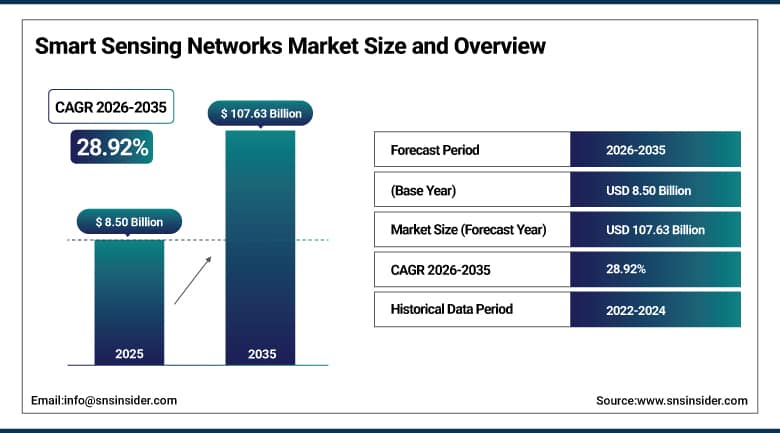
Smart Sensing Networks Market was valued at USD 8.50 Billion in 2025 and is expected to reach USD 107.63 Billion by 2035, growing at a CAGR of 28.92% from 2026–2035.
The smart sensing networks market is experiencing consistent growth due to the growing demand for connected sensing, real-time monitoring, and intelligent data-driven solutions across industries. The increasing adoption of IoT-enabled devices, industrial automation, smart infrastructure, connected vehicles, and advanced healthcare systems has accelerated the deployment of smart sensing networks, thereby supporting market growth. Investments in advanced sensing technologies, edge computing, wireless connectivity, and intelligent network infrastructure have enhanced real-time data collection, processing, and decision-making capabilities. The focus of companies has been on improving sensing accuracy, connectivity, interoperability, low-latency processing, and energy efficiency. Growing demand for intelligent automation, predictive maintenance, smart infrastructure, and real-time monitoring is further driving technological advancements.
In February 2025, researchers published a study on advanced smart sensing networks, highlighting the importance of intelligent sensing, edge-based data processing, and reliable connectivity for improving real-time monitoring and decision-making. The research supports the development of optimized sensing architectures and networked sensor systems for applications across industrial automation, smart infrastructure, healthcare, transportation, and other connected environments.
Market Size and Forecast
-
Market Size 2026E: USD 10.94 Billion
-
Market Size 2035: USD 107.63 Billion
-
CAGR: 28.92% from 2026 to 2035
-
Fastest Growing Region: Asia-Pacific
-
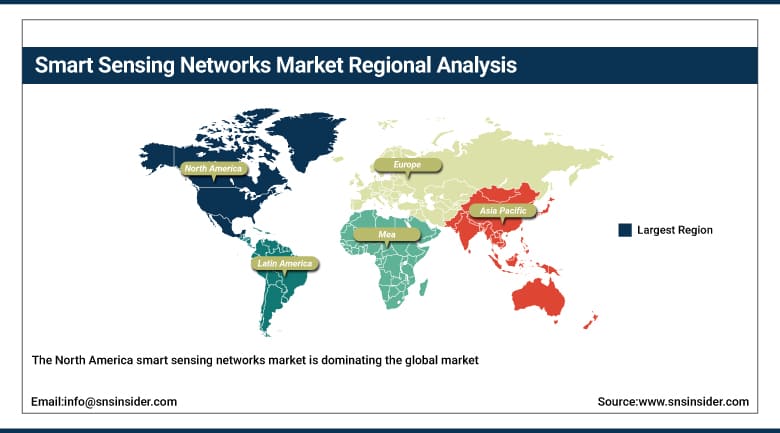
Largest Region: North America
To Get More Information On Smart Sensing Networks Market - Request Free Sample Report
Smart Sensing Networks Market Trends
-
Growing adoption of smart sensing networks across industrial, commercial, and infrastructure applications is driving demand for advanced sensing, connectivity, and real-time monitoring solutions.
-
Rising deployment of IoT-enabled devices, industrial automation, smart buildings, and connected transportation systems is increasing demand for intelligent sensing networks and networked sensor technologies.
-
Increasing demand for real-time data collection, edge analytics, predictive maintenance, and automated decision-making is supporting the growth of smart sensing network solutions.
-
Growing focus on improving sensing accuracy, network reliability, low-latency processing, energy efficiency, and interoperability is creating opportunities for smart sensing network providers.
-
Advancements in sensor technologies, edge computing, wireless connectivity, AI-enabled sensing, 5G/6G networks, and intelligent network infrastructure are improving sensing and data-processing capabilities and supporting market adoption.
The U.S. Smart Sensing Networks Market Outlook
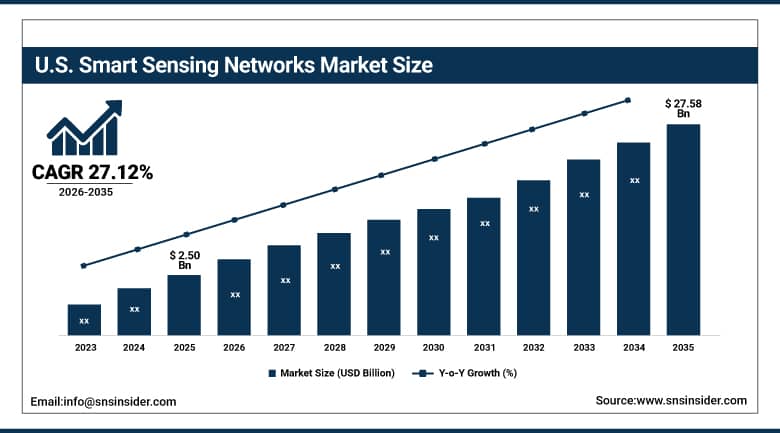
The U.S. Smart Sensing Networks Market was valued at USD 2.50 Billion in 2025 and is expected to reach around USD 27.58 Billion by 2035, growing at a CAGR of 27.12% from 2026–2035.
The U.S. market for smart sensing networks is expanding rapidly, driven by the increasing adoption of intelligent sensing, real-time monitoring, connected devices, and distributed network technologies across industries. The growing deployment of IoT-enabled sensors, industrial automation systems, smart buildings, connected transportation, and advanced healthcare infrastructure is creating strong demand for smart sensing network solutions. Increasing investments in AI-enabled sensing, edge computing, wireless connectivity, sensor fusion, and intelligent data-processing technologies are enhancing real-time data collection, local processing, predictive insights, and automated decision-making.The expansion of smart infrastructure, Industry 4.0 initiatives, connected transportation systems, energy management, and digital monitoring applications is further supporting market growth in the U.S.
In August 2025, Sony Semiconductor Solutions announced deployments of advanced edge AI sensing technologies in Lakewood, Colorado, and San José, California, supporting road safety and traffic management. The initiatives demonstrate the growing adoption of intelligent vision sensors and real-time edge-based sensing networks in U.S. smart-city applications, supporting safer transportation, improved traffic monitoring, and data-driven urban mobility.
Smart Sensing Networks Market Segment Analysis
-
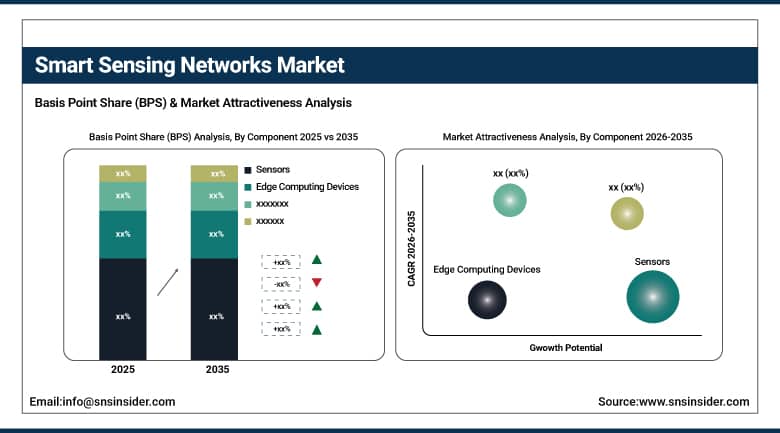
By Component, sensors dominated the smart sensing networks market with a 31.84% share in 2025, while edge computing devices are projected to be the fastest-growing segment, registering a 32.57% CAGR during 2026–2035.
-
By Sensing Technology, motion & position sensing dominated the smart sensing networks market with a 28.76% share in 2025, while image & vision sensing is projected to be the fastest-growing segment, registering a 31.19% CAGR during 2026–2035.
-
By Network Type, wireless networks dominated the smart sensing networks market with a 39.84% share in 2025, while 5G/6G networks are projected to be the fastest-growing segment, registering a 32.58% CAGR during 2026–2035.
-
By Deployment, cloud-based dominated the smart sensing networks market with a 35.72% share in 2025, while edge-based is projected to be the fastest-growing segment, registering a 31.31% CAGR during 2026–2035.
-
By Enterprise Size, large enterprises dominated the smart sensing networks market with a 68.43% share in 2025, while small & medium-sized enterprises are projected to be the fastest-growing segment, registering a 30.79% CAGR during 2026–2035.
-
By End Use, industrial dominated the smart sensing networks market with a 31.68% share in 2025, while healthcare is projected to be the fastest-growing segment, registering a 32.72% CAGR during 2026–2035.
By Component, sensors dominated the smart sensing networks market, while edge computing devices are expected to grow fastest.
Sensors will lead the market during 2025 due to their significant contribution to real-time data collection, monitoring, and intelligent decision-making across industrial, commercial, and infrastructure applications. The increasing demand for accurate sensing capabilities across industrial automation, smart buildings, healthcare, automotive, and energy applications has been boosting the adoption of sensors. Improvements in sensing accuracy, miniaturization, connectivity, and energy efficiency are likely to further support market growth.
Edge computing devices are anticipated to grow with the highest CAGR throughout the forecast period of 2026 to 2035. The rising demand for real-time data processing, low-latency analytics, and decentralized decision-making, along with the growing deployment of IoT-enabled sensing systems, is propelling the development of edge computing technologies that enhance processing efficiency and support intelligent sensing applications.
By Sensing Technology, motion & position sensing dominated the smart sensing networks market, while image & vision sensing is expected to grow fastest.
Motion & position sensing was the dominating type of the market in 2025 due to its widespread use in industrial automation, robotics, automotive systems, smart infrastructure, and connected devices. The growing need for accurate detection of movement, orientation, and positioning is encouraging the deployment of smart sensing technologies across diverse applications.
Image & vision sensing is projected to exhibit the highest growth rate over the forecast period 2026–2035. The growing demand for computer vision, AI-enabled monitoring, automated inspection, security systems, and real-time visual analytics is encouraging the adoption of advanced image and vision sensing technologies.
By Network Type, wireless networks dominated the smart sensing networks market, while 5G/6G networks are expected to grow fastest.
Wireless networks held a dominant position in the market in 2025 due to their flexibility, scalability, and widespread deployment across IoT, industrial automation, smart buildings, connected transportation, and remote monitoring applications. The increasing demand for flexible connectivity and real-time communication across distributed sensing devices has been instrumental in fostering demand for wireless smart sensing networks.
5G/6G networks are likely to have the highest CAGR during the forecast period of 2026–2035. The growing demand for high-speed connectivity, ultra-low latency, massive device connectivity, and real-time data transmission is increasing the adoption of advanced cellular networks for smart sensing applications across industrial, healthcare, automotive, and smart infrastructure environments.
Regional Analysis
|
Region |
Major Country |
Share within Region, 2025(%) |
|---|---|---|
|
North America |
United States |
82.06% |
|
Europe |
Germany |
34.30% |
|
Asia Pacific |
China |
48.54% |
|
Middle East & Africa |
Saudi Arabia |
23.50% |
|
Latin America |
Brazil |
23.00% |
North America Smart Sensing Networks Market Insights
The North America smart sensing networks market is dominating the global market and is expected to maintain its leading position during 2026–2035, driven by increasing demand for real-time monitoring, connected devices, industrial automation, smart infrastructure, and intelligent data processing. North America dominated the smart sensing networks market in 2025, accounting for a 35.84% market share, and is expected to retain its leading position throughout the forecast period. The region is benefiting from investments in advanced sensor technologies, edge computing, AI-enabled analytics, wireless connectivity, 5G networks, and intelligent network infrastructure that help organizations improve real-time monitoring, automation, and decision-making.
The United States is expected to dominate the regional market of the North America market share in 2025. The country's dominance is supported by strong technology infrastructure, widespread adoption of IoT, AI, cloud platforms, industrial automation, smart buildings, and connected transportation systems. Canada is also expected to contribute to regional growth, supported by increasing adoption of smart infrastructure, connected technologies, industrial IoT, and advanced sensing solutions.
Get Customized Report as Per Your Business Requirement - Enquiry Now
Europe Smart Sensing Networks Market Insights
The smart sensing networks market in Europe will experience stable growth over the forecast period due to the increasing adoption of industrial automation, IoT technologies, smart buildings, connected transportation, and intelligent monitoring systems. Increased attention to energy efficiency, predictive maintenance, automation, and digital transformation is driving demand for sophisticated sensing, connectivity, edge computing, and network infrastructure technologies.
Germany is anticipated to continue being one of the key national markets in Europe, fueled by its strong industrial sector, advanced manufacturing capabilities, increasing adoption of industrial IoT, automation, and smart factory technologies. In addition, countries in Europe such as the UK, France, Italy, and others will contribute to regional demand through investments in smart infrastructure, healthcare technologies, connected transportation, and intelligent building systems.
Asia Pacific Smart Sensing Networks Market Insights
The Asia Pacific smart sensing networks market is the fastest-growing region and is expected to register a CAGR of 31.73% during 2026–2035, supported by rapid industrialization, digitalization, increasing IoT adoption, smart-city development, and expanding deployment of connected devices. The region is also benefiting from the expansion of manufacturing infrastructure, 5G networks, edge computing, AI-enabled sensing, and advanced digital technologies.
China will continue to be a major market in the Asia Pacific region due to its large manufacturing and technology ecosystem, extensive adoption of IoT, AI, automation, smart infrastructure, and 5G connectivity. Japan and South Korea will continue to play significant roles due to their established electronics, automotive, telecommunications, robotics, and industrial automation industries, while India is expected to witness increasing demand with the growth of digital infrastructure, smart-city initiatives, industrial automation, connected devices, and enterprise technology adoption.
Middle East & Africa and Latin America Smart Sensing Networks Market Insights
There will be consistent growth within the smart sensing networks markets in the Middle East & Africa and Latin America from 2026 to 2035, driven by increasing investments in smart infrastructure, industrial automation, IoT deployment, connected transportation, renewable energy systems, and digital transformation initiatives. There will be increasing opportunities in these regions for advanced sensing, wireless connectivity, edge computing, and intelligent network technologies owing to growing efforts to improve operational efficiency, real-time monitoring, and data-driven decision-making.
Saudi Arabia will continue to be an important market in the Middle East & Africa, supported by investments in smart-city development, digital infrastructure, industrial automation, renewable energy, and connected technologies. In Latin America, Brazil will continue to be an important country-level market due to its large industrial base, smart infrastructure development, connected transportation, energy applications, and growing adoption of IoT technologies. Other Latin American countries will also contribute to regional growth through increasing digitalization, smart infrastructure investments, industrial IoT adoption, and deployment of connected sensing solutions.
Market Dynamics
Growth Driver: Increasing demand for efficient sensing and real-time data processing is driving market growth
One of the major driving forces behind the growth of the global smart sensing networks market is the increasing need for real-time sensing, monitoring, and data-driven decision-making across industries. The growing adoption of connected devices, industrial automation, smart buildings, healthcare monitoring systems, connected vehicles, and energy management solutions is increasing demand for advanced sensing networks. These networks enable organizations to collect, transmit, and analyze data from sensors in real time, supporting improved operational efficiency, predictive maintenance, safety, and resource optimization.
In addition, advancements in sensor technologies, wireless connectivity, edge computing, artificial intelligence, and cloud platforms are supporting the development of more intelligent and connected sensing solutions. Investments in industrial IoT infrastructure, smart city projects, 5G/6G networks, and edge computing are further accelerating the adoption of smart sensing networks.
Restraint: Complex network integration and data management challenges can limit market adoption
The complexity of integrating diverse sensors, connectivity technologies, edge devices, gateways, and software platforms can pose challenges to the adoption of smart sensing networks. Differences in communication protocols, device architectures, data formats, and network environments can make interoperability and system integration difficult, particularly for organizations operating large and distributed networks.
Moreover, smart sensing networks generate large volumes of real-time data that require efficient processing, storage, security, and management. Organizations may also face challenges related to cybersecurity, data privacy, network reliability, system maintenance, and the high initial costs associated with deploying advanced sensing infrastructure. These factors can create barriers to adoption, particularly for small and medium-sized enterprises with limited technical resources and investment capacity.
Opportunity: Growing adoption of edge computing, 5G/6G, and intelligent sensing applications creates new market opportunities
The rapid expansion of edge computing and advanced wireless connectivity presents substantial opportunities for smart sensing networks market participants. As organizations increasingly require low-latency processing and real-time decision-making, edge-based sensing networks can process data closer to the source, reducing transmission delays and improving network efficiency. The deployment of 5G/6G networks is also expected to support large-scale connectivity for industrial, automotive, healthcare, smart building, and other applications.
Further, the increasing adoption of artificial intelligence, machine learning, predictive analytics, and automation is creating opportunities for intelligent sensing solutions capable of analyzing sensor data and generating actionable insights. The expansion of smart factories, connected healthcare, autonomous and connected transportation, smart energy systems, and precision agriculture is expected to create additional demand for advanced smart sensing networks and integrated sensing platforms.
Recent Developments
-
2026: Bosch Sensortec expanded its smart sensing solutions for industrial and consumer applications, supporting the integration of advanced sensors into connected devices, edge systems, and intelligent sensing networks.
-
2026: Honeywell continued advancing connected sensing and industrial automation technologies, supporting real-time monitoring, predictive maintenance, and intelligent asset management across industrial applications.
-
2026: Siemens expanded its industrial IoT and edge computing capabilities, supporting the integration of smart sensors, connectivity, and real-time data analytics for smart manufacturing and infrastructure applications.
-
2026: STMicroelectronics continued developing advanced MEMS sensors and connectivity solutions, supporting the growing adoption of smart sensing technologies across industrial, automotive, consumer electronics, and other applications.
-
2026: Texas Instruments continued expanding its portfolio of sensing, connectivity, and edge processing solutions, supporting the deployment of intelligent sensing networks across industrial and automotive applications.
Smart Sensing Networks Market key players are:
-
Bosch Sensortec GmbH
-
Honeywell International Inc.
-
STMicroelectronics N.V.
-
Texas Instruments Incorporated
-
Siemens AG
-
Analog Devices, Inc.
-
Infineon Technologies AG
-
NXP Semiconductors N.V.
-
TE Connectivity Ltd.
-
ABB Ltd.
-
Cisco Systems, Inc.
-
Qualcomm Technologies, Inc.
-
Emerson Electric Co.
-
Schneider Electric SE
-
Murata Manufacturing Co., Ltd.
-
Sensirion AG
-
Omron Corporation
-
Advantech Co., Ltd.
-
Intel Corporation
-
Semtech Corporation
Smart Sensing Networks Market Report Scope:
| Report Attributes | Details |
|---|---|
| Market Size in 2025 | USD 8.50 Billion |
| Market Size by 2035 | USD 107.63 Billion |
| CAGR | CAGR of 28.92% From 2026 to 2035 |
| Base Year | 2025 |
| Forecast Period | 2026-2035 |
| Historical Data | 2022-2024 |
| Report Scope & Coverage | Market Size, Segments Analysis, Competitive Landscape, Regional Analysis, DROC & SWOT Analysis, Forecast Outlook |
| Key Segments | • By Component (Sensors, Connectivity Modules, Edge Computing Devices, Gateways, Network Infrastructure, Software & Platforms) • By Sensing Technology (Temperature Sensing, Pressure Sensing, Motion & Position Sensing, Image & Vision Sensing, Environmental Sensing, Other Sensing Technologies) • By Network Type (Wireless Networks, Wired Networks, LPWAN, 5G/6G Networks, Mesh Networks) • By Deployment (On-Premises, Cloud-Based, Edge-Based, Hybrid) • By Enterprise Size (Large Enterprises, Small & Medium-Sized Enterprises) • By End Use (Industrial, Smart Buildings, Healthcare, Automotive & Transportation, Energy & Utilities, Other End Uses) |
| Regional Analysis/Coverage | North America (US, Canada), Europe (Germany, UK, France, Italy, Spain, Russia, Poland, Rest of Europe), Asia Pacific (China, India, Japan, South Korea, Australia, ASEAN Countries, Rest of Asia Pacific), Middle East & Africa (UAE, Saudi Arabia, Qatar, South Africa, Rest of Middle East & Africa), Latin America (Brazil, Argentina, Mexico, Colombia, Rest of Latin America) |
| Company Profiles | Bosch Sensortec GmbH, Honeywell International Inc., STMicroelectronics N.V., Texas Instruments Incorporated, Siemens AG, Analog Devices, Inc., Infineon Technologies AG, NXP Semiconductors N.V., TE Connectivity Ltd., ABB Ltd., Cisco Systems, Inc., Qualcomm Technologies, Inc., Emerson Electric Co., Schneider Electric SE, Murata Manufacturing Co., Ltd., Sensirion AG, Omron Corporation, Advantech Co., Ltd., Intel Corporation, Semtech Corporation |

Frequently Asked Questions
The Smart Sensing Networks Market is expected to grow at a CAGR of 28.92% from 2026 to 2035.
The Smart Sensing Networks Market was valued at approximately USD 8.50 billion in 2025.
The market is primarily driven by the increasing adoption of smart sensors, connected devices, industrial IoT, edge computing, 5G/6G networks, real-time monitoring, and intelligent automation across industrial, healthcare, automotive, energy, smart building, and other applications.
Sensors dominated the Smart Sensing Networks Market in 2025, accounting for a 31.84% share.
North America dominated the Smart Sensing Networks Market in 2025, accounting for a 35.84% share.
