
Spa services Market Report Scope & Overview:
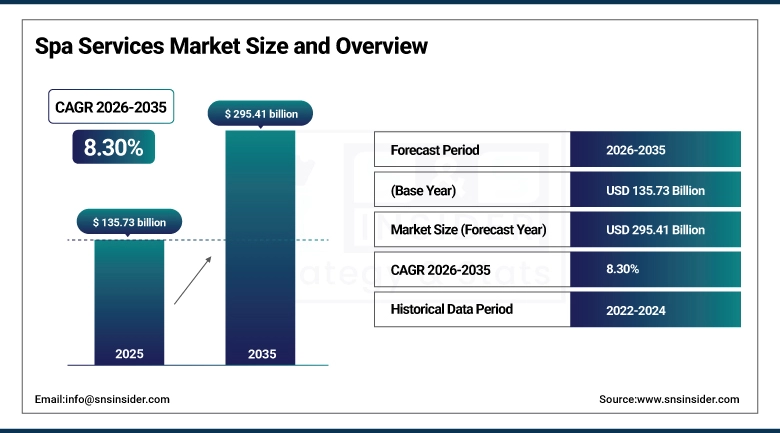
The Spa Services Market was estimated at USD 135.73 billion in 2025 and is expected to reach USD 295.41 billion by 2035 and grow at a CAGR of 8.30% over the forecast period of 2026-2035.
The Spa Services Market is witnessing substantial growth driven by increasing consumer focus on wellness, stress management, preventive healthcare, and lifestyle enhancement. Rising urbanization, growing disposable incomes, and expanding awareness regarding physical and mental well-being are significantly boosting demand for massage therapies, skincare treatments, wellness programs, and premium spa experiences. The increasing popularity of self-care routines, coupled with the expansion of wellness tourism and luxury hospitality infrastructure, is further accelerating market penetration across both developed and emerging economies.
Ensana Hotels, one of Europe’s leading health spa operators, entered a multi-year collaboration with Sabre Hospitality to deploy advanced retailing technology for personalized wellness and spa experiences. The initiative enables better monetization of spa offerings and highlights increasing investment in digital platforms and customer-centric wellness services.
Market Size and Forecast
-
Market Size in 2025: USD 135.73 Billion
-
Market Size by 2035: USD 295.41 Billion
-
CAGR: 8.30% from 2026 to 2035
-
Base Year: 2025
-
Forecast Period: 2026–2035
-
Historical Data: 2022–2024
To Get more information on Spa Services Market - Request Free Sample Report
Spa services Market Trends
-
Rising consumer focus on wellness, stress reduction, and preventive healthcare is increasing demand for regular spa and self-care experiences.
-
Increasing integration of digital booking platforms and mobile wellness applications is accelerating seamless customer engagement and service accessibility.
-
Rapid adoption of personalized wellness programs and AI-enabled treatment recommendations is enhancing customer experience and service customization.
-
Growing demand for medical wellness and aesthetic spa treatments is expanding premium and specialized service offerings globally.
-
Increasing investments in wellness tourism, luxury hospitality infrastructure, and destination spa projects are driving market expansion worldwide.
-
Rising popularity of membership-based wellness models and subscription services is improving customer retention and recurring revenue streams.
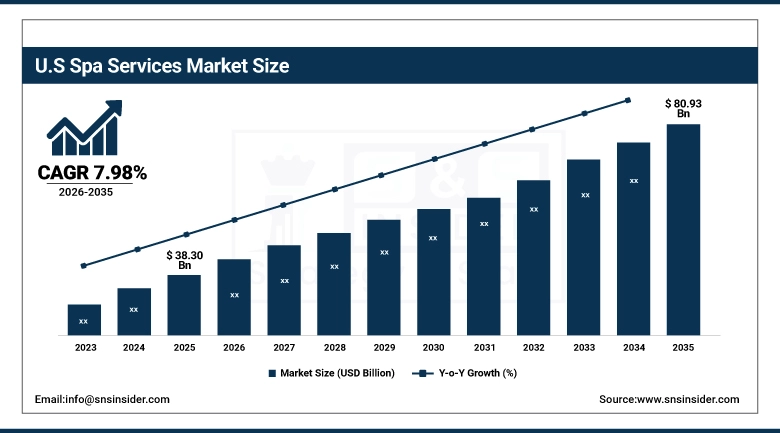
The U.S. Spa Services Market was valued at USD 38.30 billion in 2025 and is expected to reach around USD 80.93 billion by 2035, growing at a CAGR of 7.98% from 2026–2035.
The United States remains at the forefront when it comes to demand for spa services owing to healthy levels of consumer expenditure in the wellness market, high-quality facilities for hospitality, and an increasing trend towards preventive health care practices. Further support for the demand is evident from trends related to luxury wellness tourism, personalized treatment offerings, and increased interest in medical and aesthetic wellness spa offerings. This has been made possible by the continued investments being made by key wellness players in the creation of integrated wellness ecosystems.
Additionally, recent developments such as Sensei’s partnership with Zadún, a Ritz-Carlton Reserve in Los Cabos to launch personalized wellness and spa programs and Ensana Hotels entering a multi-year technology agreement with Sabre Hospitality to modernize wellness and spa experiences through advanced retailing platforms are reinforcing long-term market growth and accelerating innovation in the premium wellness ecosystem
Spa services Market Segment Analysis
-
By Service Type, Massage Therapy (Swedish, Thai, Deep Tissue, Aromatherapy) dominated the Spa Services Market with 35.36% share in 2025; Medical Spa Treatments (laser therapy, injectables, anti-aging treatments) fastest growing CAGR.
-
By Spa Type, Day Spas dominated the Spa Services Market with 42.15% share in 2025; Medical Spas (MedSpas) fastest growing CAGR.
-
By End User, Individual Consumers dominated the Spa Services Market with 46.51% share in 2025; Medical/Aesthetic Patients fastest growing CAGR.
-
By Booking Channel, Walk-In Services dominated the Spa Services Market with 34.23% share in 2025; Mobile Apps & Online Platforms fastest growing CAGR.
-
By Price Range, Mid-Range Spa Services dominated the Spa Services Market with 50.09% share in 2025; Luxury Spa Services fastest growing CAGR.
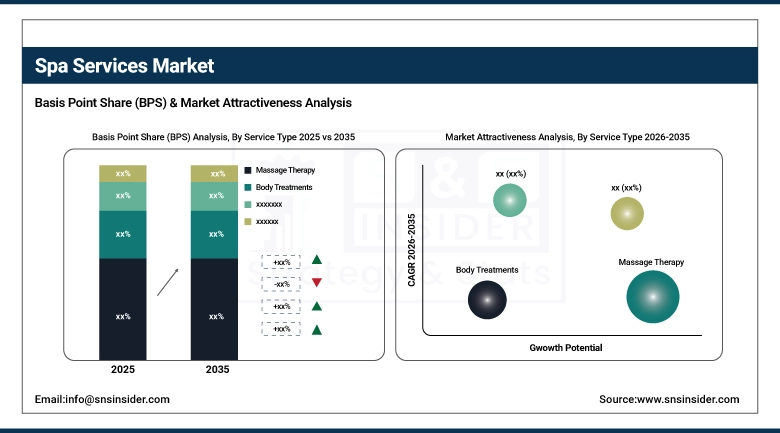
By Service Type, Massage Therapy segment dominates the Spa Services Market, Medical Spa Treatments expected to grow fastest
In 2025, the Massage Therapy (Swedish, Thai, Deep Tissue, Aromatherapy) segment maintained its dominant position in the Spa Services Market, accounting for 35.36% of total revenue. The primary motivating factor behind this type of leadership is the consumer’s strong liking for stress management and relaxation therapies, as well as their heightened awareness about preventive wellness programs and the widespread use of massage therapy.
From 2026 to 2035, the Medical Spa Treatments (laser therapy, injectables, anti-aging treatments) segment is projected to record the highest CAGR. The factors that drive the fast-paced growth in the industry include increasing consumer demand for minimally invasive cosmetic procedures, higher demand for treatments related to aging and skin rejuvenation, and increased synergy between wellness and medicine.
By Spa Type, Day Spas segment dominates the Spa Services Market, Medical Spas (MedSpas) expected to grow fastest
The Day Spas segment held the largest share of 42.15% in 2025, As a result of high levels of accessibility, low-cost services, and increased consumer interest in receiving wellness services conveniently without having to travel long distances. Consumers have become interested in obtaining services that can help them relax in short periods within their normal daily routine activities.
The Medical Spas (MedSpas) segment is expected to register the highest CAGR during the 2026–2035 forecast period. Growth is fueled by rising demand for health management services under medical supervision, increased adoption of anti-aging treatments, and higher customer preference for results-oriented health management solutions. Further advancements in aesthetics technology and customization are expected to drive growth in the future.
By End User, Individual Consumers segment dominates the Spa Services Market, Medical/Aesthetic Patients expected to grow fastest
The Individual Consumers segment held the largest share of 46.51% in 2025, supported by rising consumer consciousness about well-being, stress management, and self-care practices. The rise in disposable income, greater emphasis on healthy living, and the demand for continuous well-being experiences have been major factors driving the uptake among individuals.
The Medical/Aesthetic Patients segment is anticipated to witness the highest CAGR during the forecast period. The growth is driven by the increasing trend among consumers for medically guided skin care and aesthetic treatments, wider use of preventive anti-aging treatments, and growing awareness about customized wellness programs and cosmetic treatments.
By Booking Channel, Walk-In Services segment dominates the Spa Services Market, Mobile Apps & Online Platforms segment expected to grow fastest
In 2025, the Walk-In Services segment maintained its dominant position in the Spa Services Market, accounting for 34.23% of total revenue. This type of dominance results from the high level of consumer desire for spontaneity in their health visits, instant appointment making, and personal consultations prior to choosing a service. Clients in spas usually depend on visits to receive custom-tailored advice and services, especially in day spas and hospitality spas.
The Mobile Apps & Online Platforms segment is projected to achieve the highest growth rate during 2026–2035.
By Price Range, Mid-Range Spa Services segment dominates the Spa Services Market, Luxury Spa Services segment expected to grow fastest
In 2025, the Mid-Range Spa Services segment maintained its dominant position in the Spa Services Market, accounting for 50.09% of total revenue. The dominance is reinforced by wide consumer access, competitive pricing policies, and growing trends toward affordable wellness services in the middle-income group. Customers are now demanding regular wellness services with quality service delivery at affordable price levels. Mid-range spas are thus very appealing to customers from urban and developing economies due to their affordability.
From 2026 to 2035, the Luxury Spa Services segment is projected to record the highest CAGR.
Regional Insights
|
Region |
Major Country |
Share within Region (%) |
|---|---|---|
|
North America |
United States |
92.24% |
|
Europe |
Germany |
18.75% |
|
Asia Pacific |
China |
27.98% |
|
Middle East & Africa |
UAE |
23.06% |
|
Latin America |
Brazil |
40.93% |
North America Spa Services Market Insights
North America functions in a matured wellness environment with high consumer spend on personal well-being, high prevalence of preventive wellness practices, and growing trend of incorporating premium spa offerings along with hospitality and health care service. North America enjoys the advantage of the availability of existing wellness operators in the form of many luxury hotels and high consumer demand for wellness products. The dominant position of North America in the wellness market can be attributed to the leadership of the U.S., wellness tourism, high use of aesthetic procedures, and expenditure on repeated wellness sessions.
Supporting this position, wellness providers across the U.S. and Canada are increasingly investing in digital wellness ecosystems, AI-driven personalization platforms, and membership-based engagement models to improve customer retention and premium service experiences.
Additionally, recent developments such as Sensei expanding its personalized wellness partnership ecosystem through Zadún, a Ritz-Carlton Reserve and Ensana Hotels implementing advanced retailing technologies through strategic hospitality technology collaborations are reinforcing innovation across premium wellness and spa experiences.
Get Customized Report as per Your Business Requirement - Enquiry Now
Asia Pacific Spa Services Market Insights
The Asia Pacific is projected to register the highest CAGR of 9.0% from 2026–2035, Driven by greater awareness of health and wellness, the rapid growth of the luxury hospitality sector, and the growing need for preventive care services. The countries of China, India, Japan, South Korea, Thailand, and Southeast Asia are becoming popular wellness destinations, where China and India have shown more growth because of their larger urban population and higher disposable income.
In 2025, multiple luxury hospitality groups across Thailand, Bali, and Southeast Asia expanded integrated wellness resort investments focused on long-stay wellness tourism and personalized treatment experiences. This reflects increasing capital allocation toward destination wellness infrastructure.
Wellness operators across China and India accelerated partnerships integrating traditional therapies with modern wellness programs, strengthening premium wellness tourism offerings and expanding high-value service packages.
Europe Spa Services Market Insights
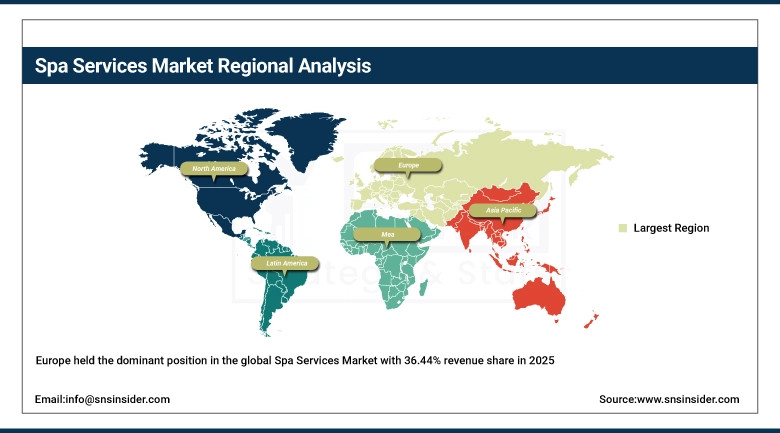
Europe held the dominant position in the global Spa Services Market with 36.44% revenue share in 2025 due to their established heritage as thermal spas, advanced wellness tourism facilities, and consumer preference for preventative health care and holistic wellness treatments. Countries like Germany, France, Italy, Switzerland, and the Scandinavian countries are still at the forefront of wellness services because of high consumer spending and a strong wellness industry ecosystem.
Supporting this position, European wellness operators are increasingly integrating sustainability-focused wellness concepts and personalized treatment programs into premium service offerings, accelerating adoption of eco-conscious spa experiences.
Additionally, recent developments such as Lanserhof expanding premium medical wellness offerings and luxury hospitality operators increasing investments in integrated wellness retreat experiences across Europe are reinforcing innovation and strengthening Europe's role as a mature wellness market.
Latin America, Middle East & Africa (LAMEA) Spa Services Market Insights
In the LAMEA region, the Spa Services Market is experiencing constant growth due to an increase in wellness tourism, development of luxury hospitality facilities, and increased consumer consciousness towards preventive wellness and aesthetics. Nations like Brazil, UAE, Saudi Arabia, and South Africa have gained prominence as key contributors to the demand for spa services.
In the UAE and Saudi Arabia, hospitality and tourism developers accelerated investments in integrated wellness destinations and premium resort projects under broader tourism diversification initiatives, supporting expansion of luxury wellness ecosystems.
Wellness and hospitality partnerships across Brazil and the Middle East increasingly focused on premium therapeutic experiences and destination-based wellness programs, strengthening service accessibility and luxury spa offerings across emerging markets.
Spa services Market Growth Drivers:
-
Rising consumer focus on wellness, preventive healthcare, and personalized self-care experiences is driving strong demand for advanced spa and wellness service ecosystems across global markets
The primary driving force that impacts the Spa Services Market is the change in consumer lifestyle choices with regard to stress relief, mental wellness, preventative health care, and overall holistic wellbeing. Consumers have begun to emphasize the importance of physical rejuvenation, mindfulness, and wellness results, leading to an increased demand for massage therapy, skin care services, holistic wellness programs, and medical aesthetics treatments. The market has also seen success through the rising popularity of experiential wellness services that incorporate relaxation, optimized health, and customized treatment packages.
Additionally, recent strategic developments such as Sensei expanding its personalized wellness ecosystem through its partnership with Zadún, a Ritz-Carlton Reserve in 2025, and Ensana Hotels implementing advanced wellness retailing technology through a multi-year collaboration with Sabre Hospitality, are accelerating technology-enabled customer engagement and strengthening long-term market adoption across premium wellness environments.
Spa services Market Restraints:
-
High service costs, workforce shortages, and inconsistencies in therapist availability are increasing operational complexity and limiting scalability across the spa services industry
In the Spa Services Market, the key constraint is connected to escalating costs of operation that arise due to high-quality maintenance of facilities, employment of trained therapists, training needs, and higher wage bills for labor. The spa businesses are currently experiencing difficulties in maintaining their service standards, retaining their therapists, and offering customized services without spending too much on operations and earning profits. Moreover, the lack of human resources in the wellness sector presents an additional challenge for spa businesses.
Spa services Market Opportunities:
-
Expansion of wellness tourism, integrated hospitality ecosystems, and premium preventive health experiences is creating strong opportunities for destination-based and personalized spa service offerings across global wellness markets
One of the significant opportunities in the Spa Services Market includes the evolution of the well-being experience into an ecosystem comprising elements of wellness, tourism, and travel, wherein spa services are seen not just as relaxations but as components of holistic well-being services, lifestyles, and experiences. Increased demand for wellness and health retreats and destinations has led to the increased development of integrated wellness resorts and longevity programs, as well as wellness service bundles. Investments made in luxury tourism and medical wellness tourism are providing opportunities for spas to offer valuable services in the form of unique ecosystems of well-being.
Recent Developments:
-
2026: Marriott International expanded luxury wellness integration initiatives across selected premium properties by introducing enhanced spa personalization platforms, wellness-focused guest packages, and technology-enabled treatment experiences designed to strengthen premium hospitality wellness offerings.
-
2026: Massage Envy accelerated expansion of its membership-based wellness ecosystem through advanced skincare and recovery service integration initiatives, supporting stronger recurring customer engagement and diversified wellness treatment portfolios across its franchise network.
-
2025: Banyan Tree Group expanded its integrated wellness strategy by strengthening destination spa experiences with personalized wellbeing programs and holistic wellness concepts across key hospitality locations in Asia and the Middle East.
-
2025: Canyon Ranch enhanced its premium wellness portfolio through expanded longevity-focused experiences, advanced recovery therapies, and personalized wellness programming aimed at increasing customer engagement and high-value service adoption across luxury wellness segments.
Spa services Market Key Players
-
Massage Envy
-
Marriott International (Spa Division)
-
Four Seasons Hotels & Resorts
-
Mandarin Oriental Hotel Group
-
The Ritz-Carlton Hotel Company
-
Six Senses Hotels Resorts Spas
-
Aman Group
-
Hand & Stone Franchise Corp.
-
Woodhouse Spas
-
Mandara Spa
-
Miraval (Hyatt Corporation)
-
Banyan Tree Spa
-
ESPA International
-
Chiva-Som International Health Resort
-
Fairmont Spa (Accor)
-
Kempinski Hotels (Spa Division)
-
Lanserhof Group
-
Canyon Ranch
-
Clinique La Prairie
-
AYANA Wellness & Spa
Spa services Market Report Scope:
| Report Attributes | Details |
|---|---|
| Market Size in 2025 | USD 135.73 Billion |
| Market Size by 2035 | USD 295.41 Billion |
| CAGR | CAGR of 8.30% From 2026 to 2035 |
| Base Year | 2025 |
| Forecast Period | 2026-2035 |
| Historical Data | 2022-2024 |
| Report Scope & Coverage | Market Size, Segments Analysis, Competitive Landscape, Regional Analysis, DROC & SWOT Analysis, Forecast Outlook |
| Key Segments | • By Service Type: Massage Therapy; Facial Treatments & Skincare Services; Body Treatments; Medical Spa Treatments; Ayurveda & Traditional Wellness Therapies • By Spa Type: Day Spas; Resort & Hotel Spas; Medical Spas (MedSpas); Airport & Transit Spas; Mobile/Home-Based Spa Services • By End User: Individual Consumers; Corporate Clients; Hospitality Guests; Medical/Aesthetic Patients; Wellness Tourists • By Booking Channel: Walk-In Services; Direct Spa Booking; Mobile Apps & Online Platforms; Hotel & Resort Concierge Booking; Online Travel Agencies (OTAs) • By Price Range: Mid-Range Spa Services; Luxury Spa Services; Budget/Express Spa Services |
| Regional Analysis/Coverage | North America (US, Canada), Europe (Germany, UK, France, Italy, Spain, Russia, Poland, Rest of Europe), Asia Pacific (China, India, Japan, South Korea, Australia, ASEAN Countries, Rest of Asia Pacific), Middle East & Africa (UAE, Saudi Arabia, Qatar, South Africa, Rest of Middle East & Africa), Latin America (Brazil, Argentina, Mexico, Colombia, Rest of Latin America). |
| Company Profiles | Massage Envy, Marriott International (Spa Division), Four Seasons Hotels & Resorts, Mandarin Oriental Hotel Group, The Ritz-Carlton Hotel Company, Six Senses Hotels Resorts Spas, Aman Group, Hand & Stone Franchise Corp., Woodhouse Spas, Mandara Spa, Miraval (Hyatt Corporation), Banyan Tree Spa, ESPA International, Chiva-Som International Health Resort, Fairmont Spa (Accor), Kempinski Hotels (Spa Division), Lanserhof Group, Canyon Ranch, Clinique La Prairie, AYANA Wellness & Spa |
Frequently Asked Questions
Europe dominated the Spa services Market in 2025.
The Massage Therapy (Swedish, Thai, Deep Tissue, Aromatherapy) segment dominated the Spa services Market in 2025.
Rising consumer focus on wellness, preventive healthcare, personalized self-care experiences, and growing wellness tourism infrastructure is the primary growth driver of the Spa Services Market.
The Spa services Market was valued at USD 135.73 billion in 2025.
The Spa services Market is expected to grow at a CAGR of 8.30% from 2026 to 2035.
