
Textile Machinery Market Report Scope & Overview:
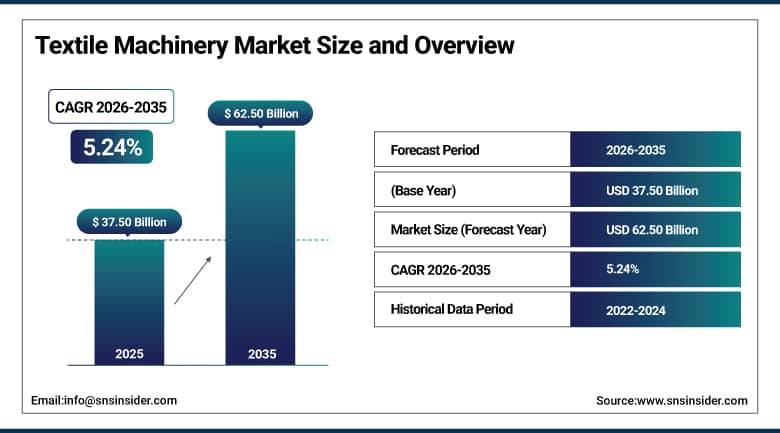
The Textile Machinery Market was valued at USD 37.50 Billion in 2025 and is expected to reach USD 62.50 Billion by 2035, growing at a CAGR of 5.24% from 2026 to 2035.
The Textile Machinery Market is experiencing a sustained growth trend due to the increase in textile production around the world, modernization of the textile manufacturing environment, and an increase in the demand for machines that enable automation and energy efficiency in textile manufacturing. The textile machinery, which consists of spinning, weaving, knitting, and finishing machinery, converts raw fiber inputs into finished or semi-finished textiles in the apparel, home textiles, and technical textiles markets. In addition, the market is further driven by the continued replacement of old textile manufacturing systems with new digitally enabled systems, applications of technical textiles outside traditional apparel manufacturing, and investments in textile manufacturing capacity in emerging countries.
Rieter and Trützschler both increased their production capacity of automated spinning and carding machinery in 2026 in order to meet increasing demand from textile manufacturers in the Asia Pacific region.
Market Size and Forecast
-
Market Size in 2026E: USD 39.45 Billion
-
Market Size by 2035: USD 62.50 Billion
-
CAGR: 5.24% from 2026 to 2035
-
Fastest Growing Region: Latin America
-
Largest Region: Asia Pacific
To Get More Information On Textile Machinery Market - Request Free Sample Report
Textile Machinery Market Trends
-
Rising adoption of fully automated textile machinery is being driven by labor cost pressure and the need for consistent, high-precision fabric production across large-scale manufacturing facilities.
-
Growing demand for technical and industrial textiles used in automotive, construction, and medical applications is expanding textile machinery demand beyond traditional apparel manufacturing.
-
Increasing integration of digital monitoring and Industry 4.0 connectivity into textile machinery is improving production efficiency and enabling predictive maintenance across mills.
-
Expanding textile manufacturing capacity investment in emerging economies is driving demand for both new machinery installations and replacement of aging conventional equipment.
-
Strategic partnerships among machinery manufacturers, textile mills, and automation technology vendors are supporting development of increasingly energy-efficient, low-waste production platforms.
U.S. Textile Machinery Market Outlook
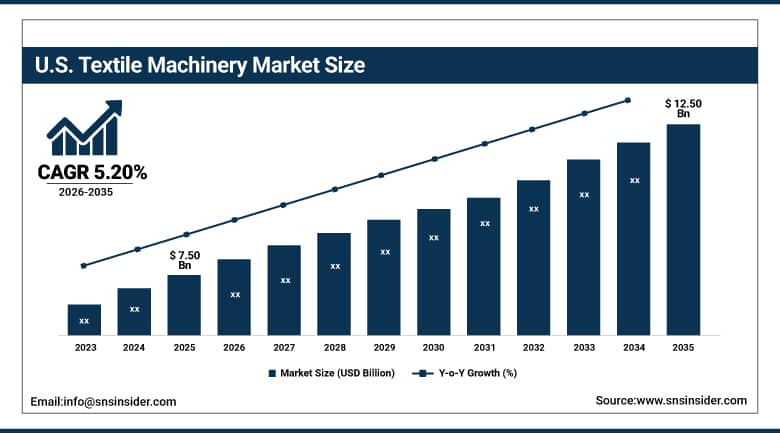
The U.S. Textile Machinery Market was valued at USD 7.50 Billion in 2025 and is projected to reach USD 12.50 Billion by 2035, growing at a CAGR of 5.20% during 2026–2035.
Textile manufacturers in the country keep investing in automated machinery in pursuit of sustainable and innovative goals, as well as in light of increasing demand for locally produced technical and industrial textiles. The increased investments in reshoring of specialty textile manufacturing, together with the rising demand for locally produced automotive and medical technical textiles, contribute to the steady demand for advanced machinery in the country.
In 2026, Lindauer DORNIER extended its distribution and servicing network in the United States for its advanced weaving machinery due to increasing local demand from technical textile manufacturers with automated production capabilities.
Textile Machinery Market Segment Analysis
-
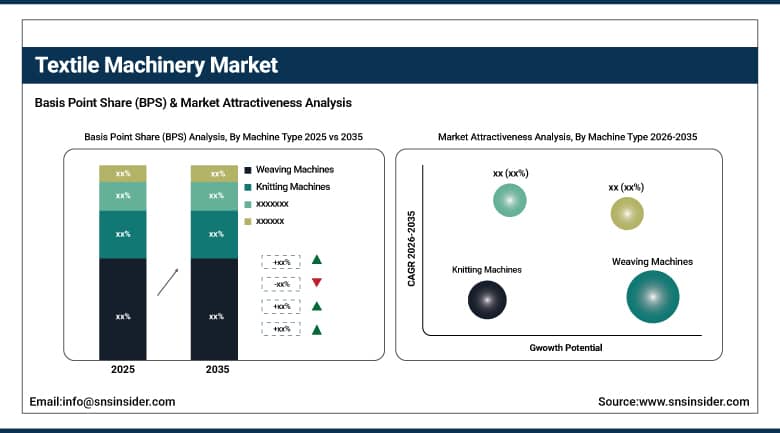
By Machine Type, Weaving Machines dominated the Textile Machinery Market with a 28.30% share in 2025, while Knitting Machines is the fastest-growing machine type segment with a CAGR of 6.80% from 2026–2035.
-
By Automation Level, Semi-Automatic dominated the Textile Machinery Market with a 43.00% share in 2025, while Fully-Automatic is the fastest-growing automation level segment with a CAGR of 7.60% from 2026–2035.
-
By Application, Apparel dominated the Textile Machinery Market with a 52.50% share in 2025, while Technical Textiles is the fastest-growing application segment with a CAGR of 7.90% from 2026–2035.
-
By Fiber Type, Synthetic Fibers dominated the Textile Machinery Market with a 42.60% share in 2025, while Blended Fibers is the fastest-growing fiber type segment with a CAGR of 7.20% from 2026–2035.
By Machine Type, Weaving Machines dominated the Textile Machinery Market, while Knitting Machines is the fastest-growing segment.
The weaving machines segment emerged as the leader within the Textile Machinery Market, accounting for 28.30% of the total market revenues in 2025. The weaving machines category continues to be the largest machine category in terms of sales due to its extensive application in the manufacture of woven textiles used for clothing, interior fabrics, and industries.
The Knitting Machines segment is expected to exhibit the highest CAGR of 6.80% over the forecast period of 2026-2035. Demand for knitted clothes and apparels, along with increased preference for computerized knitting technologies that can create complicated fabrics structures, is driving the growth of the segment.
By Automation Level, Semi-Automatic dominated the Textile Machinery Market, while Fully-Automatic is the fastest-growing segment.
The Semi-Automatic segment dominated the Textile Machinery Market with a revenue share of 43.00% in 2025. Semi-automatic machinery remains the largest automation category owing to its favorable balance of capital cost and operational flexibility, making it the practical choice for a broad range of textile manufacturers, particularly in emerging markets not yet ready for full automation investment.
The Fully-Automatic segment is expected to witness the fastest CAGR of 7.60% during the forecast period 2026-2035. Rising labor cost pressure and growing enterprise investment in Industry 4.0 automation technology are driving rapid adoption of fully automatic textile machinery, which delivers consistent, high-precision fabric production with minimal manual intervention.
By Application, Apparel dominated the Textile Machinery Market, while Technical Textiles is the fastest-growing segment.
The Apparel segment dominated the Textile Machinery Market with a revenue share of 52.50% in 2025. Apparel manufacturing remains the largest application category owing to the sheer global scale of clothing production, which continues to drive sustained demand for spinning, weaving, and knitting machinery across virtually every major textile-producing region.
The Technical Textiles application segment is estimated to have the highest growth in terms of CAGR of 7.90%. The growing demand for technical textiles in the manufacture of products related to automobiles interior, construction geotextiles, and medical industry is creating a demand for specialized machinery to cater to requirements other than the conventional textile machinery.
By Fiber Type, Synthetic Fibers dominated the Textile Machinery Market, while Blended Fibers is the fastest-growing segment.
The Synthetic Fibers segment dominated the Textile Machinery Market with a revenue share of 42.60% in 2025. Synthetic fiber processing remains the largest fiber type category owing to the substantial global production volume of polyester, nylon, and other synthetic materials, which continue to account for the majority of global textile fiber consumption across apparel and technical applications.
The Blended Fibers segment is expected to witness the fastest CAGR of 7.20% during the forecast period 2026-2035. Growing consumer and brand demand for fabrics combining the performance characteristics of multiple fiber types, such as cotton-polyester and wool-synthetic blends, is driving rising adoption of machinery capable of precisely processing blended fiber compositions.
Regional Insights
|
Region |
Major Country |
Share within Region, 2025 (%) |
|---|---|---|
|
North America |
United States |
78.60% |
|
Europe |
Germany |
26.80% |
|
Asia Pacific |
China |
46.90% |
|
Middle East & Africa |
UAE |
25.40% |
|
Latin America |
Brazil |
39.60% |
Asia Pacific Textile Machinery Market Insights
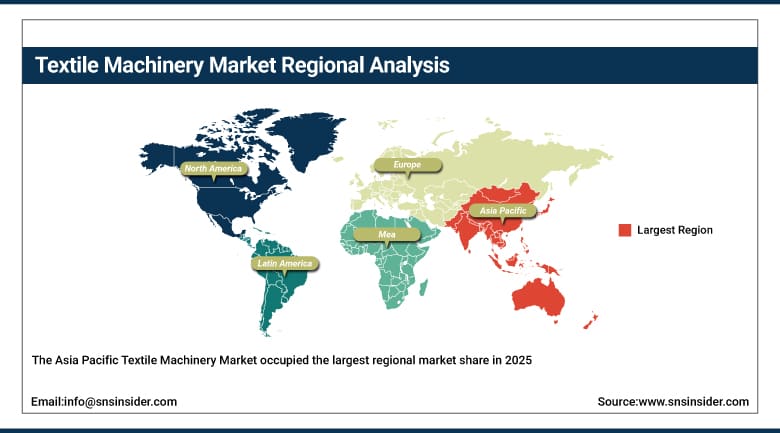
The Asia Pacific Textile Machinery Market occupied the largest regional market share in 2025 owing to the region's massive textile manufacturing base, rapidly rising apparel export demand, and heavy investment by Asian manufacturers in automated production lines to meet growing global demand.
China is one of the main growth drivers in the Asia Pacific Textile Machinery Market, owing to its dominant global textile manufacturing position, rapidly expanding domestic machinery manufacturing capability, and growing technical textile production. India, Bangladesh, and Vietnam are also contributing to regional growth through expanding apparel export manufacturing capacity.
Get Customized Report as Per Your Business Requirement - Enquiry Now
North America Textile Machinery Market Insights
The North America Textile Machinery Market held a significant regional market share in 2025 owing to growing reshoring investment in specialty and technical textile production, rising demand for domestically manufactured automotive and medical textiles, and strong adoption of advanced, sustainability-focused machinery.
The US was the leading country within the North America Textile Machinery Market in 2025 with a market share of 78.60% of the regional market, driven by growing technical textile manufacturing investment, strong innovation focus, and rising demand for automated production equipment. Canada is contributing to regional growth through expanding technical textile manufacturing capacity.
Europe Textile Machinery Market Insights
Europe has emerged as one of the significant regions of the Textile Machinery Market during 2025 due to its highly advanced machinery manufacturing base, technical textile innovations, and luxury and speciality textile production know-how in several significant countries within the region.
Some of the significant countries of Europe, Germany being one of them, due to its highly advanced machinery manufacturing base and textile technology know-how. Some other countries that are contributing to market growth include France, Italy, and the United Kingdom among others.
Middle East & Africa and Latin America Textile Machinery Market Insights
Middle East & Africa and Latin American regions are gradually expanding textile machinery adoption, with the Latin America region expected to register the fastest regional CAGR during the forecast period. Growing regional textile manufacturing investment is opening meaningful avenues for market growth across these regions.
Brazil is set to be a prominent Latin American market fueled by growing domestic textile manufacturing capacity and rising apparel production investment. The Middle East & Africa region has Turkey and Egypt investing in expanding textile export manufacturing capacity to serve growing regional and international demand.
Growth Drivers: Rising textile production and manufacturing modernization driving market growth
The growth in textile production worldwide, the modernization of the textile manufacturing environment, and the rising need for automatic and energy-efficient machinery to produce fabric are some of the factors influencing the growth of the Textile Machinery Market. Textile machinery is one of the basic capital machinery used in the textile manufacturing industry throughout the world.
Technical developments in digital technology, energy-efficient drives, and precise fiber processing have been a major factor in making textile machinery more productive and sustainable. The replacement of old machinery, technical textiles applications, and investments in textile manufacturing capacity in emerging economies are adding to the market demand.
Restraints: High capital costs and raw material price volatility limiting market expansion
The primary challenge facing market development is the large amount of capital needed to invest in current textile machinery and payback times which may not be certain, making it difficult for small textile companies to replace their existing machinery.
Also, raw material prices, which influence the production cost of machinery and cost of textile fibers, may be volatile and unpredictable when manufacturers seek to expand their capacities. There is an increase in environmental policies governing the production process in the textile industry, leading to changes in machinery.
Opportunities: Expansion of technical textiles and automation adoption creating new growth avenues
The accelerated application of technology-based textile products in automotive, construction, and health care industries along with increasing automation in textile production processes in emerging economies is set to create ample scope for the Textile Machinery Market. There is an increase in the demand for efficient and interconnected production machines that will boost demand in the coming years.
Another major growth driver will be in the development of entirely automated machinery systems that will lower dependence on labor while offering improved production efficiency. Increasing investments in the capacity to manufacture textiles in Latin American and Southeast Asian countries will create ample scope for growth.
Recent Developments:
-
2025: Rieter launched its J 26 rotor spinning machine, featuring improved energy efficiency and increased spinning position density for large-scale yarn manufacturing operations.
-
2025: Trützschler introduced an updated TC 30 card generation, offering enhanced fiber processing precision and reduced energy consumption for spinning mill operators.
-
2026: Picanol launched its OmniPlus-i airjet weaving machine, featuring improved weft insertion speed and digital connectivity for real-time production monitoring.
-
2026: Karl Mayer updated its HKS 3-M warp knitting machine platform, incorporating enhanced pattern flexibility and energy-efficient drive technology for technical textile production.
Textile Machinery Companies are:
-
Rieter Holding AG
-
Trützschler Group SE
-
Murata Machinery, Ltd.
-
Toyota Industries Corporation
-
Itema S.p.A.
-
Lindauer DORNIER GmbH
-
SHIMA SEIKI MFG., LTD.
-
Van de Wiele Group
-
Zhejiang Jingwei Textile Machinery Co., Ltd.
-
Santoni S.p.A. (Lonati Group)
-
Karl Mayer Textilmaschinenfabrik GmbH
-
Groz-Beckert KG
-
Saurer Group
-
TSUDAKOMA Corp.
-
Lakshmi Machine Works Limited
-
CHTC Fong's Industries Co., Ltd.
-
Zhejiang Taitan Company Limited
-
A.T.E. Enterprises Private Limited
Textile Machinery Market Report Scope:
| Report Attributes | Details |
|---|---|
| Market Size in 2025 | USD 37.50 Billion |
| Market Size by 2035 | USD 62.50 Billion |
| CAGR | CAGR of 5.24% From 2026 to 2035 |
| Base Year | 2025 |
| Forecast Period | 2026-2035 |
| Historical Data | 2022-2024 |
| Report Scope & Coverage | Market Size, Segments Analysis, Competitive Landscape, Regional Analysis, DROC & SWOT Analysis, Forecast Outlook |
| Key Segments | • By Machine Type (Spinning Machines, Weaving Machines, Knitting Machines, Finishing Machines) • By Automation Level (Manual, Semi-Automatic, Fully-Automatic) • By Application (Apparel, Home Textiles, Technical Textiles, Industrial Textiles) • By Fiber Type (Natural Fibers, Synthetic Fibers, Blended Fibers) |
| Regional Analysis/Coverage | North America (US, Canada), Europe (Germany, UK, France, Italy, Spain, Russia, Poland, Rest of Europe), Asia Pacific (China, India, Japan, South Korea, Australia, ASEAN Countries, Rest of Asia Pacific), Middle East & Africa (UAE, Saudi Arabia, Qatar, South Africa, Rest of Middle East & Africa), Latin America (Brazil, Argentina, Mexico, Colombia, Rest of Latin America). |
| Company Profiles | Rieter Holding AG, Trützschler Group SE, Murata Machinery, Ltd., Toyota Industries Corporation, Picanol Group NV, Itema S.p.A., Lindauer DORNIER GmbH, SHIMA SEIKI MFG., LTD., Van de Wiele Group, Zhejiang Jingwei Textile Machinery Co., Ltd., Santoni S.p.A. (Lonati Group), Karl Mayer Textilmaschinenfabrik GmbH, Groz-Beckert KG, Saurer Group, TSUDAKOMA Corp., Monti Antonio S.p.A., Lakshmi Machine Works Limited, CHTC Fong's Industries Co., Ltd., Zhejiang Taitan Company Limited, A.T.E. Enterprises Private Limited |
Frequently Asked Questions
The Textile Machinery Market is expected to grow at a CAGR of 5.24% from 2026 to 2035.
The Textile Machinery Market was valued at USD 37.50 Billion in 2025.
The market is driven by rising global textile production, structural modernization of manufacturing ecosystems, and increasing demand for automated, energy-efficient fabric production equipment.
The Weaving Machines segment dominated the Textile Machinery Market in 2025, accounting for approximately 28.30% market share.
The Asia Pacific region dominated the Textile Machinery Market in 2025, led by China's dominant global textile manufacturing position.
