
V2X Cybersecurity Market Key Insights:
To Get More Information on V2X Cybersecurity Market - Request Sample Report
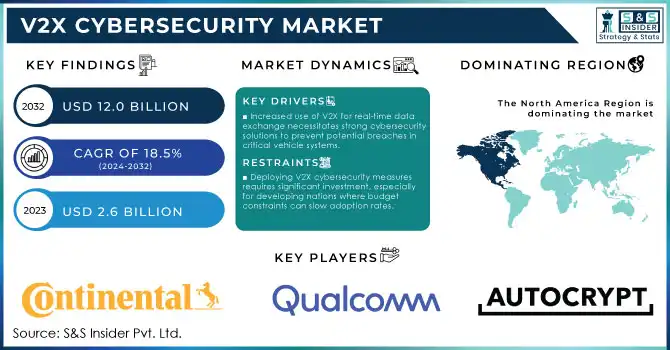
The V2X Cybersecurity Market Size was valued at USD 2.6 billion in 2023 and is expected to reach USD 12.0 billion by 2032, growing at a CAGR of 18.5% over the forecast period 2024-2032.
The Vehicle-to-Everything (V2X) Cybersecurity Market has witnessed substantial growth, driven primarily by rising governmental mandates on automotive cybersecurity standards and increased funding for secure vehicle connectivity infrastructures. Governments worldwide are investing heavily in secure V2X technology to counter cyber threats and safeguard passenger safety. For instance, the U.S. Department of Transportation (DOT) recently allocated $50 million in grants to develop secure V2X frameworks that aim to reduce traffic accidents and prevent cyber vulnerabilities. In Europe, the European Commission (EC) has introduced stringent cybersecurity measures for vehicle communications as part of its Cooperative, Connected, and Automated Mobility (CCAM) strategy, which aims to boost V2X deployment across member states. According to the EC, V2X cybersecurity is a critical enabler of the EU's goal to have 100% of vehicles equipped with connected technology by 2030. Furthermore, the Asia-Pacific region, particularly China, has embraced V2X advancements, with China's Ministry of Industry and Information Technology (MIIT) setting up a National Center for V2X Cybersecurity to address increasing threats to connected vehicles. This strategic shift aligns with the global push for a safer and more interconnected automotive ecosystem and enhances the V2X cybersecurity market's potential growth, especially as governments support initiatives to secure intelligent transportation systems.
Connected and autonomous vehicles are transforming the automotive industry, with V2X technology playing a critical role in enabling real-time data exchange. Companies like Mercedes-Benz, BMW, Continental AG, and BYD are investing heavily in autonomous driving technology, with BYD recently receiving China’s first Level 3 ADAS testing license in January 2024. Also, Continental and Aurora launched the first scalable Level 4 autonomous truck system.
Tech giants such as Google, NVIDIA, Uber, and Tesla are accelerating efforts to develop autonomous vehicles, with NVIDIA partnering with Ansys in January 2024 to advance this technology. The growing shift towards autonomous vehicles, however, increases cybersecurity risks, boosting the demand for V2X cybersecurity solutions. This evolution presents opportunities for cloud providers, OEMs, and V2X cybersecurity firms to collaborate. Companies like NVIDIA, Qualcomm, and Autotalks are developing the necessary components for large-scale autonomous vehicle deployment, creating a demand for secure, connected transportation systems.
Market Dynamics
Drivers
-
The increasing presence of autonomous and connected vehicles creates a heightened demand for cybersecurity. V2X systems enable vehicles to communicate with each other and infrastructure, making robust security measures essential to protect against unauthorized access and cyber threats.
-
Increased use of V2X for real-time data exchange necessitates strong cybersecurity solutions to prevent potential breaches in critical vehicle systems.
-
V2X systems are deployed in smart city infrastructure, and transportation networks become more susceptible to cyber-attacks. Protecting vehicle-to-infrastructure (V2I) communication is critical to ensuring safe and efficient transport operations.
The increasing number of connected and autonomous vehicles is one of the key factors propelling the growth of the V2X (Vehicle-to-Everything) cybersecurity market. The automotive industry is increasingly moving towards V2X, which is a state-of-the-art technology that connects vehicles with other dynamic and static equipment to obtain real-time information that can be used to inform driving processes. More than 775 million connected cars are estimated to be on the road worldwide by 2024 and safe, certified V2X systems are essential to protecting these vehicles from cyber-attacks.
All this connectivity can lead to more efficient traffic management, improved safety, and even autonomous driving capabilities but also opens up new vectors for cyber-attacks. According to a recent survey, approximately 62% of automotive organizations have experienced some form of cyber-attack in the past year, a trend expected to grow with the increasing adoption of V2X systems. As an example in 2022, a vulnerability in Tesla's V2X system allowed hackers to execute vehicle functions remotely which demonstrated the inherent weaknesses in this technology and the need for cybersecurity improvements. This is forcing automakers and technology providers to develop comprehensive solutions for securing V2X from cybersecurity attacks, including encryption, firewall protection, and intrusion detection systems. However, the rising adoption of autonomous and connected vehicles on the roads coupled with increasing risks of cyber threats makes way for more impressive breakthroughs and investments in V2X cybersecurity with the intent of securing vehicles as well as surrounding infrastructure.
Restraints
-
Deploying V2X cybersecurity measures requires significant investment, especially for developing nations where budget constraints can slow adoption rates.
-
The complexity and cost associated with integrating V2X cybersecurity into existing infrastructure can limit its widespread implementation, particularly in less developed markets.
-
The V2X industry currently faces challenges due to a lack of standardized cybersecurity protocols, which creates compatibility issues and increases vulnerability risks.
The absence of standardized security protocols across vehicle OEM and infrastructure providers is the major hindrance to the growth of the V2X cybersecurity market. There are numerous systems and types of communication under V2X (vehicle-to-everything) with the possibility of varied technologies and standards in usage. If there is no coherent cybersecurity policy in place, it is difficult to ensure that all aspects of the organization are protected. These variations among protocols and tools make it hard to roll out universal security solutions and some systems are being left out of security checks and are therefore more exposed to cyber threats. The non-standardization also increases the time to implement security updates and security patches, making every solution have some customized service for different sets of systems, leading to the escalation of both time and cost. Consequently, the lack of consistent standards not only hinders the efficiency of cybersecurity measures but also introduces risk, as any unprotected component can serve as a gateway for cyber-attacks across connected networks.
Regional Analysis
By Unit Type
In 2023, the on-board units (OBUs) segment contributed the largest revenue share of about 59% in the V2X cybersecurity market. An OBU interface with in-vehicle networking and communication with external infrastructure for example, roadside units and other vehicles is crucial for enabling secure V2X communication. The growing penetration of ON-Board units including hardware and software is primarily fueled by governing authorities enforcing the integration of OBUs for V2X communications. For instance, in the USA, the FCC has allocated the 5.9 GHz spectrum band specifically for vehicle safety applications, forcing automotive OEMs to equip OBUs as standard. In the European Union, OBUs are critical for compliance with the EU's General Data Protection Regulation (GDPR), which necessitates secure data transmission within connected vehicles. The fact that OBUs are prioritized by the governments and the automotive industry as they provide strong, secure communication channels for vehicles to communicate will boost the market share of OBUs significantly.
By Communication
In 2023, the vehicle-to-vehicle (V2V) communication segment commanded the leading revenue share, accounting for over 33%. V2V communication allows for information to be exchanged directly between vehicles and for the vehicles to communicate in real-time with one another to enhance safety on the roads, by sharing data about vehicle speed, position, and movement direction. It minimizes the chances of accidents by notifying the drivers about the possible dangers. The U.S. National Highway Traffic Safety Administration (NHTSA) has estimated that if V2V is deployed widely, it could help eliminate more than 600,000 crashes per year. The U.S. government has responded by taking major steps to require V2V in all vehicles. Likewise, V2V communication is a core element of the European Commission's 'Smart Mobility' initiative in Europe, which seeks to create a safer network of vehicles connected for better road safety and traffic management. Focus on safety-critical communication worldwide strengthens the V2V adoption leading to its dominance in the overall V2X cybersecurity market.
By Security Type
The endpoint security segment held the largest share in the V2X cybersecurity market in 2023, at around 39%. Data integrity and confidentiality of the message among the vehicle networks will be established by performing Endpoint Security in V2X (Vehicle To Everything) systems to restrict illegal and unauthorized access. The growing focus on endpoint security for automotive systems is driven in part by recent government regulations. For example, the U.S. National Institute of Standards and Technology (NIST) has issued cybersecurity guidelines for automotive endpoints, encouraging OEMs to protect in-vehicle communication channels and endpoints from hacking and cyber intrusion. Within its cybersecurity framework for the cybersecurity of autonomous and connected vehicles, the EU Agency for Cybersecurity (ENISA) also imposes strict endpoint security protocols. Focusing on endpoint security, this segment serves the burgeoning trend of securing access points in vehicles, thus making it a fundamental part of V2X cybersecurity market.
By Vehicle Type
In 2023, the V2X cybersecurity market was dominated by the passenger car segment, which accounted for over 64% of the overall market. Advanced connected features such as collision avoidance and automatic braking systems are becoming more mainstream in passenger vehicles in which there is a need of security of V2X communications. New government regulations are forcing automakers to focus more on the cybersecurity of passenger vehicles. As an example, recently added V2X cybersecurity requirements for passenger cars under the Federal Motor Vehicle Safety Standards (FMVSS) in the United States highlight the necessarily holistic approach to cybersecurity. Likewise, the MIIT has required compliance to cybersecurity in new passenger cars in China to better protect against cybersecurity attacks and data breaches. Passenger vehicles account for a substantial share of the global automotive fleet, and this large market share presents an immediate call to action for cybersecurity in the passenger car segment.
Regional Insights
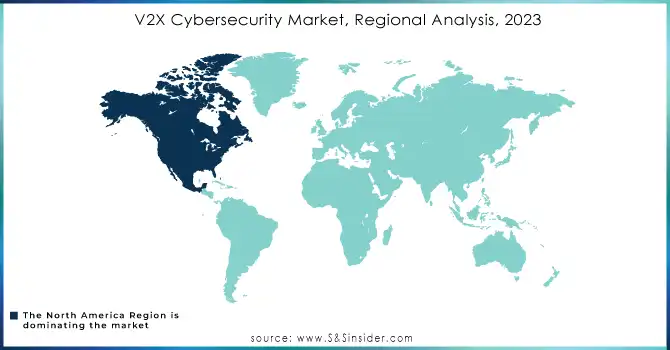
In 2023, North America led the V2X cybersecurity market, primarily driven by robust regulatory frameworks and significant government funding aimed at advancing vehicle connectivity and cybersecurity. The U.S. Department of Transportation (DOT) played a critical role, allocating multi-million-dollar grants to support the development of V2X technologies. These grants are part of the U.S. government’s broader commitment to ensuring the safety and security of connected vehicles. Regulatory efforts, such as the Federal Communications Commission’s (FCC) dedicated spectrum for V2X communications, have further solidified North America’s leadership in this space, making it a primary region for innovation in automotive cybersecurity. The strong regulatory support, coupled with an increasing number of cybersecurity initiatives, highlights North America's leading role in the V2X cybersecurity market.
Meanwhile, the Asia-Pacific region is poised for the fastest growth, with a projected compound annual growth rate (CAGR) outpacing other regions. This is evident from the region's market share of approximately 25% in 2023. China, in particular, is playing a pivotal role in driving this growth. The country’s Ministry of Industry and Information Technology (MIIT) has placed a strong emphasis on automotive cybersecurity and smart transportation, fostering the rapid adoption of V2X technologies. Additionally, Japan's “Society 5.0” vision, which aims to integrate digital technologies into daily life and support smart cities, has further propelled the region as a key growth hub for V2X cybersecurity solutions, ensuring that Asia-Pacific remains a critical player in the global market.
Do You Need any Customization Research on V2X Cybersecurity Market - Inquire Now
Recent Developments
-
In January 2024, AUTOCRYPT and Cohda Wireless signed a Memorandum of Understanding (MOU) at CES 2024, marking the beginning of their partnership to create a V2X solution with integrated security features.
-
Commsignia Ltd. raised USD 15 million in a Series B round in September 2023, with new investments from Inventure, Inference Partners, PortfoLion Capital Partners, and Day One Capital. The firm plans to leverage this funding to extend its footprint in the automotive sector by expanding into new geographical markets.
-
In January of 2023, INTEGRITY Security Services (ISS) teamed up with SaeSol Tech (SST) to provide V2X technology to automotive manufacturers. It is an effort-based collaboration to help ISS evolve its business features and spread out in the Asian market.
Key Players
Key Service Providers/Manufacturers
-
AUTOCRYPT Co., Ltd. (AutoCrypt V2X, SCMS)
-
Qualcomm Technologies, Inc. (C-V2X Solution, Snapdragon Automotive Platform)
-
Continental AG (Argus Cyber Security Solutions, Connected Vehicle Solutions)
-
ESCRYPT GmbH (CycurV2X, CycurIDS)
-
Autotalks (Tekton3, Secton3)
-
HARMAN International (HARMAN Shield, Cybersecurity Platform)
-
Denso Corporation (DENSO V2X Module, Secure Communication Solutions)
-
NXP Semiconductors (V2X Application Modules, SAF4000)
-
Infineon Technologies AG (AURIX Microcontroller, SECORA Connect)
-
Bosch Mobility Solutions (V2X Hardware Modules, Cybersecurity Framework)
Key Users of V2X Cybersecurity Products/Services
-
Ford Motor Company
-
General Motors
-
Toyota Motor Corporation
-
Volkswagen AG
-
Honda Motor Co., Ltd.
-
Hyundai Motor Company
-
BMW Group
-
Nissan Motor Co., Ltd.
-
Daimler AG (Mercedes-Benz)
-
Tesla, Inc.
| Report Attributes | Details |
|---|---|
| Market Size in 2023 | USD 2.6 Billion |
| Market Size by 2032 | USD 11.9 Billion |
| CAGR | CAGR of 18.5% From 2024 to 2032 |
| Base Year | 2023 |
| Forecast Period | 2024-2032 |
| Historical Data | 2020-2022 |
| Report Scope & Coverage | Market Size, Segments Analysis, Competitive Landscape, Regional Analysis, DROC & SWOT Analysis, Forecast Outlook |
| Key Segments | • By Connectivity (Dedicated Short Range Communications (DSRC), Cellular) • By Vehicle Type (Passenger Cars, Commercial Vehicles) • By Unit Type (On-board Units (OSUs), Roadside Units (RSUs)) • By Communication (Vehicle-to-Vehicle (V2V), Vehicle-to-Infrastructure (V2I), Vehicle-to-Grid (V2G), Vehicle-to-Pedestrian (V2P), Vehicle-to-Cloud (V2C)) • By Propulsion (Internal Combustion Engine (ICE), Electric & Hybrid) • By Security Type (Endpoint Security, Software Security, Cloud Security) |
| Regional Analysis/Coverage | North America (US, Canada, Mexico), Europe (Eastern Europe [Poland, Romania, Hungary, Turkey, Rest of Eastern Europe] Western Europe] Germany, France, UK, Italy, Spain, Netherlands, Switzerland, Austria, Rest of Western Europe]), Asia Pacific (China, India, Japan, South Korea, Vietnam, Singapore, Australia, Rest of Asia Pacific), Middle East & Africa (Middle East [UAE, Egypt, Saudi Arabia, Qatar, Rest of Middle East], Africa [Nigeria, South Africa, Rest of Africa], Latin America (Brazil, Argentina, Colombia, Rest of Latin America) |
| Company Profiles | AUTOCRYPT Co., Ltd., Qualcomm Technologies, Inc., Continental AG, ESCRYPT GmbH, Autotalks, HARMAN International, Denso Corporation, NXP Semiconductors, Infineon Technologies AG, Bosch Mobility Solutions. |
| Key Drivers | • The increasing presence of autonomous and connected vehicles creates a heightened demand for cybersecurity. V2X systems enable vehicles to communicate with each other and infrastructure, making robust security measures essential to protect against unauthorized access and cyber threats. • Increased use of V2X for real-time data exchange necessitates strong cybersecurity solutions to prevent potential breaches in critical vehicle systems. |
| Restraints | • Deploying V2X cybersecurity measures requires significant investment, especially for developing nations where budget constraints can slow adoption rates. • The complexity and cost associated with integrating V2X cybersecurity into existing infrastructure can limit its widespread implementation, particularly in less developed markets. |
Frequently Asked Questions
Ans:
- Deploying V2X cybersecurity measures requires significant investment, especially for developing nations where budget constraints can slow adoption rates.
- The complexity and cost associated with integrating V2X cybersecurity into existing infrastructure can limit its widespread implementation, particularly in less developed markets.
And: The endpoint security type segment dominated the V2X Cybersecurity Market in 2023.
Ans. The CAGR of the V2X Cybersecurity Market is 18.5% During the forecast period of 2024-2032.
Ans: The North America region dominated the V2X Cybersecurity Market in 2023.
Ans. The projected market size for the V2X Cybersecurity Market is USD 11.96 Billion by 2032.
