
Wearable Dialysis Devices Market Report Scope and Overview:
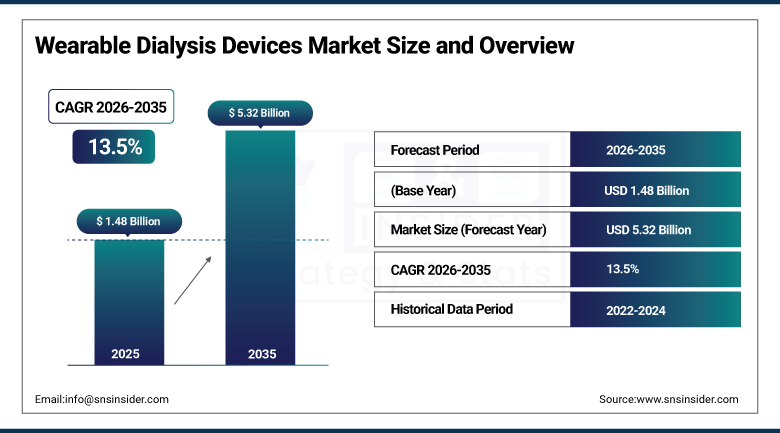
The Wearable Dialysis Devices Market was valued at USD 1.48 Billion in 2025 and is projected to reach USD 5.32 Billion by 2035, registering a CAGR of 13.5% from 2026 to 2035.
The global wearable dialysis devices market growth is being driven by the rising global burden of end-stage renal disease and chronic kidney disease, which is increasing demand for renal replacement therapy that does not confine patients to fixed dialysis-center schedules. Continued miniaturization of sorbent-based dialysate regeneration cartridges, growing clinical trial activity around ambulatory and belt-worn hemodialysis and peritoneal dialysis systems, and rising patient preference for home-based treatment are collectively expanding the addressable market. Additional momentum is coming from academic and industry research into dialysate-free filtration methods and continuous wireless monitoring, which are gradually shifting kidney replacement therapy away from center-based intermittent sessions toward more flexible, patient-controlled formats.
In 2025 and 2026, AWAK Technologies advanced clinical development of its Automated Wearable Artificial Kidney, a belt-worn peritoneal dialysis system built around rapidly regenerating sorbent cartridges, moving the device closer to broader patient access across its home markets.
To Get more information On Wearable Dialysis Devices Market - Request Free Sample Report
Wearable Dialysis Devices Market Trends
-
Growing clinical trial activity around sorbent-based, belt-worn peritoneal dialysis systems continues expanding the pool of commercially viable wearable devices.
-
Rising research into dialysate-free filtration using membrane and phase-transition technology continues pointing toward lighter, lower-water-consumption designs.
-
Expanding partnerships between device developers and dialysate-sorbent manufacturers continue shortening development timelines for next-generation systems.
-
Increasing integration of wireless biosensors and remote monitoring continues allowing nephrology teams to track home dialysis patients between clinic visits.
-
Growing insurer and national health-service interest in home dialysis continues reshaping reimbursement policy in several developed markets.
U.S. Wearable Dialysis Devices Market Outlook
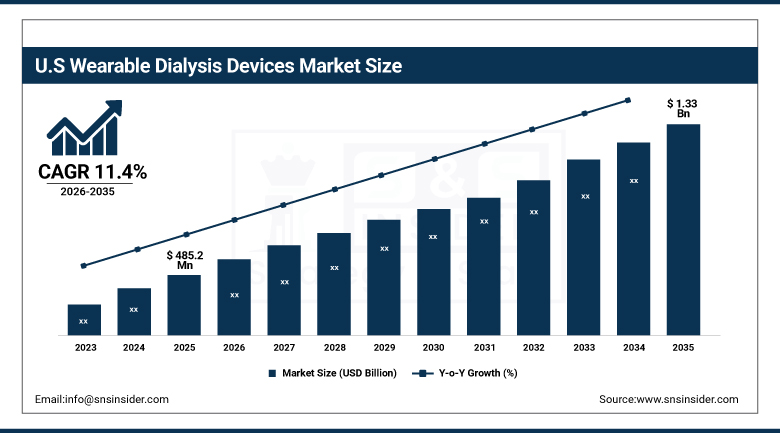
The U.S. Wearable Dialysis Devices Market was valued at approximately USD 485.2 Million in 2025 and is projected to reach approximately USD 1.33 Billion by 2035, registering a CAGR of approximately 11.4% from 2026 to 2035.
The U.S. market is underpinned by a large and growing dialysis-dependent population, an established regulatory framework for expedited review of home dialysis technology, and continued federal policy attention toward shifting kidney care away from in-center hemodialysis. A concentration of established dialysis-equipment manufacturers alongside newer entrants developing belt-worn and portable systems is keeping clinical trial activity centered domestically. Growing Medicare initiatives supporting home dialysis adoption, combined with rising patient demand for greater treatment flexibility, are further reinforcing the country's position as the largest single market for wearable dialysis technology.
In 2025 and 2026, NextKidney, the Dutch-Swiss venture built on Debiotech's DialEase platform, continued preparing its compact home hemodialysis system for expanded clinical testing, targeting a device light enough to be carried as airline hand luggage.
Wearable Dialysis Devices Market Segment Analysis
-
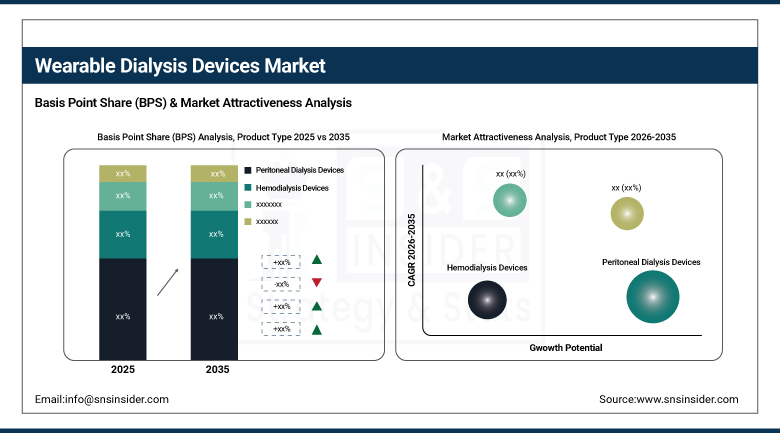
By Product Type, Peritoneal Dialysis Devices segment dominated the market in 2025 with 46% share; Hemodialysis Devices segment is the fastest growing segment, registering a CAGR of 15.2% from 2026 to 2035.
-
By Technology, Sorbent-Based Dialysate Regeneration segment dominated the market in 2025 with 58% share; Membrane-Based Filtration Systems segment is the fastest growing segment, registering a CAGR of 15.0% from 2026 to 2035.
-
By Application, End-Stage Renal Disease segment dominated the market in 2025 with 41% share; Chronic Kidney Disease segment is the fastest growing segment, registering a CAGR of 14.8% from 2026 to 2035.
-
By End-User, Hospitals & Clinics segment dominated the market in 2025 with 43% share; Home Care Settings segment is the fastest growing segment, registering a CAGR of 15.5% from 2026 to 2035.
By Product Type: Peritoneal Dialysis Devices Lead, Hemodialysis Devices Grow Fastest
The Peritoneal Dialysis Devices segment accounted for the largest revenue share in 2025, supported by the relative simplicity of adapting sorbent-based dialysate regeneration into a compact, belt-worn form factor compared with the higher blood-flow and filtration demands of hemodialysis. Devices built on this approach require substantially less dialysate than conventional systems, making them easier to engineer into a wearable format capable of extended, ambulatory use. Continued clinical trial progress among established peritoneal dialysis developers has reinforced this segment's lead in commercially available and late-stage wearable platforms.
The Hemodialysis Devices segment is projected to expand at the fastest rate, driven by growing research into miniaturized, sorbent-regenerating hemodialysis platforms capable of matching the filtration performance of center-based machines in a portable form. Recent laboratory and preclinical progress toward dialysate-free filtration methods is narrowing the technical gap that has historically kept wearable hemodialysis further from commercialization than peritoneal alternatives. As these systems move through clinical validation, demand is expected to accelerate among patients seeking more frequent, flexible hemodialysis without center-based scheduling constraints.
By Technology: Sorbent-Based Regeneration Dominates, Membrane-Based Systems Advance Fastest
The Sorbent-Based Dialysate Regeneration segment held the largest technology share, reflecting its established role in reducing the volume of dialysate a wearable device needs to carry, a critical constraint for any system designed to be worn continuously rather than operated from a fixed water supply. Sorbent cartridges allow used dialysate to be chemically regenerated and reused within a closed loop, and this approach underpins the majority of wearable peritoneal dialysis systems currently in clinical trials or early commercial use.
The Membrane-Based Filtration Systems segment is registering the fastest growth, supported by emerging research into dialysate-free designs that rely on gas-permeable membranes and adsorption technology rather than liquid dialysate regeneration entirely. Early preclinical results demonstrating meaningful water clearance and toxin removal without bulky dialysate reservoirs are drawing growing research funding and industry interest, positioning membrane-based approaches as a technology pathway with substantial long-term potential for lighter, simpler wearable kidney replacement devices.
By Application: End-Stage Renal Disease Leads, Chronic Kidney Disease Grows Fastest
The End-Stage Renal Disease segment led the market by application, reflecting the fact that this population represents the core patient base currently reliant on regular dialysis and therefore the primary target for wearable and portable alternatives to center-based treatment. Patients in this category typically require dialysis multiple times per week, making the flexibility and mobility offered by wearable systems especially valuable, and clinical trial recruitment for new wearable platforms has concentrated heavily within this population.
The Chronic Kidney Disease segment is expanding at the fastest pace, as nephrology practices increasingly explore earlier, more frequent dialysis initiation to slow disease progression before patients reach end-stage renal failure. Growing clinical interest in gentler, more frequent dialysis regimens delivered through wearable or portable devices is extending the addressable population beyond patients currently classified as end-stage, supporting faster relative growth within this earlier-stage application category.
By End-User: Hospitals & Clinics Dominate, Home Care Settings Expand Fastest
The Hospitals & Clinics segment accounted for the largest end-user share, reflecting the current concentration of clinical trials, early commercial deployments, and specialist nephrology oversight required for most wearable dialysis systems still in the process of gaining broader regulatory clearance. Clinical and academic dialysis centers remain the primary sites where patients are trained on and transitioned to wearable devices before any home-based use is considered appropriate.
The Home Care Settings segment is the fastest-growing end-user category, driven by rising patient and payer interest in reducing the time burden of center-based dialysis and by growing clinical confidence in remote monitoring capabilities built into newer wearable platforms. As more devices complete clinical validation and secure regulatory clearance for unsupervised or minimally supervised use, home care is expected to account for a steadily increasing share of total wearable dialysis device utilization.
Regional Analysis
|
Region |
Major Country |
Share within Region, 2025 (%) |
|
North America |
United States |
83.00% |
|
Europe |
Germany |
24.50% |
|
Asia Pacific |
China |
31.20% |
|
Middle East and Africa |
UAE |
26.40% |
|
Latin America |
Brazil |
34.60% |
North America Wearable Dialysis Devices Market Insights
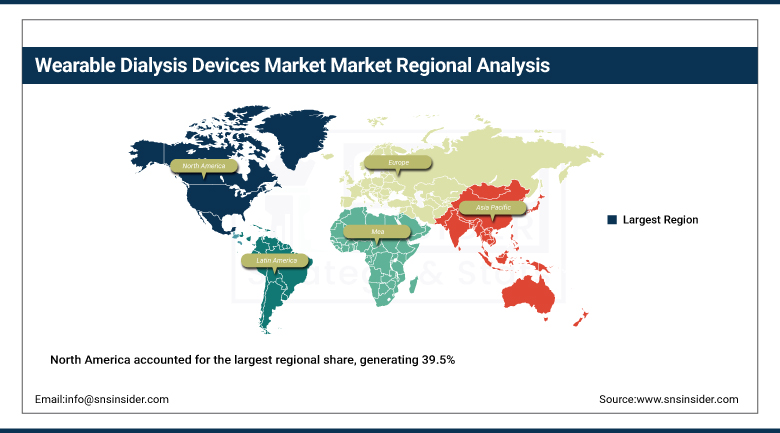
North America accounted for the largest regional share, generating 39.5% of global wearable dialysis device revenue in 2025. This position reflects the region's large dialysis-dependent patient population, an established base of dialysis-equipment manufacturers, and a regulatory environment that has supported expedited review pathways for several home and portable dialysis technologies. National dialysis policy initiatives promoting home-based kidney care have further reinforced institutional and patient interest in wearable alternatives to center-based treatment.
The United States represented the larger share of North American revenue, supported by extensive nephrology infrastructure, sustained clinical trial activity among both established manufacturers and newer device developers, and Medicare policy attention toward home dialysis expansion. Canada contributed a smaller but steady share through academic hospital partnerships and early clinical evaluation programs, together keeping North America the largest addressable market for wearable dialysis device vendors.
Get Customized Report as per Your Business Requirement - Enquiry Now
Europe Wearable Dialysis Devices Market Insights
Europe held a meaningful share of global revenue, supported by strong national health-service interest in home dialysis as a means of reducing in-center treatment capacity constraints and long-term care costs. Several European academic medical centers have played a direct role in early-stage wearable dialysis device development, and regulatory alignment under the EU Medical Device Regulation continues to support multi-country commercialization once initial approval is secured.
Germany accounted for major share of European revenue, supported by an established dialysis-equipment manufacturing base and strong nephrology research infrastructure. The Netherlands and Switzerland contributed disproportionately to regional device development activity given the concentration of wearable dialysis research programs based there, and continued national health-service investment in home dialysis is expected to support steady regional growth through the forecast period.
Asia Pacific Wearable Dialysis Devices Market Insights
Asia Pacific is projected to register the fastest regional growth, with a CAGR of 17.2% from 2026 to 2035. This expansion is being driven by a rapidly growing dialysis-dependent population linked to rising rates of diabetes and hypertension, combined with government health-policy attention toward reducing the cost and capacity strain that in-center dialysis places on public healthcare systems across the region's most populous economies.
China represented the largest share of regional revenue, supported by substantial government investment in expanding nephrology and home dialysis infrastructure to meet a growing patient population. Japan contributed meaningful additional demand, supported by its advanced medical device manufacturing base and long-established dialysis-equipment industry, while Singapore's role as a hub for wearable dialysis research and development has kept the broader region closely tied to ongoing device innovation.
MEA and Latin America Wearable Dialysis Devices Market Insights
The Middle East and Africa and Latin America together represent a comparatively smaller share of global revenue, though both regions are seeing steady growth tied to rising chronic kidney disease prevalence and growing government investment in nephrology infrastructure. In markets where dialysis-center capacity has struggled to keep pace with patient demand, wearable and portable devices are increasingly viewed as a way to extend treatment access without the capital cost of building additional fixed-site dialysis centers.
The UAE led demand within Middle East and Africa, supported by a well-funded private healthcare sector and rising government investment in specialized nephrology care. Saudi Arabia contributed further regional demand through its own healthcare capacity expansion programs. Brazil accounted for the largest share within Latin America, where a large and growing dialysis-dependent population has continued to support demand for both center-based and emerging wearable treatment alternatives.
Market Dynamics
Growth Drivers: Rising Dialysis-Dependent Population and Demand for Treatment Flexibility
Growth is being driven by the rising global prevalence of end-stage renal disease and chronic kidney disease, both closely linked to growing rates of diabetes, hypertension, and an aging population, which is steadily expanding the pool of patients requiring long-term dialysis. Conventional in-center hemodialysis requires patients to commit several hours multiple times per week to fixed treatment schedules, and growing patient preference for greater flexibility and mobility is increasing interest in wearable and portable alternatives that reduce this burden.
Continued progress in sorbent-based dialysate regeneration and emerging membrane-based filtration research is gradually narrowing the technical gap between wearable devices and conventional dialysis machines in terms of filtration performance. National health-policy initiatives in several developed markets promoting home-based dialysis, partly to reduce healthcare system capacity strain, are providing additional regulatory and reimbursement tailwinds that continue to support device development and clinical trial activity across both hemodialysis and peritoneal dialysis platforms.
Restraints: High Development Costs and Limited Clinical Availability
Developing a wearable dialysis device capable of matching the filtration performance of conventional machines within a compact, low-power form factor requires substantial engineering investment and multi-year clinical trial programs before any commercial revenue is realized. This cost and timeline burden has kept much of the market concentrated among a small number of well-funded developers, several of which remain in clinical trial stages rather than full commercial availability.
Limited clinical availability represents a further restraint, as many wearable dialysis systems remain in pilot or early clinical trial phases rather than being broadly available to patients. Reimbursement frameworks in most healthcare systems have not yet caught up with this emerging device category, and the high per-unit cost of early-generation systems, often exceeding conventional dialysis equipment, continues to limit near-term adoption outside of clinical research settings.
Opportunities: Home-Based Kidney Care and Emerging Filtration Technology
The clearest growth opportunity lies in expanding home-based kidney care, as national health systems increasingly look to reduce in-center dialysis capacity strain and total treatment cost by shifting stable patients toward home and wearable dialysis options. Developers that successfully combine regulatory clearance with remote monitoring capability sufficient to reassure clinicians overseeing unsupervised or minimally supervised home use are well positioned to capture this shift as it moves beyond current pilot programs.
A further opportunity lies in emerging dialysate-free filtration technology, which could substantially reduce the water and dialysate volumes that have historically limited how compact and lightweight a wearable dialysis device can become. Developers that successfully commercialize membrane-based or phase-transition filtration methods stand to open wearable dialysis to a broader patient population, including those for whom current sorbent-based systems remain too bulky or complex for regular daily use.
Recent Developments:
-
2026: NextKidney kept developing the NeoKidney mobile dialysis system at home, allowing patients to receive dialysis anywhere and anytime they require it. The system is more flexible and convenient for patients because it can be used anywhere.
-
2025: Quanta worked to develop its Quanta Dialysis System which is compact and aimed at enabling dialysis in different settings. This includes home dialysis. It is focused on portable equipment, ease of use, and less complex treatments.
-
2025: Diality kept on developing its products TabloCart and portable hemodialysis system. The portable nature of the product is in line with the trend in the industry of moving towards more convenient renal replacement therapies.
Wearable Dialysis Devices Market key players are:
-
Fresenius Medical Care AG & Co. KGaA
-
Baxter International Inc.
-
Medtronic plc
-
Asahi Kasei Corporation
-
Outset Medical, Inc.
-
Quanta Dialysis Technologies Ltd.
-
AWAK Technologies Pte Ltd.
-
Nanodialysis B.V.
-
Debiotech SA
-
NextKidney SA
-
Diality Inc.
-
Nikkiso Co., Ltd.
-
Nipro Corporation
-
B. Braun Melsungen AG
-
Rockwell Medical, Inc.
-
Teleflex Incorporated
-
Terumo Corporation
-
Mozarc Medical
-
Physidia SAS
-
JMS Co., Ltd.
Wearable Dialysis Devices Market Report Scope:
| Report Attributes | Details |
|---|---|
| Market Size in 2025 | USD 1.48 Billion |
| Market Size by 2035 | USD 5.32 Billion |
| CAGR | CAGR of 13.5% From 2026 to 2035 |
| Base Year | 2025 |
| Forecast Period | 2026-2035 |
| Historical Data | 2022-2024 |
| Report Scope & Coverage | Market Size, Segments Analysis, Competitive Landscape, Regional Analysis, DROC & SWOT Analysis, Forecast Outlook |
| Key Segments | • By Product Type (Hemodialysis Devices, Peritoneal Dialysis Devices) • By Technology (Sorbent-Based Dialysate Regeneration, Membrane-Based Filtration Systems) • By Application (Chronic Kidney Disease, End-Stage Renal Disease, Acute Kidney Injury, Others) • By End-User (Home Care Settings, Hospitals & Clinics, Ambulatory Surgical Centers, Others) |
| Regional Analysis/Coverage | North America (US, Canada), Europe (Germany, UK, France, Italy, Spain, Russia, Poland, Rest of Europe), Asia Pacific (China, India, Japan, South Korea, Australia, ASEAN Countries, Rest of Asia Pacific), Middle East & Africa (UAE, Saudi Arabia, Qatar, South Africa, Rest of Middle East & Africa), Latin America (Brazil, Argentina, Mexico, Colombia, Rest of Latin America). |
| Company Profiles | Fresenius Medical Care AG & Co. KGaA, Baxter International Inc., Medtronic plc, Asahi Kasei Corporation, Outset Medical, Inc., Quanta Dialysis Technologies Ltd., AWAK Technologies Pte Ltd., Nanodialysis B.V., Debiotech SA, NextKidney SA, Diality Inc., Nikkiso Co., Ltd., Nipro Corporation, B. Braun Melsungen AG, Rockwell Medical, Inc., Teleflex Incorporated, Terumo Corporation, Mozarc Medical, Physidia SAS, JMS Co., Ltd. |

Frequently Asked Questions
Key players include Fresenius Medical Care AG & Co. KGaA, Baxter International Inc., Medtronic plc, Asahi Kasei Corporation, and Outset Medical, Inc., among others.
Key opportunities include rising demand for home-based dialysis, miniaturization of dialysis technologies, increasing remote patient monitoring, improved device portability, and growing preference for patient-centric renal care.
The major growth factor is the rising global burden of end-stage renal disease and chronic kidney disease, combined with growing patient and health-system demand for flexible, home-based dialysis alternatives.
The Peritoneal Dialysis Devices segment dominated the Wearable Dialysis Devices Market by product type, representing the largest share of revenue in 2025.
North America dominated the Wearable Dialysis Devices Market in 2025, holding an estimated 39.5% share of total global market revenue.
