
Wearable Ultrasound Patches Market Report Scope and Overview:
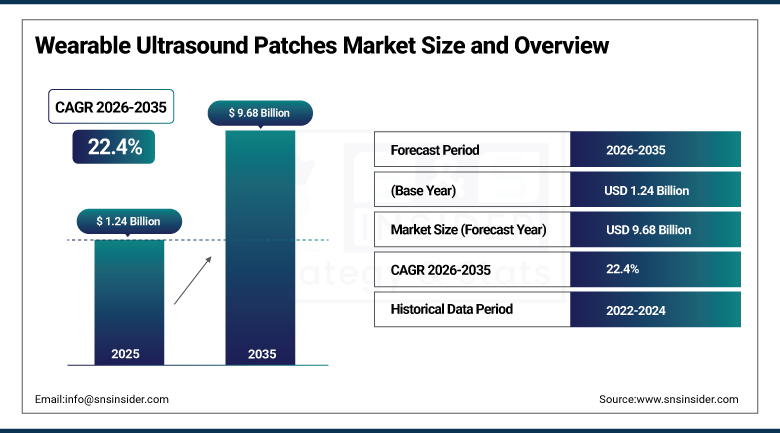
The Wearable Ultrasound Patches Market was valued at USD 1.24 Billion in 2025 and is projected to reach USD 9.68 Billion by 2035, registering a CAGR of 22.4% from 2026 to 2035.
The global wearable ultrasound patches market growth is being driven by the rising prevalence of cardiovascular, urological, and high-risk obstetric conditions that require frequent physiological assessment beyond what conventional cart-based ultrasound can practically deliver on a continuous basis. Expanding remote patient monitoring infrastructure, ongoing miniaturization of piezoelectric and micromachined transducer arrays, and growing clinical validation of wearable diagnostic accuracy are collectively accelerating adoption across critical care, home healthcare, and maternal health settings. Further momentum is coming from expedited regulatory pathways for breakthrough diagnostic devices and rising use of artificial intelligence for automated image interpretation, which is reducing dependence on trained sonographers and widening the addressable clinical population.
In 2026, Flosonics Medical expanded deployment of FloPatch, its wireless Doppler ultrasound patch worn on the neck to track blood-flow velocity, into additional intensive care units across the U.S. East Coast, giving critical-care teams a bedside indicator of whether a patient is likely to benefit from further intravenous fluid administration.
To Get more information On Wearable Ultrasound Patches Market - Request Free Sample Report
Wearable Ultrasound Patches Market Trends
-
Growing convergence of wearable ultrasound patches with AI-powered image interpretation continues reducing dependency on trained sonographers.
-
Rising adoption of CMUT and PMUT transducer arrays continues enabling thinner, more flexible, and lower-power patch form factors.
-
Expanding FDA breakthrough device designations continue compressing regulatory timelines for continuous point-of-care imaging platforms.
-
Increasing integration of wearable patches into remote patient monitoring platforms continues extending hemodynamic and fetal monitoring into home-care settings.
-
Rapid growth in cloud-connected, subscription-based diagnostic software continues creating recurring revenue streams alongside hardware sales.
U.S. Wearable Ultrasound Patches Market Outlook
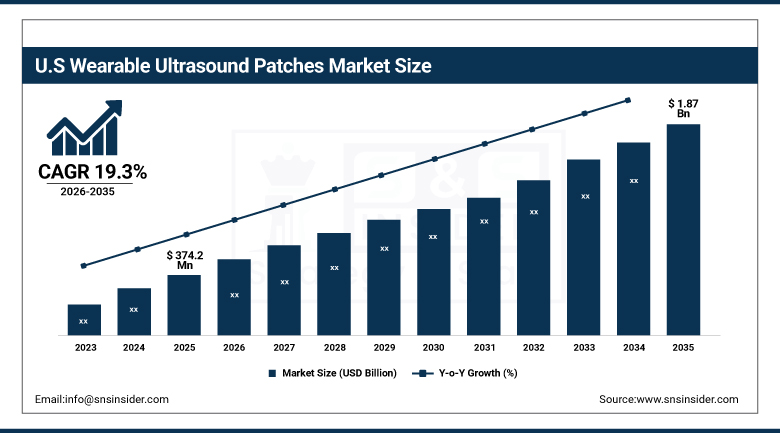
The U.S. Wearable Ultrasound Patches Market was valued at approximately USD 374.2 Million in 2025 and is projected to reach approximately USD 1.87 Billion by 2035, registering a CAGR of approximately 19.3% from 2026 to 2035.
Wireless Doppler and diagnostic patches for intensive care fluid management are widely adopted in hospitals in the early stages and have continued to be adopted due to high clustering of medical device innovations, research institutions, and manufacturing companies in the US. Increasing pilot reimbursement schemes from various payers are helping reduce the previous uncertainties associated with billing that used to hinder widespread adoption. Increased adoption of the ultrasound patches in physical therapy, prenatal diagnostics, and recovery settings is another area that is increasing demand for wearable ultrasound patches from their original application in intensive care, making the US the largest and most mature market for the same globally.
In 2026, Butterfly Network advanced its Compass wearable patch through the FDA's Breakthrough Device Program, pairing the company's Ultrasound-on-Chip semiconductor with a soft, adhesive housing designed to enable continuous tracking of cardiac and pulmonary activity beyond the brief window of a single handheld scan.
Wearable Ultrasound Patches Market Segment Analysis
-
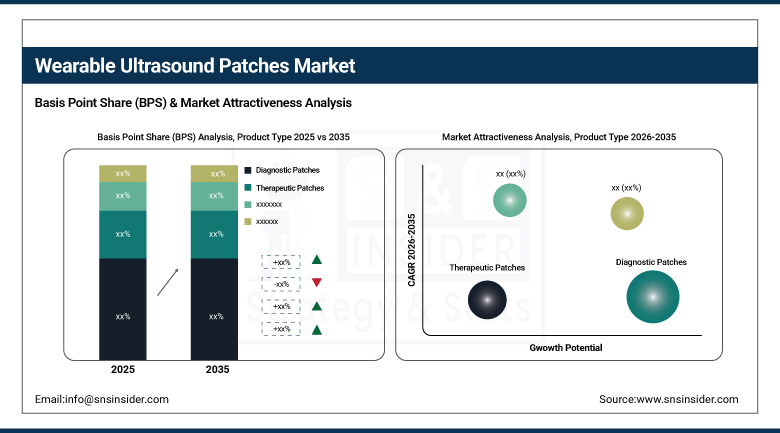
By Product Type, Diagnostic Patches segment dominated the market in 2025 with 44% share; Monitoring Patches segment is the fastest growing segment, registering a CAGR of 24.1% from 2026 to 2035.
-
By Technology, Piezoelectric segment dominated the market in 2025 with 51% share; CMUT segment is the fastest growing segment, registering a CAGR of 25.0% from 2026 to 2035.
-
By Application, Cardiovascular Monitoring segment dominated the market in 2025 with 32% share; Obstetrics & Fetal Monitoring segment is the fastest growing segment, registering a CAGR of 24.6% from 2026 to 2035.
-
By End-Use, Hospitals & Clinics segment dominated the market in 2025 with 47% share; Home Healthcare segment is the fastest growing segment, registering a CAGR of 24.4% from 2026 to 2035.
By Product Type: Diagnostic Patches Lead, Monitoring Patches Grow Fastest
The Diagnostic Patches segment accounted for the largest revenue share of the Wearable Ultrasound Patches Market in 2025 due to the well-defined clinical workflows for point-of-care Doppler evaluation in intensive care and emergency medicine. Diagnostic patches deliver a quick and direct fluid responsiveness or hemodynamic measurement during a single encounter without the need for additional personnel trained in sonography or mobile carts equipped with ultrasound devices. Clinical validation through peer-reviewed studies that show an accuracy similar to catheter-based methods has led to institutional acceptance for purchasing diagnostic-level wearable patches in surgical, transplant and critical care units.
The Monitoring Patches segment is projected to expand at the fastest rate, driven by rising demand for continuous, longitudinal physiological tracking beyond single-encounter diagnostic checks. The need for more patches that can sense early signs of deterioration of the patient’s fluid or hemodynamic condition is growing due to payers’ greater focus on preventing readmissions, whereas the development of more efficient batteries and miniaturized transducers makes it possible for patches to operate for several days. The patches’ usage is primarily limited to cardiology and urology.
By Technology: Piezoelectric Transducers Dominate, CMUT Advances Fastest
The Piezoelectric segment held the largest technology share, supported by a mature manufacturing base, established supply chains, and decades of clinical validation within conventional ultrasound systems. This established foundation allows manufacturers to achieve lower per-unit production costs and faster regulatory submissions relative to emerging transducer technologies, which remains a significant advantage for companies bringing new diagnostic wearables to market. Established medical device manufacturers have continued to invest in refining piezoelectric array miniaturization, reinforcing the technology's position as the default choice for FDA-cleared wearable ultrasound patches.
The Capacitive Micromachined Ultrasonic Transducers (CMUT) segment is currently witnessing rapid growth because of the reduced power consumption and flexible high density transducers that are not easily realizable by piezoelectric material. This makes them ideal for applications in which energy efficiency is important, such as skin patches. Research organizations and startup firms are currently turning to CMUT and PMUT technology for future generations of ultrasonic devices. There are increasing partnerships between these organizations and semiconductor foundries to enable production of prototypes into full-fledged devices.
By Application: Cardiovascular Monitoring Leads, Obstetrics & Fetal Monitoring Grows Fastest
The Cardiovascular Monitoring segment led the market by application, driven by widespread clinical use of wireless Doppler patches for hemodynamic assessment and fluid-responsiveness testing in critical-care settings. These devices allow clinicians to guide fluid-resuscitation and vasopressor decisions without reliance on invasive catheter-based monitoring, reducing procedural risk while accelerating time to clinical decision. Growing evidence linking patch-guided fluid management to improved patient outcomes and shorter intensive-care stays has continued to reinforce health-system investment in this application area.
The Obstetrics & Fetal Monitoring segment is experiencing the fastest growth, owing to the increasing requirement for home-based monitoring of the fetal heart rate among high-risk pregnancies. Maternal telehealth services that are growing in number are gradually adding wearables to their prenatal care offerings, along with increasing clinical validation of the home-based fetal monitors when compared to reference hospital-based monitors, thereby allowing physicians to prescribe such monitors beyond only high-risk cases. Further miniaturization of the device and its connectivity to smartphones is helping in this regard.
By End-Use: Hospitals & Clinics Dominate, Home Healthcare Expands Fastest
The Hospitals & Clinics segment accounted for the largest end-use share, reflecting concentrated procurement budgets and established clinical demand for continuous bedside monitoring within intensive care and emergency medicine. Wearable ultrasound patches allow institutions to obtain repeatable hemodynamic data without diverting sonography resources or cart-based equipment from other clinical priorities. Expanding hospital contracting through group purchasing organizations has continued to simplify procurement, reinforcing institutional demand as the leading end-use category.
The Home Healthcare segment is the fastest-growing end-user segment owing to increasing shifts from hospital-based treatment to home-care treatment and growing chronic diseases amongst the elderly. Wearable ultrasound technology is becoming a common addition to remote patient monitoring systems in order for physicians to keep track of fluid levels, urine level, and cardiovascular functions even remotely. Reimbursement for telehealth is expected to continue expanding the use of wearable ultrasound technology in patient discharge care.
Regional Analysis
|
Region |
Major Country |
Share within Region, 2025 (%) |
|
North America |
United States |
82.10% |
|
Europe |
Germany |
22.80% |
|
Asia Pacific |
China |
33.40% |
|
Middle East and Africa |
UAE |
25.10% |
|
Latin America |
Brazil |
33.75% |
North America Wearable Ultrasound Patches Market Insights
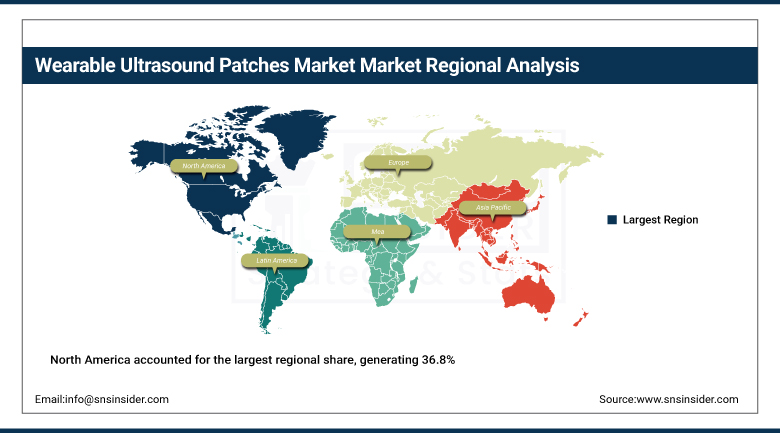
North America accounted for the largest regional share, generating 36.8% of global wearable ultrasound patch revenue in 2025. This leadership position reflects a strong concentration of device innovators headquartered across the region, spanning ICU-focused hemodynamic monitoring platforms to emerging breast-screening wearables, most of which commercialize domestically before expanding internationally. Sustained venture capital investment in medical wearables has continued to support product development pipelines, while favorable FDA breakthrough device pathways have shortened time-to-market for several regional manufacturers.
The United States represented major share of North American revenue, owing to intensive contract agreements between hospitals for ICU wearable ultrasound technology and a high prevalence of venture backed medical devices developers carrying out product testing within the country. The contribution from Canada was slightly lower but growing through collaborations between academic hospitals and early-stage pilot studies, hence cementing North America as the largest addressable market for wearable ultrasound patches.
Get Customized Report as per Your Business Requirement - Enquiry Now
Europe Wearable Ultrasound Patches Market Insights
Europe held a meaningful share of global revenue, supported by expanding national health-service pilot programs evaluating wearable diagnostic technologies across public hospital networks. Regulatory alignment under the EU Medical Device Regulation has continued to streamline market entry, allowing device manufacturers that secure a single approval to commercialize across multiple member states without repeating country-specific regulatory processes.
Germany accounted for major share of European revenue, owing to the country’s presence of a good academic background for medical research, and the digitization of clinical processes. Demand from the UK and France added up to it, and future investments on remote patient monitoring system infrastructure in the region will fuel market growth during the forecast period.
Asia Pacific Wearable Ultrasound Patches Market Insights
Asia Pacific is projected to register the fastest regional growth, with a CAGR of 25.6% from 2026 to 2035. This expansion is being driven by rising government investment in primary-care screening initiatives aimed at underserved rural populations, combined with the region's established manufacturing capability for transducer and patch component production at scale and comparatively lower cost.
China represented the largest share of regional revenue, owing to the large government support for developing the point-of-care diagnostics facilities in the underdeveloped regions. The large rural population of India, where most people do not have easy access to regular ultrasound machines, is a long runway for the adoption of this technology. Japan is a well-established producer of sensors and semiconductors for ultrasound transducers.
MEA and Latin America Wearable Ultrasound Patches Market Insights
The Middle East and Africa and Latin America together represent a comparatively smaller share of global revenue, though growth across both regions has remained consistent, supported by national digital health strategies and sustained demand for cost-effective diagnostic solutions in areas with limited access to conventional ultrasound infrastructure. Wearable ultrasound patches are increasingly viewed as a practical means of extending diagnostic imaging capability to populations historically underserved by cart-based systems.
The UAE led demand within Middle East and Africa, supported by a well-capitalized private healthcare sector and government-backed digital health adoption programs. Saudi Arabia contributed further regional demand through its own healthcare modernization initiatives. Brazil accounted for the largest share within Latin America, where maternal health and cardiovascular screening requirements have provided wearable ultrasound patches a clear entry point across both public and private healthcare systems.
Market Dynamics
Growth Drivers: Continuous Monitoring Needs and the Shift Toward Remote Care
Growth is being driven by the rising prevalence of cardiovascular, urological, and high-risk obstetric conditions that require monitoring more frequently than conventional point-in-time ultrasound can practically support. Expanding remote patient monitoring infrastructure has matured to the point where wearable ultrasound data can be integrated directly into clinician-facing platforms, while continued improvements in transducer size and power efficiency are extending usable wear time from minutes to multiple days, broadening the scope of clinically viable use cases.
AI-assisted interpretation is emerging as an equally significant driver, enabling clinicians and, increasingly, patients themselves to obtain actionable diagnostic read-outs without requiring specialized sonography training. Regulatory bodies have responded to this shift by expanding access to breakthrough device pathways, allowing a growing share of wearable ultrasound platforms to move through expedited review relative to the multi-year timelines historically associated with conventional imaging equipment, meaningfully compressing time-to-market for new entrants.
Restraints: Development Costs and Reimbursement Gaps
Bringing a wearable ultrasound patch from prototype to a cleared, commercially viable product requires substantial capital investment across clinical validation, transducer miniaturization engineering, and regulatory submission. This cost structure is manageable for established device manufacturers with existing revenue streams but represents a meaningful barrier for smaller manufacturers funding multi-year development cycles ahead of first commercial revenue, contributing to market concentration among a limited number of well-capitalized companies.
Inconsistent reimbursement coverage represents a further restraint, as many insurers and public health systems have yet to establish clear billing codes for continuous wearable ultrasound monitoring. This ambiguity leaves healthcare providers uncertain about reimbursement eligibility and leaves patients uncertain about coverage for home-use devices. Until reimbursement frameworks are more broadly standardized, this uncertainty is expected to continue moderating the pace of procurement decisions relative to established, already-reimbursed diagnostic modalities.
Opportunities: Home-Based Diagnostics and Underserved Markets
Home-based monitoring represents a substantial growth opportunity, spanning fetal heart-rate tracking for high-risk pregnancies, fluid-status assessment for heart failure patients, and post-surgical bladder monitoring, applications that currently require clinic visits but do not inherently require in-person supervision. Manufacturers developing patches designed specifically for unsupervised patient use, rather than scaled-down versions of hospital-grade devices, are well positioned to capture this opportunity as adoption extends beyond current pilot-stage deployments into standard clinical practice.
A further opportunity exists within markets that never developed extensive conventional ultrasound infrastructure or sonography workforce capacity. Rather than replicating that infrastructure at significant cost, several governments are evaluating wearable ultrasound patches as a means of extending basic diagnostic imaging directly to rural clinics and community health workers. Manufacturers capable of delivering reliable, cost-effective devices suited to this setting stand to capture meaningful, currently underserved demand across these markets.
Recent Developments:
-
2026: Exo Imaging advanced its AI-enabled handheld ultrasound platform, combining semiconductor-based imaging and software tools to support compact point-of-care diagnostics and the broader miniaturization of ultrasound technology.
-
2026: Clarius expanded its wireless ultrasound portfolio and AI-enabled imaging capabilities, enabling real-time point-of-care examinations through smartphone-connected probes and supporting increasingly compact, cable-free ultrasound workflows.
-
2025: iSono Health continued expanding clinical validation of its ATUSA automated wearable ultrasound patch for breast tissue screening, targeting broader deployment across community imaging centers.
Wearable Ultrasound Patches Market key players are:
-
Butterfly Network, Inc.
-
Flosonics Medical
-
Exo Imaging, Inc.
-
Clarius Mobile Health Corp.
-
GE HealthCare Technologies Inc.
-
Koninklijke Philips N.V.
-
Siemens Healthineers AG
-
Canon Medical Systems Corporation
-
FUJIFILM Sonosite, Inc.
-
Mindray Medical International Limited
-
Samsung Medison Co., Ltd.
-
Konica Minolta, Inc.
-
Chison Medical Technologies Co., Ltd.
-
EchoNous, Inc.
-
iSono Health, Inc.
-
Onera Health B.V.
-
Vave Health, Inc.
-
Nuvo Group Ltd.
-
Sonic Incytes Medical Corp.
-
PulseNmore Ltd.
Wearable Ultrasound Patches Market Report Scope:
| Report Attributes | Details |
| Market Size in 2025 | USD 1.24 Billion |
| Market Size by 2035 | USD 9.68 Billion |
| CAGR | CAGR of 22.4% From 2026 to 2035 |
| Base Year | 2025 |
| Forecast Period | 2026-2035 |
| Historical Data | 2022-2024 |
| Report Scope & Coverage | Market Size, Segments Analysis, Competitive Landscape, Regional Analysis, DROC & SWOT Analysis, Forecast Outlook |
| Key Segments | • By Product Type (Diagnostic Patches, Therapeutic Patches, Monitoring Patches) • By Technology (Piezoelectric, Capacitive Micromachined Ultrasonic Transducers (CMUT), Piezoelectric Micromachined Ultrasonic Transducers (PMUT)) • By Application (Cardiovascular Monitoring, Bladder & Urology Monitoring, Musculoskeletal & Sports Medicine, Obstetrics & Fetal Monitoring, Oncology, Others) • By End-Use (Hospitals & Clinics, Home Healthcare, Ambulatory Surgical Centers, Sports & Fitness Centers) |
| Regional Analysis/Coverage | North America (US, Canada), Europe (Germany, UK, France, Italy, Spain, Russia, Poland, Rest of Europe), Asia Pacific (China, India, Japan, South Korea, Australia, ASEAN Countries, Rest of Asia Pacific), Middle East & Africa (UAE, Saudi Arabia, Qatar, South Africa, Rest of Middle East & Africa), Latin America (Brazil, Argentina, Mexico, Colombia, Rest of Latin America). |
| Company Profiles | Butterfly Network, Inc., Flosonics Medical, Exo Imaging, Inc., Clarius Mobile Health Corp., GE HealthCare Technologies Inc., Koninklijke Philips N.V., Siemens Healthineers AG, Canon Medical Systems Corporation, FUJIFILM Sonosite, Inc., Mindray Medical International Limited, Samsung Medison Co., Ltd., Konica Minolta, Inc., Chison Medical Technologies Co., Ltd., EchoNous, Inc., iSono Health, Inc., Onera Health B.V., Vave Health, Inc., Nuvo Group Ltd., Sonic Incytes Medical Corp., PulseNmore Ltd. |

Frequently Asked Questions
Key players include Butterfly Network, Inc., Flosonics Medical, Exo Imaging, Inc., Clarius Mobile Health Corp., and GE HealthCare Technologies Inc., among others.
Key opportunities include growing demand for continuous monitoring, advances in flexible ultrasound technology, expanding point-of-care applications, remote patient monitoring adoption, and increasing use in chronic disease management.
The major growth factor is rising demand for continuous, non-invasive diagnostic monitoring, expansion of remote patient monitoring programs, and increasing miniaturization of wearable transducer technology.
The Diagnostic Patches segment dominated the Wearable Ultrasound Patches Market by product type, representing the largest share of revenue in 2025.
North America dominated the Wearable Ultrasound Patches Market in 2025, holding an estimated 36.8% share of total global market revenue.
