
Wi-SUN Technology Market Report Scope & Overview:
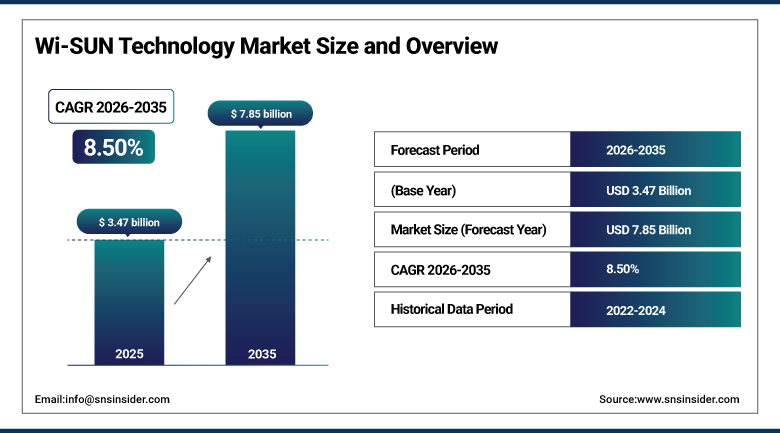
The Wi-SUN Technology Market was valued at USD 3.47 Billion in 2025 and is expected to reach USD 7.85 Billion by 2035, growing at a CAGR of 8.50% from 2026–2035.
The Wi-SUN Technology Market is growing owing to an increase in investment in the modernization of smart grids, metering infrastructure, and utility network installations. Increased uptake of Internet of Things-based technologies, the development of smart cities, and the need for wireless communication networks that are secure, scalable, and interoperable are contributing to the expansion of the market. The utilities are adopting the Wi-SUN technology to ensure improved reliability of the grid, provide real-time monitoring, and optimize energy transmission. Moreover, government backing for digital infrastructures, use of connected streetlights, and water management systems are boosting the market.
Wi-SUN technology deployment exceeded 1.2 million nodes in 2025, driven by smart grid modernization, AMI rollouts, and the broader expansion of IoT-enabled utility networks. That kind of node count reflects just how embedded this networking standard has become in day-to-day utility operations across multiple continents.
Market Size and Forecast:
-
Market Size in 2026E: USD 3.77 Billion
-
Market Size by 2035: USD 7.85 Billion
-
CAGR: 8.50% from 2026 to 2035
-
Fastest Growing Region: Asia Pacific
-
Largest Region: North America
To Get more information Wi-SUN Technology Market - Request Free Sample Report
Wi-SUN Technology Market Trends:
-
Smart grid modernization initiatives worldwide continue driving broader adoption of Wi-SUN communication solutions among utility providers.
-
Rising deployment of advanced metering infrastructure keeps increasing demand for reliable field, neighborhood, and home area networks.
-
IoT-enabled utility networks and automated street lighting continue expanding, adding to overall connectivity requirements across municipal infrastructure.
-
Integration with smart city and energy management platforms is improving operational efficiency and enabling genuinely real-time monitoring.
-
Continued advancement in mesh networking, cybersecurity, and low-power wide-area communication keeps improving network scalability and reliability.
U.S. Wi-SUN Technology Market Outlook:
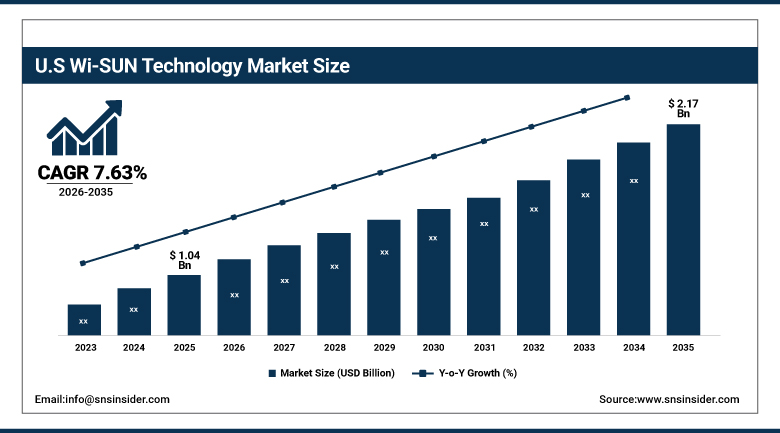
The U.S. Wi-SUN Technology Market was valued at approximately USD 1.04 Billion in 2025 and is expected to reach approximately USD 2.17 Billion by 2035, growing at a CAGR of approximately 7.63%.
Growth in the U.S. market is being driven by large-scale smart grid modernization, expanding advanced metering infrastructure deployment, and smart city initiatives that keep gaining momentum across the country. Rising adoption of secure IoT-based utility communication networks, alongside growing deployment of distribution automation and IoT-enabled street lighting, continues reinforcing the U.S. as the leading Wi-SUN market within North America specifically.
In March 2025, Cisco launched its Industrial Router series certified for Wi-SUN FAN 1.1, enhancing low-power, high-throughput connectivity for smart grids and smart cities and enabling resilient, interoperable communication across utility and IoT networks. The certification reflects growing industry standardization around Wi-SUN's newer FAN protocol as utilities look for equipment that can genuinely interoperate across vendors.
Wi-SUN Technology Market Segment Analysis:
-
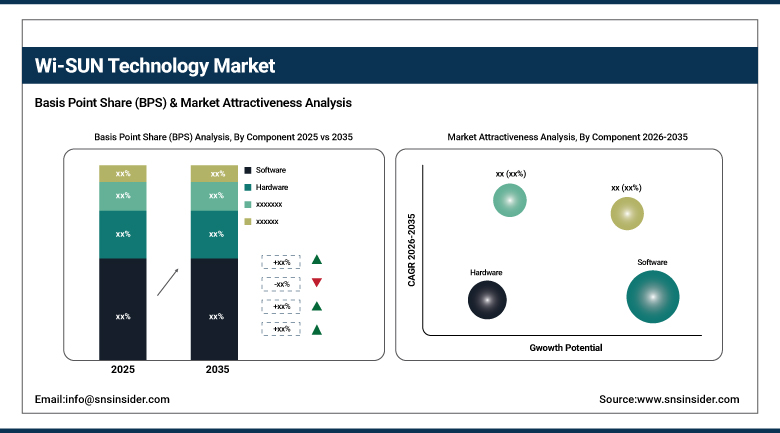
By Component, Software segment dominated the Wi-SUN Technology Market in 2025 with 42% share; Services segment is the fastest growing segment.
-
By Network Type, Field Area Network (FAN) segment dominated the market in 2025 with 48% share; Neighborhood Area Network (NAN) segment is the fastest growing segment.
-
By Application, Advanced Metering Infrastructure (AMI) segment dominated the market in 2025 with 45% share; Distribution Automation segment is the fastest growing segment.
-
By End User, Electric Utilities segment dominated the market in 2025 with 52% share; Smart Cities segment is the fastest growing segment.
By Component, Software segment dominates the Wi-SUN Technology Market, Services segment expected to grow fastest
The Software segment dominated the Wi-SUN Technology Market in 2025 owing to rising demands for network management, security, data analytics, and device management solutions. Software plays a crucial role in providing the ability to communicate, connect, and operate effectively. Advanced software solutions have been increasingly adopted by utilities and smart infrastructures to enable management of the connected devices and performance of the Wi-SUN network. Increasing adoption of IoT applications and smart infrastructure is driving demand for Wi-SUN software solutions.
The Services segment is the fastest growing due to increasing demands for services such as installation, integration, consultation, maintenance, and technical support. Organizational deployment of Wi-SUN technology at a large scale requires skilled professionals who can help in configuring the network, connecting the devices, and optimizing performance of the network. Increasing adoption of smart grids, smart cities, and IoT applications is leading to higher demand for professional services.
By Network Type, Field Area Network (FAN) segment dominates the Wi-SUN Technology Market, Neighborhood Area Network (NAN) segment expected to grow fastest
The Field Area Network (FAN) segment dominated the Wi-SUN Technology Market in 2025 because of the high deployment of FAN technology in utility communications networks, especially smart grid and field device connections. FAN technology allows for effective, secure, and long-distance communication between various utility assets like smart meters, distribution equipment, and sensors. Modernization of electricity grids, requirement for real-time monitoring, and the usage of advanced metering infrastructure are some of the factors that are boosting the demand for FAN based Wi-SUN technology.
The Neighborhood Area Network (NAN) segment is the fastest growing because of the rising deployment of smart meters, connected devices, and localized IoT networks in residential and urban areas. The Neighborhood Area Network enables effective communication among multiple smart devices in specific geographic locations. Smart city initiatives and increased demand for urban connectivity and IoT solutions are driving the market for this technology.
By Application, Advanced Metering Infrastructure (AMI) segment dominates the Wi-SUN Technology Market, Distribution Automation segment expected to grow fastest
The Advanced Metering Infrastructure (AMI) segment dominated the Wi-SUN Technology Market in 2025 due to increasing installation of smart meters and modernization of the utilities network in 2025. Wi-SUN technology ensures the connectivity needed in the transmission of real-time energy consumption data reliably and securely. AMI systems have been adopted by utilities in order to ensure grid efficiency, facilitate remote monitoring of power systems, decrease operational costs, and manage demand management. Increasing investments in smart grid technologies and energy efficiency have further promoted the adoption of AMI systems.
The Distribution Automation segment is the fastest growing due to increasing requirement for efficient distribution of electricity, real-time fault detection, and grid reliability. Wi-SUN-based distribution automation systems have been adopted by utilities for the purpose of monitoring the distribution network, optimizing power flow, and reducing the downtime associated with outages. Increasing adoption of renewable sources of energy and the complexities associated with power grids have further enhanced the adoption of distribution automation technologies.
By End User, Electric Utilities segment dominates the Wi-SUN Technology Market, Smart Cities segment expected to grow fastest
The Electric Utilities segment dominated the Wi-SUN Technology Market in 2025 because of the increase in the investments made towards the modernization of the smart grid, advanced metering infrastructure, and reliable communications network. Adoption of Wi-SUN technology by utilities companies will help in grid monitoring, improving efficiency, and exchange of real-time data. The reduction of power losses, better energy management, and integration of renewable energy are some of the factors that drive adoption by the electricity provider.
The Smart Cities segment is the fastest growing because of the increase in the number of government initiatives regarding urban digitalization and efficient utilization of resources. Wi-SUN technology will help in applications related to smart cities such as intelligent lighting, environmental monitoring, smart parking, and public services connectivity. Urbanization, demand for sustainable infrastructure, and growth in Internet of Things (IoT) based solutions in the municipal environment are the factors driving the adoption.
Regional Analysis:
|
Region |
Major Country |
Share within Region, 2025 (%) |
|---|---|---|
|
North America |
United States |
82.33% |
|
Europe |
Germany |
25.23% |
|
Asia Pacific |
China |
37.56% |
|
Latin America |
Brazil |
36.38% |
|
Middle East & Africa |
Saudi Arabia |
26.67% |
North America Wi-SUN Technology Market Insights
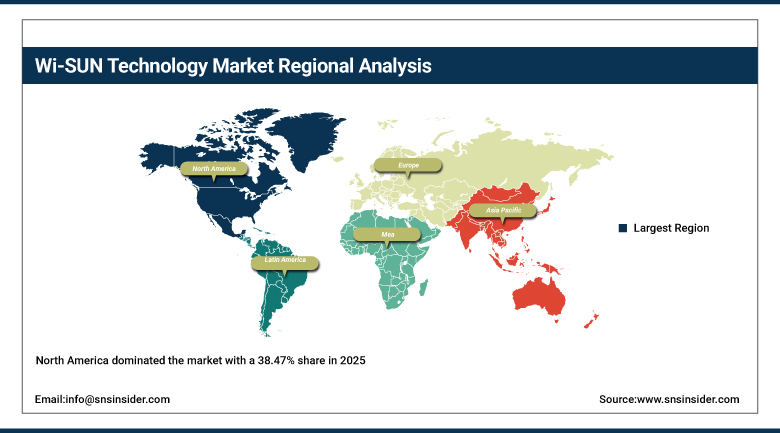
North America dominated the market with a 38.47% share in 2025, driven by strong adoption across the U.S. and Canada. Large-scale smart grid modernization, advanced metering infrastructure deployment, and smart city initiatives continue fueling regional growth, with electric utilities and municipalities increasingly investing in reliable, secure communication networks for energy management and street lighting automation.
Continuous technological advancement, supportive regulatory frameworks, and high IoT penetration further strengthen North America's position as a mature and genuinely attractive Wi-SUN market. That combination of infrastructure investment and regulatory clarity looks likely to keep the region at the top for the foreseeable future.
Get Customized Report as per Your Business Requirement - Enquiry Now
Europe Wi-SUN Technology Market Insights
Europe's Wi-SUN technology market is driven by rising investment in smart grid modernization, smart city development, and energy efficiency initiatives. Germany, France, and the UK are shaping regional demand through widespread deployment of advanced metering infrastructure, distribution automation, and IoT-enabled utility networks.
Expansion of intelligent street lighting projects, renewable energy integration, and regulatory support for digital utilities continue boosting adoption across the region. Germany specifically leads the European market, supported by advanced smart grid initiatives and strong regulatory focus on energy efficiency and digitalization.
Asia Pacific Wi-SUN Technology Market Insights
Asia Pacific is the fastest-growing region, projected to expand at a CAGR of about 9.59% through the forecast period. Rapid urbanization, expanding smart grid investment, and large-scale smart city initiatives across China, India, Japan, and Australia continue driving this growth, with increasing deployment of AMI, IoT-enabled utility networks, and intelligent street lighting all accelerating adoption.
Strong government support, rising energy efficiency mandates, and expanding utility digitization programs continue reinforcing Asia Pacific's dynamic growth trajectory. China in particular is emerging as a key regional contributor, supported by rapid urbanization and strong smart city initiatives.
MEA & Latin America Wi-SUN Technology Market Insights
The Latin America Wi-SUN technology market is growing on the back of increasing smart grid investment and expanding smart city initiatives, supported by rising deployment of advanced metering infrastructure and utility digitization across Brazil, Mexico, and Argentina. Government-backed infrastructure modernization programs continue driving regional market growth.
The Middle East and Africa Wi-SUN market is expanding as well, driven by rising smart grid investment, smart city programs, and utility infrastructure modernization. Increasing adoption of AMI and IoT-enabled utility networks is driving demand, with Saudi Arabia, the UAE, and South Africa emerging as key regional markets.
Market Dynamics:
Growth Drivers: Smart grid modernization and IoT utility networks fuel strong demand
Smart grid modernization and advancements in IoT-based utility networks have driven the growth of this market. Utility companies and municipalities are adopting state-of-the-art communication solutions for reliable grid performance, automation of streetlights, and efficient energy management systems. AMI and HAN, FAN, and NAN networks are being increasingly deployed and each one needs effective and reliable connectivity. The constant improvements in mesh networking, low power communications, and security make the networks more efficient.
Wi-SUN communication technologies were implemented in over 48% of smart grid and IoT utility networks by 2025 in order to improve connectivity and efficiency despite being a comparatively new technology.
Restraints: High deployment costs and interoperability challenges restrain adoption
Deployment costs and interoperability issues are legitimate constraints to the growth of this market. Budget constraints and lack of resources are common problems with small and medium-sized utilities, which prevent the implementation of more sophisticated FAN, NAN, and HAN technology, while integrating Wi-SUN products with the current smart grid technologies can be complicated.
There is a need for considerable investment to ensure reliable network performance, which some utilities do not have the capacity or the required expertise to meet. All these act as barriers to market penetration amid increasing demand for smart utility communications, especially for small utilities that lack the technical experts like bigger firms.
Opportunities: IoT-enabled utility adoption and smart grid modernization unlock new growth
The growing popularity of IoT-enabled utilities and smart grids provides an excellent growth potential for the Wi-SUN market segment. There is increasing demand among utility operators and cities for innovative and robust communication systems to improve energy management, lighting, and AMI implementations, and firms offering Wi-SUN solutions will likely take advantage of that.
Innovations in the field of mesh and low-power communications along with integration within the smart city frameworks are leading to larger implementation of Wi-SUN within the energy, water, and municipal infrastructures. Advanced Wi-SUN communications were used in 27% of all the smart grid and IoT utility projects implemented in 2025, a percentage that is constantly growing due to innovations in the network modernization.
Recent Developments:
-
2025: In March 2025, Cisco launched its Industrial Router series certified for Wi-SUN FAN 1.1, enhancing low-power, high-throughput connectivity for smart grids and smart cities and enabling resilient, interoperable communication across utility and IoT networks.
-
2025: In April 2025, Toshiba launched the RemotEye 5 IIoT network card, supporting real-time monitoring, predictive analytics, and Ethernet-based connectivity for industrial and utility networks, strengthening smart system and connected infrastructure deployment.
-
2025: In August 2025, Texas Instruments introduced its Certified Wi-SUN portfolio, including the CC1352P7 and SimpleLink software stacks, enabling developers to deploy low-power, high-node-count mesh networks for smart grids, utilities, and IoT infrastructure with improved interoperability.
Wi-SUN Technology Market Key Players:
-
Cisco Systems Inc.
-
Texas Instruments Incorporated
-
Toshiba Corporation
-
Renesas Electronics Corporation
-
Omron Corporation
-
Itron Inc.
-
Landis+Gyr
-
Trilliant Holdings Inc.
-
Rohm Semiconductor Co.
-
Analog Devices, Inc.
-
Murata Manufacturing Co., Ltd.
-
Fuji Electric Co., Ltd.
-
Osaki Electric Co., Ltd.
-
Vertexcom Technologies
-
TÜV Rheinland
-
Silicon Labs
-
NXP Semiconductors
-
Microchip Technology
-
STMicroelectronics
-
Infineon Technologies
Wi-SUN Technology Market Report Scope:
| Report Attributes | Details |
|---|---|
| Market Size in 2025 | USD 3.47 Billion |
| Market Size by 2035 | USD 7.85 Billion |
| CAGR | CAGR of 8.50% From 2026 to 2035 |
| Base Year | 2025 |
| Forecast Period | 2026-2035 |
| Historical Data | 2022-2024 |
| Report Scope & Coverage | Market Size, Segments Analysis, Competitive Landscape, Regional Analysis, DROC & SWOT Analysis, Forecast Outlook |
| Key Segments | • By Component (Hardware, Software, Services) • By Network Type (Field Area Network (FAN), Neighborhood Area Network (NAN), Home Area Network (HAN)) • By Application (Advanced Metering Infrastructure (AMI), Smart Grid Communication, Distribution Automation, Street Lighting, Others) • By End-User (Electric Utilities, Gas Utilities, Water Utilities, Smart Cities, Others) |
| Regional Analysis/Coverage | North America (US, Canada), Europe (Germany, UK, France, Italy, Spain, Russia, Poland, Rest of Europe), Asia Pacific (China, India, Japan, South Korea, Australia, ASEAN Countries, Rest of Asia Pacific), Middle East & Africa (UAE, Saudi Arabia, Qatar, South Africa, Rest of Middle East & Africa), Latin America (Brazil, Argentina, Mexico, Colombia, Rest of Latin America). |
| Company Profiles | Cisco Systems Inc., Texas Instruments Incorporated, Toshiba Corporation, Renesas Electronics Corporation, Omron Corporation, Itron Inc., Landis+Gyr, Trilliant Holdings Inc., Rohm Semiconductor Co., Analog Devices, Inc., Murata Manufacturing Co., Ltd., Fuji Electric Co., Ltd., Osaki Electric Co., Ltd., Vertexcom Technologies, TÜV Rheinland, Silicon Labs, NXP Semiconductors, Microchip Technology, STMicroelectronics, Infineon Technologies |

Frequently Asked Questions
The Wi-SUN Technology Market was valued at USD 3.47 Billion in 2025.
Growth is driven by smart grid modernization, IoT-enabled utility networks, advanced metering infrastructure, street lighting automation, and smart city initiatives.
Software segment dominated the Wi-SUN Technology Market.
Hardware dominated with a 44.38% share in 2025, while Software is projected to grow at the fastest CAGR of 9.45% during 2026–2033.
North America dominated with a 38.47% share in 2025, while Asia Pacific is the fastest-growing region, expected to expand at a CAGR of about 9.59%.
