
WiGig Market Report Scope & Overview:
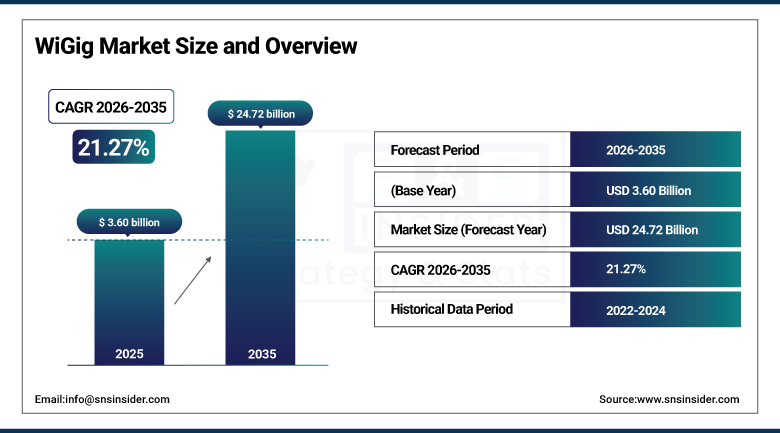
The WiGig Market size was valued at USD 3.60 billion in 2025 and is expected to reach USD 24.72 billion by 2035, growing at a CAGR of 21.27% from 2026–2035.
Growth in the global WiGig (Wireless Gigabit) Market is driven by the increasing demand for ultra-high-speed wireless connectivity, growing adoption of bandwidth-intensive applications, and rising deployment of wireless communication technologies across consumer and enterprise environments. Businesses and consumers are increasingly adopting WiGig-enabled devices to support high-speed data transfer, wireless docking, low-latency video streaming, and immersive AR/VR experiences. Furthermore, advancements in 60 GHz wireless technology, integration with Wi-Fi 6 and Wi-Fi 7 ecosystems, and continuous innovations in semiconductor and networking solutions are enhancing WiGig performance, reliability, and scalability. The growing preference for cable-free connectivity, smart devices, and next-generation wireless infrastructure is further accelerating market growth by enabling seamless, secure, and high-capacity communication across multiple connected devices.
In 2025, Qualcomm Technologies, Inc. expanded its WiGig portfolio by introducing advanced 60 GHz wireless connectivity solutions designed to deliver ultra-high-speed data transfer, low-latency communication, and enhanced wireless docking capabilities. The latest innovations leverage next-generation WiGig technology to improve AR/VR experiences, 4K/8K video streaming, and enterprise networking, enabling faster, more reliable cable-free connectivity across consumer and commercial devices.
To Get more information on WiGig Market - Request Free Sample Report
WiGig Market Trends Highlights
-
Growing adoption of ultra-high-speed wireless connectivity is driving demand for WiGig technology across consumer electronics, enterprise networking, and industrial applications.
-
Increasing integration of WiGig with AR/VR devices, wireless docking stations, and high-resolution display systems is enhancing low-latency communication and seamless user experiences.
-
Rising demand for cable-free connectivity solutions is accelerating the deployment of 60 GHz wireless technology for fast data transfer and multimedia streaming.
-
Expanding advancements in Wi-Fi 6, Wi-Fi 7, and 60 GHz wireless technologies are improving network performance, bandwidth efficiency, and device interoperability.
-
Growing adoption of smart devices, IoT ecosystems, and edge computing is boosting the need for high-speed, short-range wireless communication solutions worldwide.
U.S. Wireless Gigabit Market Size Outlook
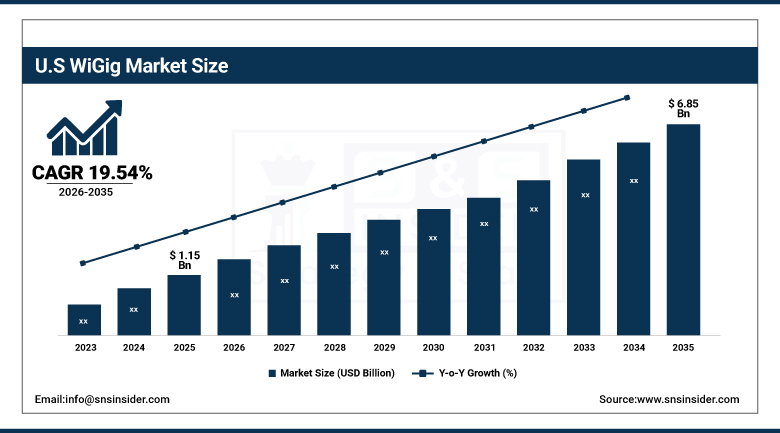
The U.S. Wireless Gigabit Market was valued at USD 1.15 billion in 2025 and is expected to reach around USD 6.85 billion by 2035, growing at a CAGR of 19.54% from 2026–2035.
The U.S. WiGig Market is expanding steadily due to the increasing demand for ultra-high-speed wireless connectivity, rising adoption of bandwidth-intensive applications, and growing deployment of next-generation networking technologies. The increasing use of WiGig-enabled devices for wireless docking, high-speed data transfer, immersive AR/VR experiences, and ultra-high-definition video streaming is driving market growth across both consumer and enterprise sectors. Furthermore, advancements in 60 GHz wireless technology, Wi-Fi 6 and Wi-Fi 7 integration, and semiconductor innovations are enhancing network performance, low-latency communication, and seamless device connectivity. Rising investments in smart infrastructure, enterprise digital transformation, edge computing, and advanced wireless communication solutions are further accelerating the adoption of WiGig technology across the United States.
The company introduced an advanced WiGig solution featuring ultra-high-speed wireless connectivity, low-latency data transmission, and enhanced wireless docking capabilities. The platform delivers multi-gigabit data transfer, seamless 4K/8K video streaming, reliable device-to-device connectivity, and secure high-bandwidth communication, enabling consumers and enterprises to experience faster, cable-free connectivity across multiple WiGig-enabled devices.
WiGig Market Segment Analysis
-
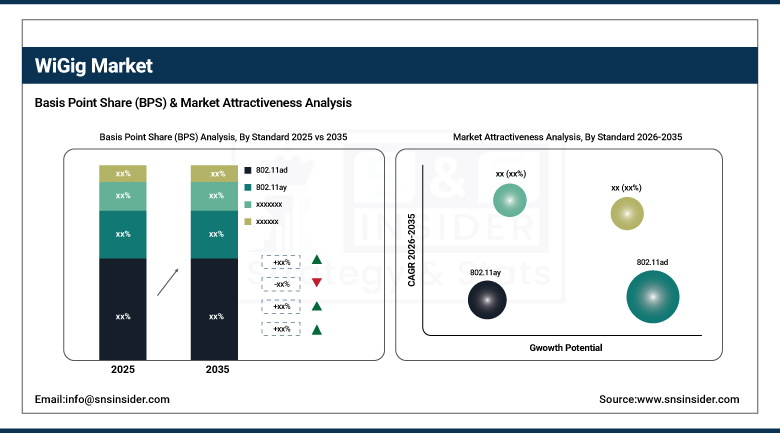
By Standard, 802.11ad dominated the WiGig Market with a 61.35% share in 2025; while 802.11ay is the fastest-growing segment with a CAGR of 25.70% during 2026–2035.
-
By Component, Hardware dominated the WiGig Market with a 68.40% share in 2025; while Software is the fastest-growing segment with a CAGR of 27.00% during 2026–2035.
-
By Technology, Wireless Data Transfer dominated the WiGig Market with a 52.45% share in 2025; while Multi-Gigabit Connectivity is the fastest-growing segment with a CAGR of 25.47% during 2026–2035.
-
By End User, Consumer Electronics dominated the WiGig Market with a 35.80% share in 2025; while Automotive is the fastest-growing segment with a CAGR of 21.27% during 2026–2035.
-
By Region, North America dominated the WiGig Market with a 37.80% share in 2025; while Asia-Pacific is the fastest-growing region with a CAGR of 22.60% during 2026–2035.
By Standard, 802.11ad dominated the WiGig Market, while 802.11ay is expected to grow the fastest
The 802.11ad segment held the dominant market share in 2025 due to its widespread commercialization, broad ecosystem support, and extensive deployment across wireless docking stations, high-speed networking equipment, and consumer electronics. Its ability to deliver multi-gigabit wireless connectivity with low latency has driven adoption in enterprise environments, media streaming, and device-to-device communication. Furthermore, the availability of mature chipsets, established infrastructure, and compatibility with existing WiGig-enabled devices continues to strengthen the leadership of the 802.11ad standard globally.
On the other hand, 802.11ay is expected to register the highest growth rate during the forecast period owing to its enhanced throughput, extended communication range, and improved spectrum efficiency over its predecessor. The increasing demand for bandwidth-intensive applications such as AR/VR, 8K video streaming, cloud gaming, and next-generation enterprise networking is accelerating the adoption of 802.11ay technology. In addition, continuous advancements in wireless communication standards and growing investments in high-performance connectivity solutions are expected to further drive the expansion of the 802.11ay segment through 2035.
By Component, Hardware dominated the WiGig Market, while Software is expected to grow the fastest
Hardware accounted for the largest market share in 2025 owing to the widespread deployment of WiGig-enabled chipsets, wireless docking stations, networking equipment, display devices, and communication modules across consumer and enterprise applications. Growing demand for ultra-high-speed wireless connectivity, increasing adoption of AR/VR devices, and expanding use of high-bandwidth multimedia applications have further strengthened the dominance of the hardware segment. Additionally, continuous advancements in 60 GHz wireless technology and semiconductor innovation continue to drive hardware adoption across multiple industries.
Software is expected to witness the highest growth during the forecast period due to the increasing demand for advanced network management, device configuration, security, and connectivity optimization solutions. As enterprises and consumers deploy more WiGig-enabled devices, the need for intelligent software platforms that enable seamless communication, performance monitoring, firmware management, and interoperability is expected to accelerate. The continued integration of AI-driven network optimization, cloud-based management platforms, and next-generation wireless technologies will further propel the software segment through 2035.
By Technology, Wireless Data Transfer dominated the WiGig Market, while Multi-Gigabit Connectivity is expected to grow the fastest
Wireless Data Transfer accounted for the largest market share in 2025 due to its widespread adoption across consumer electronics, enterprise networking, wireless docking stations, and high-speed file transfer applications. The growing demand for cable-free connectivity, low-latency communication, and seamless transmission of large data volumes has strengthened the segment's leadership. Furthermore, increasing deployment of WiGig-enabled devices for ultra-high-definition media streaming, virtual reality, and industrial connectivity continues to support the dominance of the Wireless Data Transfer segment.
Multi-Gigabit Connectivity is expected to witness the highest CAGR during the forecast period owing to the increasing demand for bandwidth-intensive applications, next-generation wireless networks, and advanced enterprise connectivity solutions. The rapid adoption of AR/VR, cloud computing, edge computing, and high-resolution video streaming is driving the need for faster and more reliable wireless communication. Continuous advancements in 60 GHz wireless technologies, Wi-Fi 7 integration, and next-generation networking infrastructure are expected to further accelerate the growth of the Multi-Gigabit Connectivity segment through 2035.
Regional Analysis
|
Region |
Major Country |
Share within Region, 2025(%) |
|---|---|---|
|
North America |
United States |
84.60% |
|
Europe |
Germany |
26.80% |
|
Asia Pacific |
China |
35.20% |
|
Middle East & Africa |
Saudi Arabia |
28.10% |
|
Latin America |
Brazil |
38.60% |
North America WiGig Market Insights.
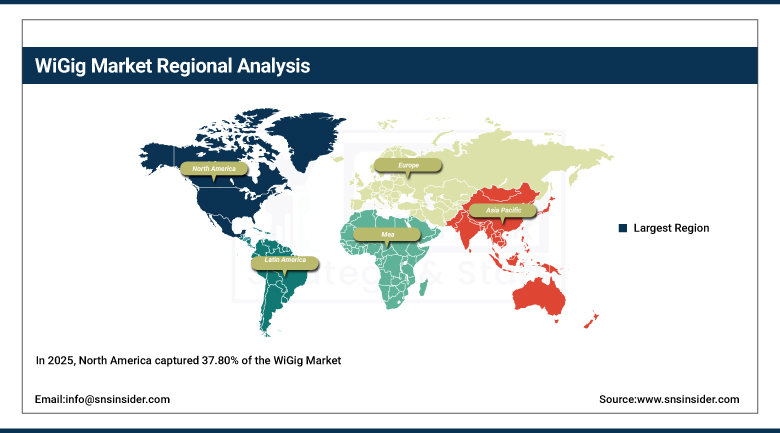
In 2025, North America captured 37.80% of the WiGig Market owing to the widespread adoption of ultra-high-speed wireless communication technologies, strong demand for bandwidth-intensive applications, and the presence of leading semiconductor, networking, and consumer electronics companies. Increasing deployment of WiGig-enabled devices for wireless docking, AR/VR applications, high-definition media streaming, and enterprise networking has further supported regional market growth. In 2025, the United States dominated the region, accounting for 84.60% of the North America WiGig Market due to significant investments in next-generation wireless infrastructure, rapid adoption of advanced connectivity solutions, and the strong presence of key technology companies driving innovation in 60 GHz wireless communication.
Get Customized Report as per Your Business Requirement - Enquiry Now
Europe WiGig Market Insights
Europe continues to be an important market for the WiGig Market owing to the increasing adoption of high-speed wireless communication technologies, growing demand for advanced enterprise networking solutions, and rising deployment of bandwidth-intensive applications across industries. The region is witnessing strong investments in digital infrastructure, industrial automation, and smart manufacturing, which are accelerating the adoption of WiGig-enabled devices and 60 GHz wireless technology. Germany stands out as the frontrunner in the region, holding a share of 26.80% of the European market in 2025 due to its strong semiconductor and automotive industries, widespread adoption of Industry 4.0 technologies, and increasing investments in next-generation wireless connectivity solutions across industrial and commercial applications.
Asia Pacific WiGig Market Insights
The Asia-Pacific region is expected to grow at the highest CAGR of 22.60% during the forecast period due to the rapid expansion of digital infrastructure, increasing deployment of next-generation wireless communication technologies, and growing demand for ultra-high-speed connectivity across consumer and enterprise applications. Rising investments in 5G networks, smart manufacturing, data centers, and consumer electronics are accelerating the adoption of WiGig-enabled devices throughout the region. China accounts for the largest share of the Asia-Pacific market, representing 35.20% of the regional market in 2025, owing to its strong electronics manufacturing ecosystem, expanding semiconductor industry, and increasing adoption of advanced wireless technologies across industrial, commercial, and consumer sectors.
Growing investments in smart cities, industrial automation, AR/VR applications, and high-bandwidth wireless networking, coupled with continuous advancements in 60 GHz communication technologies, are expected to create significant growth opportunities for the WiGig Market across the Asia-Pacific region through 2035.
Middle East & Africa and Latin America WiGig Market Insights
The Middle East & Africa WiGig Market is witnessing steady growth owing to the increasing adoption of advanced wireless communication technologies, rising investments in smart city initiatives, and expanding deployment of high-speed networking infrastructure. Saudi Arabia is the dominant country in the region, holding a 28.10% share of the Middle East & Africa market in 2025, supported by government-led digital transformation initiatives, growing investments in 5G and smart infrastructure, and increasing adoption of next-generation wireless connectivity solutions across commercial and industrial sectors.The WiGig Market in Latin America is experiencing continuous growth owing to rising investments in digital infrastructure, expanding enterprise networking, and increasing demand for high-bandwidth wireless communication technologies. Brazil is the largest contributor to the Latin American WiGig Market, accounting for 38.60% of the regional market in 2025, driven by the growing adoption of advanced networking technologies, increasing deployment of smart devices, and expanding investments in telecommunications and industrial digitalization.
Growth Driver: Rising adoption of ultra-high-speed wireless connectivity and next-generation 60 GHz communication technologies
One of the primary factors driving the growth of the WiGig Market is the increasing demand for ultra-high-speed wireless connectivity and next-generation 60 GHz communication technologies. Enterprises and consumers are increasingly adopting WiGig-enabled solutions to support high-speed data transfer, wireless docking, low-latency communication, and seamless connectivity across laptops, displays, storage devices, and AR/VR systems. With advancements in wireless networking technologies, WiGig is enabling cable-free environments while delivering multi-gigabit performance for bandwidth-intensive applications.
Additionally, the rapid expansion of smart devices, edge computing, enterprise digital transformation, and immersive technologies is accelerating the adoption of WiGig solutions across multiple industries. Continuous investments in semiconductor innovation, Wi-Fi 6 and Wi-Fi 7 integration, and advanced networking infrastructure, along with the growing demand for high-performance wireless communication in consumer electronics, industrial automation, and commercial environments, are further propelling the growth of the WiGig Market.
Restraint: Limited communication range and infrastructure deployment challenges
Limited communication range and the inability of 60 GHz signals to effectively penetrate walls and physical obstructions remain major challenges for the expansion of the WiGig Market. Since WiGig technology is designed for short-range, high-bandwidth communication, its performance can be significantly affected by environmental obstacles, making deployment more complex in large offices, industrial facilities, and public spaces. These limitations often require additional access points or networking equipment to ensure reliable connectivity, increasing overall deployment costs.
In addition, interoperability challenges, high infrastructure investment requirements, and competition from alternative wireless technologies such as Wi-Fi 6, Wi-Fi 6E, and Wi-Fi 7 can slow market adoption. The need for specialized hardware, compatibility across multiple devices, and maintaining consistent high-speed connectivity in dynamic environments continue to present challenges for manufacturers and network providers, thereby restraining the growth of the WiGig Market during the forecast period.
Opportunity: Growing adoption of next-generation wireless technologies and smart connected devices
The increasing adoption of next-generation wireless technologies, including WiGig, Wi-Fi 6, Wi-Fi 7, and 5G, is creating significant growth opportunities for the WiGig Market. Enterprises and consumers are increasingly deploying WiGig-enabled solutions for ultra-high-speed data transfer, wireless docking, high-resolution video streaming, and low-latency connectivity across laptops, displays, storage devices, and AR/VR systems. As a result, substantial investments are being made in advanced semiconductor technologies, 60 GHz wireless chipsets, intelligent networking platforms, and next-generation communication infrastructure.
Growing demand for digital transformation, edge computing, cloud services, and high-bandwidth enterprise networking is expected to create additional market opportunities over the coming years. Organizations are increasingly adopting WiGig technology to enable cable-free workplaces, improve productivity, and support bandwidth-intensive applications. Moreover, rising investments in smart infrastructure, industrial automation, immersive AR/VR experiences, and connected devices are accelerating the adoption of advanced wireless communication solutions.
The increasing popularity of smart consumer electronics, wireless displays, gaming devices, industrial IoT solutions, and enterprise networking platforms is further strengthening market demand. Technology providers are focusing on improving network performance, interoperability, security, energy efficiency, and seamless integration with next-generation wireless ecosystems, creating substantial opportunities for the continued growth of the WiGig Market through 2035.
Recent Developments
-
2025: Intuit Inc. expanded its AI-powered QuickBooks and Credit Karma capabilities by introducing enhanced personalized budgeting, automated financial insights, and predictive cash flow management features for consumers and small businesses.
-
2024: Quicken Inc. enhanced its Simplifi by Quicken platform with AI-driven spending analysis, customizable budgeting tools, and expanded investment tracking capabilities to improve users' financial planning experience.
-
2024: Rocket Money introduced advanced subscription management, AI-powered bill negotiation, and personalized savings recommendations, helping users reduce recurring expenses and improve financial wellness.
-
2023: Plaid Inc. expanded its open banking platform by strengthening secure financial data connectivity and account aggregation capabilities, enabling personal finance applications to deliver more accurate real-time financial insights and seamless user experiences.
WiGig (Wireless Gigabit) Companies are:
-
Intel Corporation
-
Broadcom Inc.
-
MediaTek Inc.
-
Cisco Systems, Inc.
-
Dell Technologies Inc.
-
NETGEAR, Inc.
-
TP-Link Technologies Co., Ltd.
-
ASUS Computer International
-
Acer Inc.
-
Lenovo Group Limited
-
Samsung Electronics Co., Ltd.
-
LG Electronics Inc.
-
Panasonic Holdings Corporation
-
Sony Group Corporation
-
Microsoft Corporation
-
Apple Inc.
-
Peraso Inc.
-
Sivers Semiconductors AB.
WiGig Market Report Scope:
| Report Attributes | Details |
|---|---|
| Market Size in 2025 | USD 3.60 Billion |
| Market Size by 2035 | USD 24.72 Billion |
| CAGR | CAGR of 21.27% From 2026 to 2035 |
| Base Year | 2025 |
| Forecast Period | 2026-2035 |
| Historical Data | 2022-2024 |
| Report Scope & Coverage | Market Size, Segments Analysis, Competitive Landscape, Regional Analysis, DROC & SWOT Analysis, Forecast Outlook |
| Key Segments | • By Standard (802.11ad, 802.11ay) • By Component (Hardware, Software, Services) • By Technology (Wireless Data Transfer, Multi-Gigabit Connectivity, Video Streaming) • By End User (Consumer Electronics, IT & Telecommunications, Healthcare, Automotive, Others). |
| Regional Analysis/Coverage | North America (US, Canada, Mexico), Europe (Eastern Europe [Poland, Romania, Hungary, Turkey, Rest of Eastern Europe] Western Europe] Germany, France, UK, Italy, Spain, Netherlands, Switzerland, Austria, Rest of Western Europe]), Asia Pacific (China, India, Japan, South Korea, Vietnam, Singapore, Australia, Rest of Asia Pacific), Middle East & Africa (Middle East [UAE, Egypt, Saudi Arabia, Qatar, Rest of Middle East], Africa [Nigeria, South Africa, Rest of Africa], Latin America (Brazil, Argentina, Colombia, Rest of Latin America) |
| Company Profiles | Qualcomm Technologies, Inc., Intel Corporation, Broadcom Inc., MediaTek Inc., Cisco Systems, Inc., Dell Technologies Inc., Hewlett Packard Enterprise (HPE), NETGEAR, Inc., TP-Link Technologies Co., Ltd., ASUS Computer International, Acer Inc., Lenovo Group Limited, Samsung Electronics Co., Ltd., LG Electronics Inc., Panasonic Holdings Corporation, Sony Group Corporation, Microsoft Corporation, Apple Inc., Peraso Inc., Sivers Semiconductors AB. |
Frequently Asked Questions
