
Workflow Management System Market Report Scope & Overview:
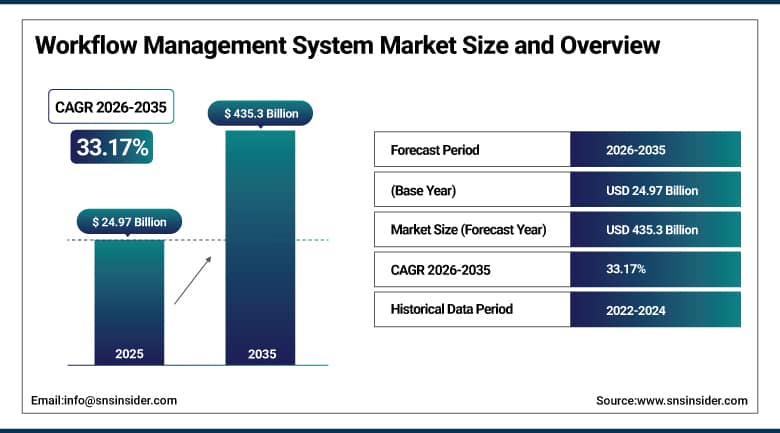
The Workflow Management System Market was valued at USD 24.97 Billion in 2025 and is expected to reach USD 435.3 Billion by 2035, growing at a CAGR of 33.17% from 2026 to 2035.
The global workflow management system market is experiencing exceptional and accelerating growth. The market’s extraordinary commercial momentum reflects enterprises’ systematic replacement of manual, paper-based, and email-driven process management with automated digital workflow platforms that reduce cycle times, eliminate human error, improve regulatory compliance documentation, and provide real-time process visibility. Rising demand for automation, the increasing focus on cost efficiency, and the seamless integration with existing enterprise systems like ERP, CRM, and HR platforms are collectively fueling expansion across virtually every industry vertical. Additionally, the growing adoption of AI-powered workflow automation, no-code and low-code development capabilities, and cloud-native deployment models are making workflow management accessible to organisations of all sizes, substantially expanding the addressable market.
In May 2024, IBM released an upgraded version of Watson Orchestrate with enhanced AI-driven decision-making workflows, enabling business users to create and deploy intelligent automation sequences that integrate across enterprise applications without requiring extensive IT development resources. The upgrade demonstrates the commercial direction of workflow management toward AI-native architectures that democratize complex automation development beyond the IT department to business operations teams who understand the processes but previously lacked the technical capability to automate them.
To Get More Information On Workflow Management System Market - Request Free Sample Report
Workflow Management System Market Trends
-
Generative AI is enabling intelligent workflow automation, process optimization, and natural language-based workflow creation.
-
No-code and low-code platforms are accelerating workflow automation by empowering business users without programming expertise.
-
Hyperautomation is integrating workflow management with RPA, AI, and process mining for end-to-end business automation.
-
Cloud-native workflow platforms are gaining rapid adoption due to scalability, flexibility, and subscription-based deployment models.
-
API-first architectures are enhancing seamless integration between workflow platforms and enterprise business applications.
The U.S. Workflow Management System Market Outlook
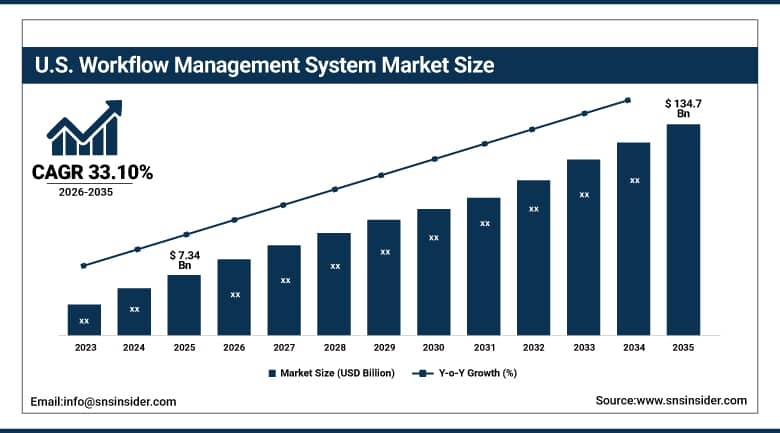
The U.S. Workflow Management System Market was valued at approximately USD 7.34 Billion in 2025 and is expected to reach approximately USD 134.7 Billion by 2035, growing at a CAGR of approximately 33.10%.
The U.S. is the world’s most commercially significant workflow management system market, home to ServiceNow, Microsoft Power Automate, IBM, Oracle, SAP, Appian, Nintex, and Pegasystems whose combined platform investment creates the global innovation trajectory for enterprise workflow automation. The CDC’s documentation that over 20% of U.S. adults experience chronic pain underscores the healthcare workflow automation opportunity, while the growing digital banking, claims automation, and regulatory compliance workflow requirements of the BFSI sector sustain the largest single end-use vertical procurement. The U.S. enterprise technology adoption culture, strong venture capital investment in workflow automation startups, and the mature cloud services infrastructure collectively sustain above-average domestic market growth across the forecast period.
In January 2023, CenTrak launched WorkflowRT, a scalable cloud-based platform that automates workflow and communications in clinical care settings, reducing the workload associated with manual paperwork needed for each stage of patient care while providing real-time workflow status visibility to clinical and administrative staff.
Workflow Management System Market Segment Analysis
-
By Type, the production workflow systems segment dominated the workflow management system market with approximately 36% share in 2025, while the suite-based workflow systems segment is the fastest growing.
-
By Service, the consulting & advisory segment dominated the workflow management system market with the largest share in 2025, while the integration & implementation segment is the fastest growing.
-
By Deployment, the cloud-based segment dominated the workflow management system market with approximately 68% share in 2025, while the cloud-based segment is also the fastest growing.
-
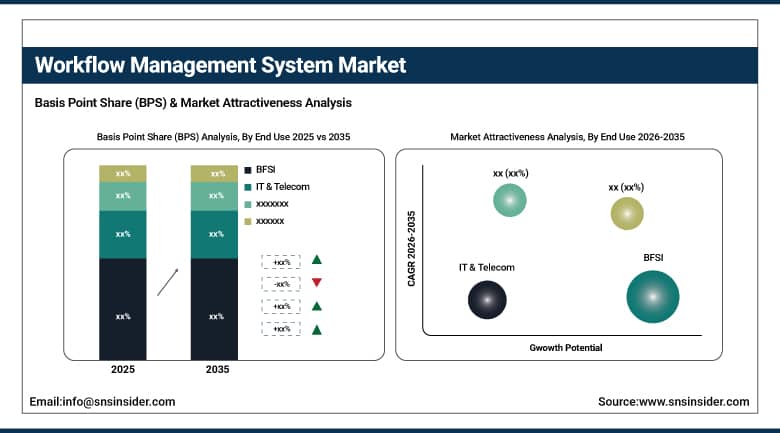
By End Use, the BFSI segment dominated the workflow management system market with approximately 33% share in 2025, while the IT & telecom segment is the fastest growing.
By End Use, BFSI dominates, IT and telecom grow fastest
BFSI retained the dominant end-use position with approximately 33% of the workflow management system market in 2025. BFSI’s commercial primacy reflects the extraordinary process automation requirement of financial services operations whose regulatory compliance documentation, risk management workflow, customer onboarding verification, loan processing automation, and claims management collectively create the most commercially intensive per-organization workflow management investment of any industry vertical. The financial services sector’s regulatory environment creates workflow compliance documentation requirements whose manual completion creates prohibitive labour cost that workflow automation directly addresses. Each bank whose loan origination process involves dozens of sequential approval, verification, and documentation steps creates workflow platform procurement whose per-workflow commercial value compounds with loan volume growth.
IT and Telecom is the fastest growing end use at approximately 35.67% CAGR because the sector’s fundamental need for operational workflow automation in IT service delivery, cloud migration orchestration, DevOps pipeline management, and remote work infrastructure support creates above-average workflow platform procurement from a sector whose own digital sophistication accelerates automation adoption. The growing complexity of hybrid multi-cloud IT operations, the expansion of managed IT service delivery to enterprise clients, and the telecoms sector’s customer service workflow automation requirement collectively create IT and telecom workflow management procurement whose growth rate exceeds all other end-use verticals.
By Type, production workflow systems dominate, suite-based grows fastest
Production workflow systems retained the dominant type position with approximately 36% of the workflow management system market in 2025. The commercial primacy of production workflow systems reflects their foundational role in manufacturing, logistics, and service delivery operations whose process execution at commercial scale creates the highest per-system commercial value and deepest enterprise dependency of any workflow category. Each manufacturing facility that deploys production workflow systems for work order management, quality control checkpoint sequencing, and production scheduling creates workflow management procurement whose replacement cost and operational dependency sustain long-duration commercial relationships.
Suite-based workflow systems are the fastest growing type because enterprise digital transformation programmes that seek to consolidate fragmented departmental workflow tools into unified multi-department automation platforms create above-average suite procurement whose per-enterprise commercial value substantially exceeds single-department point solution alternatives. Each enterprise that transitions from department-specific workflow tools to a unified suite-based platform creates consolidation procurement whose scope encompasses HR, finance, operations, IT, and customer service workflow automation simultaneously.
Regional Analysis
|
Region |
Major Country |
Share within Region, 2025 (%) |
|---|---|---|
|
North America |
United States |
87.4% |
|
Europe |
Germany |
22.3% |
|
Asia Pacific |
China |
44.8% |
|
Middle East & Africa |
UAE |
31.2% |
|
Latin America |
Brazil |
44.2% |
North America Workflow Management System Market Insights
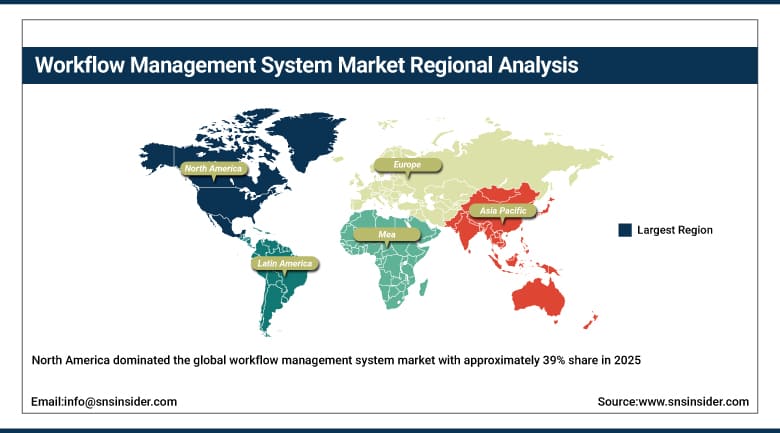
North America dominated the global workflow management system market with approximately 39% share in 2025, supported by its matured IT infrastructure, high cloud adoption stage, and the concentration of leading workflow management vendors including ServiceNow, Microsoft, IBM, Oracle, SAP, Appian, Nintex, and Pegasystems. The United States accounts for approximately 87.4% of North American revenues through its extraordinary enterprise technology adoption and AI integration leadership in workflow automation.
Canada contributes approximately 12.6% of North American revenues through its growing enterprise technology adoption, the financial services sector’s process automation investment, and the government sector’s digital service delivery workflow modernization programme.
Get Customized Report as Per Your Business Requirement - Enquiry Now
Europe Workflow Management System Market Insights
Europe is a technically sophisticated workflow management system market where GDPR data processing compliance documentation creates mandatory workflow automation requirements, the financial services sector’s regulatory compliance burden creates structured automation investment, and the manufacturing sector’s Industry 4.0 digital transformation creates production workflow demand. Germany accounts for approximately 22.3% of European revenues through SAP’s domestic enterprise leadership, the manufacturing sector’s production workflow system investment, and the BFSI sector’s compliance automation procurement.
The United Kingdom and France are significant secondary markets where the financial services sector’s process automation investment, the NHS’ clinical workflow digitization, and the growing enterprise digital transformation programmes create consistent workflow management system procurement.
Asia Pacific Workflow Management System Market Insights
Asia Pacific is the fastest growing regional workflow management system market with 24.7% CAGR, driven by rapid digitization initiatives, rising SME adoption of cloud-based workflow tools, growing demand for enterprise automation in China, India, and South East Asia, and government focus on digital transformation that is increasing workflow management implementation opportunities. China accounts for approximately 44.8% of Asia Pacific revenues through its manufacturing sector’s production workflow investment, the financial services sector’s digital transformation, and the government’s enterprise digitalization initiative.
India represents the most commercially dynamic emerging market within Asia Pacific where the growing technology sector’s IT process automation investment, the financial services sector’s digital banking workflow requirement, and the government’s Digital India programme creating public sector workflow automation procurement create above-average workflow management system market growth.
MEA & Latin America Workflow Management System Market Insights
The UAE leads MEA revenues at approximately 31.2% through its government's digital transformation investment, the financial services sector's process automation adoption, and the smart city infrastructure's workflow management requirement creating consistent enterprise automation procurement. Saudi Arabia's Vision 2030 digital government initiative and the growing manufacturing sector add substantial Gulf demand.
Brazil leads Latin American revenues at approximately 44.2% through its financial services sector's process automation investment, the growing enterprise digital transformation programme, and the government's e-government workflow digitization initiative. Mexico and Colombia collectively sustain regional market development through 2035.
Market Dynamics
Growth Drivers: AI-powered automation and enterprise digital transformation
AI integration in workflow management is the market’s most commercially transformative structural growth driver, creating workflow automation capability that compounds the linear efficiency improvement of rule-based automation with the adaptive intelligence of machine learning. AI-driven systems that analyze workflow patterns and deliver a 20% reduction in process cycle times, combined with predictive analytics that identify bottleneck formation before productivity impact occurs, create measurable ROI that justifies premium AI-integrated platform investment over conventional workflow alternatives. Each enterprise whose AI workflow deployment creates quantifiable cycle time improvement creates an ROI reference case that accelerates subsequent workflow automation investment.
Enterprise digital transformation programmes that systematically replace manual, paper-based, and email-driven processes with automated digital workflows create structured and sustained workflow management system procurement. The shift to remote and hybrid work models, with approximately 35% of U.S. workers working remotely full time in 2023, creates workflow management requirement for distributed team coordination that physical office co-location previously handled without technology investment.
Restraints: Integration complexity with legacy systems and data privacy compliance creating deployment barriers
Integration complexity with legacy enterprise systems including mainframe-era financial systems, proprietary manufacturing execution systems, and custom-built operational databases creates workflow automation deployment challenges whose technical debt reduction investment precedes workflow benefit realization. Each enterprise whose legacy system landscape requires custom integration development before workflow automation deployment creates implementation timeline extension that moderates the pace of commercial adoption.
Data privacy compliance requirements including GDPR, CCPA, and industry-specific regulatory frameworks create workflow platform compliance evaluation requirements that extend procurement cycles and may restrict cloud deployment alternatives for regulated industries whose data residency requirements create on-premise specification preference that moderates cloud subscription revenue growth.
Opportunities: No-code democratization and hyper automation convergence
No-code and low-code workflow platform democratization represents the most commercially accessible near-term market expansion opportunity whose citizen developer enablement creates first-time workflow automation adoption from organisations whose IT development resource limitations previously prevented automation investment. Each SME whose business operations team builds and deploys workflow automation without IT development dependency creates platform subscription revenue whose commercial aggregate across millions of global SMEs sustains above-average market growth.
Hyper automation convergence creating unified orchestration of workflow management, RPA, AI decision engines, and process mining represents the most commercially premium technology development direction whose end-to-end process automation capability creates per-platform commercial value substantially exceeding individual component alternatives.
Recent Developments:
-
2026: ServiceNow Inc. expanded its AI-powered workflow automation capabilities with new agentic AI features to streamline enterprise operations and service management.
-
2026: Camunda GmbH expanded its process orchestration platform with enhanced AI-driven workflow automation and cloud-native integration capabilities for enterprise applications.
-
2025: Microsoft Corporation enhanced Power Automate with advanced generative AI and Copilot capabilities to simplify workflow creation and business process automation.
-
2025: Appian Corporation introduced new AI Process Platform enhancements, enabling intelligent document processing and end-to-end workflow automation.
Workflow Management System Market key players are:
-
ServiceNow Inc.
-
Microsoft Corporation
-
IBM Corporation
-
Oracle Corporation
-
SAP SE
-
Appian Corporation
-
Nintex Global Limited
-
Pegasystems Inc.
-
Newgen Software Technologies Limited
-
Creatio LLC
-
monday.com Ltd.
-
Asana, Inc.
-
Kissflow Inc.
-
ProcessMaker Inc.
-
Zoho Corporation Pvt. Ltd.
-
Comindware Inc.
-
Software AG
-
Laserfiche International LLC
-
Kofax Inc.
-
Camunda GmbH
Workflow Management System Market Report Scope:
| Report Attributes | Details |
|---|---|
| Market Size in 2025 | USD 24.97 Billion |
| Market Size by 2035 | USD 435.3 Billion |
| CAGR | CAGR of 33.17% From 2026 to 2035 |
| Base Year | 2025 |
| Forecast Period | 2026-2035 |
| Historical Data | 2022-2024 |
| Report Scope & Coverage | Market Size, Segments Analysis, Competitive Landscape, Regional Analysis, DROC & SWOT Analysis, Forecast Outlook |
| Key Segments | • By Type (Production Workflow Systems, Collaboration-Based Workflow Systems, Administrative Workflow Systems, Suite-Based Workflow Systems, Others) • By Service (Consulting & Advisory, Integration & Implementation, Training & Support, Managed Services) • By Deployment (Cloud-Based, On-Premise) • By End Use (BFSI, IT & Telecom, Healthcare & Life Sciences, Manufacturing, Retail & E-Commerce, Government & Defense, Education, Others) |
| Regional Analysis/Coverage | North America (US, Canada), Europe (Germany, UK, France, Italy, Spain, Russia, Poland, Rest of Europe), Asia Pacific (China, India, Japan, South Korea, Australia, ASEAN Countries, Rest of Asia Pacific), Middle East & Africa (UAE, Saudi Arabia, Qatar, South Africa, Rest of Middle East & Africa), Latin America (Brazil, Argentina, Mexico, Colombia, Rest of Latin America). |
| Company Profiles | ServiceNow Inc., Microsoft Corporation, IBM Corporation, Oracle Corporation, SAP SE, Appian Corporation, Nintex Global Limited, Pegasystems Inc., Newgen Software Technologies Limited, Creatio LLC, monday.com Ltd., Asana, Inc., Kissflow Inc., ProcessMaker Inc., Zoho Corporation Pvt. Ltd., Comindware Inc., Software AG, Laserfiche International LLC, Kofax Inc., Camunda GmbH |
Frequently Asked Questions
The market is expected to grow at a CAGR of 33.17% from 2026 to 2035.
The Workflow Management System Market was valued at USD 24.97 Billion in 2025.
AI integration creating measurable workflow process cycle time reductions and cost efficiency.
Production Workflow Systems dominated the market with approximately 36% share in 2025.
BFSI dominated the market with approximately 33% share in 2025.
