
The global anatomic pathology market is entering a period of significant transformation as healthcare providers expand cancer screening, introduce advanced tissue diagnostics and modernize laboratory operations. Greater biopsy volumes, rising need for individualized treatments, and use of artificial intelligence are generating new avenues for manufacturers, pathology laboratories and IT players.
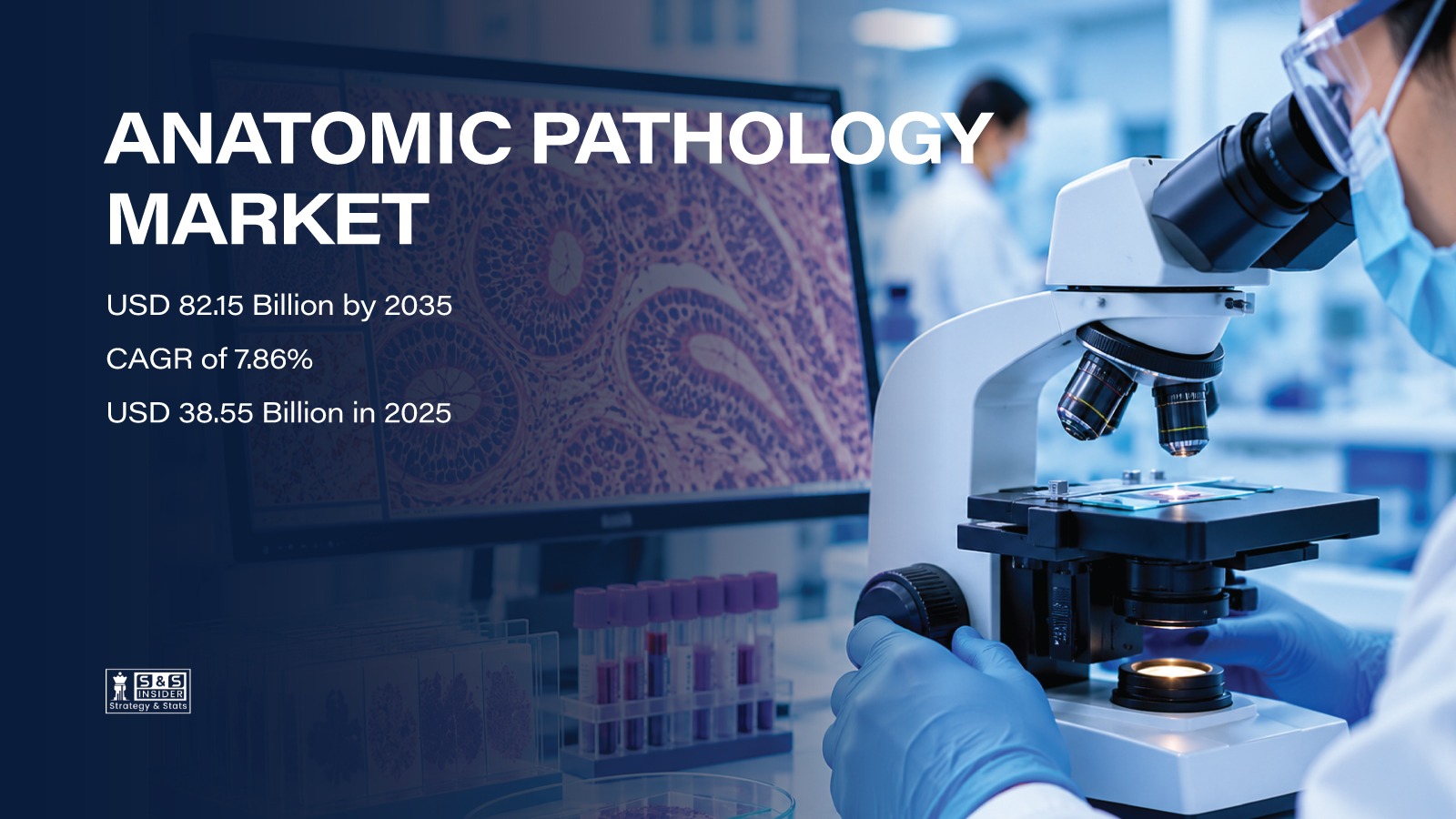
According to the latest SNS Insider, Anatomic Pathology Market Report, the global market was worth USD 38.55 billion in 2025, forecast to be valued at USD 41.58 billion in 2026, and is expected to achieve a value of USD 82.15 billion in 2035, growing at a CAGR of 7.86% in 2026-2035.
Anatomic pathology remains essential for diagnosing cancer and tissue abnormality detection. Medical facilities now depend on such technologies like histopathology, immunochemistry, molecular pathology and whole-slide imaging.
There is increasing need for automation of lab operations and outsourcing of diagnostic services in this field. Hospital labs as well as independent facilities are using digital processes for more efficient operations and for consulting specialists in case of higher numbers of tissue samples.
North America takes the leading position in the market due to its health infrastructure, and the Asia-Pacific region is set to experience the highest growth rate due to the expansion of oncology services.
Market Size and Forecast
|
Market Indicator |
Value |
|---|---|
|
Market Size, 2025 |
USD 38.55 Billion |
|
Market Size, 2026 |
USD 41.58 Billion |
|
Market Forecast, 2035 |
USD 82.15 Billion |
|
CAGR, 2026–2035 |
7.86% |
|
Leading Region |
North America (39.46%) |
|
Fastest-Growing Region |
Asia-Pacific (9.46% CAGR) |
|
Leading Product Segment |
Consumables (47.12%) |
|
Leading Application |
Disease Diagnosis (69.37%) |
Demand Drivers and Market Constraints
Primary Demand Drivers
-
Increasing cancer incidence: Growing demand for tissue biopsies, tumor classification and early disease detection is expanding the need for reliable anatomic pathology services.
-
Expansion of precision medicine: Biomarker testing, companion diagnostics and targeted cancer therapies are increasing the clinical importance of specialized tissue analysis.
-
Digital pathology adoption: Whole-slide imaging and digital image management systems enable remote consultations, centralized reporting and more flexible diagnostic workflows.
-
Laboratory automation: Automated tissue processors, staining platforms and specimen tracking technologies help laboratories manage higher testing volumes.
-
Growing diagnostic infrastructure: Investment in hospitals, oncology centers and independent laboratories is expanding access to pathology services in developing economies.
-
Artificial intelligence integration: AI-assisted image analysis offers opportunities to support pathologists in identifying suspicious tissue regions and evaluating biomarkers.
Potential Growth Constraints
The industry faces several barriers, including high equipment acquisition costs, shortages of trained pathologists and the complexity of implementing digital infrastructure.
Regulatory validation, laboratory accreditation, data privacy requirements and limited interoperability between imaging platforms can delay technology adoption.
Smaller diagnostic facilities may also struggle to finance advanced scanners, automated staining systems and long-term software maintenance.
Demand Structure by Product and Service
Consumables (2025 Market Share: 47.12%)
Consumables represent the largest product and service category, accounting for approximately 47.12% of global revenue in 2025.
Pathology laboratories continuously require tissue stains, antibodies, reagents, sample slides, cassettes and detection kits for processing their clinical specimens.
These supplies produce repeat buying needs which are directly associated with diagnostic activities, unlike the case of equipment.
Growing cancer screening efforts and the usage of complex immunoassays are enhancing demand for unique supplies.
Suppliers of relevant reagent mixes and auto staining systems enjoy extended relationships with labs.
Current trend: Growing demand for advanced staining reagents and standardized diagnostic consumables.
Major trends: Companion diagnostic assays, antibody-based testing, automated staining compatibility and recurring reagent supply agreements.
Pathology Services (Forecast CAGR: 10.56%)
Pathology services are expected to represent the fastest-growing product and service category, registering a CAGR of 10.56% through 2035.
Hospitals increasingly depend on reference laboratories and specialist service providers for complex tissue evaluations, advanced testing and additional diagnostic capacity.
Outsourcing allows smaller healthcare facilities to access specialist expertise without establishing fully equipped pathology departments.
Digital slide sharing and remote consultations are also supporting new service delivery models.
Current trend: Expansion of outsourced and digitally enabled pathology services.
Major trends: Reference laboratory partnerships, remote diagnostic consultation, specialized oncology testing and digital image analysis services.
Demand Structure by Technology
Histopathology (2025 Market Share: 32.64%)
Histopathology dominates the technology segment, accounting for approximately 32.64% of market revenue in 2025.
The technique remains fundamental to diagnosing cancer and evaluating tissue abnormalities through microscopic examination.
Hospitals and laboratories use tissue processing, embedding, sectioning and staining procedures to investigate biopsy and surgical specimens.
Growing demand for accurate tumor identification and disease classification continues to support investment in histopathology instruments and consumables.
Current trend: Sustained demand for conventional tissue examination alongside increasing laboratory automation.
Digital Pathology (Forecast CAGR: 10.36%)
Digital pathology is projected to become the fastest-growing technology segment, recording a CAGR of 10.36% during 2026–2035.
Whole-slide scanners convert traditional glass slides into digital images that can be reviewed, shared and analyzed electronically.
Healthcare organizations are introducing these platforms to support remote diagnosis, specialist collaboration and centralized pathology operations.
AI-assisted software can additionally help prioritize suspicious areas and support standardized image assessment, subject to appropriate clinical validation.
Current trend: Transition from microscope-centered workflows toward integrated digital pathology platforms.
Major trends: Whole-slide imaging, artificial intelligence, cloud image management, telepathology and automated image analysis.
Demand Structure by Application
Disease Diagnosis (2025 Market Share: 69.37%)
Disease diagnosis accounts for the largest application segment, holding approximately 69.37% of global revenue in 2025.
Anatomic pathology is central to confirming cancer diagnoses, determining tumor characteristics and identifying abnormalities in tissue specimens.
Increasing screening activity and the growing clinical use of biomarker testing are supporting demand for advanced diagnostic procedures.
Pathology results also guide treatment selection, particularly in oncology, where tissue characteristics influence therapeutic decisions.
Current trend: Increasing use of tissue-based biomarkers to support precise clinical diagnoses.
Drug Discovery and Development (Forecast CAGR: 10.06%)
Drug discovery and development is forecast to grow at a CAGR of 10.06% through 2035.
Tissue analysis is used by pharmaceuticals and biotech firms to explore treatment targets, assess treatment outcomes and conduct research in clinical settings.
Improvements in multiplex staining and molecular pathology techniques are creating new possibilities for studying the mechanism of disease in tissue samples.
Targeted treatments are also leading to increased cooperation between drug makers and diagnostics companies.
Current trend: Increasing integration of tissue-based research with precision medicine development.
Demand Structure by End User
Hospitals (2025 Market Share: 41.28%)
Hospitals lead the end-user market, representing approximately 41.28% of revenue in 2025.
The pathology department of hospitals performs surgical biopsies, oncology specimens and other diagnostic cases.
Automated equipment, digital imaging and diagnostic assays are being increasingly used by large medical centers to streamline their processes.
Current trend: Modernization of hospital pathology laboratories through automation and digital connectivity.
Diagnostic Laboratories (Forecast CAGR: 10.86%)
Diagnostic laboratories are expected to register the fastest end-user growth, with a CAGR of 10.86% from 2026 to 2035.
Independent and reference laboratories are expanding their capabilities as hospitals outsource specialized testing and seek additional processing capacity.
Centralized laboratory networks can improve equipment utilization, standardize testing procedures and provide access to specialist pathology expertise.
Current trend: Expansion of independent diagnostic networks and high-volume automated testing facilities.
Regional Market Dynamics
North America (2025 Market Share: 39.46%)
North America dominates the global market, accounting for 39.46% of revenue in 2025.
The region benefits from extensive cancer screening, established laboratory networks and strong demand for advanced diagnostic technologies.
The United States represents the largest national contributor, with a market valuation of USD 12.95 billion in 2025 and an anticipated CAGR of 7.62% through 2035.
Healthcare organizations continue adopting digital pathology and AI-supported diagnostic technologies to improve laboratory productivity.
Direction: Sustained leadership supported by advanced oncology diagnostics and laboratory modernization.
Asia-Pacific (Forecast CAGR: 9.46%)
Asia-Pacific is expected to register the fastest regional expansion, advancing at a CAGR of 9.46% during 2026–2035.
Growing hospital infrastructure, increasing cancer screening and expanding private diagnostic networks are strengthening demand across China and India.
Japan, South Korea and Australia are also supporting regional development through digital pathology adoption and advanced laboratory technologies.
Direction: Rapid growth driven by diagnostic infrastructure development and increasing access to specialized testing.
Europe
Europe is an example of a well-established market with structured screening programs, modern healthcare facilities and a strong research base for pharmaceuticals.
Germany, UK, France and Italy are among the countries contributing to the demand for pathology equipment, supplies, and services.
Consolidation of laboratories, and investments in digital infrastructure are driving automation and centralization of diagnostics.
Direction: Continued expansion through precision diagnostics and digital laboratory transformation.
Latin America and Middle East & Africa
Latin America and the Middle East & Africa offer developing opportunities as healthcare institutions expand oncology services and upgrade laboratory infrastructure.
Brazil and Mexico remain important Latin American markets, while Saudi Arabia, the UAE and South Africa support diagnostic modernization across the Middle East and Africa.
Direction: Gradual expansion supported by healthcare investment and increasing laboratory capacity.
Competitive Landscape
Competition in the anatomic pathology market includes established diagnostics manufacturers, laboratory service providers and digital pathology technology companies.
Prominent participants include Roche Diagnostics, Danaher, Agilent Technologies, Sakura Finetek, Epredia, Hologic, Hamamatsu Photonics, Labcorp, NeoGenomics, Sonic Healthcare, Tempus AI, PathAI, Ibex Medical Analytics and Indica Labs.
Manufacturers are competing through automated staining systems, pathology scanners, diagnostic reagent portfolios and software integration.
Technology providers are also pursuing collaborations with hospitals and reference laboratories to expand the practical application of digital pathology and AI-supported workflows.
Recent Industry Developments
-
October 2026: Roche introduced its VENTANA BAP1 (SP527) immunohistochemistry test, supporting the differential diagnosis of mesothelioma.
-
October 2026: NeoGenomics expanded its partnership with Indica Labs, selecting the HALO AP platform to support scalable digital pathology operations.
-
March 2026: Leica Biosystems and Bio-Techne introduced BOND-PRIME RNAscope Brown Detection in the United States, enabling automated RNA in situ hybridization workflows.
These developments demonstrate increasing industry investment in advanced diagnostic assays, laboratory automation and enterprise digital pathology.
Market Outlook (2026–2035)
The global anatomic pathology market size is expected to hit USD 82.15 billion by 2035 thanks to growth in diagnostics for cancer, precision medicine and digitization of labs.
The future growth will increasingly rely on the capability of health care organizations to handle increasing number of specimens without compromising on quality and efficiencies.
Artificial Intelligence, whole slide imaging and automated staining will be key in the modernization of labs.
Consumables will continue to be crucial for repetitive costs related to the diagnostics while pathology services and digitization have great prospects for growth.
The North America region will continue being the leading one while the Asia-Pacific is forecasted to show the highest growth.
Overall, the anatomic pathology market is positioned for substantial development through 2035, with future competitiveness shaped by diagnostic innovation, laboratory automation, precision medicine and broader access to advanced tissue analysis.



