
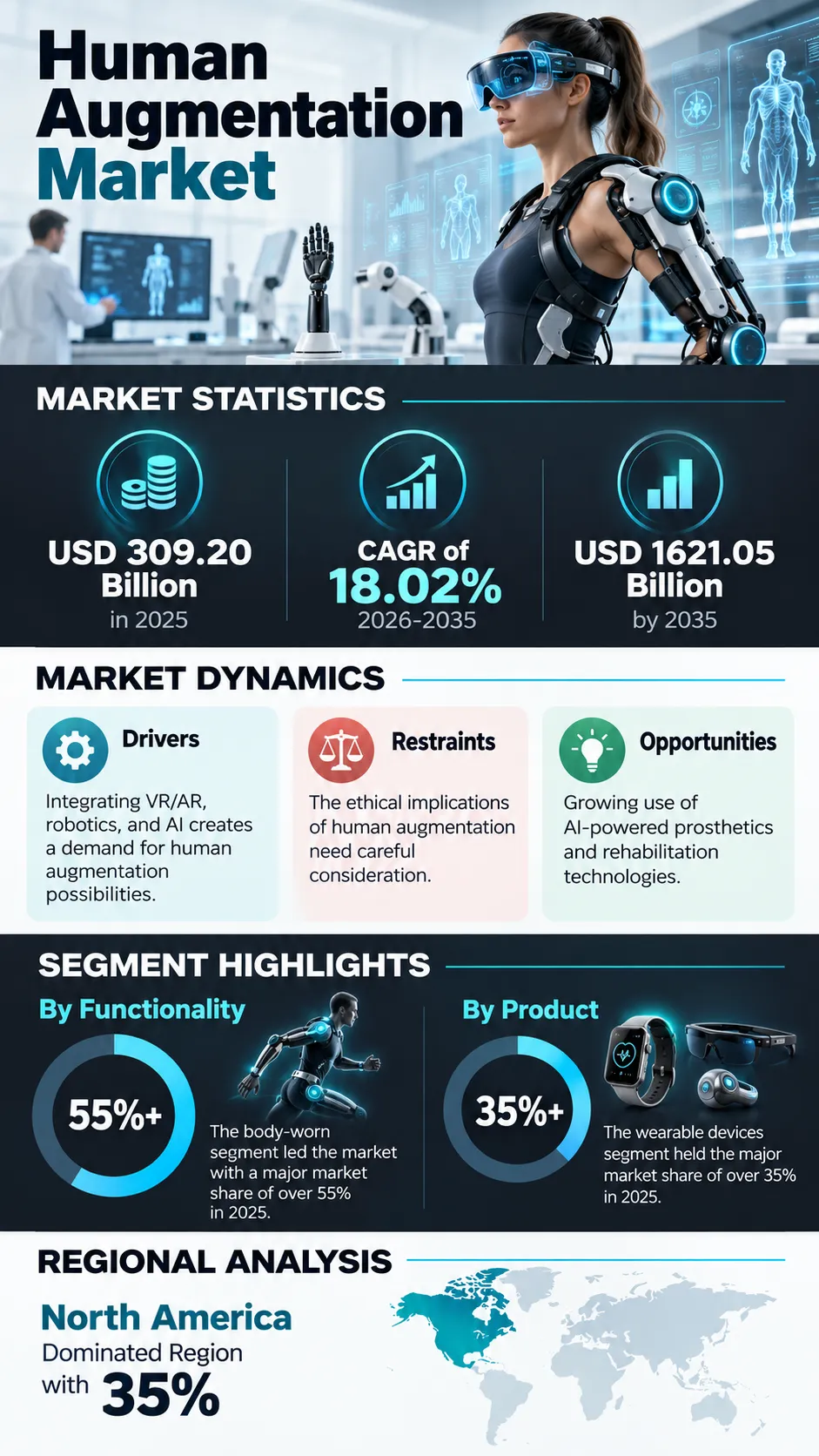
The global Human Augmentation Market is poised to experience tremendous growth in the coming years, due to the innovations in areas such as artificial intelligence, robotics, wearable electronics, and human-machine interfaces. According to a recent study by SNS Insider, the global Human Augmentation Market size valued at USD 309.20 billion in 2025, is anticipated to grow to USD 1,621.05 billion by 2035, registering a CAGR of 18.02% over the 2026–2035 forecast period.
The rise in demand for technologies enabling mobility, rehabilitation, enhanced workplace performance, immersive training and personalized health care is increasing the size of the potential market. Whether through wearable technology or robotic assistance devices to neurotechnology, developers are designing systems that merge the powers of humans with advanced digital technology.
One of the key areas where such technologies are used is healthcare, as augmentation technologies help solve issues with limited mobility and physiological monitoring and assist in rehabilitation. Alongside healthcare, there is another area that provides growth prospects, which include industry, military and consumers.
To Get Detailed Insights on the Human Augmentation Market – Request a Sample Report
AI, Robotics and Connected Devices Create New Growth Opportunities
The convergence of artificial intelligence, robotics, sensors, and immersive technologies is developing an ecosystem of human enhancement. These intelligent systems are able to interpret data and change their operation according to the individual user, thereby enhancing the adaptability and practicality of these enhancement technologies.
Moreover, there is increased investment in wearable technologies, exoskeletons, biometrics, and brain-computer interface because companies require solutions that would increase efficiency, security, and quality of life. In the industrial environment, robotic assistance can help avoid physical stress, while immersive augmented reality and virtual reality systems can help train and perform certain operations.
However, ethical considerations, privacy concerns, affordability, and questions surrounding equitable access remain important challenges. As augmentation technologies become more sophisticated, developers and regulators will need to address responsible deployment alongside technical innovation.
Key Market Insights Highlight Shifting Demand Patterns
By functionality, body-worn solutions maintained the dominant position, accounting for more than 55% of market revenue in 2025. With their increased usage in health monitoring, fitness, assistance at work, and performance enhancement, the demand will remain strong. Meanwhile, non-body worn solutions are expected to grow at a faster pace until 2035 due to the development of non-invasive brain-computer interfaces and external augmentation.
Based on product, wearable devices segment held more than 35% of market revenue in 2025. This segment will profit from an increasing use of connected health and fitness devices that incorporate increasingly advanced sensors. Biometric identification systems for humans are expected to grow at the most rapid pace as various industries such as finance, healthcare, and government tighten their security requirements.
By technology, AI integration segment held a 42% market share in 2025. AI enables augmentation systems to interpret sensor information, personalize device performance, and respond dynamically to user behavior. Biohacking and bio-augmentation technologies are expected to achieve the fastest growth as developments in implantable technologies, tissue engineering, and other biological interventions broaden the scope of human enhancement.
Wearable Intelligence and Rehabilitation Applications Gain Momentum
The market is progressing from simple activity trackers to devices which can continuously analyze physiological data and provide assistance. The integration of biosensors, wearables, and advanced analytical systems has started gaining momentum in order to design personalized solutions for both healthcare and consumer sectors.
Also gaining popularity are robotic exoskeletons and advanced prosthetic devices in order to help people with physical disabilities. On the other hand, AR and VR technology has found application in training programs for defense, workforce training, education, and certain professions.
North America Leads Market with 35% Share as Asia Pacific Emerges as Fastest-Growing Region
North America will continue to lead the regional market by generating over 35% of total revenues in 2025. Advanced technology advancements, high healthcare expenditure, developed research facilities, and investments in AI and robotics are some of the factors driving the regional adoption of technology.
Asia Pacific is anticipated to show the fastest growth rate during the forecast period up to 2035. The rapid advancements in technology in China, Japan, South Korea, and other economies, along with growing healthcare needs and investments in robotics and wearable medical devices, are creating good prospects for the market.
Europe is showing steady adoption of technology as companies use AR/VR, robotics, and AI for rehabilitation, increased industrial production, healthcare, and military uses. Latin America and Middle East and Africa regions are forming emerging opportunities as governments and businesses invest in advanced healthcare and technological systems.
Industry Participants Focus on Intelligent Augmentation Solutions
Competition is increasing as technology firms, medical device makers, and robotics engineers create advanced systems of human augmentation. The focus for these businesses is artificial intelligence interfaces, wearable robots, neural technology, intelligent sensors, and customized systems that enhance human ability.
Key companies operating in the global Human Augmentation Market include Samsung Electronics, Google LLC, Ekso Bionics, Vuzix Corporation, Garmin Ltd., Fossil Group, Inc., B-Temia Inc., Casio, Magic Leap, ReWalk Robotics, Cyberdyne Inc., Neuralink, and Cochlear Limited.
An SNS Insider analyst Sushant Kadam commented, “The convergence of artificial intelligence, robotics, advanced sensing, and human-machine interfaces is creating a new generation of augmentation technologies. As healthcare, industrial, defense, and consumer applications mature, companies that combine intelligent functionality with safety, accessibility, and user-centered design will be positioned to capture significant opportunities in this rapidly expanding market.”About the Author

Get in touch




