
Adeno-Associated Virus (AAV) CDMO Market Report Scope & Overview:
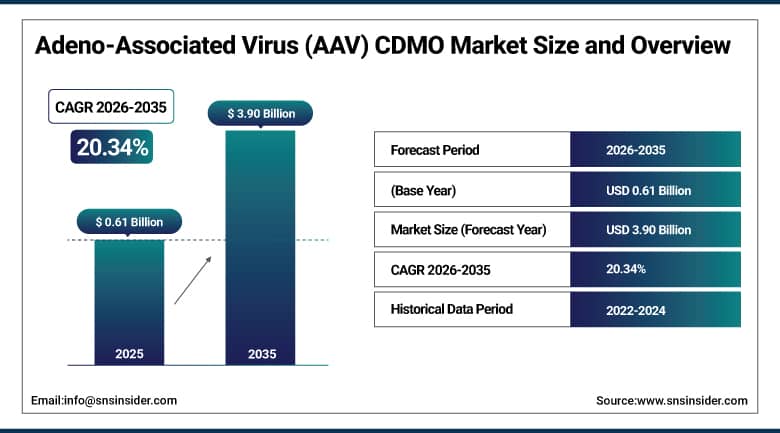
The Adeno-Associated Virus (AAV) CDMO Market was valued at USD 0.61 billion in 2025 and is expected to reach USD 3.90 billion by 2035, growing at a CAGR of 20.34% from 2026–2035.
The adeno-associated virus (AAV) CDMO market is witnessing strong growth in the global market owing to rising demand for gene therapy manufacturing services. Increasing prevalence of rare genetic disorders is supporting market expansion. Growing outsourcing of viral vector production to CDMO providers is accelerating adoption. Expanding clinical pipelines in gene therapy are driving manufacturing demand. Technological advancements in scalable AAV production are improving efficiency. Increasing regulatory approvals for gene therapies are further boosting market growth.
As per the FDA CBER and EMA advanced therapy medicinal product, over 40 clinical trials employing AAV-based gene therapy products were being conducted globally in 2025, and accounted for a considerable proportion of viral vector-based gene delivery research. According to the Alliance for Regenerative Medicine’s clinical database, 60% of gene therapy product development programs employ AAV vectors as their backbone technology platform.
To Get More Information On Adeno-Associated Virus (AAV) CDMO Market - Request Free Sample Report
Adeno-Associated Virus (AAV) CDMO Market Trends
-
-
The increase in the outsourcing of AAV manufacturing to specialized CDMO service providers is lowering infrastructure costs and increasing biopharmaceutical manufacturing efficiencies.
-
The increased complexity in the manufacturing of viral vectors is pushing more demands for advanced technologies provided by existing CDMOs.
-
The growing partnerships between biotech firms and the existing CDMOs are providing more access to scalable and high-quality manufacturing facilities.
-
The use of suspension-based manufacturing processes along with advanced purification processes is contributing toward increased manufacturing scalability and lowering manufacturing bottlenecks.
-
Increased utilization of automation processes and single-use systems is increasing manufacturing efficiencies while minimizing contamination risks in AAV manufacturing.
-
Growing use of modular manufacturing facilities along with increased research and development spending is helping accelerate innovation in gene therapies globally.
-
U.S. Adeno-Associated Virus (AAV) CDMO Market Outlook.
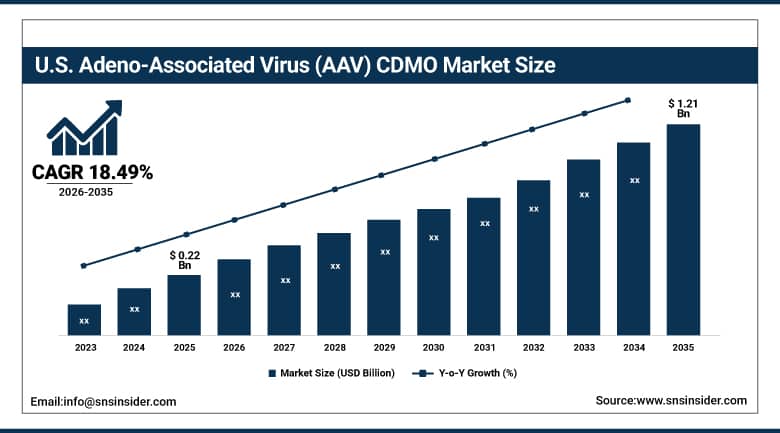
The U.S. Adeno-Associated Virus (AAV) CDMO Market was valued at USD 0.22 billion in 2025 and is expected to reach around USD 1.21 billion by 2035, growing at a CAGR of 18.49% from 2026–2035.
The U.S. adeno-associated virus (AAV) CDMO market is growing steadily owing to strong demand for gene therapy manufacturing services. Increasing prevalence of rare genetic diseases is supporting market expansion. Rising clinical trials for AAV based therapies is driving production outsourcing. Strong presence of leading biopharma companies is boosting CDMO adoption. Advancements in scalable viral vector manufacturing technologies are improving efficiency. Increasing regulatory approvals for gene therapies is further accelerating market growth.
As per the U.S. Food and Drug Administration Center for Biologics Evaluation and Research 2025 gene therapy guidance framework, over 35 gene therapy products that involve AAV vectors have been approved for IND applications in the United States, and there are several gene therapies at the later stage of their development cycle. More than 60% of the gene therapy in vivo programs under the genetic medicine research program of the NIH involve AAV vectors.
Adeno-Associated Virus (AAV) CDMO Market Segment Analysis
-
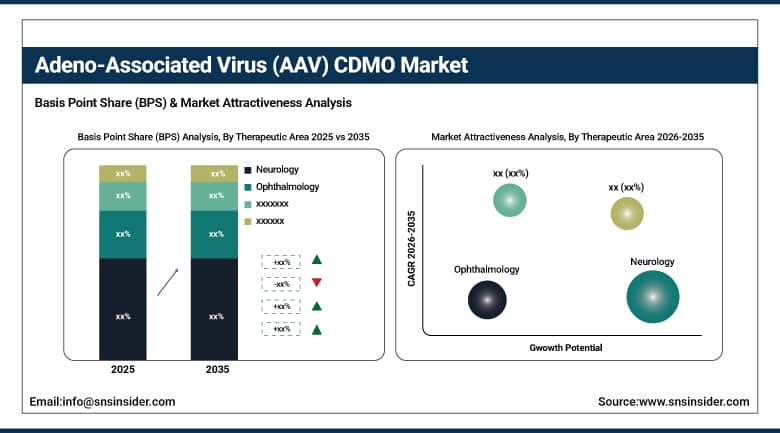
By Therapeutic Area, neurology dominated the market with 39.84% share in 2025; while ophthalmology is the fastest growing segment with CAGR of 26.65% during 2026 to 2035.
-
By Service Type, adeno-associated virus (AAV) vector dominated the market with 56.32% share in 2025; while lentiviral vector manufacturing is the fastest growing segment with CAGR of 23.94% during 2026 to 2035.
-
By Vector Type, self-complementary AAV (scAAV) dominated the market with 50.73% share in 2025; while single-stranded AAV (ssAAV) is the fastest growing segment with CAGR of 22.82% during 2026 to 2035.
-
By Capacity, medium-scale dominated the market with 50.12% share in 2025; while large-scale is the fastest growing segment with CAGR of 24.51% during 2026 to 2035.
-
By End User, large pharma dominated the market with 54.76% share in 2025; while biotech start-ups is the fastest growing segment with CAGR of 23.97% during 2026 to 2035.
By Therapeutic Area, Neurology dominated the adeno-associated virus (AAV) CDMO market, while Ophthalmology is the fastest growing segment.
Neurology was the leading segment in terms of revenue share in 2025 in the adeno-associated virus (AAV) CDMO market owing to high prevalence of neurodegenerative disorders including Parkinson's disease, Alzheimer's disease, and spinal muscular atrophy. Rising usage of gene therapy for central nervous system is another factor driving the demand for outsourcing services for CDMO service providers. Growing clinical pipelines and approvals for neurological treatment through AAV is expected to drive the consistent outsourcing to CDMO service providers.
Ophthalmology is anticipated to experience the fastest CAGR from 2026 to 2035 owing to increasing number of inherited retinal disorders and diseases causing loss of vision. The eye is considered to be one of the most ideal targets for Adeno-associated virus-based gene therapy owing to its localized nature and low immune reaction. Clinical successes of retinal gene therapy and investments in rare eye diseases is fueling the demand for CDMO services globally.
By Service Type, adeno-associated virus (AAV) vector manufacturing dominated the adeno-associated virus (AAV) CDMO market, while lentiviral vector manufacturing is the fastest growing segment.
Adeno-Associated Virus (AAV) Vector Manufacturing Segment captured the dominated market share in the adeno-associated virus (AAV) CDMO market in 2025. The high adoption in the development and commercialization process of gene therapies is responsible for this segment's market dominance. The increasing demand for scalable and GMP-compliant viral vector manufacturing will drive this segment's growth. Clinical trial activities along with outsourcing to expert CDMOs are fueling the growth of this market segment.
The Lentiviral Vector Manufacturing Segment is projected to register the fastest CAGR during 2026-2035 owing to the growing application of lentiviral vectors in the cell and gene therapies. The growing use of these vectors in the development of CAR-T and advanced immunotherapy pipelines is boosting the adoption rate. The rising focus on oncology and personalized medicine research is contributing to the growth of this segment.
By Vector Type, self-complementary AAV (scAAV) dominated the adeno-associated virus (AAV) CDMO market, while single-stranded AAV (ssAAV) is the fastest growing segment.
The self-complementary Adeno-Associated Virus (AAV) (scAAV) segment held the dominated market share in terms of revenue in the adeno-associated virus (AAV) CDMO market in 2025. The market leadership of this segment can be attributed to the high gene delivery efficacy and rapidness in gene expression. This segment decreases the reliance on the second strand DNA synthesis process and helps in improving the efficacy of the treatment. Its high adoption rate in neurological and ophthalmic treatments is yet another contributing factor for its market leadership.
Single-stranded AAV (ssAAV) segment is anticipated to exhibit the fastest CAGR between 2026 and 2035. High packaging capacity and adaptability of single-stranded AAV to carry large genetic payloads drive the adoption of this segment. Growing research into more complex gene therapy is fueling the adoption of this segment. Less stringent manufacturing process of single stranded AAV than that of self-complementary AAV is propelling the adoption rate of this segment.
By Capacity, medium-scale dominated the adeno-associated virus (AAV) CDMO market, while large-scale is the fastest growing segment.
Medium-scale segment ruled the adeno-associated virus (AAV) CDMO market by generating dominated revenue in 2025. The reason behind its ruling position is that it provides optimum scalability, cost-effectiveness, and flexibility requirements of gene therapy products. The majority of the CDMOs prefer to have medium scale facilities to fulfill the demands of increasing clinical trial programs. Also, it provides less risk during the manufacturing process than large scale production facilities.
Large-scale segment is anticipated to witness a faster CAGR from 2026 to 2035 owing to increased commercialization of gene therapies. Increasing number of approvals of AAV-based therapies is increasing the demand for large-scale production of these therapies. Increased investment by pharmaceutical companies towards scalable manufacturing facilities is propelling the demand. Increased need for cost-effective mass production is also contributing to its growth.
By End User, large pharma dominated the adeno-associated virus (AAV) CDMO market, while biotech start-ups is the fastest growing segment.
The Large Pharma category was the major revenue generator for the adeno-associated virus (AAV) CDMO market, accounting for the dominated share in 2025. The high share held by the category is owing to strong financial power and existing biologics pipelines. The firms in the segment are focused on the development of gene therapy and are highly inclined toward outsourcing. Besides, their preference for scalable and compliant manufacturing through CDMOs, their active involvement in clinical trials and knowledge about regulations is adding to their market leadership.
The Biotech Start-ups segment will witness the fastest CAGR between 2026 and 2035 on account of growing innovations in the field of gene therapy development. There is an increasing focus among biotech start-up firms on rare disease treatments and personalized medicine. Due to the unavailability of manufacturing capabilities, there is strong dependence on outsourcing services. The availability of venture capital funding and strategic partnerships with large pharma companies is further helping their development.
Regional Analysis
|
Region |
Major Country |
Share within Region, 2025(%) |
|---|---|---|
|
North America |
United States |
86.42% |
|
Europe |
Germany |
29.10% |
|
Asia Pacific |
China |
44.20% |
|
Middle East & Africa |
UAE |
18.50% |
|
Latin America |
Brazil |
47.80% |
North America Adeno-Associated Virus (AAV) CDMO Market Insights.
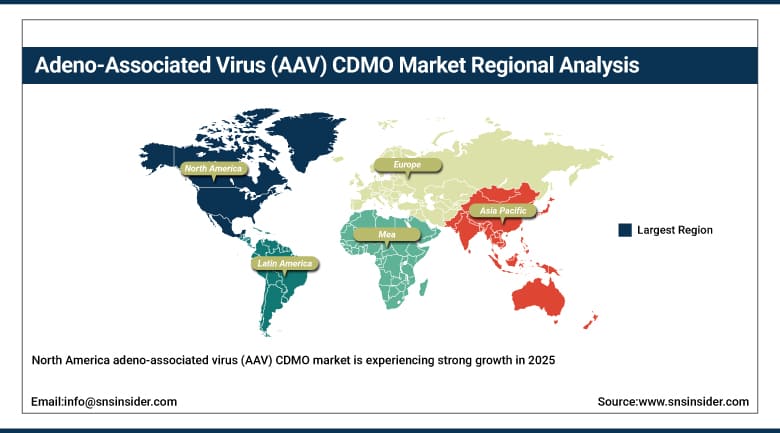
North America adeno-associated virus (AAV) CDMO market is experiencing strong growth in 2025, accounting for about 41.86% share of the global market, owing to strong presence of biopharma companies. The region benefits from advanced biotechnology infrastructure and high gene therapy investments. Increasing demand for scalable viral vector production is improving manufacturing efficiency. Expansion of clinical trials for rare diseases is driving outsourcing. Strong regulatory framework is further supporting market development and CDMO adoption.
According to the U.S. Food and Drug Administration Center for Biologics Evaluation and Research 2025 gene therapy registry, over 30 adeno-associated virus AAV-based gene therapies have entered clinical development in the United States, with multiple programs advancing through Phase II and Phase III trials. As per the National Institutes of Health Office of Rare Diseases Research, more than 7,000 rare diseases collectively affect an estimated 25–30 million Americans, driving sustained demand for scalable viral vector manufacturing.
Get Customized Report as Per Your Business Requirement - Enquiry Now
Europe Adeno-Associated Virus (AAV) CDMO Market Insights.
Europe adeno-associated virus (AAV) CDMO market is characterized by steady growth in 2025 owing to strong regulatory frameworks and advanced biotech ecosystem. Key countries include Germany, France, United Kingdom, and Switzerland. Rising demand for innovative gene therapies is driving CDMO outsourcing. Expansion of academic research collaborations is supporting early-stage development. Increasing focus on rare disease treatments is further accelerating adoption of viral vector manufacturing services across the region.
According to the European Medicines Agency Advanced Therapy Medicinal Products regulatory database and the European Commission’s Horizon Europe biotechnology framework, over 25 gene therapy products have received marketing authorization or are in late-stage regulatory review in Europe as of 2025, with AAV vectors representing the dominant delivery platform in more than 70% of approved in vivo gene therapies. As per the European Federation of Pharmaceutical Industries and Associations clinical pipeline indicators, over 60% of ongoing gene therapy clinical trials in Europe utilize viral vector systems, with AAV-based modalities widely used for rare genetic disease and ophthalmology applications, driving sustained expansion of AAV-focused CDMO manufacturing capacity across the region.
Asia Pacific Adeno-Associated Virus (AAV) CDMO Market Insights.
Asia Pacific is the fastest growing region in the adeno-associated virus (AAV) CDMO market, registering a CAGR of about 22.48% during 2026–2035. Rapid expansion of biotechnology industries and clinical research is driving strong demand. Countries such as China, India, Japan, and South Korea are investing heavily in gene therapy development. Increasing outsourcing of manufacturing services is supporting growth. Rising patient population is further accelerating adoption of advanced therapies in the region.
As per Japan’s Pharmaceuticals and Medical Devices Agency and China’s National Medical Products Administration, more than 80 gene therapy clinical studies are actively registered across the region, with increasing focus on viral vector platforms. The U.S. Food and Drug Administration comparators indicate that over 20 AAV-based therapies are in global clinical pipelines, reflecting expanding CDMO utilization in Asia Pacific biomanufacturing ecosystems.
Middle East & Africa and Latin America Adeno-Associated Virus (AAV) CDMO Market Insights.
The Middle East & Africa along with Latin America regions are witnessing gradual growth due to rising healthcare infrastructure development. Key contributing countries include Brazil, Mexico, UAE, Saudi Arabia, and South Africa. Increasing awareness of advanced gene therapies is supporting early-stage adoption. Growing investment in biotechnology research is improving regional capabilities. Expansion of clinical trial activities is further supporting demand for Adeno-Associated Virus (AAV) CDMO services across emerging markets.
According to the World Health Organization 2025 Global Health Observatory and regional biotechnology capacity assessments, Latin America accounts for approximately 5% of global clinical trial activity, while Africa contributes around 2%, reflecting emerging but limited advanced therapy development infrastructure. As per UNESCO Institute for Statistics biotechnology capacity indicators, fewer than 30% of countries in these regions have established advanced biomanufacturing frameworks for gene and cell therapies.
Market Dynamics
Growth Drivers: Expanding outsourcing trend toward specialized CDMO providers improving scalable viral vector manufacturing efficiency
The biopharmaceuticals industry is outsourcing the production of AAV through specialized CDMOs due to high costs involved in setting up the required infrastructure. The manufacturing process of viral vectors is complex and thus needs sophisticated equipment and knowledge. CDMOs provide scalable services from clinical to commercial phase. This results in more efficient development process with minimized risks. Collaborations between biotech companies and international CDMOs have led to increased availability of modern manufacturing techniques. Increased attention towards low-cost manufacturing processes has further increased outsourcing requirements.
According to the Alliance for Regenerative Medicine clinical trial tracker data, around 70% of all gene therapy clinical trials that are going on across the globe are based on AAV-mediated approaches, signifying a heavy reliance on viral vectors in pipelines. FDA has also stated the increased adoption of outsourcing of manufacturing in GMP compliant facilities, most of which are related to AAVs.
Restraints: High manufacturing complexity and scalability limitations restricting Adeno-Associated Virus (AAV) CDMO Market expansion globally
The process of production of Adeno-Associated Virus (AAV) vectors is a very complicated biological process involving rigorous quality controls and dedicated infrastructures. Scarcity of scaling up of existing technology hampers the commercial manufacturing process. Higher costs of production and long development times complicate the process for CDMOs. Stringent regulatory standards further complicate the matter. Scarcity of skilled labor force in biomanufacturing also becomes a constraint to the process of production. The variations in the yield and purification procedures affect the process and also limit supply. All these factors together become an obstacle to the commercial production of gene therapies and limit the growth of the AAV CDMO market.
Opportunities: Increasing advancements in scalable gene therapy manufacturing technologies creating strong growth potential for AAV CDMO providers
Technological innovations in bioprocessing have enhanced efficiencies and scalability in the production of AAV. The emergence of systems that operate under suspension along with advanced purification technologies is overcoming challenges in manufacturing. Automation technologies and single use systems are boosting production rates while minimizing contamination concerns. Modular manufacturing plants are being increasingly adopted, which has improved scalability potential. These innovations are driving the process of large-scale production of viral vectors at affordable costs. Increased focus on R&D is leading to technological breakthroughs. Increasing need for next generation gene therapies has created excellent opportunities for CDMO companies to broaden their operations globally.
According to the U.S. Food and Drug Administration 2025 biologics and gene therapy tracking data, more than 40 gene therapy products have received regulatory approval globally, with AAV vectors representing the dominant delivery platform in in vivo gene therapies. As per the European Medicines Agency advanced therapy medicinal product registry, over 70% of late-stage gene therapy clinical candidates utilize viral vector systems, primarily AAV.
Recent Developments
-
2026: WuXi AppTec increased gene therapy CDMO capacity with new AAV production suites and advanced analytical technology upgrades in China.
-
2025: Lonza expanded viral vector and gene therapy manufacturing capabilities in Switzerland and US supporting AAV demand growth.
-
2025: Fujifilm Diosynth Biotechnologies progressed large-scale gene therapy and AAV manufacturing site expansion in North Carolina facilities.
-
2024: Thermo Fisher Scientific expanded viral vector services capacity across multiple sites, strengthening AAV and cell therapy manufacturing network globally.
Adeno-Associated Virus (AAV) CDMO Market Key Players are:
-
Lonza
-
Thermo Fisher Scientific
-
WuXi AppTec
-
Fujifilm Diosynth Biotechnologies
-
AGC Biologics
-
Samsung Biologics
-
Charles River Laboratories
-
Oxford Biomedica
-
Merck KGaA
-
Pfizer
-
Abzena
-
Emergent BioSolutions
-
FinVector
-
Batavia Biosciences
-
Recipharm
-
WuXi Biologics
-
Boehringer Ingelheim
-
Rentschler Biopharma
-
Vive Biotech
-
Polymun Scientific
Adeno-Associated Virus (AAV) CDMO Market Report Scope:
| Report Attributes | Details |
|---|---|
| Market Size in 2025 | USD 0.61 Billion |
| Market Size by 2035 | USD 3.90 Billion |
| CAGR | CAGR of 20.34% From 2026 to 2035 |
| Base Year | 2025 |
| Forecast Period | 2026-2035 |
| Historical Data | 2022-2024 |
| Report Scope & Coverage | Market Size, Segments Analysis, Competitive Landscape, Regional Analysis, DROC & SWOT Analysis, Forecast Outlook |
| Key Segments | • By Service Type (Adeno-Associated Virus (AAV) Vector Manufacturing, Lentiviral Vector Manufacturing, Plasmid DNA Manufacturing, Cell Line Development and Production) • By Therapeutic Area (Neurology, Oncology, Ophthalmology, Cardiovascular, Other Therapeutic Areas) • By Vector Type (Self-complementary AAV (scAAV), Single-stranded AAV (ssAAV), Hybrid AAV (HAAV), Other Vector Types) • By Capacity (Small-scale, Medium-scale, Large-scale) • By End User (Large Pharma, Biotech Start-ups, Academic & Non-Profit Institutes) |
| Regional Analysis/Coverage | North America (US, Canada), Europe (Germany, UK, France, Italy, Spain, Russia, Poland, Rest of Europe), Asia Pacific (China, India, Japan, South Korea, Australia, ASEAN Countries, Rest of Asia Pacific), Middle East & Africa (UAE, Saudi Arabia, Qatar, South Africa, Rest of Middle East & Africa), Latin America (Brazil, Argentina, Mexico, Colombia, Rest of Latin America). |
| Company Profiles | Lonza, Thermo Fisher Scientific, WuXi AppTec, Fujifilm Diosynth Biotechnologies, AGC Biologics, Samsung Biologics, Charles River Laboratories, Oxford Biomedica, Merck KGaA, Pfizer, Abzena, Emergent BioSolutions, FinVector, Batavia Biosciences, Recipharm, WuXi Biologics, Boehringer Ingelheim, Rentschler Biopharma, Vive Biotech, Polymun Scientific |
Frequently Asked Questions
The major growth factors include rising demand for gene therapy manufacturing services, increasing outsourcing to specialized CDMOs, expanding clinical pipelines, scalable AAV manufacturing advancements, regulatory approvals, and growing prevalence of rare genetic disorders.
The adeno-associated virus (AAV) vector manufacturing dominated the market in 2025 due to rising gene therapy demand and increasing outsourcing to specialized CDMOs.
North America dominated the adeno-associated virus (AAV) CDMO market in 2025 due to advanced biotechnology infrastructure, strong biopharmaceutical presence, and increasing gene therapy investments.
