
Spatial Multiomics Market Report Scope & Overview:
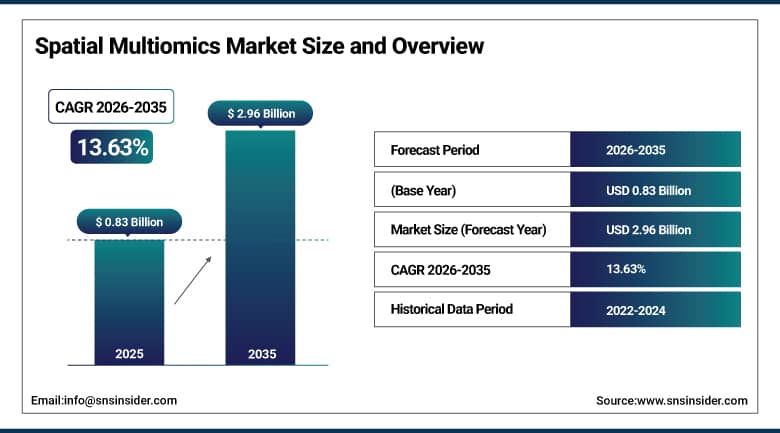
The Spatial Multiomics Market was valued at USD 0.83 Billion in 2025 and is projected to reach USD 2.96 Billion by 2035, expanding at a CAGR of 13.63% during the forecast period 2026–2035.
The spatial multiomic market has experienced hyper-growth over recent years, with researchers driving the adoption of techniques that profile multiple molecules including gene expression, proteins and metabolomics’ in the context of tissue biology. Offering high-resolution data on cellular interactions and within tissue diversity, spatial multiomics technology is critical in supporting researchers within oncology, neuroscience, immunology, and precision medicine. A new report from Precedence Research finds that advancements in next-generation sequencing, highplex-imaging technologies, artificial intelligence-based analytical methods and cloud-based bioinformatics platforms will drive the use of spatial multiomics by academia, pharmaceutical companies, and translational research institutions.
Key drivers contributing to growing market penetration in spatial multiomics is an increase in investment in single-cell and spatial biology programs; increasing application of biomarker driven drug development as well as a demand from healthcare industry for reproducible tissue-level molecular profiling. Growing importance of artificial intelligence in image segmentation, recognizing spatial patterns in multiple markers or types of molecules, and inferring meaning from the integrated information is boosting overall efficiency and capacity to analyze huge data sets.
To Get More Information On Spatial Multiomics Market - Request Free Sample Report
Spatial Multiomics Market Trends:
-
Increasing adoption of spatial transcriptomics in oncology research programs.
-
Growing integration of AI-driven spatial data interpretation platforms.
-
Expansion of cloud-based bioinformatics and collaborative analytics workflows.
-
Rising pharmaceutical investment in tissue-level biomarker discovery.
-
Convergence of sequencing, imaging, and proteomics technologies.
U.S. Spatial Multiomics Market Size Outlook:
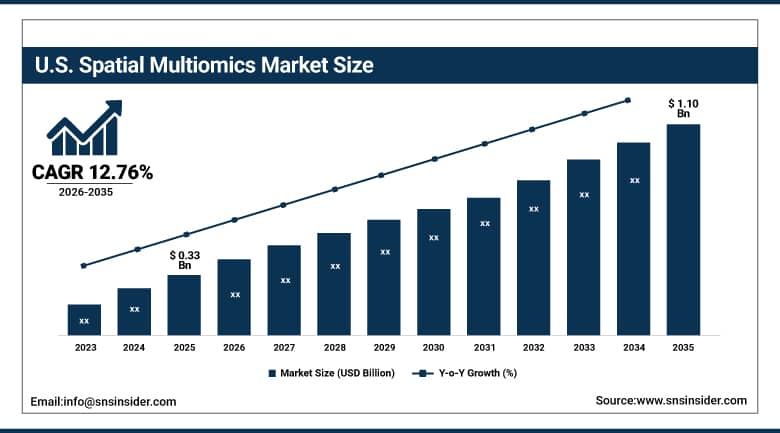
The U.S. Spatial Multiomics Market was valued at USD 0.33 billion in 2025 and is expected to reach approximately USD 1.10 billion by 2035, expanding at a CAGR of 12.76% during 2026–2035.
The U.S. Maintains its hold on the North American marketplace powered by its research strengths in biomedical facilities, high density of drug and biotech companies, and vast research investment in cancer, neuroscience and precision medicine projects. Academic medical centers (AMCs) and research consortia are greatly increasing investment in spatial transcriptomics, multiplex imaging and AI-tissue analytic technologies as drivers in speeding up finding new biomarkers and developing therapies; with established tech developers and companies in sequencing platforms to foster faster commercial viability and deployment.
A recent important trend to follow is the development of larger-scale of national level spatial biology programs undertaken by US researchers and commercial organizations. Industry organizations have developed an increased focus on an all-in-one sequencing, imagery, and cloud data analytic pipeline that boosts both throughput and robustness in clinical applications of spatial data. The demand for companion diagnostics in addition to tissue testing and molecular profile in the future may fuel this sector more due to the use cases related to spatial multiomics applications.
Spatial Multiomics Market Segment Analysis:
-
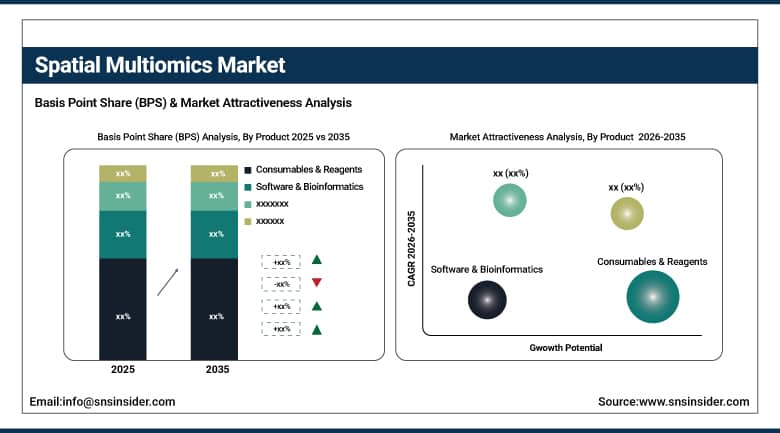
By Product, consumables & reagents dominated the market with 45.00% share in 2025, while software & bioinformatics is projected to witness the fastest growth with 14.97% CAGR during 2026–2035.
-
By Technology, spatial transcriptomics dominated the market with 35.00% share in 2025, while spatial proteomics is projected to witness the fastest growth with 14.47% CAGR during 2026–2035.
-
By Application, oncology research dominated the market with 39.00% share in 2025, while drug discovery & development is projected to witness the fastest growth with 14.62% CAGR during 2026–2035.
-
By End User, academic & research institutes dominated the market with 38.00% share in 2025, while pharmaceutical & biotechnology companies are projected to witness the fastest growth with 15.20% CAGR during 2026–2035.
By Product, consumables & reagents dominated the market, while software & bioinformatics grows fastest.
In 2025, the consumables & reagents accounted for the largest share, 45.00%, in the market size. The growing demand can be attributed to their reusability nature in most of the spatial transcriptomics, spatial proteomics and spatial imaging workflows. Library preparation kits, capture probes, antibodies, staining reagents and sequencing consumables are major part of budget for any research labs & Pharma organizations. As most of the spatial studies are gradually moving from pilot-project to cohort studies in large scale, consumption of standardized higher flow Consumables is growing.
The current trend in the industry is introduction of higher plex reagent panels and workflow dedicated consumables for Oncology and Immunology. Software & bioinformatics to witness fastest growth with a CAGR of 14.97% between 2026 and 2035. With the spatial data complexities mounting, there will be high need for advanced analytic platform to aggregate complex spatial datasets includingomics and Imaging data. Use of AI for image segmentation, cell-typing annotation, spatial clustering & Predictive modeling has become crucial in spatial biology. Cloud integrated solutions along with interoperability standards across research stakeholders are driving greater use among large research consortium and organizations and are increasing speed of Adoption.
By Technology, spatial transcriptomics dominated the market, while spatial proteomics grows fastest.
Spatial transcriptomics dominated the market share in 2025 with35.00% to its name. The market’s leading segment dominates by virtue of facilitating in-situ analysis of gene expression in original tissue anatomy which supports visualization for cellular heterogeneity, cancer microenvironments and evolutionary anatomy at finest resolution. It is employed across studies of cancer, an atlas development, transitional biology, etc., for providing the basic platform to the total platform of spatially diverse multiomics technology. The field’s momentum is on rising toward multiomics based integrated sequencing and imaging workflow that assist with raising data output and standards, technology provider; offering superior grade imaging platform and automated sample preparing mechanisms for scaled analyses.
Growth of spatial proteomics to record highest CAGR of 14.47%. Its rapid progress is in rise by and by due to the understanding that protein’s expression along with it’s’ post translational modifications conveys info of a different, and often greater, value over transcriptomics. Moreover, Highplex-based imaging that include antibody-labeling of specific proteins together with mass-spec based spatial proteomics and AI powered image processing capabilities allows high resolution protein and image evaluation within any target area and also enables the precise detection and spatial analysis of immune cell infiltration, therapeutic responses and novel therapeutic targets.
By Application, oncology research dominated the market, while drug discovery & development grows fastest.
Oncology research held 39.00% share of global spatial multiomics market size in 2025, the spatial multiomics market, based on application segments, in 2025, was dominated by the Oncology Research segment. The growing necessity to decode tumor heterogeneity, cellular co-operations, immunological cell infiltration and drug resistance at a single cellular level resolution led to such a dominant trend of this segment. Spatial multiomics has developed into a crucial technology for the identification of innovative breast cell markers, tumor microenvironment analyses and supports various applications for tailored cancer therapy approaches. Major cancer pharmaceutical companies, research organizations in translation medicine, etc. are using comprehensive spatial molecular and tissue scan data for better identification and therapy choosing criteria of cancerous patients.
Drug development is predicted to expand at a CAGR of 14.62% over the forecast period of 2026-2035, leading pharmaceutical and biotechnology firms are adopting spatial multiomics in their earliest phase development activities as an imperative strategy towards effective identification of a new target(s), to analyze the mode(s) of action of drugs, assessment of toxic effects, & evaluation of markers. The combination of molecular imaging, proteomics, and transcriptomics within the integrity of tissues helps better perceive and determine biological aspects of various maladies while diminishing risks in later stage drug-making prospects.
Regional Analysis:
|
Region |
Major Country |
Share within Region, 2025 (%) |
|---|---|---|
|
North America |
United States |
93.00% |
|
Europe |
Germany |
29.00% |
|
Asia Pacific |
China |
22.00% |
|
Middle East & Africa |
UAE |
3.50% |
|
Latin America |
Brazil |
2.50% |
North America Spatial Multiomics Market Insights
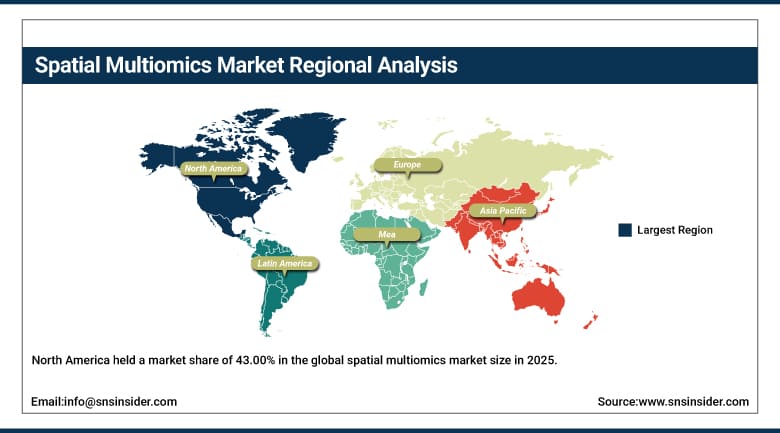
North America held a market share of 43.00% in the global spatial multiomics market size in 2025, which can be attributed to various factors such as the established genomics ecosystem, extensive biomedical funding, and the presence of major biotechnology firms in the region. Within North America, the U.S. Leads to its increasing funding of precision medicine, cancer genomics research, and translation of R&D from university research, life sciences companies to the government.
Widespread adoption of technologies such as high-resolution spatial transcriptomics, multiplex imaging, and advanced AI-based Bioinformatics platform in commercial, diagnostic and academic spaces has sped up the adoption in the R&D settings as well as clinical development. Innovation by platform providers combined with strategic alliances between sequencing companies and pharma has supported the dominance of the market in the region. Ongoing investments in national biomedical missions and development of cloud infrastructure will likely enhance the role of this region in driving the growth of the spatial multiomics market during the forecasted timeline.
Get Customized Report as Per Your Business Requirement - Enquiry Now
Europe Spatial Multiomics Market Insights
Europe benefits from robust biomedical research infrastructure, global research collaborations and strong governmental investment in genomics as well as precise medicine, with countries like Germany, UK, France, Switzerland and the Netherlands continue expanding research scope for cancer biology, neurobiology, immunology and rare diseases. Academic institutions and tech organizations are leveraging their translational medical applications by integrating spatial multiomics to accelerate biomarker research and therapeutic discovery. Strong increased investments toward digital pathology, artificial intelligence (AI), and advance molecular diagnostics are also facilitating expansion for the whole market. Several collaborations between Europe-based life sciences organization and tech developers enhanced the utilization of spatial high-throughout-ness in recent years.
Asia Pacific Spatial Multiomics Market Insights
The fastest CAGR of 16.81% during 2026-2035 in Asia Pacific is anticipated. Quick growth in Biotechnology R&D, increment of healthcare spending, and immense investment in genomic medicine have accelerated the growth of usage all across China, Singapore, Japan, Singapore, India and Australia, as governmental policies to develop national precision medicine plans increase the genomics infrastructure and financing.
Increase in using spatial multiomics in the drug manufacturing, tumor-oncology and other immunity fields for the growing usage of genomic data by medicinal companies is attributed to growing access of latest high quality sequencing technology along with bio informatics knowledge. Recent investment in specialized genomic innovation centers and hi-technology molecular investigation facilities have speeded up the regional acceptance for most modern technologies in the top of Asia and west Pacific.
Middle East & Africa and Latin America Spatial Multiomics Market Insights
The Middle East & Africa market is steadily growing driven by increased spending on biomedical research infrastructure, precision medicine initiatives, and advanced molecular diagnostics. The United Arab Emirates, Saudi Arabia, and South Africa, among others, continue to scale up their national genomics programs through collaborative initiatives with global researchers and technology vendors. The growing consciousness regarding personalized medicine and increasing setting up of specialized research facilities are facilitating incremental uptake of spatial multiomics technologies. The region anticipates long-term market gains through sustained government investments towards boosting biotech innovation.
Latin America is showing sustained expansion led by ramping up of research work in countries such as Brazil, Mexico, Argentina, and Chile along with the expansion of academic tie-ups and growth of R&D investment in the area of genomics. Collaboration among academia, biotech companies and clinical research organizations are increasingly employing spatial biology techniques across the spectrum of oncology and translational research. Expansion of healthcare and biotech infrastructure within the Latin America region along with increased involvement of countries with international precision medicine consortia will pave way for growth in the market for next decade.
Market Dynamics:
Growth Drivers: Adoption of precision medicine and spatial biology in translational research.
The proliferation of precision medicine initiatives and the growing trend of studying tissue microenvironment are among the most powerful growth drivers for the spatial multiomics market. Unlike traditional sequencing strategies, spatial multiomics offers deeper biological insight by simultaneously assessing gene expression, protein location and interactions between cells in their native tissue context. Biotechnology companies, pharmaceuticals and academic institutions are utilizing the technology for discovery of novel biomarkers, patient stratification and target identification in oncology, neuroscience, immunology and rare diseases.
Enhancements in sequencing chemistries, multiplex imaging, artificial intelligence and cloud computing bioinformatics platforms continue to drive faster and more efficient spatial multiomics workflows, which are becoming invaluable tools in translational and clinical research across the healthcare market. In June 2025, 10x Genomics launched new Xenium spatial platform solutions and higher plex capabilities, which can lead to greater biological insights at the tissue level.
Restraints: Prohibitive cost and computation hinder wider market penetration.
Spatial multiomics cannot gain widespread commercial viability due to the costly instruments, disposables and in-house laboratories plus associated compute required to enable access to such an experiment. Expensive high-resolution cameras, next-generation sequencers, automated liquid handlers and AI image processing need costly upfront investment, such that even research facilities that would benefit from such applications may lack the necessary funding.
Add a growing expectation among scientists and laboratory operations for standardized analysis protocols to understand large multidimensional sets and the need for high-powered computing and it's clear why not only is a large team of experienced bio-informaticians required but also scalability through secure and flexible cloud-compute resources. Lack of an all-inclusive workflow with interoperability will also stall even a broader implementation in evolving health markets. Standard Bio Tools focused on the 2025 launch in further developing of in vitro optimized spatial biology workflow and analytical software to demystify multiomics data and optimize laboratory work.
Opportunities: AI-Powered spatial analytics & pharm biomarker discovery holds significant long term commercial potential.
AI/ML, multi cloud native, bioinformatics and other spatial multiomics components are bringing extensive new commercial value for companies throughout the spatial ecosystem. Automated image segmentation, cell phenol typing classification, modeling protein – protein interactions and predictive biomarker development are being developed in high throughput mode on AI cloud hosted analytical engines. This offers for simplification of the total analysis, higher reproducibility and greater speed of discovery to be gained.
The spatial biology space continues to evolve for large and large pharma for targeted oncology drug discovery, immunotherapy research, companion Diagnostics, Personalized medicine programs. Increasing collaborations between sequencing platform development, commercial, cloud software, CROs and pharm will bring full pipeline, “integrated workflow” spatial multiomics applications for translational research enabling. As clinical utility is developed, spatial multiomics technology will evolve from within only into large-scale translational R&D and into the clinic. Throughout 2025, bruker spatial biology grew spatial proteomics/transcriptomics applications by enhancing its multiplexed imaging product lines to enable translational and biomarker discovery research.
Recent Developments:
-
2026: 10x Genomics expanded its Xenium spatial biology platform by introducing enhanced high-plex imaging capabilities and workflow improvements, enabling more comprehensive tissue-scale molecular analysis for translational and pharmaceutical research.
-
2026: Bruker Spatial Biology strengthened its spatial multiomics portfolio through continued advancement of integrated spatial proteomics and transcriptomics technologies supporting precision medicine and biomarker discovery workflows.
-
2025: Illumina continued expanding collaborations supporting multiomic sequencing and advanced genomic research, reinforcing integration between next-generation sequencing and spatial biology applications.
-
2025: Standard BioTools advanced its spatial biology solutions by enhancing high-parameter imaging, proteomics, and computational analysis capabilities for translational research laboratories worldwide.
Spatial Multiomics Market Key Players are:
-
10x Genomics, Inc.
-
Bruker Corporation
-
Illumina, Inc.
-
Standard BioTools Inc.
-
Vizgen, Inc.
-
Akoya Biosciences, Inc.
-
Parse Biosciences
-
Oxford Nanopore Technologies plc
-
Bio-Techne Corporation
-
Revvity, Inc.
-
Leica Microsystems
-
Zeiss Group
-
Thermo Fisher Scientific Inc.
-
Agilent Technologies, Inc.
-
Danaher Corporation
-
Bio-Rad Laboratories, Inc.
-
S2 Genomics, Inc.
-
Singular Genomics Systems, Inc.
-
Miltenyi Biotec
-
Lunaphore Technologies
Spatial Multiomics Market Report Scope:
| Report Attributes | Details |
|---|---|
| Market Size in 2025 | USD 0.83 Billion |
| Market Size by 2035 | USD 2.96 Billion |
| CAGR | CAGR of 13.63% From 2026 to 2035 |
| Base Year | 2025 |
| Forecast Period | 2026-2035 |
| Historical Data | 2022-2024 |
| Report Scope & Coverage | Market Size, Segments Analysis, Competitive Landscape, Regional Analysis, DROC & SWOT Analysis, Forecast Outlook |
| Key Segments | • By Product (Consumables & Reagents, Instruments, Software & Bioinformatics, Services) • By Technology (Spatial Transcriptomics, Spatial Proteomics, Spatial Genomics, Spatial Metabolomics, Others) • By Application (Oncology Research, Drug Discovery & Development, Neuroscience, Immunology, Others) • By End User (Academic & Research Institutes, Pharmaceutical & Biotechnology Companies, Hospitals & Diagnostic Centers, Contract Research Organizations) |
| Regional Analysis/Coverage | North America (US, Canada), Europe (Germany, UK, France, Italy, Spain, Russia, Poland, Rest of Europe), Asia Pacific (China, India, Japan, South Korea, Australia, ASEAN Countries, Rest of Asia Pacific), Middle East & Africa (UAE, Saudi Arabia, Qatar, South Africa, Rest of Middle East & Africa), Latin America (Brazil, Argentina, Mexico, Colombia, Rest of Latin America). |
| Company Profiles | 10x Genomics, Inc., Bruker Corporation, Illumina, Inc., Standard BioTools Inc., Vizgen, Inc., Akoya Biosciences, Inc., Parse Biosciences, Oxford Nanopore Technologies plc, Bio-Techne Corporation, Revvity, Inc., Leica Microsystems, Zeiss Group, Thermo Fisher Scientific Inc., Agilent Technologies, Inc., Danaher Corporation, Bio-Rad Laboratories, Inc., S2 Genomics, Inc., Singular Genomics Systems, Inc., Miltenyi Biotec, Lunaphore Technologies |
Frequently Asked Questions
The Spatial Multiomics Market was valued at USD 0.83 Billion in 2025.
The market is projected to reach USD 2.96 Billion by 2035.
The market is anticipated to expand at a CAGR of 13.63% during the forecast period.
North America dominated the global Spatial Multiomics Market with a 43.00% revenue share in 2025.
Consumables & Reagents accounted for the largest revenue share of 45.00% in 2025.
