
Permanent Artificial Skin Market Report Scope & Overview:
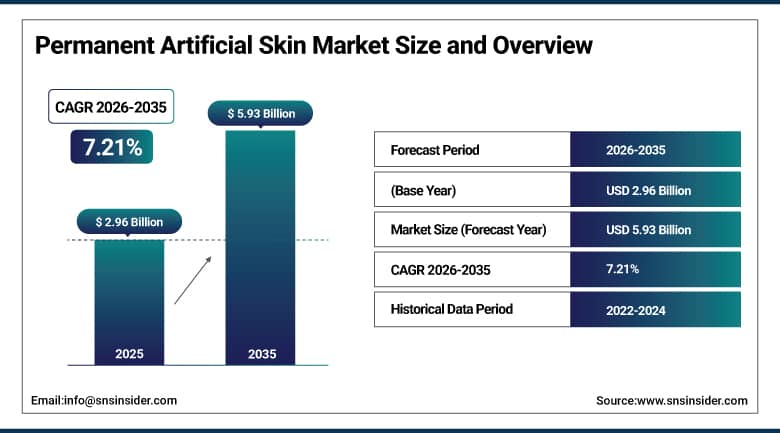
The Permanent Artificial Skin Market was valued at USD 2.96 Billion in 2025 and is projected to reach USD 5.93 Billion by 2035, expanding at a CAGR of 7.21% during the forecast period 2026–2035.
The market for permanent artificial skin is constantly expanding owing to the rising occurrences of extensive burns, chronic wounds, diabetic ulcers, trauma injuries and reconstructive surgical operations that demands permanent dermal substitution. Advanced biomaterials, tissue engineering and regenerative medicine technologies are being utilized to develop permanent artificial skin that replicates structure and physiology of skin. The ongoing advancements of a cellular dermal matrices, cellular skin substitutes, hybrid scaffolds and engineered skin substitutes are enhancing engraftment, vascularity and the risk of infections to provide better results. Investment in tissue engineering, biomaterial innovation, stem cells technologies, bio printing platform and bio fabrication platform has changed the competition in the market of permanent artificial skin.
Integration of 3D bio printing, bioactive extracellular matrices, complex collagen scaffolds, AI-based wound assessment platforms and targeted regenerative therapies are leading towards personalized therapies that facilitate accelerated healing and shorten hospitalization. In April 2025, the US FDA approved AVITA Medical's RECELL GO system that provides point-of-care regenerative treatment for acute thermal burn patients and strengthens utilization of revolutionary skin regeneration methods within the American burn centers.
To Get More Information On Permanent Artificial Skin Market - Request Free Sample Report
Permanent Artificial Skin Market Trends:
-
Increasing adoption of bioengineered permanent skin substitutes for complex wound management.
-
Growing investments in tissue engineering and regenerative medicine technologies globally.
-
Rising utilization of hybrid biomaterials improving graft durability and integration.
-
Expansion of specialized burn centers driving advanced skin replacement procedures.
-
AI-enabled wound assessment supporting personalized regenerative treatment planning.
U.S. Permanent Artificial Skin Market Size Outlook:
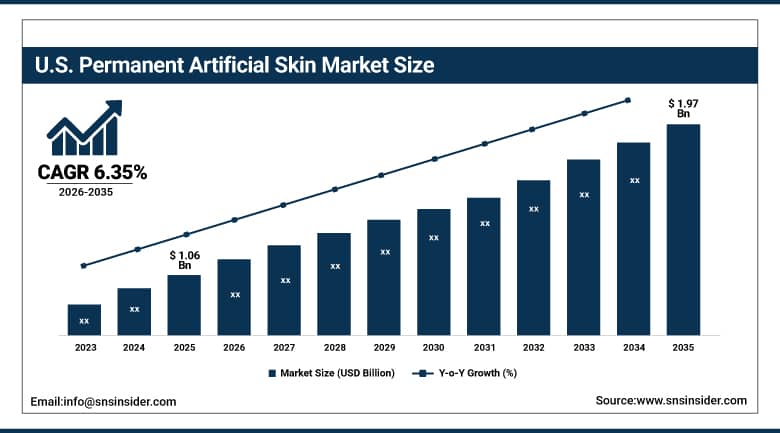
The U.S. Permanent Artificial Skin Market was valued at USD 1.06 billion in 2025 and is expected to reach approximately USD 1.97 billion by 2035, expanding at a CAGR of 6.35% during 2026–2035.
The United States leads the North American market for permanent artificial skin. The high quality of the US healthcare systems, the capabilities of its burn centers, excellent reimbursement facilities and fast commercialization of regenerative medicine technologies have contributed significantly to the market's success. The rising number of diabetic patients, chronic wounds, burn injuries and complex reconstructive surgery procedures, have boosted the demand for permanent skin replacement products in all hospitals and wound care centers. The investment in biological skin substitutes, the study and development of extracellular matrix (ECM) products and a cellular dermal matrix (ADM) and tissue engineered skin products is rapidly improving outcomes with fewer chances of infection and no reoperations.
The partnership among biotech companies and academic institutions is a driver in developing and launching new technologies. With advanced wound care programs becoming more efficient using AI powered wound assessment systems, advanced regenerative medicines, 3D bio printing capabilities and latest cellular skin substitutes, a great demand is predicted. AVITA Medical was focused on expanding commercialization in the U.S. After receiving FDA approval for RECELL GO in 2025; strengthening the care for burns patients in various hospitals and centers.
Permanent Artificial Skin Market Segmentation Analysis:
-
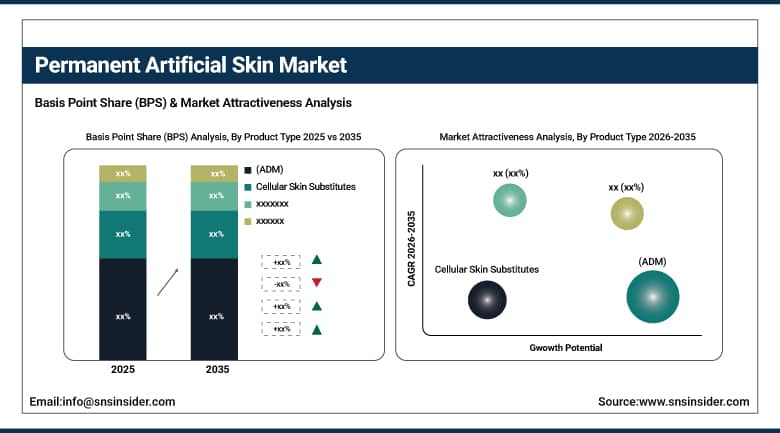
By Product Type, acellular dermal matrices (ADM) dominated the market with 31.00% share in 2025, while cellular skin substitutes are projected to witness the fastest growth with 8.70% CAGR during the forecast period.
-
By Material, biological materials dominated the market with 44.00% share in 2025, while hybrid biomaterials are projected to witness the fastest growth with 8.87% CAGR during the forecast period.
-
By Application, burn treatment dominated the market with 33.00% share in 2025, while chronic wounds are projected to witness the fastest growth with 8.65% CAGR during the forecast period.
-
By End User, hospitals dominated the market with 46.00% share in 2025, while specialty wound care clinics are projected to witness the fastest growth with 9.38% CAGR during the forecast period.
By Product Type, acellular dermal matrices (ADM) dominated, while cellular skin substitutes grows fastest.
Acellular dermal matrices (ADMs) held 31.00% of the permanent artificial skin market share in 2025 based on their extensive clinical applications in reconstructive surgery, soft tissue reconstruction, and burn healing and chronic wounds. As these biologically derived matrices demonstrate robust biocompatibility, fast vascularization, structural support and minimal immune response, ADMs remained the first choice in Permanent Dermal replacement. In May 2025, the clinical application of Integra Life Science’s dermal regeneration technologies maintained traction with growth in reconstructive and complex wound care procedures, expanding their use in acute burn treatment programs.
Cellular skin substitutes recorded the fastest CAGR of 8.70% through the forecast period 2026 to 2035 in line with growing interest in regenerative medicine and functional tissue replenishment. These products utilize living cells which contribute to accelerated wound closure, angiogenesis, epithelial healing and collagen production; they are particularly suited for large tissue deficits and chronic wound care. With the advancements in stem cell therapy, regenerative medicine, bioactive scaffold and tissue engineering technologies, the therapeutic potential of cellular skin substitutes continued to rise, facilitating personalized regenerative therapies. In 2025, Organogenesis Holdings Inc. Further broadened its cellular regenerative products through ongoing research that supports tissue regeneration and advanced wound healing applications.
By Material, biological materials dominated, while hybrid biomaterials grows fastest.
Bio-Materials accounted for the largest market share of 44.00% in 2025 due to their great biocompatibility, natural extracellular matrix architecture, outstanding tissue incorporation and well-established long-term clinical efficacy. The use of materials derived from human or animal tissues allows cells to effectively colonize, vascularize and naturally regenerate skin with minimal inflammation. In 2025 MiMedx Group accounted for the continued market penetration of biologic regenerative medicine solutions for advanced wound care and tissue repair in healthcare institutions.
Hybrid Bio-Materials were projected to exhibit the fastest CAGR of 8.87% over the forecast period owing to their characteristic combination of biological materials' regenerative characteristics and synthetic polymer's robust mechanical properties and rigidity. Hybrid bio-materials offer greater structural stability, tunable biodegradation patterns, enhanced antimicrobial properties and an optimized environment for cell proliferation, accelerating skin regeneration in the long run. Researchers from National Institutes of Health in 2025 advanced the research of hybrid bio-materials for better vascularization and functional skin regeneration.
By Application, burn treatment dominated, while chronic wounds grows fastest.
The burn treatment segment represented a 33.00% share of the permanent artificial skin market in 2025 as a result of the growing prevalence of severe thermal injuries that necessitates permanent replacement or long-term constructive care. Permanent artificial skin ensures a better healing with efficient wound closure, reduced chances of infections, decreased fluid loss, and better cosmetic and functional recovery in the patients with severe burns. In April 2025 AVITA Medical received expanded FDA approval for RECELL GO and enhanced the regenerative treatments to acute thermal burn patients in the whole United States.
The chronic wounds segment is expected to emerge as the fastest growing segment with an 8.65% CAGR in the forecast period owing to the fast growing incidence of diabetic foot ulcers, venous leg ulcers, pressure injuries, and age related chronic wounds in the entire world. The permanent artificial skin products ensure durable tissue regeneration, rapid healing, and decreased recurrence in comparison with conventional methods of wound treatment. During 2025, Wound Healing Society encouraged the evidence based acceptance of advanced biological skin substitutes for managing chronic wounds through updated educational awareness programs.
Regional Analysis:
|
Region |
Major Country |
Share within Region, 2025 (%) |
|---|---|---|
|
North America |
United States |
92.00% |
|
Europe |
Germany |
28.00% |
|
Asia Pacific |
China |
26.00% |
|
Middle East & Africa |
UAE |
4.00% |
|
Latin America |
Brazil |
3.00% |
North America Permanent Artificial Skin Market Insights
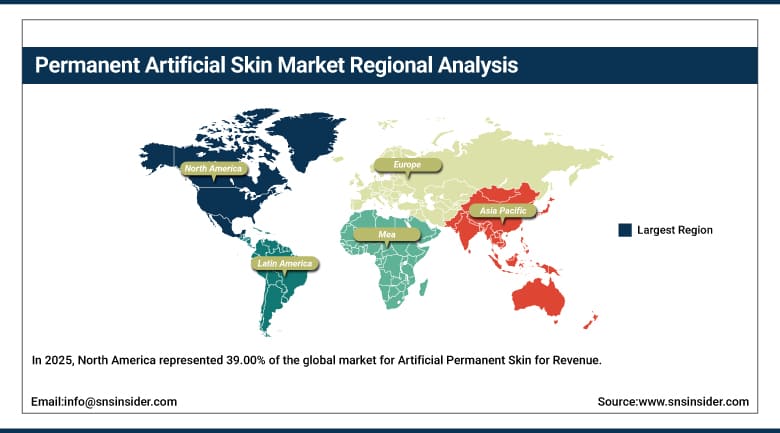
In 2025, North America represented 39.00% of the global market for Artificial Permanent Skin for Revenue, due to superior healthcare infrastructure, a growing prevalence of regenerative medicines utilization, sophisticated burn treatment centers, and favorable healthcare reimbursement policies for modern wound care across the United States. The demand for artificial skin Substitutes, biologic acellular skin grafts, and tissue generated constructs is increasing in North America.
As demand and growth of such medical solutions improve globally due to increased technological R&D, strong commercialization of regenerative technologies and increased biotechnology collaboration with health-care facilities, so will the Regional Market’ growth increase at rapid rates for application in chronic wounding. A boost for burn-focused treatments as AVAITA MEDICAL is granted by the US Food & Drug Administration approval extension for their RECELL GO System as of April 2025 to augment acute thermal burn treatments.
Get Customized Report as Per Your Business Requirement - Enquiry Now
Europe Permanent Artificial Skin Market Insights
Europe still ranks as the most mature geographical market for the permanent use of artificial skin due to robust healthcare systems, incidence of chronic wound conditions and rapid adoption of regenerative medicine techniques in European Countries (e.g., GER, FRA, GBR, ITA, ESP), the investments are substantially made in the field of tissue engineering (TE), in biologics wound healing and reconstructive surgeries. The demand of advanced skin substitute in the European region are rising due to rise in the aging population and increase in the number of diabetic foot ulcers, and supportive reimbursing practices promote clinical usage. Smith+Nephew continued to increase penetration into European healthcare systems for innovative advanced wound solutions in 2025.
Asia Pacific Permanent Artificial Skin Market Insights
The Asia Pacific’s permanent artificial skin market to witness fastest Growth Rate China-By End Use, 2025 As Asia Pacific permanent artificial skin market is expected to expand with a faster CAGR 9.46% from 2026 to 2035; rapid progress of healthcare infrastructure development, rising healthcare expenditures, expansion of burn care centers and proliferating incidences of chronic diabetes wounds are driving market growth significantly.
China, Japan, South Korea, Australia, and India are heavily invested in innovative research on regenerative medicines; and advancement of tissue engineering, modern wound care solutions are significantly boosting its market, on rise as public's know -how about the same along with increased domestic supply of biomaterials are leading to create opportunities of manufacturers within The Asian Pacific. China Academy of Sciences was continually leading to the Tissue Engineering research with their breakthrough development of next gen bioengineered skin Substitutes for regenerative Wound.
Middle East & Africa and Latin America Permanent Artificial Skin Market Insights
The Middle East & Africa market is gradually growing due to enhanced healthcare infrastructure, surge in investments towards specialized burn care centers, and growing access to regenerative wound care. Saudi Arabia, UAE, and South Africa among several other countries are witnessing increased pace of strengthening their trauma care service and expanding access to skin substitutes and reconstructive procedures. By 2025 Dubai Health is expanding specialized burn and reconstruction procedure by strengthening the availability of the regenerative care based solution technologies in various health facilities.
Latin America is observing the gradual growth in the market size on account of expansion in healthcare infrastructure and funding, increase in awareness about the novel wound management, rise in chronic wound and injuries like diabetic ulcers and burns and more widespread availability of biologic products. Brazil, Mexico and Argentina and Chile represent key markets in the region as they account for the growth in terms of facilities for regenerative medicine and rise in the adoption of innovative wound solutions. By 2025, MiMedx Group is widening the reach of its regenerative medicine and wound care solution product in several countries by adopting strategic distribution partners to work with the region’s clinicians.
Growth Drivers: Growing instances of chronic wounds driving increased need for permanent skin regeneration.
Rising global burden of chronic wounds, burns, traumatic injuries, diabetic foot ulcers, venous leg ulcers, and pressure injuries is one of the factors leading to growth in the permanent artificial skin market. Increased life expectancy, rapid growth in diabetes affected people and prevalence of obesity have led to a significant rise in the patients requiring innovative wound care solutions for permanent tissue regeneration. Traditional treatments cannot fully replace dermis in extensive tissue loss thereby increasing the use of permanent artificial skin solutions offering better vascularization, and improved patient recovery. AVITA Medical broadened commercialization of its RECELL GO regenerative treatment platform after acquiring another FDA approval, thereby enhancing advanced burn care and permanent skin regeneration among US healthcare providers.
Restraints: High costs and complicated production limiting application.
The overall benefits of treatment with permanent skin substitutes are undeniable, but adoption in the clinical practice space will continue to be stymied by expensive manufacturing operations. The manufacture of the biological substrates, tissue-engineered devices, and living cell based skin substitute’s demand manufacturing infrastructure, significant quality controls, sterile development operations, and clinical trial validation to achieve viable.
In addition to product development costs, third party reimbursement issues for medical facilities in the emerging economies can pose challenges to equitable treatment delivery of innovative regeneration techniques. Storage conditions, the expiration dates of some biologics, additional surgical skill required for deployment of advanced products, and elongated time for regulatory approval pose additional constraints for the commercialization of any new and innovative material. To address those challenges, Integra Life Sciences continued their efforts on manufacturing operations and process improvements focused on enhancing scale.
Opportunities: Tissue engineering, hybrid biomaterials, and regenerative medicine offer major scope for commercial growth.
Innovative advancements in the stem-cell biology, three-dimensional bio printing, extracellular matrix engineering, regenerative medicine, and biomaterial science are leading considerable long-term commercialization opportunities in the Permanent Artificial Skin Market. These can potentially deliver lasting graft solutions for various burn and reconstruction needs. Advanced mechanical integrity through composite designs enhances Graft durability and vascular function during implantation and promotes a greater level of tissue regeneration.
Improved clinician efficiency and improved Patient outcomes by aided intelligent clinical decisions and patient monitoring. National Institutes of Health supported different research initiatives focused toward creating bioengineered skin substitutes by the using the three-dimensional (3D) and stem cell bio printing processes to improve tissue characteristics.
Recent Developments:
-
2026: Smith+Nephew continued strengthening its Advanced Wound Management portfolio through ongoing innovation and commercialization of biologic wound healing technologies across global healthcare markets.
-
2025: Organogenesis Holdings Inc. continued advancing clinical evidence supporting its portfolio of regenerative wound care products for chronic wound management and tissue repair.
-
2025: Integra LifeSciences expanded investments in regenerative tissue technologies and manufacturing capabilities to support growing global demand for advanced dermal regeneration products.
-
2025: AVITA Medical received U.S. FDA approval for the expanded use of RECELL GO, enhancing point-of-care regenerative treatment options for patients with acute thermal burn injuries.
Permanent Artificial Skin Market Key Players are:
-
AVITA Medical, Inc.
-
MiMedx Group, Inc.
-
Vericel Corporation
-
Mallinckrodt plc
-
B. Braun SE
-
Convatec Group PLC
-
Coloplast A/S
-
Cook Biotech Incorporated
-
Gunze Limited
-
PolyMedics Innovations GmbH
-
Kerecis
-
Mölnlycke Health Care AB
-
Solventum Corporation (formerly 3M Health Care)
-
MedSkin Solutions Dr. Suwelack AG
-
PolyNovo Limited
-
Aroa Biosurgery Limited
-
ETS Wound Care
Permanent Artificial Skin Market Report Scope:
| Report Attributes | Details |
|---|---|
| Market Size in 2025 | USD 2.96 Billion |
| Market Size by 2035 | USD 5.93 Billion |
| CAGR | CAGR of 7.21% From 2026 to 2035 |
| Base Year | 2025 |
| Forecast Period | 2026-2035 |
| Historical Data | 2022-2024 |
| Report Scope & Coverage | Market Size, Segments Analysis, Competitive Landscape, Regional Analysis, DROC & SWOT Analysis, Forecast Outlook |
| Key Segments | • By Product Type (Acellular Dermal Matrices (ADM), Cellular Skin Substitutes, Composite Skin Constructs, Collagen-Based Skin Scaffolds, Others) • By Material (Biological Materials, Synthetic Biomaterials, Hybrid Biomaterials, Stem Cell-Based Constructs) • By Application (Burn Treatment, Chronic Wounds, Trauma & Reconstructive Surgery, Diabetic Foot Ulcers, Others) • By End User (Hospitals, Burn Centers, Specialty Wound Care Clinics, Research Institutes, Others) |
| Regional Analysis/Coverage | North America (US, Canada), Europe (Germany, UK, France, Italy, Spain, Russia, Poland, Rest of Europe), Asia Pacific (China, India, Japan, South Korea, Australia, ASEAN Countries, Rest of Asia Pacific), Middle East & Africa (UAE, Saudi Arabia, Qatar, South Africa, Rest of Middle East & Africa), Latin America (Brazil, Argentina, Mexico, Colombia, Rest of Latin America). |
| Company Profiles | Integra LifeSciences Holdings Corporation, Organogenesis Holdings Inc., Smith+Nephew plc, AVITA Medical, Inc., MiMedx Group, Inc., Vericel Corporation, Mallinckrodt plc, B. Braun SE, Convatec Group PLC, Coloplast A/S, Cook Biotech Incorporated, Gunze Limited, PolyMedics Innovations GmbH, Kerecis, Mölnlycke Health Care AB, Solventum Corporation (formerly 3M Health Care), MedSkin Solutions Dr. Suwelack AG, PolyNovo Limited, Aroa Biosurgery Limited, ETS Wound Care |
Frequently Asked Questions
The Permanent Artificial Skin Market was valued at USD 2.96 Billion in 2025.
The market is projected to reach USD 5.93 Billion by 2035.
The market is anticipated to expand at a CAGR of 7.21% during the forecast period.
North America dominated the global Permanent Artificial Skin Market in 2025 with a 39.00% revenue share.
Acellular Dermal Matrices (ADM) accounted for the largest revenue share of 31.00% in 2025.
