
AI Edge Computing Infrastructure Market Report Scope & Overview:
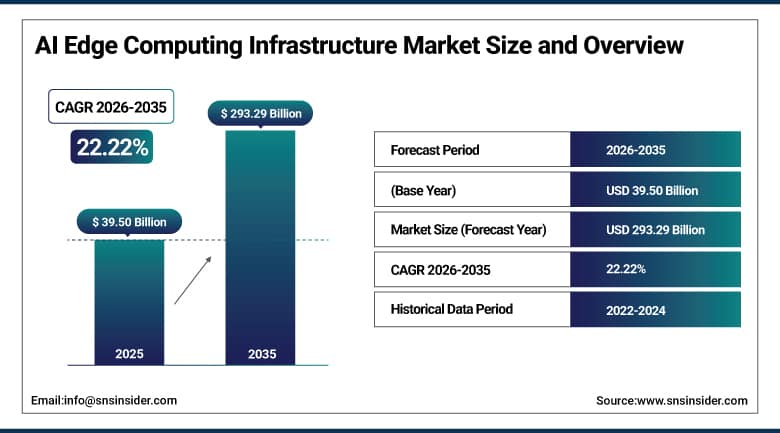
The AI Edge Computing Infrastructure Market was valued at USD 39.50 Billion in 2025 and is expected to reach USD 293.29 Billion by 2035, growing at a CAGR of 22.22% from 2026–2035.
The AI Edge Computing Infrastructure Market is experiencing consistent growth due to increasing demand for low-latency, high-performance, scalable, and reliable computing infrastructure closer to data sources. The expansion of artificial intelligence, Internet of Things (IoT), 5G networks, autonomous systems, smart devices, and real-time analytics is driving demand for distributed edge computing capabilities. Investments in edge AI processors and accelerators, edge servers, edge storage, networking equipment, edge gateways, and micro data centers are enhancing computational performance, connectivity, scalability, and energy efficiency. Companies are focusing on faster AI inference, real-time data processing, reduced latency, improved bandwidth utilization, and efficient workload distribution between edge and cloud environments. Growing demand for localized computing across manufacturing, healthcare, automotive and transportation, telecommunications, retail and e-commerce, and energy and utilities is accelerating the deployment of edge infrastructure.
In September 2026, MINISFORUM unveiled next-generation Edge AI computing solutions powered by AMD Ryzen AI MAX+ PRO 495 processors, introducing new local AI computing platforms designed to deliver high-performance AI processing closer to data sources. The developments are expected to support the expansion of AI edge infrastructure globally by improving local inference capabilities, processing efficiency, responsiveness, and deployment flexibility across intelligent devices and distributed computing environments.
To Get More Information On AI Edge Computing Infrastructure Market - Request Free Sample Report
AI Edge Computing Infrastructure Market Trends
-
Growing demand for low-latency computing is driving the adoption of AI edge infrastructure for real-time data processing and localized AI workloads.
-
Rising deployment of AI, IoT, 5G, autonomous systems, and smart devices is increasing demand for distributed computing closer to data sources.
-
Advancements in edge AI processors, accelerators, servers, storage, networking equipment, and gateways are improving computing performance, connectivity, and scalability.
-
Growing focus on faster AI inference, reduced latency, energy efficiency, and real-time decision-making is creating opportunities for AI edge infrastructure providers.
-
Increasing integration of edge and cloud environments is enabling flexible workload management and supporting the deployment of AI applications across manufacturing, healthcare, automotive, telecommunications, retail, and energy sectors.
U.S. AI Edge Computing Infrastructure Market Outlook
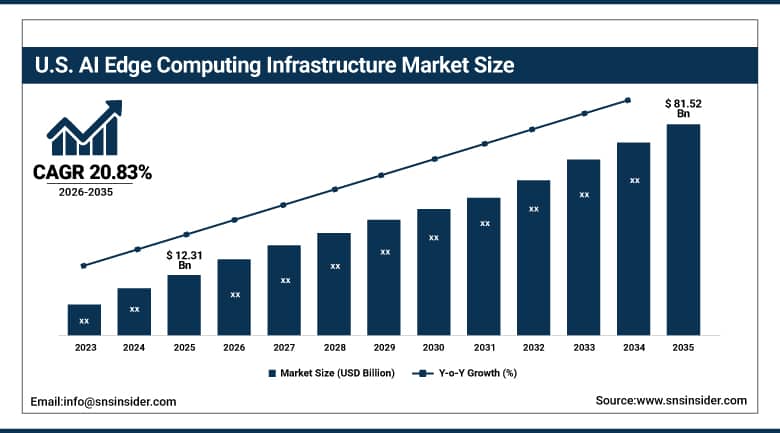
The U.S. AI Edge Computing Infrastructure Market was valued at USD 12.31 Billion in 2025 and is expected to reach around USD 81.52 Billion by 2035, growing at a CAGR of 20.83% from 2026–2035.
The U.S. AI edge computing infrastructure Market is growing steadily due to rising demand for low-latency, high-performance, and scalable computing infrastructure closer to data sources. The expansion of artificial intelligence, IoT, 5G networks, autonomous systems, smart devices, and real-time analytics is driving demand for distributed AI computing capabilities. Investments in edge AI processors and accelerators, edge servers, edge storage, networking equipment, edge gateways, and micro data centers are improving computing performance, scalability, connectivity, and energy efficiency. Growing adoption of edge infrastructure across hyperscale data centers, telecommunications networks, manufacturing facilities, healthcare systems, automotive applications, retail environments, and energy infrastructure is supporting market demand. Companies are focusing on faster AI inference, real-time data processing, reduced latency, efficient workload distribution, and seamless integration between edge and cloud environments.
In April 2026, Comcast announced an initiative with NVIDIA to bring AI processing closer to customers through NVIDIA GPU-powered infrastructure at the network edge, enabling faster processing for next-generation AI applications. The initiative is expected to accelerate adoption of edge AI infrastructure in the U.S. by reducing latency, supporting near-real-time workloads, and expanding distributed AI computing capabilities across telecommunications and enterprise environments.
AI Edge Computing Infrastructure Market Segment Analysis
-
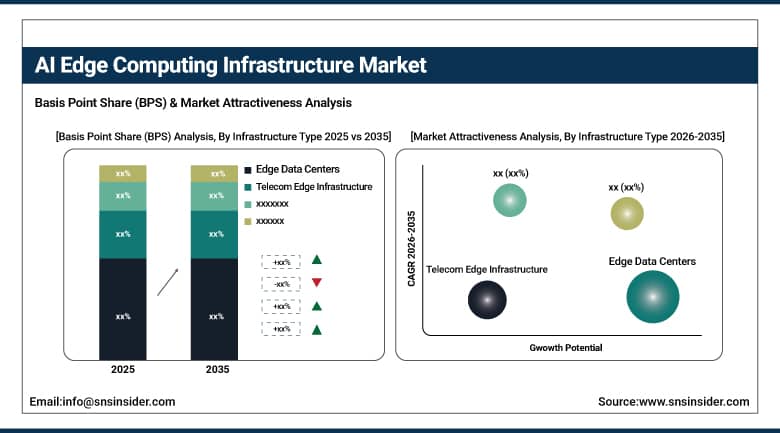
By Infrastructure Type, edge data centers dominated the AI edge computing infrastructure Market with a 31.84% share in 2025, while telecom edge infrastructure is projected to be the fastest-growing segment, registering a 26.54% CAGR during 2026–2035.
-
By Component, edge AI processors & accelerators dominated the AI edge computing infrastructure Market with a 34.62% share in 2025, while other components are projected to be the fastest-growing segment, registering a 24.51% CAGR during 2026–2035.
-
By Deployment, on-premises dominated the AI edge computing infrastructure Market with a 43.76% share in 2025, while hybrid is projected to be the fastest-growing segment, registering a 24.27% CAGR during 2026–2035.
-
By Organization Size, large enterprises dominated the AI edge computing infrastructure Market with a 68.47% share in 2025, while small & medium enterprises are projected to be the fastest-growing segment, registering a 24.50% CAGR during 2026–2035.
-
By Application, computer vision dominated the AI edge computing infrastructure Market with a 32.84% share in 2025, while autonomous systems are projected to be the fastest-growing segment, registering a 27.03% CAGR during 2026–2035.
-
By End Use, manufacturing dominated the AI edge computing infrastructure Market with a 29.63% share in 2025, while automotive & transportation is projected to be the fastest-growing segment, registering a 26.82% CAGR during 2026–2035.
By Infrastructure Type, edge data centers dominated the AI edge computing infrastructure market, while telecom edge infrastructure is expected to grow fastest
Edge data centers accounted for the dominant share in 2025, driven by increasing demand for localized computing, low-latency AI processing, and real-time data management. The rapid growth of AI applications, IoT deployments, autonomous systems, and data-intensive workloads is encouraging organizations to deploy computing resources closer to end users and data sources. Increasing requirements for faster inference, reduced network latency, improved bandwidth utilization, and reliable edge processing are further supporting the expansion of edge data center infrastructure.
Telecom edge infrastructure is projected to exhibit the highest growth rate during 2026–2035. The expansion of 5G networks, distributed computing, connected devices, and real-time AI applications is increasing demand for computing capabilities within telecommunications networks. Telecom operators are increasingly integrating edge computing with network infrastructure to support low-latency AI workloads, intelligent network management, autonomous applications, and real-time analytics. Growing convergence between telecommunications, cloud computing, and AI is expected to further accelerate deployment of telecom-based edge infrastructure.
By Component, edge AI processors & accelerators dominated the AI Edge Computing Infrastructure Market, while other components are expected to grow fastest
Edge AI processors & accelerators held the leading position in the Market in 2025, supported by their critical role in enabling localized AI inference, real-time data processing, and intelligent decision-making at the network edge. Growing deployment of artificial intelligence, Internet of Things (IoT), autonomous systems, smart devices, and real-time analytics is increasing demand for high-performance processing capabilities closer to data sources. Advances in AI accelerators, specialized processors, and energy-efficient edge computing architectures are further improving processing performance, reducing latency, and supporting increasingly complex AI workloads across distributed environments.
Other components are anticipated to register the highest CAGR during the forecast period from 2026 to 2035. Increasing demand for specialized edge infrastructure components, supporting hardware, and emerging technologies is creating opportunities for additional components within AI edge deployments. The expansion of distributed AI workloads, smart infrastructure, industrial automation, and connected devices is expected to accelerate adoption of complementary edge technologies and support the development of more scalable and flexible AI edge computing environments.
By Application, computer vision dominated the AI edge computing infrastructure market, while autonomous systems are expected to grow fastest
Computer vision held the dominant position in the Market in 2025, supported by its extensive use in real-time image and video processing across manufacturing, healthcare, retail, transportation, security, and smart infrastructure. The increasing adoption of intelligent cameras, automated inspection systems, surveillance solutions, and real-time visual analytics is driving demand for edge-based AI processing. Processing visual data closer to the source enables faster decision-making, reduced latency, lower bandwidth requirements, and improved responsiveness for time-sensitive applications.
Autonomous systems are expected to register the highest CAGR during the forecast period from 2026 to 2035. The growing adoption of autonomous vehicles, robotics, drones, industrial automation, and intelligent machines is generating strong demand for localized AI computing capabilities. Autonomous applications require rapid processing of sensor and environmental data to support real-time perception, decision-making, and control. Increasing integration of AI processors, edge servers, sensors, and real-time analytics is expected to accelerate the deployment for autonomous systems.
Regional Analysis
|
Region |
Major Country |
Share within Region, 2025(%) |
|---|---|---|
|
North America |
United States |
82.40% |
|
Europe |
Germany |
34.30% |
|
Asia Pacific |
China |
48.54% |
|
Middle East & Africa |
Saudi Arabia |
23.50% |
|
Latin America |
Brazil |
23.00% |
North America AI Edge Computing Infrastructure Market Insights
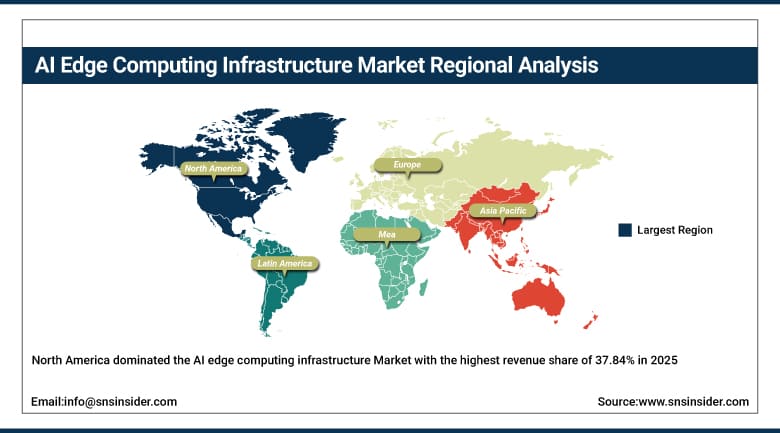
North America dominated the AI edge computing infrastructure Market with the highest revenue share of 37.84% in 2025, supported by its advanced digital infrastructure, strong presence of hyperscale cloud and data center operators, widespread 5G connectivity, and high adoption of artificial intelligence and edge computing technologies. The region is experiencing increasing demand for low-latency computing, real-time data processing, and localized AI inference across manufacturing, telecommunications, healthcare, automotive, retail, and energy applications. Strong investments in AI infrastructure, edge data centers, IoT platforms, autonomous systems, and high-performance computing are encouraging organizations to deploy computing resources closer to data sources.
The growing volume of data generated by connected devices, industrial systems, intelligent cameras, autonomous machines, and enterprise applications is increasing demand for distributed edge computing infrastructure. Organizations are increasingly adopting edge AI processors and accelerators, edge servers, storage, networking equipment, and edge gateways to support faster inference, reduced latency, improved bandwidth utilization, and real-time decision-making. These factors are expected to sustain North America's leading market position through 2035.
Get Customized Report as Per Your Business Requirement - Enquiry Now
Europe AI Edge Computing Infrastructure Market Insights
The AI edge computing infrastructure Market in Europe is expected to witness steady growth over the forecast period, supported by increasing adoption of artificial intelligence, IoT, 5G connectivity, edge data centers, and localized computing infrastructure. Growing digital transformation across industrial, healthcare, automotive, telecommunications, retail, and energy sectors is increasing demand for real-time data processing and low-latency AI capabilities. Organizations are increasingly deploying edge computing infrastructure to process data closer to end users and connected devices while reducing dependence on centralized cloud environments
Germany is anticipated to remain one of the key national markets in Europe, driven by its strong manufacturing base, industrial digitalization, automation initiatives, and increasing adoption of AI-enabled technologies. Investments in edge data centers, AI processors, industrial IoT, autonomous systems, and real-time analytics are creating additional opportunities for AI edge infrastructure providers.
Asia Pacific AI Edge Computing Infrastructure Market Insights
Asia Pacific is expected to grow at the fastest CAGR of about 24.60% from 2026–2035, driven by rapid digital transformation, expanding 5G networks, increasing AI adoption, and accelerating deployment of connected and intelligent devices. Countries including China, Japan, South Korea, India, Singapore, and other Southeast Asian economies are investing substantially in data centers, edge computing infrastructure, smart manufacturing, telecommunications, autonomous systems, and AI-enabled applications.
The increasing deployment of AI processors and accelerators, edge servers, gateways, and micro data centers is strengthening regional demand for distributed computing capabilities. Growing adoption of autonomous vehicles, robotics, intelligent cameras, predictive maintenance, and AI-powered healthcare applications is further increasing the need for low-latency processing
Middle East & Africa and Latin America AI Edge Computing Infrastructure Market Insights
The AI Edge Computing Infrastructure Market in the Middle East & Africa and Latin America is expected to witness consistent growth from 2026 to 2035, supported by expanding telecommunications infrastructure, increasing cloud adoption, 5G deployment, digital transformation, and growing demand for real-time computing. The development of smart cities, connected infrastructure, industrial automation, digital healthcare, intelligent transportation, and modern retail systems is creating demand for localized AI processing and edge computing capabilities.
Saudi Arabia is expected to remain an important market in the Middle East & Africa, supported by investments in digital infrastructure, 5G networks, smart cities, cloud computing, data centers, and AI-enabled technologies. Digital transformation initiatives and economic diversification programs are encouraging the deployment of intelligent infrastructure and localized computing capabilities. In Latin America, Brazil is anticipated to remain a key country-level market due to its large telecommunications sector, expanding cloud and data center infrastructure, increasing IoT adoption, and growing demand for real-time digital services.
Growth Driver: Increasing demand for low-latency and real-time AI computing is driving market growth
One of the key factors driving the growth of the global AI edge computing infrastructure Market is the rapid increase in demand for real-time data processing closer to data sources. The expansion of artificial intelligence, machine learning, Internet of Things (IoT), 5G networks, autonomous systems, smart devices, and real-time analytics is generating substantial demand for localized computing capabilities. As centralized cloud infrastructure can introduce latency and bandwidth constraints for time-sensitive workloads, organizations are increasingly deploying edge AI processors and accelerators, edge servers, edge storage, networking equipment, and edge gateways to process data closer to end users and connected devices.
Restraint: High infrastructure costs and deployment complexity can limit market adoption
The high cost and technical complexity associated with deploying AI edge computing infrastructure can restrict market adoption, particularly among small and medium-sized organizations. Edge AI processors and accelerators, edge servers, storage systems, networking equipment, gateways, and supporting power and cooling infrastructure require significant capital investment. Deploying distributed edge infrastructure across multiple locations can also increase installation, maintenance, monitoring, and operational costs. Moreover, managing geographically distributed edge environments requires specialized technical expertise and advanced infrastructure management capabilities. Integration challenges between edge devices, existing IT systems, cloud platforms, and networking infrastructure can further increase deployment complexity
Opportunity: Rapid expansion of AI applications and distributed computing creates new market opportunities
The rapid expansion of artificial intelligence, autonomous systems, IoT, and real-time applications presents significant opportunities for AI edge computing infrastructure providers. Increasing deployment of AI-enabled cameras, industrial robots, autonomous vehicles, predictive maintenance systems, smart healthcare solutions, and intelligent retail applications is generating strong demand for localized processing and real-time decision-making. Organizations are increasingly adopting edge computing to reduce latency, improve responsiveness, optimize bandwidth utilization, and process sensitive data closer to its source. Furthermore, the growing adoption of hybrid edge and cloud architectures creates opportunities for providers of edge AI processors and accelerators, edge servers, micro data centers, networking equipment, and edge gateways.
Recent Developments
-
2026: NVIDIA Corporation continued expanding AI edge computing solutions for real-time AI inference, autonomous systems, and intelligent applications.
-
2026: Intel Corporation continued advancing edge AI processors and computing platforms for real-time analytics, industrial automation, and AI workloads.
-
2026: Qualcomm Incorporated continued strengthening edge AI platforms for IoT, computer vision, robotics, automotive, and on-device AI applications.
-
2026: Cisco Systems, Inc. continued expanding edge networking and computing solutions supporting AI infrastructure, secure connectivity, and distributed workloads.
-
2026: Dell Technologies Inc. continued advancing AI-enabled edge servers and infrastructure for real-time analytics and distributed enterprise applications.
AI Edge Computing Infrastructure Market Key Players are:
-
NVIDIA Corporation
-
Intel Corporation
-
Advanced Micro Devices, Inc. (AMD)
-
Qualcomm Incorporated
-
Cisco Systems, Inc.
-
Dell Technologies Inc.
-
Hewlett Packard Enterprise (HPE)
-
Lenovo Group Limited
-
Advantech Co., Ltd.
-
Amazon Web Services, Inc. (AWS)
-
Microsoft Corporation
-
Google LLC
-
Huawei Technologies Co., Ltd.
-
IBM Corporation
-
Siemens AG
-
Oracle Corporation
-
Fujitsu Limited
-
NEC Corporation.
AI Edge Computing Infrastructure Market Report Scope:
| Report Attributes | Details |
|---|---|
| Market Size in 2025 | USD 39.50 Billion |
| Market Size by 2035 | USD 239.29 Billion |
| CAGR | CAGR of 22.22% From 2026 to 2035 |
| Base Year | 2025 |
| Forecast Period | 2026-2035 |
| Historical Data | 2022-2024 |
| Report Scope & Coverage | Market Size, Segments Analysis, Competitive Landscape, Regional Analysis, DROC & SWOT Analysis, Forecast Outlook |
| Key Segments | • By Component (Edge AI Processors & Accelerators, Edge Servers, Edge Storage, Networking Equipment, Edge Gateways, Other Components) • By Infrastructure Type (Edge Data Centers, Micro Data Centers, On-Premises Edge Infrastructure, Telecom Edge Infrastructure, Cloud-Connected Edge Infrastructure) • By Deployment (On-Premises, Cloud, Hybrid) • By Organization Size (Large Enterprises, Small & Medium Enterprises) • By Application (Computer Vision, Predictive Maintenance, Autonomous Systems, Natural Language Processing, Real-Time Analytics, Other Applications) • By End Use (Manufacturing, Healthcare, Automotive & Transportation, Telecommunications, Retail & E-Commerce, Energy & Utilities) |
| Regional Analysis/Coverage | North America (US, Canada), Europe (Germany, UK, France, Italy, Spain, Russia, Poland, Rest of Europe), Asia Pacific (China, India, Japan, South Korea, Australia, ASEAN Countries, Rest of Asia Pacific), Middle East & Africa (UAE, Saudi Arabia, Qatar, South Africa, Rest of Middle East & Africa), Latin America (Brazil, Argentina, Mexico, Colombia, Rest of Latin America) |
| Company Profiles | NVIDIA Corporation, Intel Corporation, Advanced Micro Devices, Inc. (AMD), Qualcomm Incorporated, Cisco Systems, Inc., Dell Technologies Inc., Hewlett Packard Enterprise (HPE), Lenovo Group Limited, Advantech Co., Ltd., ADLINK Technology Inc., Amazon Web Services, Inc. (AWS), Microsoft Corporation, Google LLC, Huawei Technologies Co., Ltd., IBM Corporation, Siemens AG, Schneider Electric SE, Oracle Corporation, Fujitsu Limited, NEC Corporation. |

Frequently Asked Questions
Key players in the AI Edge Computing Infrastructure Market include NVIDIA Corporation, Intel Corporation, Advanced Micro Devices, Inc. (AMD), Qualcomm Incorporated, Cisco Systems, Inc., Dell Technologies Inc, among others.
Key opportunities in the AI Edge Computing Infrastructure Market include the expansion of AI applications, edge data centers, micro data centers, 5G networks, autonomous systems, smart manufacturing, real-time analytics, and hybrid edge-cloud infrastructure.
The market is primarily driven by increasing demand for low-latency computing, real-time AI inference, localized data processing, and the growing adoption of AI, IoT, 5G, autonomous systems, and smart devices.
The Edge AI Processors & Accelerators segment dominated the AI Edge Computing Infrastructure Market, accounting for approximately 34.62% market share in 2025, supported by growing demand for accelerated AI inference, real-time processing, and localized computing.
The North America region dominated the AI Edge Computing Infrastructure Market in 2025 with a 37.84% share, driven by advanced digital infrastructure, strong AI adoption, 5G deployment, edge data centers, cloud infrastructure, and increasing demand for low-latency computing.
