
Photonic Computing Market Report Scope & Overview:
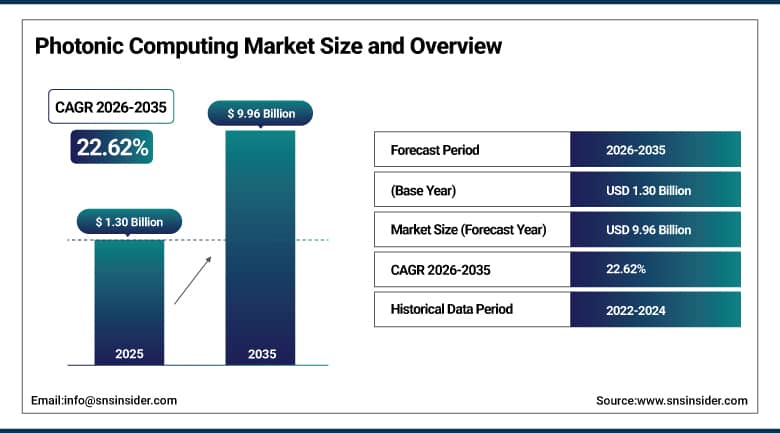
Photonic Computing Market was valued at USD 1.30 billion in 2025 and is expected to reach USD 9.96 billion by 2035, growing at a CAGR of 22.62% from 2026-2035.
The Photonic Computing Market is witnessing rapid growth as a result of increasing demands for computing technologies that are fast and power-efficient, able to perform heavy tasks. Photonics Computing utilizes light to convey and compute information, thereby providing benefits like rapid data transmission, low latency, and reduced power usage relative to electronic devices. Increased application of artificial intelligence, machine learning, high-performance computing, and other data-intensive applications is leading to the need for improved computing technology. Furthermore, developments in photonic integrated circuits, optical interconnects, silicon photonics, and optical processors are enhancing the scalability and performance of the technology.
⮞DOE has supported research into all-optical chiplets based on photonic integrated circuits designed to improve the energy efficiency of AI computing in data centers and computing facilities.
To Get More Information On Photonic Computing Market - Request Free Sample Report
Photonic Computing Market Trends
-
Rising demand for high-performance computing is driving adoption of photonic computing to accelerate data-intensive artificial intelligence and machine learning workloads.
-
Increasing data center workloads are encouraging adoption of optical computing technologies offering higher bandwidth, lower latency, and improved energy efficiency.
-
Growing demand for AI accelerators is expanding opportunities for photonic processors capable of performing high-speed matrix multiplication and parallel computations.
-
Advancements in photonic integrated circuits are improving scalability, computational performance, integration density, and commercial viability of optical computing architectures.
U.S. Photonic Computing Market Outlook
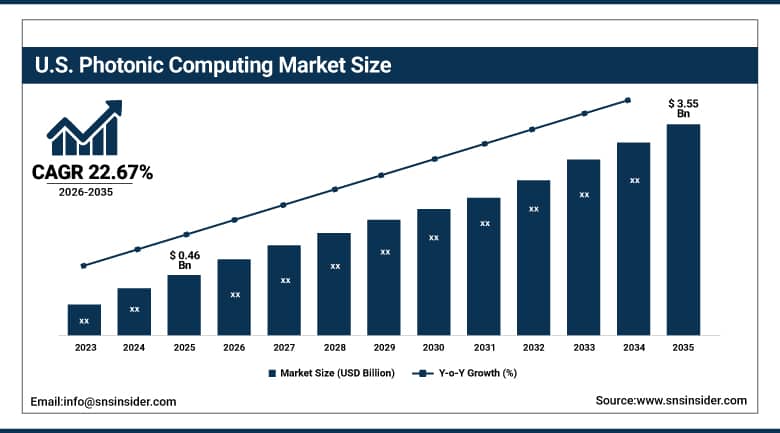
U.S. Photonic Computing Market was valued at USD 0.46 billion in 2025 and is expected to reach USD 3.55 billion by 2035, growing at a CAGR of 22.67% from 2026-2035.
The U.S. Photonic Computing Market is witnessing rapid growth on account of the rising requirements for high-performance, power-efficient computing solutions that can facilitate the deployment of AI, machine learning, and other data-driven applications. In photonic computing, high-speed data communication and processing are made possible through the use of light, providing an array of benefits compared to traditional electronics in terms of bandwidth, latency, and power efficiency. The rising spending on infrastructure for artificial intelligence, high-performance computing, and future data centers is adding to this trend. Moreover, the developments in silicon photonics, photonic ICs, optical processors, and optical interconnects have contributed to making photonic computing more efficient and scalable.
Commerce awarded up to $93 million to Infinera to expand U.S. photonic semiconductor fabrication and advanced packaging, with applications connecting data centers and AI/ML clusters.
Photonic Computing Market Segment Analysis
-
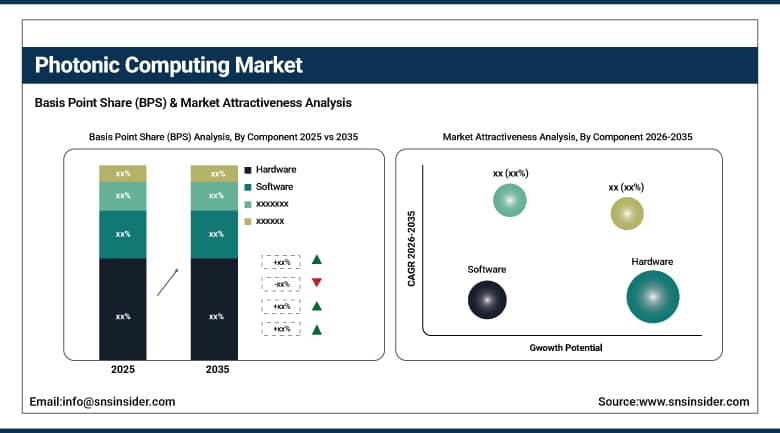
By Component, Hardware dominated the Photonic Computing Market with 61% share in 2025; Software is expected to grow at the fastest CAGR of 24.51% from 2026–2035.
-
By Technology, Photonic Integrated Circuits dominated the Photonic Computing Market with 38% share in 2025; Optical Interconnects are expected to grow at the fastest CAGR of 24.71% from 2026–2035.
-
By Application, Data Centers dominated the Photonic Computing Market with 30% share in 2025; Artificial Intelligence is expected to grow at the fastest CAGR of 24.20% from 2026–2035.
-
By End-User, IT and Telecommunications dominated the Photonic Computing Market with 30% share in 2025; Manufacturing is expected to grow at the fastest CAGR of 25.24% from 2026–2035.
By Component, Hardware dominates the photonic computing market, Software grows fastest.
Hardware segment dominated the Photonic Computing Market with the highest revenue share of about 61% in 2025 resulting from increasing use of photonic processors, optical components, photonic integrated circuits, and high-speed interconnects. The hardware mentioned is what facilitates low latency, bandwidth, and energy efficiency in computing. Increasing investment in photonic computing infrastructure and need for fast data processing also contributes to hardware adoption worldwide.
Software segment is expected to grow at the fastest CAGR of 24.51% from 2026-2035 Due to rising requirements of software compatible with photonic designs and photonic/electronic hybrid computing platforms. Software allows for efficient mapping and programming of the system along with its optimization. Rising AI load, progress in photonic algorithms, and growing community of developers are likely to increase the use of software on a global scale.
⮞In September 2026, Q.ANT launched an open-source software development kit for photonic computing, providing C and Python programming interfaces, sample applications, and a CPU-based simulation backend for developing and testing applications targeting its Native Processing Units.
By Technology, Photonic Integrated Circuits dominate the photonic computing market, Optical Interconnects grow fastest.
Photonic Integrated Circuits segment dominated the Photonic Computing Market with the highest revenue share of about 38% in 2025 owing to their capacity to combine various optical functionalities on small-sized chips. PICs enable fast data transfer, parallel processing, and efficient computation, along with reduced system complexity. Growing requirements for scalable photonic systems and computationally intensive applications contribute to their popularity around the world.
Optical Interconnects segment is expected to grow at the fastest CAGR of 24.71% from 2026-2035 because of the rising need for data transfer between processors, memory, and networking. Optical interconnects offer advantages such as higher bandwidth, lower latency, and enhanced energy efficiency than traditional electrical interconnects. Higher demands for AI processing, growing data centers, and high-speed computing needs are predicted to spur adoption worldwide.
⮞In March 2025, Ayar Labs unveiled its TeraPHY optical I/O chiplet featuring the UCIe interface and 8 Tbps bandwidth, using its 16-wavelength SuperNova light source to support high-bandwidth optical interconnections in AI computing systems.
By Application, Data Centers dominate the photonic computing market, Artificial Intelligence grows fastest.
Data Centers segment dominated the Photonic Computing Market with the highest revenue share of about 30% in 2025 because of the rising volume of data, high performance computing needs, and demand for fast and energy-efficient data transfer. Photonics helps to achieve high-speed communication and reduce latency within data center architecture. The rise of cloud computing services, AI, and hyperscale data centers also encourages global adoption.
Artificial Intelligence segment is expected to grow at the fastest CAGR of 24.20% from 2026-2035 Because of fast-growing computation demands for training, inference, and real-time AI workloads. The photonics approach can provide efficient high-speed parallel computing with increased energy efficiency. The growing popularity of generative AI, accelerators, and the need for scalable computing facilities will help to fast track photonics technology adoption worldwide.
⮞In June 2026, Q.ANT demonstrated a diffusion model and recurrent neural network running on its second-generation photonic Native Processing Unit at ISC High Performance 2026, establishing practical demonstrations of generative AI and sequential prediction workloads.
By End-User, IT and Telecommunications dominates the photonic computing market, Manufacturing grows fastest.
IT and Telecommunications segment dominated the Photonic Computing Market with the highest revenue share of about 30% in 2025 The growing demand for fast data transfer, networking, cloud computing, and sophisticated digital infrastructure has driven increased use of photonic devices. Photonic systems offer more bandwidth, lower latency, and greater efficiency when it comes to communication.
⮞In May 2026, Q.ANT announced an agreement with European cloud provider IONOS to make its Native Processing Server accessible through IONOS cloud infrastructure, extending commercial access to photonic acceleration for cloud computing and AI applications.
Manufacturing segment is expected to grow at the fastest CAGR of 25.24% from 2026-2035 This is due to increasing use of automation, industrial artificial intelligence, machine vision, and fast data processing. Photonic computing can help with real-time analysis and computation in an efficient manner. Increasing efforts in smart manufacturing, Industrial 4.0, and intelligent production systems will drive adoption.
Regional Analysis
|
Region |
Major Country |
Share within Region, 2025 (%) |
|---|---|---|
|
North America |
United States |
91.0% |
|
Europe |
Germany |
22.5% |
|
Asia Pacific |
China |
40.0% |
|
Middle East & Africa |
UAE |
15.0% |
|
Latin America |
Brazil |
34.0% |
North America Photonic Computing Market Insights
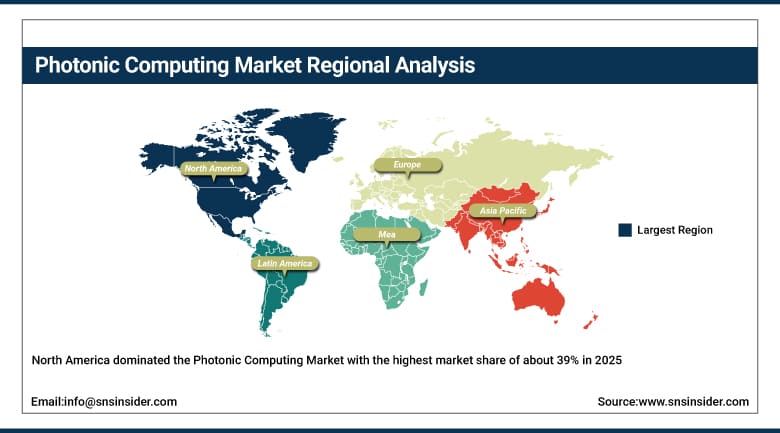
North America dominated the Photonic Computing Market with the highest market share of about 39% in 2025, backed up by robust investment in state-of-the-art computing technology, the prevalence of AI and high-performance computing applications, and the availability of leading photonic firms. Increased demand for energy-efficient high speed computing, high research and development expenditure, and semiconductors and optical technology further reinforce market dominance in the region.
The U.S. Photonic Computing Market accounted for a market share of 91.0%, backed up by significant investments in computing, artificial intelligence, and high-performance computing technologies. The increasing need for energy efficiency and speed is fueling the trend. Leading technology firms, investment in research and development, semiconductor capabilities, and photonics research provide additional impetus to the market throughout the United States.
⮞In March 2026, California-based Lightmatter announced successful sampling of its Passage co-packaged optics chiplet, demonstrating 1.6 Tbps throughput per fiber through integration with Qualcomm Technologies' optical SerDes technology for AI computing interconnects.
Get Customized Report as Per Your Business Requirement - Enquiry Now
Europe Photonic Computing Market Insights
Europe Photonic Computing Market is experiencing consistent growth owing to the increase in research and development efforts in the field of photonics, semiconductors, and computing. The demand for energy-efficient computing and optical processing is driving the adoption process. The presence of good research institutes and government efforts on photonics, in addition to various applications in AI, telecommunication, and data centers, is fueling market growth.
The Germany Photonic Computing Market accounted for a market share of 22.5%, due to capabilities of semiconductor and photonics R&D, strong automation of industry, and investment in high performance computing. The rising demand for energy efficiency and optics will be the driving force behind this. Governments' photonics projects, R&D facilities, and various applications like telecom, artificial intelligence, and data centers also aid market development.
⮞In July 2025, Germany's Leibniz Supercomputing Centre integrated Q.ANT's Native Processing Server into its operational high-performance computing environment, enabling evaluation of analog photonic acceleration for artificial intelligence and scientific simulation workloads.
Asia Pacific Photonic Computing Market Insights
Asia Pacific is expected to grow at the fastest CAGR of about 24.20% from 2026–2035, Enabled by the fast deployment of artificial intelligence, enhanced data centers, and rising funding in advanced semiconductor and photonics technologies, growth is also being driven by increasing demands for high-speed and power-efficient computing, government initiatives, and well-established electronics manufacturing base in China, Japan, South Korea, and Taiwan.
The China Photonic Computing Market accounted for a market share of 40.0%, backed up by fast AI implementation, growing data center capabilities, and substantial research in semiconductors and photonics. The rising need for energy-efficient computation is contributing to this trend. The Chinese government's efforts in technology, well-developed electronics manufacturing industry, rising research and development expenditure, and usage in AI and telecommunications reinforce the market development.
⮞In May 2026, Chinese researchers published a study in Nature Communications demonstrating an integrated optoelectronic image-processing system incorporating a 32×32 photonic computing chip, programmable compression ratios, and a jointly designed neural network for image reconstruction.
Middle East & Africa and Latin America Photonic Computing Market Insights
The Middle East & Africa and Latin America Photonic Computing Market The market is gradually expanding due to factors such as increased digitalization, cloud adoption, and advanced computing infrastructure. Increased demand for efficient computing systems is creating new possibilities. Technology-driven government programs, data center creation, AI adoption, and investments in photonics and telecommunications are aiding the growth of the market in the region.
The UAE Photonic Computing Market accounted for a market share of 15.0%, backed by increased investment in artificial intelligence, digital transformation, and high performance computing. Increased demand for high-performance computing and energy-efficient computing technologies is aiding growth. Technological development by government-led programs, expansion of data centers, developments in telecommunication, and increased investment in photonics and AI infrastructure are helping to grow the market in the UAE.
⮞In August 2025, Abu Dhabi-based QuantLase Research and Development Center announced that its industrial-grade photonic computing chip for AI matrix multiplication had completed design validation and entered fabrication at a European foundry, advancing domestic photonic processor development.
⮞In July 2026, researchers from Brazil's Federal University of Espírito Santo and Italy's University of Trento published experimental results on a neuromorphic photonic processor, demonstrating optical signal equalization across bandwidths up to 20 GHz for advanced communication systems.
Market Dynamics
Growth Drivers: Rapid growth of artificial intelligence workloads is accelerating demand for high-speed and energy-efficient photonic computing technologies
The rapid expansion of AI and machine learning workloads Photonic computing has been greatly fueled by such developments. As the complexity of AI models rises, traditional electronic chips are facing issues of data transfer, bandwidth, latency, and energy efficiency. In photonic computing, computation is done via light, taking advantage of high bandwidth, parallelism, and low latency, thus making it an ideal candidate for accelerating AI. The increasing use of generative AI, large language models, and high-performance computing is motivating work and investments in photonic processors, optical neural networks, and hybrid photonic-electronic computing systems. Integration of photonic processors has further demonstrated high speed and energy efficiency of AI computations.
⮞In March 2026, NVIDIA announced a USD 2 billion investment in Lumentum alongside multiyear agreements covering advanced laser components, manufacturing capacity, and optical technology research to support increasing bandwidth and efficiency requirements in AI data centers.
Restraints: Complex optical-electronic integration and conversion requirements can limit the commercial scalability of photonic computing systems
Complex integration between photonic and electronic components remains a major challenge for the Photonic Computing Market. While optical systems are capable of carrying out complex computation tasks at a high speed, there remain several practical architectures which rely on electronics for memory, control, nonlinearity, input-output operations, and signal translation. The repeated cycle of conversion from the optical to electrical and vice versa form an overhead cost of time and energy which limits the performance of optical processing at a system level. Engineering compact photonic systems incorporating photonic integrated circuits, electronic control, memory, lasers, detectors, and packaging technology also poses some challenges. Advances in optoelectronic packaging technology will be essential in the design of scalable photonic computing systems.
Opportunities: Rapid expansion of AI data centers creates significant opportunities for photonic accelerators and hybrid computing architectures globally
The rapid expansion of AI data centers is creating substantial opportunities for photonic computing technologies. The growing adoption of GPU clusters and AI accelerators means increasing demand for computing performance, bandwidth, and energy. The use of photonic processors can speed up computing-intensive computations while hybrid photonic-electronic platforms can combine optical acceleration with existing electronic computing technology. Studies have shown that photonic technology has great potential for applications where there is a need for high-bandwidth matrix computations and parallel computation, which includes work in AI. Companies involved in the development of photonic processors, optical tensor accelerators, and photonic interconnect-compute systems can focus on AI inference, HPC, and data center applications.
⮞In March 2026, Ayar Labs and Wiwynn announced a strategic partnership to integrate co-packaged optical interconnect technology into rack-scale AI systems, combining Ayar Labs' optical solutions with Wiwynn's infrastructure design and manufacturing capabilities for hyperscale deployments.
Recent Developments:
-
2026 : Lightmatter continued advancing Passage and Envise photonic computing platforms, using optical interconnects and photonic processing to improve bandwidth, reduce data-movement energy, and accelerate AI workloads.
-
2026 : Lightelligence continued developing photonic computing technologies for AI acceleration, focusing on optical processing architectures designed to deliver high-speed computation with improved energy efficiency for data-intensive workloads.
-
2026 : Ayar Labs continued advancing optical I/O solutions that connect processors, accelerators, and memory using light, addressing bandwidth and power limitations of conventional electrical interconnects in AI computing systems.
-
2026 : Celestial AI continued advancing its Photonic Fabric platform, using photonic connectivity to enable high-bandwidth communication between compute and memory while reducing latency and energy consumption in AI infrastructure.
Photonic Computing Market key players are:
-
Lightmatter
-
Lightelligence
-
Ayar Labs, Inc.
-
Celestial AI
-
Intel Corporation
-
NVIDIA Corporation
-
IBM Corporation
-
Hewlett Packard Enterprise
-
Optalysys Ltd.
-
Marvell Technology, Inc.
-
Cisco Systems, Inc.
-
GlobalFoundries Inc.
-
Lumentum Holdings Inc.
-
OpenLight Photonics, Inc.
-
Photonic Inc.
-
POET Technologies Inc.
-
Ranovus Inc.
-
Scintil Photonics
-
Q.ANT GmbH
-
Xanadu Quantum Technologies Inc.
Photonic Computing Market Report Scope:
| Report Attributes | Details |
|---|---|
| Market Size in 2025 | USD 1.3 Billion |
| Market Size by 2035 | USD 9.96 Billion |
| CAGR | CAGR of 22.62% From 2026 to 2035 |
| Base Year | 2025 |
| Forecast Period | 2026-2035 |
| Historical Data | 2022-2024 |
| Report Scope & Coverage | Market Size, Segments Analysis, Competitive Landscape, Regional Analysis, DROC & SWOT Analysis, Forecast Outlook |
| Key Segments | • By Component (Hardware, Software, Services) • By Technology (Optical Chips, Photonic Integrated Circuits, Optical Interconnects, Others) • By Application (Data Centers, Artificial Intelligence, High-Performance Computing, Telecommunications, Consumer Electronics, Others) • By End-User (IT and Telecommunications, BFSI, Healthcare, Defense and Aerospace, Manufacturing, Others) |
| Regional Analysis/Coverage | North America (US, Canada), Europe (Germany, UK, France, Italy, Spain, Russia, Poland, Rest of Europe), Asia Pacific (China, India, Japan, South Korea, Australia, ASEAN Countries, Rest of Asia Pacific), Middle East & Africa (UAE, Saudi Arabia, Qatar, South Africa, Rest of Middle East & Africa), Latin America (Brazil, Argentina, Mexico, Colombia, Rest of Latin America). |
| Company Profiles | Lightmatter, Lightelligence, Ayar Labs, Inc., Celestial AI, Intel Corporation, NVIDIA Corporation, IBM Corporation, Hewlett Packard Enterprise, Optalysys Ltd., Marvell Technology, Inc., Cisco Systems, Inc., GlobalFoundries Inc., Lumentum Holdings Inc., OpenLight Photonics, Inc., Photonic Inc., POET Technologies Inc., Ranovus Inc., Scintil Photonics, Q.ANT GmbH, and Xanadu Quantum Technologies Inc. |

Frequently Asked Questions
The Photonic Computing Market is expected to grow at a CAGR of 22.62% from 2026 to 2035.
The Photonic Computing Market was valued at USD 1.30 billion in 2025.
The major growth factor is rapid growth of AI workloads and demand for energy-efficient, high-speed computing, driving adoption of photonic systems for faster data processing and lower power consumption.
North America dominated the Photonic Computing Market in 2025.
