
Biomarker Testing Services Market Report Scope & Overview:
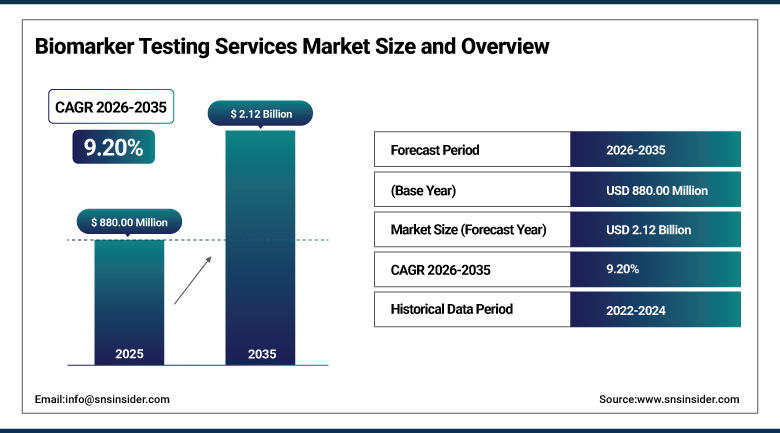
The Biomarker Testing Services Market was valued at USD 880.00 Million in 2025 and is expected to reach USD 2.12 Billion by 2035, growing at a CAGR of 9.20% from 2026-2035.
The Biomarker Testing Services Market covers outsourced laboratory services that develop, validate and run assays measuring molecular and cellular biomarkers for drug development, clinical trials and patient selection. Providers include contract research organizations, central laboratories and specialty testing companies that support pharmaceutical and biotechnology sponsors and research institutes. Growth is supported by precision medicine, the rising share of trials that use biomarker-based enrollment, companion diagnostic development and minimal residual disease monitoring, while data quality, regulatory validation and capacity constraints shape competition among service providers.
⮞In Q2 2026, Labcorp entered a clinical trial collaboration with Fox Chase Cancer Center to evaluate its Plasma Detect Genome MRD test in patients at risk of early-stage non-small cell lung cancer recurrence. The collaboration shows how laboratory services providers are generating clinical evidence for emerging biomarker tests.
To Get more information Biomarker Testing Services Market - Request Free Sample Report
Biomarker Testing Services Market Trends
- Growing use of biomarker-based patient selection in oncology and immunology clinical trials
- Rising demand for companion diagnostic development and validation services
- Adoption of next-generation sequencing, multiplex immunoassays and high-parameter flow cytometry
- Expansion of minimal residual disease and liquid biopsy testing services
- Consolidation among laboratory and genetic testing providers
U.S. Biomarker Testing Services Market Outlook
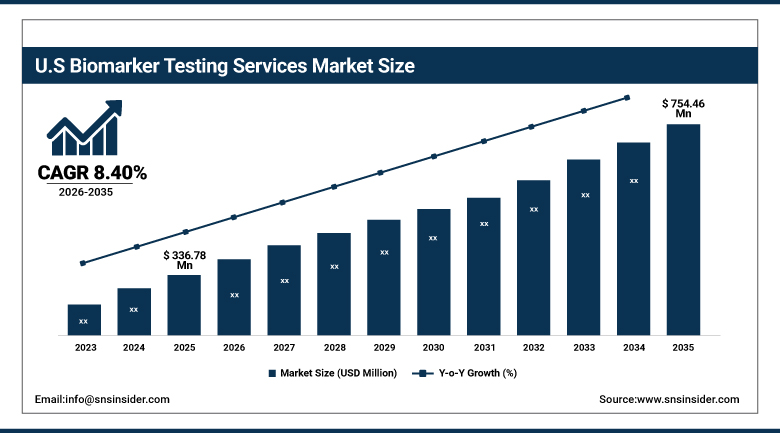
The U.S. Biomarker Testing Services Market was valued at USD 336.78 Million in 2025 and is expected to reach USD 754.46 Million by 2035, growing at a CAGR of 8.40% from 2026-2035.
The U.S. Biomarker Testing Services Market is supported by the world's largest concentration of biopharmaceutical sponsors, a deep network of contract research organizations and central laboratories, active oncology research, and FDA expectations for validated biomarker assays. Demand comes from drug developers outsourcing assay work, from companion diagnostic programs and from academic medical centers. Growth is moderated by capacity competition among providers and by pricing pressure on routine assays.
⮞In November 2024, Tempus AI announced an agreement to acquire Ambry Genetics for USD 600 Million, made up of USD 375 Million in cash and USD 225 Million in shares. The deal extends Tempus into hereditary cancer screening and broader genetic testing, reflecting consolidation among U.S. testing providers.
Biomarker Testing Services Market Segment Analysis
- By Service, biomarker assay development and validation segment dominated the Biomarker Testing Services Market in 2025 with 45.77% share; Flow Cytometry services segment is the fastest-growing segment, with an estimated CAGR of 10.40% during 2026–2035.
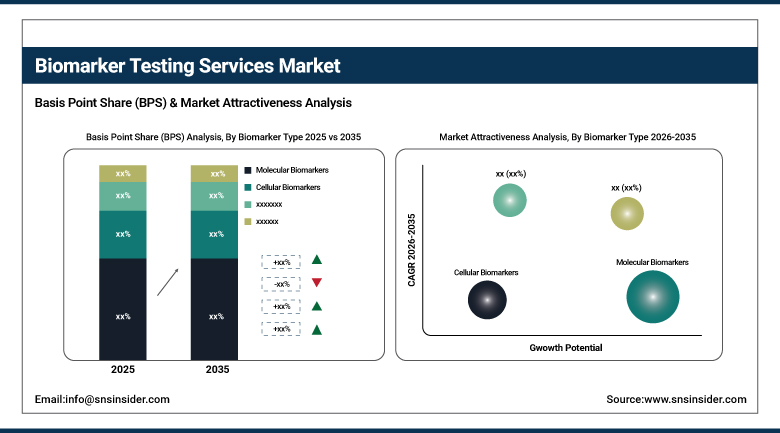
- By Biomarker Type, molecular biomarkers segment dominated the Biomarker Testing Services Market in 2025 with an estimated 66.00% share; cellular biomarkers segment is the fastest-growing segment, with an estimated CAGR of 9.80% during 2026–2035.
- By Application, oncology segment dominated the Biomarker Testing Services Market in 2025 with an estimated 52.00% share; drug discovery and development segment is the fastest-growing segment, with an estimated CAGR of 10.00% during 2026–2035.
- By End Use, pharmaceutical and biotechnology companies segment dominated the Biomarker Testing Services Market in 2025 with 45.45% share; contract research organizations segment is the fastest-growing segment, with an estimated CAGR of 10.60% during 2026–2035.
By Biomarker Type, Molecular Biomarkers Dominate Biomarker Testing Services Market; Cellular Biomarkers to Register Fastest Growth.
Molecular biomarkers dominate the Biomarker Testing Services Market because DNA, RNA, protein and metabolite markers underpin most patient selection, pharmacodynamic and safety assessments in modern trials. Next-generation sequencing, quantitative PCR, immunoassays and mass spectrometry are widely used, and sponsors rely on specialist laboratories for these platforms. Oncology programs in particular depend on mutation and expression testing to enroll patients, which keeps molecular work the largest part of demand. Sample volumes from global trials are high, so providers with large, accredited sequencing capacity hold an advantage in winning multi-site programs.
Cellular biomarkers are projected to register the fastest growth as immuno-oncology, cell therapy and autoimmune programs require detailed profiling of immune cell populations and their activation. Flow cytometry, single-cell analysis and imaging provide data that molecular assays cannot capture, and sponsors increasingly request them for cell therapy monitoring. Providers are investing in instruments and specialist scientists to meet this demand while maintaining validated workflows suitable for regulated studies. Growth in cell therapy trials is also raising demand for specialized sample logistics, including fresh and cryopreserved shipments.
⮞In July 2026, CellVoyant and HyQure announced a strategic partnership to explore AI-powered, label-free cell analysis for biologics testing and quality assessment, combining predictive cell biology with analytical testing services to develop more consistent and scalable cellular analysis workflows.
By Service, Biomarker Assay Development and Validation Dominates Biomarker Testing Services Market; Flow Cytometry Services to Register Fastest Growth.
Biomarker assay development and validation dominates the Biomarker Testing Services Market because sponsors need fit-for-purpose methods that meet regulatory expectations before samples from clinical trials can be analyzed. Providers design, optimize and validate assays for sensitivity, specificity and reproducibility, then transfer them to production in accredited laboratories. These projects are technically demanding, create long-term relationships and lead to sample testing work that continues throughout a development program, which supports high revenue per client. Regulatory inspections of laboratories also reward providers with strong documentation and audit records.
The Flow Cytometry segment of the Biomarker Testing Services Market is projected to grow at an estimated CAGR of 10.6% from 2026 to 2035, exceeding the overall market CAGR of 9.20%. Growth is supported by increasing demand for advanced cell analysis, immunophenotyping, biomarker discovery, and precision medicine research. Expanding applications in oncology, immunology, drug development, and clinical trials are expected to strengthen adoption.
⮞In July 2025, U.S.-based ORF Biologics and India's Vipragen Biosciences established a strategic partnership to advance biologics research, biomarker identification, immunogenicity testing and regulatory-compliant assay development, combining recombinant protein expertise with preclinical contract research capabilities.
By Application, Oncology Dominates Biomarker Testing Services Market; Drug Discovery and Development to Register Fastest Growth.
Oncology dominates the Biomarker Testing Services Market because cancer drug development relies heavily on biomarkers to select patients, monitor response and detect resistance. A large share of the clinical pipeline is in oncology, and many trials require tumor profiling, circulating tumor DNA analysis and companion diagnostic validation. Hospitals and laboratories also provide clinical biomarker testing to guide treatment decisions, which adds a steady stream of testing revenue to the application segment. Regulators increasingly expect biomarker data to support dose selection and label claims, which keeps spending on testing resilient.
Drug discovery and development is projected to register the fastest growth as sponsors apply biomarkers earlier to prioritize candidates, define target engagement and reduce late-stage failures. Neurology, cardiometabolic disease and immunology programs are expanding their use of biomarker endpoints, and regulators encourage biomarker strategies in rare disease trials. Providers with broad assay menus and experience across therapeutic areas are well placed to support this broadening demand. Companion diagnostics linked to approved drugs also require post-approval testing, which extends the service relationship beyond trial completion.
⮞In September 2025, Foundation Medicine introduced a tissue-informed whole-genome sequencing minimal residual disease test through its FlexOMx Lab, enabling research studies to track hundreds to thousands of tumor-specific variants and quantify circulating tumor DNA in early- and late-stage cancer research.
By End Use, Pharmaceutical and Biotechnology Companies Dominate Biomarker Testing Services Market; Contract Research Organizations to Register Fastest Growth.
Pharmaceutical and biotechnology companies dominate the Biomarker Testing Services Market because they sponsor the majority of clinical trials and outsource a large part of assay development and sample testing. Small and mid-sized biotechs in particular lack in-house laboratories and rely on specialist providers, while large pharmaceutical firms use external capacity to handle peaks and access specialized technologies. Multi-year programs create recurring revenue for service providers. Reimbursement for diagnostic testing in hospitals gives them an additional route to buy testing, though most revenue still comes from sponsored studies.
Contract research organizations are projected to register the fastest growth as sponsors consolidate vendors and prefer integrated partners that manage clinical operations together with central laboratory and biomarker services. CROs are expanding their laboratory networks and acquiring specialists to offer end-to-end packages. Research institutes and academic centers form a smaller but steady group of buyers, particularly for discovery work funded by grants and consortia. Academic medical centers often act as both customers and partners for specialized assay development, supported by public grants and collaboration with industry.
⮞In January 2025, Biofidelity and CellCarta announced a strategic partnership to deploy the Aspyre Lung assay in global clinical trials, with CellCarta planning assay validation in European laboratories before expanding implementation to its U.S. laboratories to support oncology biomarker testing.
Regional Analysis
|
Region |
Major Country |
Share within Region, 2025 (%) |
|
North America |
United States |
86.00 |
|
Europe |
United Kingdom |
24.00 |
|
Asia Pacific |
China |
38.00 |
|
Latin America |
Brazil |
50.00 |
|
Middle East & Africa |
Saudi Arabia |
28.00 |
North America Biomarker Testing Services Market Insights
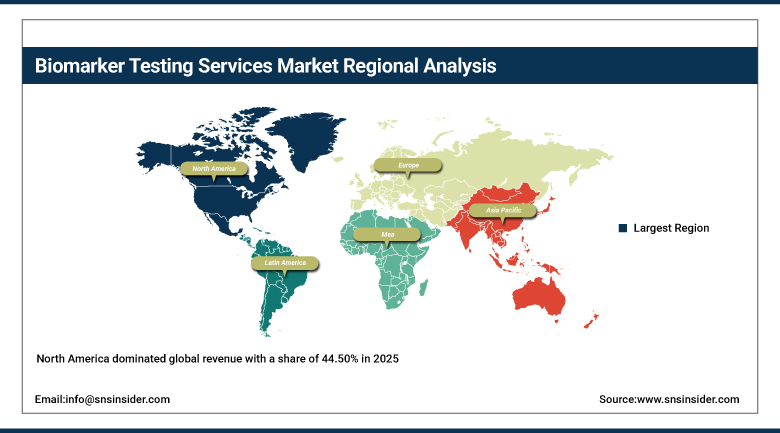
North America dominated global revenue with a share of 44.50% in 2025, supported by the highest concentration of biopharmaceutical sponsors, a dense network of contract research organizations and the presence of providers such as Labcorp, Thermo Fisher Scientific, Charles River Laboratories, BioAgilytix, ICON, IQVIA, Syneos Health and Tempus. The United States accounts for about 86.00% of regional demand, with Canada adding volume. Canada adds demand through its academic research hospitals and growing life sciences clusters in Toronto and Montreal.
FDA guidance on biomarker qualification and companion diagnostics encourages sponsors to invest in validated assays, and active oncology pipelines create steady testing volume. In November 2024, Tempus announced its agreement to acquire Ambry Genetics, and Labcorp reported 9.8% growth in its central laboratories business in the second quarter of 2026. Capacity competition and pricing pressure moderate growth in routine assays. Growing numbers of decentralized and hybrid trials are also increasing demand for standardized sample collection and rapid transport across the region, benefiting providers with national laboratory networks.
⮞In May 2026, Caris Life Sciences submitted an application to New York State's Clinical Laboratory Evaluation Program seeking authorization to test specimens originating from the state using Caris Assure, its blood-based molecular profiling assay analyzing DNA and RNA for tumor-related and other genomic alterations.
Get Customized Report as per Your Business Requirement - Enquiry Now
Europe Biomarker Testing Services Market Insights
Europe is the second-largest region, growing at a CAGR of 8.50% during 2026-2035. The United Kingdom, Germany, France and Switzerland lead, supported by Eurofins Scientific, SGS, Intertek, Randox Laboratories, Svar Life Science and Merck KGaA, along with a strong academic research base. Pharmaceutical R&D hubs and collaborative research networks provide steady demand for assay and sample testing services. Spain, Italy and the Nordic countries add further trial activity, and European academic consortia contribute to large biomarker research programs that rely on shared laboratories.
The European In Vitro Diagnostic Regulation raises requirements for companion diagnostics and clinical performance evidence, which increases demand for validation services. Providers operate multi-country laboratory networks that allow sponsors to run decentralized trials, and clinical trial regulation reforms are intended to streamline multinational studies. Cost control by health systems moderates growth in routine clinical biomarker testing. Brexit-related regulatory differences between the United Kingdom and the European Union require duplicated approvals in some cases, which favors providers with laboratories on both sides.
⮞In May 2026, Scottish Brain Sciences announced an accredited laboratory service offering blood-based and cerebrospinal fluid biomarker testing for Alzheimer's disease, following UKAS ISO 15189 accreditation, expanding access to specialized testing for clinical trials, healthcare providers and translational research partners across the United Kingdom.
Asia Pacific Biomarker Testing Services Market Insights
Asia Pacific is projected to be the fastest-growing region, advancing at a CAGR of 10.80% from 2026-2035. China leads regional demand, followed by Japan, South Korea, India and Australia, driven by expanding clinical trial activity, rising biopharmaceutical investment and government support for precision medicine. Global providers are expanding local laboratories to serve sponsors running trials in the region. Singapore and Taiwan host regional laboratory hubs, and several global providers have expanded there to serve trials across Southeast Asia and meet regulatory requirements.
Chinese biotech companies are advancing large numbers of oncology candidates and are increasingly outsourcing biomarker work to local and international laboratories. India is emerging as a cost-effective site for assay services, while Japan and South Korea maintain advanced regulatory and laboratory capabilities. Differences in data transfer rules and sample export regulations create operational complexity but also favor providers with local presence. Government programs for genomic medicine in China, Japan and Australia are building national data resources that rely on commercial laboratories for sequencing and assay services.
⮞In March 2026, BGI Genomics launched SIROmics, an AI-powered solution integrating laboratory automation, next-generation sequencing workflows, bioinformatics and clinical reporting, with NMPA certification and more than 100 units deployed in China, supporting standardized genetic testing and integrated molecular analysis.
MEA & Latin America Biomarker Testing Services Market Insights
In Latin America, Brazil leads on the strength of its large clinical trial base and research hospitals, followed by Mexico, Argentina and Colombia. Regional demand grows at about 9.40% annually as sponsors add trial sites to recruit diverse patient populations. Local laboratories partner with global providers to meet quality standards, and import of reagents and samples can be slow. Argentina and Chile contribute through public research institutes and private hospital groups that host global trials, and sponsors value the diversity of patient populations in the region.
In the Middle East and Africa, Saudi Arabia, the United Arab Emirates, Israel and South Africa lead through investment in genomics programs, research hospitals and clinical trial infrastructure. Growth of about 9.60% annually is supported by national precision medicine initiatives, although limited laboratory capacity and regulatory differences constrain the pace of expansion across much of the region. Turkey and Egypt are building trial networks, and Gulf countries are investing in national genome programs that will raise demand for sequencing and biomarker validation services from local and international providers.
⮞In January 2026, PGxAI and Saudi Arabia's Novo Genomics announced an initiative combining local laboratory processing with AI-assisted pharmacogenomic analysis and clinician-ready reporting, establishing an integrated workflow intended to expand precision medicine access while supporting local processing and genomic data governance.
Market Dynamics
Growth Drivers: Precision Medicine, Biomarker-Driven Trials and Companion Diagnostics
The expansion of precision medicine is the main driver of the Biomarker Testing Services Market. Targeted therapies and immunotherapies work only in selected patient groups, so sponsors must identify those groups through validated tests, creating demand for assay development, sample testing and data analysis. A growing share of oncology and rare disease trials now include biomarker-based enrollment or endpoints. Rising investment by governments and philanthropic groups in biomarker research also supports demand from academic and nonprofit sponsors.
Companion diagnostic development and minimal residual disease monitoring add further demand, as regulators expect rigorous validation and clinicians seek to guide treatment more precisely. Outsourcing by sponsors, particularly small biotechs, gives specialist laboratories a growing pool of work and encourages providers to expand technology platforms. Growth in regulatory acceptance of biomarkers as surrogate endpoints further supports spending on high-quality testing, since stronger data can shorten development timelines.
⮞In March 2026, Illumina and Labcorp expanded their precision oncology collaboration to develop additional genomic testing solutions, improve access to cancer biomarker testing, generate evidence supporting payer coverage and explore complementary tissue and liquid biopsy offerings for clinical care and drug development.
Restraints: Validation Complexity, Capacity Limits and Pricing Pressure
Biomarker assays must be validated to demanding regulatory standards, and projects can take months before testing begins. Sample handling, stability and variability across sites add risk, and failed validations can delay trials. Skilled scientists are in short supply, which limits capacity growth. Delays in sample shipping and customs clearance also lengthen timelines for multinational studies. Consolidation among sponsors can reduce the number of independent buyers and increase bargaining power.
Competition among providers puts pressure on pricing of standard assays, and sponsors increasingly negotiate volume discounts. Biotech funding cycles also affect demand, since reduced investment leads to fewer early-stage programs. Data privacy rules on genomic information add compliance cost for cross-border projects. Increasing scrutiny of laboratory-developed tests by regulators may add further compliance requirements for service providers over time. Competitive bidding for large outsourced programs also compresses margins in the short term.
Opportunities: Liquid Biopsy, Cell Therapy and Emerging Trial Regions
Liquid biopsy and minimal residual disease testing offer high-growth service categories as sponsors use circulating tumor DNA to monitor response and recurrence. Collaborations such as Labcorp's clinical study of its Plasma Detect Genome MRD test show how providers are building evidence to support wider use. Artificial intelligence applied to multi-omic data may also help providers identify new biomarkers and offer analysis services beyond routine testing. Wider use of decentralized trials is another avenue for providers that can support remote sample collection.
Cell therapy and immunology programs need high-parameter cellular analysis, creating demand for flow cytometry and single-cell services, while expanding trial activity in Asia Pacific and Latin America opens new geographic markets. Providers that offer integrated, multi-platform packages can win larger contracts. Strategic partnerships with pharmaceutical companies can secure multi-year volume commitments, giving providers more predictable revenue and justification for capital investment. Further, partnerships with academic centers can accelerate access to rare patient samples that are otherwise hard to obtain.
⮞In June 2025, Quest Diagnostics partnered with MD Anderson Cancer Center to develop and validate a laboratory-developed blood test using circulating protein biomarkers to stratify risk across multiple cancers, creating an opportunity to expand biomarker testing beyond established single-cancer diagnostic pathways.
Recent Developments:
- In October 2023, Guardant Health and Bristol-Myers Squibb announced a partnership on liquid biopsy for precision oncology. The collaboration supports use of circulating tumor DNA testing in drug development.
- In September 2023, Merck KGaA launched a biomarker test for early detection of certain cancers. The launch expanded its diagnostic and testing portfolio.
- In August 2023, Illumina agreed to acquire GRAIL, with the aim of strengthening multi-cancer early detection testing. The agreement was intended to bring sequencing and early detection capabilities together.
Biomarker Testing Services Market Key Players are:
-
BioAgilytix Labs
-
Eurofins Scientific SE
-
SGS SA
-
Charles River Laboratories
-
Laboratory Corporation of America Holdings (Labcorp)
-
Thermo Fisher Scientific Inc. (PPD)
-
ICON plc
-
IQVIA Holdings Inc.
-
Syneos Health
-
Intertek Group plc
-
Frontage Laboratories
-
Discovery Life Sciences
-
Creative Biolabs
-
Randox Laboratories
-
RayBiotech
-
Pacific BioLabs
-
Svar Life Science
-
Tempus AI, Inc.
-
Guardant Health, Inc.
-
Merck KGaA
Biomarker Testing Services Market Report Scope:
| Report Attributes | Details |
|---|---|
| Market Size in 2025 | USD 880.00 Million |
| Market Size by 2035 | USD 2.12 Billion |
| CAGR | CAGR of 9.20% From 2026 to 2035 |
| Base Year | 2025 |
| Forecast Period | 2026-2035 |
| Historical Data | 2022-2024 |
| Report Coverage | Market Size, Segments Analysis, Competitive Landscape, Regional Analysis, DROC & SWOT Analysis, Forecast Outlook |
| Key Segments | • By Service (Biomarker Assay Development and Validation, Flow Cytometry, and Other Services) • By Biomarker Type (Molecular Biomarkers and Cellular Biomarkers) • By Application (Oncology, Drug Discovery and Development, and Others) • By End Use (Pharmaceutical and Biotechnology Companies, Contract Research Organizations, and Research Institutes) |
| Regional Analysis/Coverage | North America (US, Canada), Europe (Germany, UK, France, Italy, Spain, Russia, Poland, Rest of Europe), Asia Pacific (China, India, Japan, South Korea, Australia, ASEAN Countries, Rest of Asia Pacific), Middle East & Africa (UAE, Saudi Arabia, Qatar, South Africa, Rest of Middle East & Africa), Latin America (Brazil, Argentina, Mexico, Colombia, Rest of Latin America). |
| Company Profiles | BioAgilytix Labs; Eurofins Scientific SE; SGS SA; Charles River Laboratories; Laboratory Corporation of America Holdings (Labcorp); Thermo Fisher Scientific Inc. (PPD); ICON plc; IQVIA Holdings Inc.; Syneos Health; Intertek Group plc; Frontage Laboratories; Discovery Life Sciences; Creative Biolabs; Randox Laboratories; RayBiotech; Pacific BioLabs; Svar Life Science; Tempus AI, Inc.; Guardant Health, Inc.; Merck KGaA |

Frequently Asked Questions
Key players include BioAgilytix Labs, Eurofins Scientific SE, SGS SA, Charles River Laboratories, Labcorp, Thermo Fisher Scientific Inc., ICON plc, IQVIA Holdings Inc. and Syneos Health.
Key opportunities include liquid biopsy and minimal residual disease testing, cell therapy biomarker analysis, companion diagnostic development and expanding trial activity in Asia Pacific.
The major growth factor is the spread of precision medicine, where biomarker-based patient selection and endpoints make outsourced assay services essential to drug development.
By Service, the Biomarker Assay Development and Validation segment dominated the market in 2025 with a 45.77% share, supported by regulatory demand for validated assays.
North America dominated the market with a share of 44.50% in 2025, driven by biopharmaceutical sponsors, contract research organizations and active oncology pipelines.
