
Biosensor Glucose Contact Lens Market Report Scope & Overview:
Biosensor Glucose Contact Lens Market was valued at USD 3.00 billion in 2025 and is expected to reach USD 10.45 billion by 2035, growing at a CAGR of 13.33% from 2026-2035.
The Biosensor Glucose Contact Lens Market is witnessing strong growth due to increasing demand for non-invasive and continuous glucose monitoring solutions. Growth in prevalence of diabetes, along with an increase in interest in convenient options to traditional blood glucose monitoring systems is promoting the investigation of biosensor embedded contact lenses. Miniaturized biosensors, flexible electronics, wireless technology, and wearable healthcare technologies are aiding in the development of these technologies. Furthermore, investments in digital health, personalized medicine, and intelligent medical devices are fueling the development of the market. The collaborations between biotechnology companies, technology developers, healthcare organizations, and research institutions are contributing to the growth of glucose-sensing contact lens technologies.
WHO estimates that more than 800 million adults worldwide are living with diabetes, increasing the need for effective glucose-monitoring technologies.
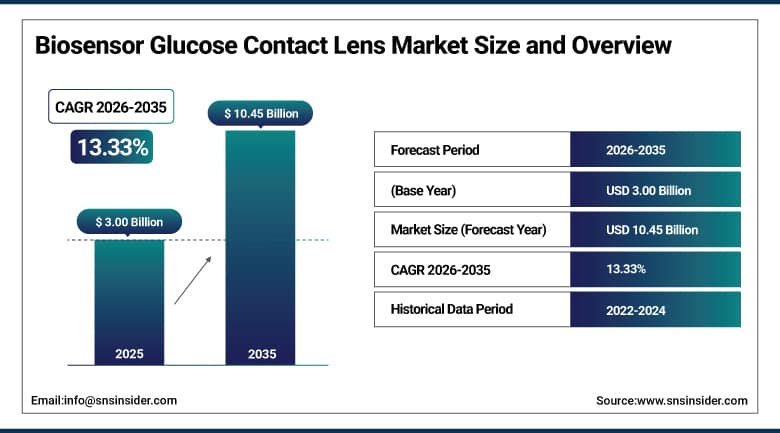
To Get More Information On Biosensor Glucose Contact Lens Market - Request Free Sample Report
Biosensor Glucose Contact Lens Market Trends
-
Rising prevalence of diabetes is driving demand for non-invasive and continuous glucose monitoring technologies that improve patient convenience and monitoring.
-
Increasing preference for painless glucose monitoring is encouraging development of biosensor-enabled contact lenses as alternatives to conventional invasive measurement methods.
-
Growing adoption of wearable healthcare technologies is expanding opportunities for smart contact lenses capable of continuously monitoring glucose-related biomarkers.
-
Advancements in biosensors, microelectronics, wireless communication, and nanomaterials are improving sensing capabilities, miniaturization, and data transmission in smart contact lenses.
-
Increasing investments in continuous glucose monitoring technologies are supporting research and development of next-generation contact lens-based biosensing platforms.
U.S. Biosensor Glucose Contact Lens Market Outlook
U.S. Biosensor Glucose Contact Lens Market was valued at USD 1.05 billion in 2025 and is expected to reach USD 3.64 billion by 2035, growing at a CAGR of 13.26% from 2026-2035.
The U.S. Biosensor Glucose Contact Lens Market is witnessing strong growth due to increasing interest in non-invasive and continuous glucose monitoring technologies. There is increasing interest in easy-to-use diabetes diagnosis methods that are stimulating development of smart contact lenses integrated with biosensors. Progress in development of miniaturized sensors, wireless communication capabilities, flexible electronics, and wearable health devices improves the functional capacity of such solutions. Furthermore, rising investment into digital health solutions, personalized healthcare services, and wearable medical devices helps to develop the market in general. Collaboration between technology companies, healthcare organizations, and research facilities is another factor that accelerates innovations in development of glucose sensing contact lenses.
CDC estimated that 40.1 million people in the U.S. had diabetes in 2023, representing a substantial population requiring ongoing glucose monitoring and diabetes-management technologies.
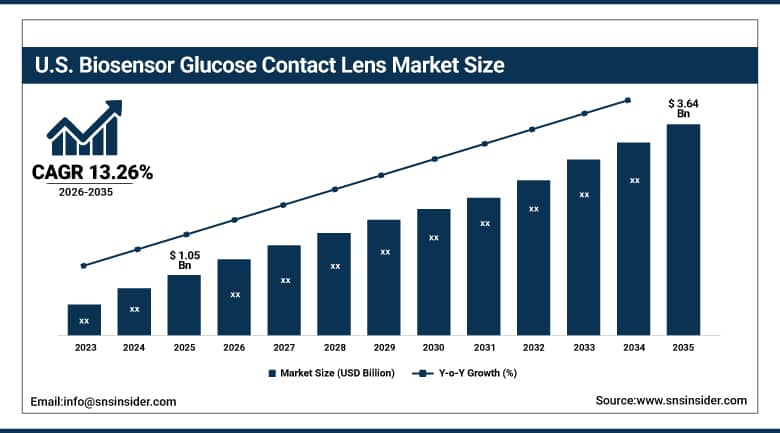
Biosensor Glucose Contact Lens Market Segment Analysis
-
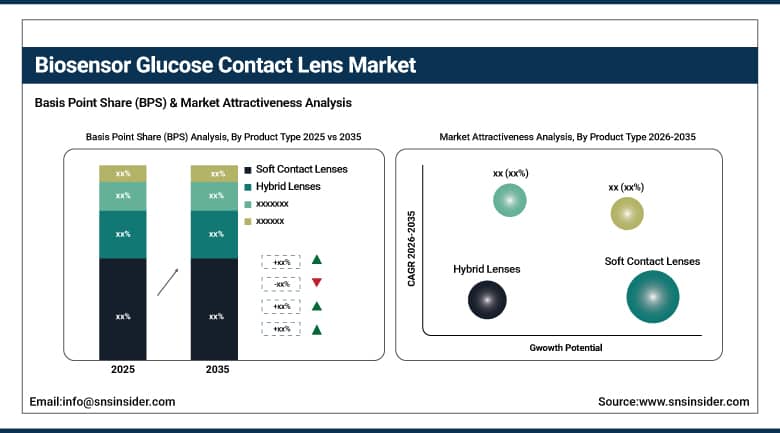
By Product Type, Soft Contact Lenses dominated the Biosensor Glucose Contact Lens Market with 67% share in 2025; Hybrid Lenses are expected to grow at the fastest CAGR of 14.55% from 2026–2035.
-
By Technology, Electrochemical dominated the Biosensor Glucose Contact Lens Market with 58% share in 2025; Optical is expected to grow at the fastest CAGR of 14.17% from 2026–2035.
-
By Application, Continuous Glucose Monitoring dominated the Biosensor Glucose Contact Lens Market with 56% share in 2025; Continuous Glucose Monitoring is expected to grow at the fastest CAGR of 13.77% from 2026–2035.
-
By End-User, Hospitals & Clinics dominated the Biosensor Glucose Contact Lens Market with 40% share in 2025; Home Care is expected to grow at the fastest CAGR of 14.27% from 2026–2035.
-
By Distribution Channel, Offline dominated the Biosensor Glucose Contact Lens Market with 62% share in 2025; Online is expected to grow at the fastest CAGR of 13.99% from 2026–2035.
By Product Type, Soft Contact Lenses dominate the biosensor glucose contact lens market, Hybrid Lenses grow fastest.
Soft Contact Lenses segment dominated the Biosensor Glucose Contact Lens Market with the highest revenue share of about 67% in 2025 Because of their comfort, flexibility, reliability, and capability for long-term use. In addition, their manufacturing infrastructure allows the inclusion of biosensors and microelectronics into the bandages. Moreover, there is an ever-growing need for non-invasive monitoring of glucose levels and the popularity of wearable technologies in healthcare.
Hybrid Lenses segment is expected to grow at the fastest CAGR of 14.55% from 2026-2035 as a result of rising need for lenses which will be comfortable, have good optical characteristics, durable, and biosensors integrated into the lens design. The hybrid design will allow for incorporation of advanced biosensors, yet still remain wearable. Innovations in the field of smart lenses, electronics, and glucose measurement will drive adoption.
By Technology, Electrochemical dominates the biosensor glucose contact lens market, Optical grows fastest.
Electrochemical segment dominated the Biosensor Glucose Contact Lens Market with the highest revenue share of about 58% in 2025 Because of its sensitivity, simplicity of design, and established use in glucose monitoring devices. Electrochemical biosensors are able to detect biological processes easily and enable small form factors. Increasing need for non-invasive glucose monitoring and integration of biosensors is adding to their usage worldwide.
Optical segment is expected to grow at the fastest CAGR of 14.17% from 2026-2035 due to increased investigation in noninvasive glucose sensing methods by employing optical sensing technology. Optical sensors could be used for continuous monitoring without blood extraction in conventional ways along with the development of miniature sensors in contact lenses. Technological improvements in photonic devices, biosensors, and wearable technology would increase the application of optical technology worldwide.
By Application, Continuous Glucose Monitoring dominates the biosensor glucose contact lens market and grows fastest.
Continuous Glucose Monitoring segment dominated the Biosensor Glucose Contact Lens Market with the highest revenue share of about 56% in 2025 Because of growing demand for continuous, easy-to-use, and non-invasive monitoring of glucose levels. Biosensor-based contact lenses may offer an opportunity for continuous monitoring without finger prick tests. Increased need for diabetes management, interest in wearable devices, and need for continuous health monitoring also support segment adoption worldwide.
Continuous Glucose Monitoring segment is expected to grow at the fastest CAGR of 13.77% from 2026-2035 due to increasing need for instant glucose data and diabetes management techniques. Developments in the field of biosensors, wireless communications, electronics, and intelligent contact lenses are enhancing monitoring capabilities. The growing trend towards non-invasive monitoring and personalized healthcare will further fuel the use of continuous glucose monitoring technology around the world.
By End-User, Hospitals & Clinics dominate the biosensor glucose contact lens market, Home Care grows fastest.
Hospitals & Clinics segment dominated the Biosensor Glucose Contact Lens Market with the highest revenue share of about 40% in 2025 because of the existence of their healthcare infrastructure, specialized personnel, and a large number of patients who need glucose testing. The use of such technologies becomes more common due to the growing number of diabetic patients and the need for continuous monitoring of their health state.
Home Care segment is expected to grow at the fastest CAGR of 14.27% from 2026-2035 This is due to the increasing demand for convenient, non-invasive, and continuous monitoring of blood glucose levels outside clinical settings. The patients today are increasingly opting for wearable technology that allows them to monitor their health independently without much trouble from regular testing. Advancements in remote healthcare and smart contact lenses will boost homecare use.
By Distribution Channel, Offline dominates the biosensor glucose contact lens market, Online grows fastest.
Offline segment dominated the Biosensor Glucose Contact Lens Market with the highest revenue share of about 62% in 2025 This is due to the unique nature of the biosensors contained in the contact lenses, the need for professional advice and guidance, and the preference to buy highly advanced medical equipment via official channels.
Online segment is expected to grow at the fastest CAGR of 13.99% from 2026-2035 Because of the increasing use of digital healthcare, easy availability of products, increased geographical presence, and growing preference among consumers for online shopping. E-commerce sites allow comparative shopping as well as access to information in favor of trends in remote healthcare. Increasing internet usage and growing awareness about wearable glucometers will further fuel their online distribution.
Regional Analysis
|
Region |
Major Country |
Share within Region, 2025 (%) |
|---|---|---|
|
North America |
United States |
88.0% |
|
Europe |
Germany |
22.0% |
|
Asia Pacific |
China |
40.0% |
|
Middle East & Africa |
UAE |
15.0% |
|
Latin America |
Brazil |
35.0% |
North America Biosensor Glucose Contact Lens Market Insights
North America dominated the Biosensor Glucose Contact Lens Market with the highest market share of about 38% in 2025, Fuelled by highly developed healthcare infrastructures, significant investments in wearable biosensors, and increasing requirements for diabetes management. Further advances in the development of non-invasive glucose testing, existing medical device ecosystems, and pharmaceutical and technological expertise are helping the region to dominate the market.
The U.S. Biosensor Glucose Contact Lens Market accounted for a market share of 88.0%, backed up with an advanced healthcare infrastructure, significant investments in wearable biosensors, and substantial demand for cutting-edge diabetes management devices. Advances in research on non-invasive glucose measurement, existing medical device technology, and digital health are helping to develop this market further, as well as ongoing R&D activities.
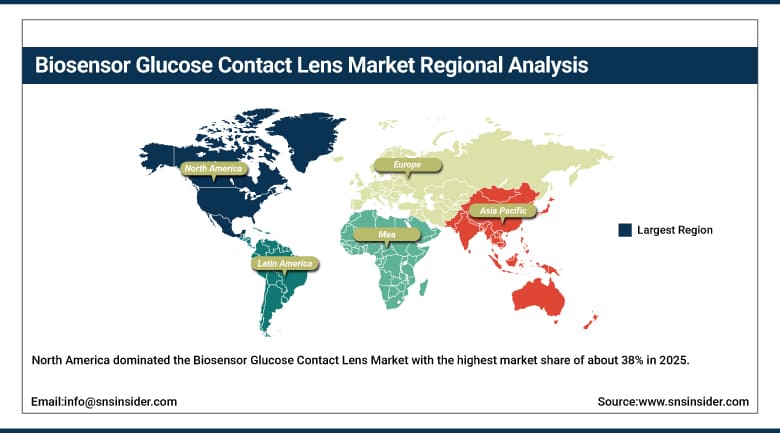
Get Customized Report as Per Your Business Requirement - Enquiry Now
Europe Biosensor Glucose Contact Lens Market Insights
Europe Biosensor Glucose Contact Lens Market is witnessing steady growth, supported by virtue of advanced healthcare infrastructure, diabetes management skills, and increased spending on non-invasive biosensors. Increasing research in wearable glucose monitoring solutions, established medical device eco systems, and initiatives by digital health are spurring innovation. Increased demand for continuous glucose monitoring and technology innovations in optical/electrochemical sensing are driving regional market growth.
The Germany Biosensor Glucose Contact Lens Market accounted for a market share of 22.0%, fueled by the presence of state-of-the-art healthcare infrastructure and robust medical device development, as well as rising interest in non-invasive glucose monitoring. Greater spending on wearable biosensors, digital health technology, and diabetes management is facilitating adoption. Existing research facilities, innovation in technology, and rising demand for continuous monitoring systems are further enhancing market growth in Germany.
Asia Pacific Biosensor Glucose Contact Lens Market Insights
Asia Pacific is expected to grow at the fastest CAGR of about 14.32% from 2026–2035, Backed by growing incidences of diabetes, the development of healthcare infrastructure, and increasing demand for non-invasive testing equipment. Growing investments in wearable bio-sensors, digitized healthcare, smart medical devices, as well as government initiatives in healthcare and increased accessibility of advanced diabetes management solutions, is propelling regional market growth further.
The China Biosensor Glucose Contact Lens Market accounted for a market share of 40.0%, underpinned by an increase in the demands for diabetes management, development of healthcare infrastructure, and investments in wearable and biosensor devices. The increasing need for non-invasive glucose measurement is fueling innovation and adoption. Healthcare government programs, digital health development, medical device capabilities, and research in smart wearables are contributing to growth within China.
Middle East & Africa and Latin America Biosensor Glucose Contact Lens Market Insights
The Middle East & Africa and Latin America Biosensor Glucose Contact Lens Market is slowly increasing owing to higher incidences of diabetes, better healthcare infrastructure, and use of glucose testing devices. Opportunities exist due to the healthcare modernization and requirement of convenient testing. Diabetes management efforts by governments, investments in digital health, expansion of specialty care network, and awareness of non-invasive testing are some factors aiding the regional market growth.
The UAE Biosensor Glucose Contact Lens Market accounted for a market share of 15.0%, Backed by healthcare modernization, increasing demand for diabetes management technology, and higher adoption of digital health solutions. The investments in wearable healthcare devices and non-invasive monitoring systems are presenting new opportunities. Government-led healthcare programs, advancements in specialty care infrastructure, and higher awareness about glucose-monitoring technologies are helping the biosensor glucose contact lens market grow further.
Market Dynamics
Growth Drivers: Growing demand for non-invasive glucose monitoring is accelerating research and development of biosensor-enabled smart contact lenses globally
Increasing demand for non-invasive glucose monitoring is significantly driving research into biosensor glucose contact lenses. The traditional methods used to monitor blood sugar levels have mostly involved finger pricking or continuous glucose monitoring systems that may be invasive, hence the need for alternative ways. Biosensor-based contact lenses are under development to sense the glucose presence from tears and even measure the results using electronic systems. The rising cases of diabetes as well as the need to monitor continuously have been pushing towards investments in such biosensing devices. Advancements in flexible electronics, small-sized sensors, wireless technology, and smart materials have made it more possible to develop these devices. More organizations in pharmaceutical, medical devices, technology, and research are looking at the platform of smart contact lenses.
Restraints: Low glucose concentration in tears and measurement variability can limit accuracy and reliability of biosensor glucose contact lenses
Low and variable glucose concentrations in tears present a major technical challenge for biosensor glucose contact lenses. There could be large variations between tear glucose concentration and the blood glucose concentration, which could be affected by the amount of tear secretion, the state of hydration, the environment, and individual physiology. It becomes challenging for one to develop a relationship that is direct between these two parameters due to the above factors. Biosensors have to be able to detect very low glucose concentrations with a high level of sensitivity while at the same time avoiding being affected by other substances found in the tears. Differences in time between changes in blood glucose levels and tear glucose levels could also affect the real-time performance of the glucose sensing process.
Opportunities: Growing diabetes prevalence creates significant opportunities for non-invasive continuous glucose monitoring through advanced smart contact lens technologies
The increasing global prevalence of diabetes creates substantial opportunities for biosensor glucose contact lens technologies. There are millions of patients who have to monitor their blood sugar levels on a constant basis, thereby creating a need for effective means of glucose monitoring that are not invasive. The development of smart contact lenses would offer a new way to perform such analysis by detecting the level of sugar in tears all the time, and without any need for finger pricks. Monitoring data can be accessed by the user via a smartphone or wearable device or any health care platform. Better tear-to-blood glucose ratio and advanced biosensors would help improve the clinical value of such a solution.
Recent Developments:
-
2026 : Samsung Electronics continued advancing non-invasive blood-glucose monitoring technologies, highlighting progress in continuous glucose monitoring integration and non-invasive glucose tracking as part of its broader digital-health strategy.
-
2026 : imec continued advancing miniaturized biosensor technologies by combining CMOS electronics, microfluidics, electrical sensors, and photonics for compact, multiplexed, and low-power biological monitoring applications.
-
2026 : InWith Corporation continued developing its smart contact-lens platform, which integrates electronic circuitry into soft contact lenses and supports potential applications including biosensing, tunable focus, and augmented-reality technologies.
-
2026 : Sensimed continued advancing its SENSIMED Triggerfish® smart contact-lens technology for continuous ocular monitoring, supporting the broader development of sensor-integrated contact lenses for non-invasive physiological monitoring.
Biosensor Glucose Contact Lens Market key players are:
-
Google LLC
-
Johnson & Johnson Vision Care, Inc.
-
Samsung Electronics Co., Ltd.
-
Novartis AG
-
Alcon Inc.
-
Sensimed AG
-
Medella Health
-
Innovega Inc.
-
InWith Corporation
-
Mojo Vision, Inc.
-
Rockley Photonics Holdings Limited
-
EPGLMed, Inc.
-
imec
-
Sony Corporation
-
Verily Life Sciences
-
Gentex Corporation
-
Toshiba Corporation
-
Microsoft Corporation
-
Bayer AG
-
CooperVision, Inc.
Biosensor Glucose Contact Lens Market Report Scope:
| Report Attributes | Details |
|---|---|
| Market Size in 2025 | USD 3.00 Billion |
| Market Size by 2035 | USD 10.45 Billion |
| CAGR | CAGR of 13.33% From 2026 to 2035 |
| Base Year | 2025 |
| Forecast Period | 2026-2035 |
| Historical Data | 2022-2024 |
| Report Scope & Coverage | Market Size, Segments Analysis, Competitive Landscape, Regional Analysis, DROC & SWOT Analysis, Forecast Outlook |
| Key Segments | • By Product Type (Soft Contact Lenses, Rigid Gas Permeable Lenses, Hybrid Lenses) • By Technology (Electrochemical, Optical, Others) • By Application (Diabetes Monitoring, Continuous Glucose Monitoring, Others) • By End-User (Hospitals & Clinics, Home Care, Research Institutes, Others) • By Distribution Channel (Online, Offline) |
| Regional Analysis/Coverage | North America (US, Canada), Europe (Germany, UK, France, Italy, Spain, Russia, Poland, Rest of Europe), Asia Pacific (China, India, Japan, South Korea, Australia, ASEAN Countries, Rest of Asia Pacific), Middle East & Africa (UAE, Saudi Arabia, Qatar, South Africa, Rest of Middle East & Africa), Latin America (Brazil, Argentina, Mexico, Colombia, Rest of Latin America). |
| Company Profiles | Google LLC, Johnson & Johnson Vision Care, Inc., Samsung Electronics Co., Ltd., Novartis AG, Alcon Inc., Sensimed AG, Medella Health, Innovega Inc., InWith Corporation, Mojo Vision, Inc., Rockley Photonics Holdings Limited, EPGLMed, Inc., imec, Sony Corporation, Verily Life Sciences, Gentex Corporation, Toshiba Corporation, Microsoft Corporation, Bayer AG, and CooperVision, Inc. |

Frequently Asked Questions
The Biosensor Glucose Contact Lens Market is expected to grow at a CAGR of 13.33% from 2026 to 2035.
The major growth factor is rising diabetes prevalence and demand for non-invasive, continuous glucose monitoring, driving development of smart contact lenses that analyze tear glucose and provide real-time monitoring.
The Soft Contact Lenses segment dominated the Biosensor Glucose Contact Lens Market in 2025.
North America dominated the Biosensor Glucose Contact Lens Market in 2025.
