
Cell Free Protein Expression Market Report Scope and Overview:
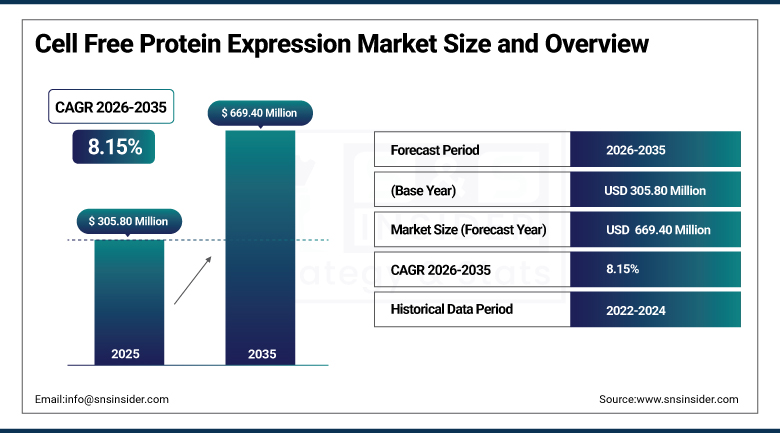
The Cell Free Protein Expression Market was valued at USD 305.80 Million in 2025 and is projected to reach USD 669.40 Million by 2035, registering a CAGR of 8.15% from 2026 to 2035.
The Cell Free Protein Expression Market is supporting rapid protein synthesis outside living cells by using cellular extracts containing transcription and translation machinery required to produce proteins directly from DNA or RNA templates within hours rather than days. The market is characterized by increasing demand for expressing toxic, membrane-bound, and other challenging-to-express proteins which cannot be effectively synthesized via traditional cell cultures, widespread implementation of cell-free platforms for high throughput screening protein engineering campaigns, and rising pharmaceutical interest in using cell-free technologies to accelerate antibody fragment and biologic drug discovery efforts. Growth is being witnessed by increasing use of high efficiency eukaryotic lysate systems, non-standard amino acid incorporation into proteins enabling unique bioengineering strategies, and cell-free bioprocessing at the point-of-need.
Thermo Fisher Scientific expanded its 1-Step Human Coupled IVT Kit portfolio throughout 2025 with new high-yield formulations optimized for producing complex human proteins bearing post-translational modifications required for accurate functional and structural studies.
To Get more information On Cell Free Protein Expression Market - Request Free Sample Report
Cell Free Protein Expression Market Trends
-
Rising demand for expressing toxic and membrane-bound proteins continues driving adoption of cell-free platforms over conventional cell-based expression systems.
-
Growing use of high-yield eukaryotic lysate systems continues improving production of complex proteins requiring accurate post-translational modification.
-
Expanding incorporation of non-natural amino acids continues enabling novel biologic design for next-generation antibody and protein therapeutic candidates.
-
Increasing adoption of high-throughput protein engineering screening continues supporting rapid iteration across structural biology and drug discovery programs.
-
Rising interest in point-of-need biomanufacturing continues expanding cell-free technology applications into field-deployable vaccine and therapeutic production.
U.S. Cell Free Protein Expression Market Outlook
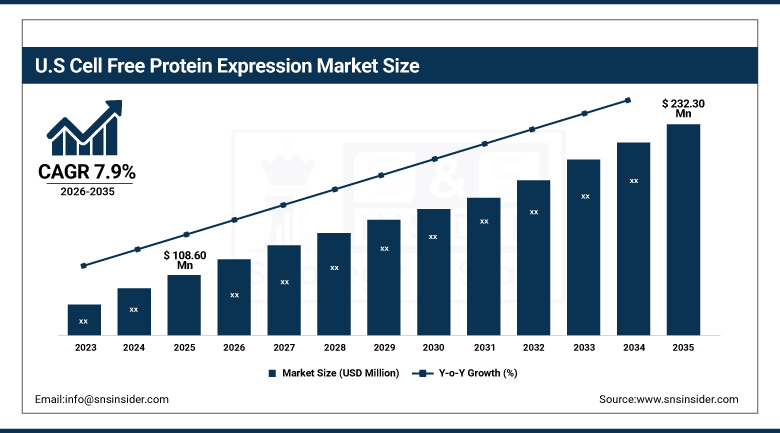
The U.S. Cell Free Protein Expression Market was valued at approximately USD 108.60 Million in 2025 and is projected to reach approximately USD 232.30 Million by 2035, registering a CAGR of approximately 7.9% from 2026 to 2035.
Demand across the United States continued to be shaped by substantial National Institutes of Health funding for structural biology and protein engineering research, a dense concentration of leading kit and reagent manufacturers headquartered domestically, and extensive biopharmaceutical research and development activity across major hubs. Rising biopharmaceutical interest in cell-free platforms for rapid antibody fragment and biologic candidate screening continued reinforcing the country's position as both the largest and most technologically advanced market for cell-free protein expression technology. Growing academic research funding and expanding contract research organization capacity added further layers of sustained domestic demand extending well beyond traditional academic laboratories into commercial biopharmaceutical research nationwide.
Sutro Biopharma advanced its XpressCF+ platform-based cancer immunotherapy candidate into Phase II clinical trials throughout 2025, demonstrating continued commercial validation of cell-free manufacturing technology for producing complex biologic therapeutics at scale.
Cell Free Protein Expression Market Segment Analysis
-
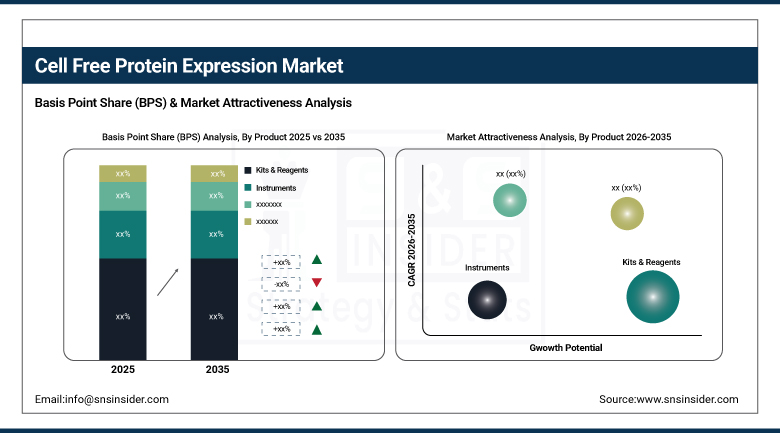
By Product, Kits & Reagents segment dominated the Cell Free Protein Expression Market in 2025 with 58.60% share; Services segment is the fastest growing segment.
-
By Expression System, E. coli-Based Systems segment dominated the market in 2025 with 52.40% share; Insect Cell-Based Systems segment is the fastest growing segment.
-
By Application, Drug Discovery & Development segment dominated the market in 2025 with 38.70% share; Biopharmaceutical Manufacturing segment is the fastest growing segment.
-
By End User, Pharmaceutical & Biotechnology Companies segment dominated the market in 2025 with 46.30% share; Academic & Research Institutes segment is the fastest growing segment.
By Product, Kits and Reagents Lead the Market While Services Post the Fastest Growth
The Kits & Reagents segment dominated the Cell Free Protein Expression Market in 2025, supported by recurring purchase behavior among academic and pharmaceutical laboratories running frequent, small-scale protein expression reactions across drug discovery and structural biology programs. Established vendor relationships and accumulated protocol validation across thousands of published studies reinforced kits and reagents as the default entry point for most laboratories adopting cell-free expression technology. Continued innovation in high-yield lysate formulations further supported this segment's continued revenue leadership. Growing laboratory preference for standardized, pre-validated kit formats has further reinforced sustained repeat purchasing behavior across academic and pharmaceutical settings.
The Services segment is the fastest growing in the Cell Free Protein Expression Market, because of the increasing demand from small and medium-size biotechnology companies and organizations for experts in performing cell-free protein expression studies without building internal capabilities in this area. Outsourcing cell-free protein expression services by Contract Research Organizations is driving strong growth in the addressable market for this type of services, particularly in the case of difficult to express proteins.
By Expression System, E. coli Systems Dominate While Insect Cell Systems Record the Fastest Growth
The E. coli-Based Systems segment dominated the Cell Free Protein Expression Market in 2025, reflecting its established cost advantage, high protein yield, and decades of accumulated optimization across academic and industrial laboratories worldwide. Widespread availability of well-characterized E. coli lysate extracts, combined with extensive published protocol libraries, reinforced this expression system as the default choice across most routine protein expression applications requiring straightforward bacterial-compatible targets.
The Insect Cell-Based Systems segment is the fastest growing in the Cell Free Protein Expression Market as rising demand for producing complex eukaryotic proteins requiring proper folding and post-translational modification continues outpacing what bacterial-derived systems can reliably deliver. Growing biopharmaceutical interest in expressing membrane proteins and glycosylated therapeutic candidates continues accelerating adoption of insect cell-derived lysate systems ahead of the broader market average. Continued advancement in insect cell lysate purification techniques continues narrowing the cost gap with more established bacterial-derived expression systems.
By Application, Drug Discovery Dominates While Biopharmaceutical Manufacturing Emerges as the Fastest-Growing Application
The Drug Discovery & Development segment dominated the Cell Free Protein Expression Market in 2025, anchored by widespread pharmaceutical industry reliance on rapid protein production for target validation, screening assay development, and structural characterization supporting early-stage drug candidate identification. Rising biopharmaceutical research and development investment continued reinforcing this application as the largest revenue-generating segment across the current forecast period.
The Biopharmaceutical Manufacturing segment is the fastest growing in the Cell Free Protein Expression Market as commercial-stage companies increasingly validate cell-free platforms for producing complex biologics, antibody fragments, and vaccine components at meaningful production scale. Growing clinical trial activity involving cell-free manufactured therapeutic candidates continues expanding this application's addressable market well beyond traditional research and discovery use cases.
By End User, Pharmaceutical Companies Dominate While Academic Institutes Post the Fastest Growth
The Pharmaceutical & Biotechnology Companies segment dominated the Cell Free Protein Expression Market in 2025 due to substantial research and development capital investment across drug discovery, biologic candidate screening, and manufacturing feasibility programs. Large pharmaceutical companies continued investing in cell-free platforms to accelerate candidate protein production timelines, reinforcing this segment's position as the largest end-user category for cell-free expression technology.
The Academic & Research Institutes segment is the fastest growing in the Cell Free Protein Expression Market as expanding government research funding and growing university investment in structural biology and synthetic biology core facilities continue broadening technology access across basic and translational research programs. Growing academic-industry collaboration around novel protein engineering approaches continues expanding this segment's addressable market beyond traditional standalone laboratory purchasing.
Regional Analysis
|
Region |
Major Country |
Share within Region, 2025 (%) |
|---|---|---|
|
North America |
United States |
85.0% |
|
Europe |
Germany |
23.0% |
|
Asia Pacific |
China |
34.0% |
|
Latin America |
Brazil |
37.0% |
|
Middle East and Africa |
Saudi Arabia |
30.0% |
North America Cell Free Protein Expression Market Insights
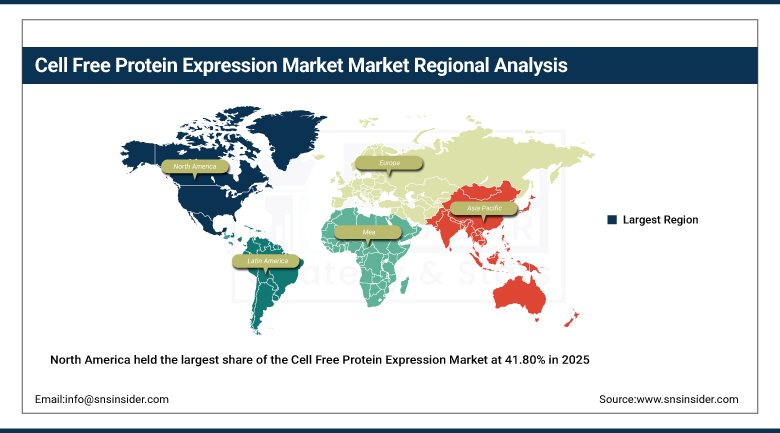
North America held the largest share of the Cell Free Protein Expression Market at 41.80% in 2025. Substantial National Institutes of Health funding for structural biology and protein engineering research, a dense concentration of leading kit and reagent manufacturers, and extensive pharmaceutical and biotechnology research activity continued reinforcing this dominant regional position. Strong biopharmaceutical investment in cell-free manufacturing validation, combined with well-established academic core facility infrastructure, further supported sustained regional demand throughout the current forecast period. Ongoing capital investment in academic core facility modernization continued adding incremental demand across major research universities and government laboratories.
The United States accounted for the substantial majority of regional revenue, anchored by its concentration of leading kit and reagent manufacturers and extensive pharmaceutical research and development activity across major biopharmaceutical hubs. Canada added further regional demand through steady public research funding for structural biology infrastructure, and that combined strength kept the continent the largest addressable market for cell-free protein expression vendors through the forecast period.
Get Customized Report as per Your Business Requirement - Enquiry Now
Europe Cell Free Protein Expression Market Insights
Europe held a meaningful share of global revenue, supported by well-established academic research institutions, strong biotechnology cluster development, and growing public research funding for structural biology and synthetic biology research across the region's major economies. Continued expansion of European core facility infrastructure and cross-border research collaboration reinforced sustained demand for cell-free protein expression technology across the region's leading research economies.
Germany led demand within the region, supported by its strong precision-instrument manufacturing base and deep academic and clinical research infrastructure. The United Kingdom and France contributed substantial additional demand through national research funding and growing biotechnology sector investment, and continued European research funding expansion should keep regional demand for cell-free protein expression technology climbing steadily through the forecast period.
Asia Pacific Cell Free Protein Expression Market Insights
Asia Pacific is projected to register the fastest growth, expanding at a CAGR of 10.60% from 2026 to 2035, driven by rapidly expanding life sciences research funding, growing government investment in biotechnology infrastructure, and rising domestic instrument and reagent manufacturing capability across the region's largest economies. Growing academic-industry collaboration kept the region's growth trajectory well ahead of every other region tracked in this report. Expanding domestic biopharmaceutical manufacturing capacity across the region continued creating fresh demand for both entry-level and advanced cell-free expression technology.
China led regional demand, supported by substantial government investment in biotechnology research infrastructure and rapidly expanding domestic reagent and instrument manufacturing capability. Japan and India contributed meaningful additional demand, with India's growing contract research hub development and Japan's advanced structural biology research infrastructure both reinforcing the region's position as the fastest-growing market tracked in this report.
MEA and Latin America Cell Free Protein Expression Market Insights
The Middle East and Africa and Latin America both showed steady growth, driven by expanding academic and clinical research infrastructure investment, growing government focus on biotechnology research capability, and rising demand for modern protein expression capacity across both areas. As these markets continued building out modern research infrastructure, cell-free protein expression offered a genuinely effective way to accelerate biomedical research capacity beyond conventional cell-based expression methods alone.
The UAE led Middle East and Africa demand, supported by the country's advanced academic medical research infrastructure and substantial biotechnology investment. Saudi Arabia contributed further demand through its own precision medicine research programs. In Latin America, Brazil accounted for the largest share of regional demand, with growing academic and pharmaceutical research investment continuing to anchor regional demand for cell-free protein expression technology.
Market Dynamics
Growth Drivers: Rising Demand for Difficult-to-Express Proteins and Rapid Screening
The industry is driven by rising demand for producing toxic, membrane-bound, and otherwise difficult-to-express proteins that conventional cell-based systems struggle to generate, growing adoption of high-throughput protein engineering screening programs, and expanding biopharmaceutical interest in rapid biologic candidate production. As drug discovery pipelines continue expanding toward more complex therapeutic targets, the need for flexible, fast-turnaround protein expression platforms continues driving sustained technology investment across pharmaceutical and academic research settings.
Growing incorporation of non-natural amino acids for novel biologic design continues reinforcing this driver, as cell-free systems offer researchers precise control over protein composition unavailable through living cell-based expression. Rising biopharmaceutical validation of cell-free platforms for commercial-scale biologic manufacturing continues expanding technology credibility, and that combination of research flexibility and manufacturing validation is exactly what keeps pharmaceutical and academic demand climbing at such a sustained, steady pace.
Restraints: High Reagent Costs and Scale-Up Manufacturing Challenges
The relatively high per-reaction cost of cell-free expression reagents compared with conventional cell culture methods continues posing a genuine restraint on faster market-wide expansion, particularly for laboratories running large-volume protein production programs where cumulative reagent expense can substantially exceed traditional recombinant expression costs. That cost profile has kept cell-free technology adoption concentrated among applications specifically requiring its unique speed and flexibility advantages.
Manufacturing scale-up challenges continue posing a further restraint, as translating laboratory-scale cell-free reactions into commercially viable, large-volume biologic manufacturing processes requires substantial process development investment. That scale-up complexity keeps some biopharmaceutical companies favoring established cell-based manufacturing platforms for commercial production despite cell-free technology's advantages during earlier discovery and development phases.
Opportunities: Commercial Manufacturing Validation and Emerging Market Research Capacity Expansion
Continued commercial-scale manufacturing validation of cell-free platforms represents a genuinely significant opportunity, as successful clinical trial outcomes for cell-free manufactured biologics could substantially expand industry confidence in this technology beyond its traditional research and discovery applications. Vendors positioned early with proven, scalable manufacturing platforms stand to capture meaningful share as biopharmaceutical companies seek faster, more flexible production alternatives. Growing convergence between cell-free expression platforms and automated liquid handling systems continues creating additional opportunities for vendors targeting high-throughput screening applications.
Expanding life sciences research infrastructure across emerging markets offers a second substantial opportunity, as government research investment programs across Asia Pacific, Latin America, and the Middle East continue creating fresh demand for accessible protein expression technology. Vendors with proven, cost-competitive kit and reagent platforms stand to capture meaningful share as developing research systems build out modern protein engineering capability from a comparatively low existing base.
Recent Developments:
-
2024: New England Biolabs launched the PURExpress Disulfide Bond Enhancer Kit, enabling improved folding and disulfide bond formation for antibody fragment and cytokine production in cell-free systems.
-
2024: GreenLight Biosciences expanded its cell-free enzymatic RNA synthesis capacity, incorporating protein expression technology to support scalable mRNA vaccine and therapeutic manufacturing programs.
-
2025: Aldevron entered a strategic manufacturing partnership to scale cell-free protein production capacity for gene therapy and vaccine development programs, addressing rising biomanufacturing demand.
Cell Free Protein Expression Market key players are:
-
Thermo Fisher Scientific Inc.
-
New England Biolabs, Inc.
-
Merck KGaA
-
Promega Corporation
-
Takara Bio Inc.
-
Sutro Biopharma, Inc.
-
Aldevron, LLC
-
GenScript Biotech Corporation
-
Creative Biolabs
-
Jena Bioscience GmbH
-
Cube Biotech GmbH
-
CellFree Sciences Co., Ltd.
-
biotechrabbit GmbH
-
LGC Biosearch Technologies
-
Arbor Biosciences
-
Bio-Rad Laboratories, Inc.
-
GeneCopoeia, Inc.
-
RiboxX GmbH
-
Kaneka Corporation
-
Angstrom Bio, Inc.
Cell Free Protein Expression Market Report Scope:
| Report Attributes | Details |
|---|---|
| Market Size in 2025 | USD 305.80 Million |
| Market Size by 2035 | USD 669.40 Million |
| CAGR | CAGR of 8.15% From 2026 to 2035 |
| Base Year | 2025 |
| Forecast Period | 2026-2035 |
| Historical Data | 2022-2024 |
| Report Scope & Coverage | Market Size, Segments Analysis, Competitive Landscape, Regional Analysis, DROC & SWOT Analysis, Forecast Outlook |
| Key Segments | • By Product (Kits & Reagents, Instruments, Services) • By Expression System (E. coli-Based Systems, Wheat Germ-Based Systems, Rabbit Reticulocyte Lysate-Based Systems, Insect Cell-Based Systems, Others) • By Application (Drug Discovery & Development, Protein Engineering & Structural Biology, Biopharmaceutical Manufacturing, Diagnostics, Others) • By End User (Pharmaceutical & Biotechnology Companies, Academic & Research Institutes, Contract Research Organizations) |
| Regional Analysis/Coverage | North America (US, Canada), Europe (Germany, UK, France, Italy, Spain, Russia, Poland, Rest of Europe), Asia Pacific (China, India, Japan, South Korea, Australia, ASEAN Countries, Rest of Asia Pacific), Middle East & Africa (UAE, Saudi Arabia, Qatar, South Africa, Rest of Middle East & Africa), Latin America (Brazil, Argentina, Mexico, Colombia, Rest of Latin America). |
| Company Profiles | Thermo Fisher Scientific Inc., New England Biolabs, Inc., Merck KGaA, Promega Corporation, Takara Bio Inc., Sutro Biopharma, Inc., Aldevron, LLC, GenScript Biotech Corporation, Creative Biolabs, Jena Bioscience GmbH, Cube Biotech GmbH, CellFree Sciences Co., Ltd., biotechrabbit GmbH, LGC Biosearch Technologies, Arbor Biosciences, Bio-Rad Laboratories, Inc., GeneCopoeia, Inc., RiboxX GmbH, Kaneka Corporation, Angstrom Bio, Inc. |
Frequently Asked Questions
Key players in the Cell Free Protein Expression Market include Thermo Fisher Scientific Inc., New England Biolabs, Merck KGaA, Promega Corporation, and Takara Bio Inc., among others.
Key opportunities include commercial manufacturing validation, automated high-throughput screening, and expanding protein engineering research infrastructure across emerging markets.
The market is driven by rising demand for difficult-to-express proteins, rapid screening, protein engineering, and expanding biopharmaceutical applications.
The E. coli-Based Systems segment dominated the Cell Free Protein Expression Market, accounting for approximately 52.40% market share.
The North America region dominated the Cell Free Protein Expression Market in 2025 with a 41.80% share, driven by research funding and biotechnology investment.
