
Endoscopic Closure Device Market Report Scope & Overview:
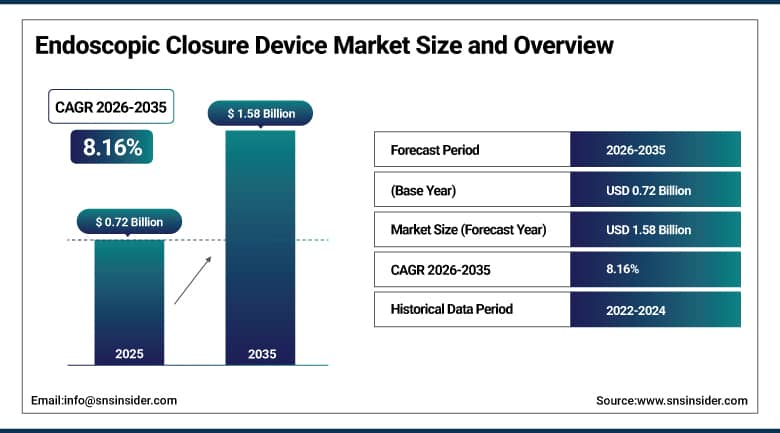
The Endoscopic Closure Device Market was valued at USD 0.72 Billion in 2025 and is expected to reach USD 1.58 Billion by 2035, growing at a CAGR of 8.16% from 2026 to 2035.
There is constant and steady growth of the Endoscopic Closure Device Market due to the rising global prevalence of gastrointestinal disorders, growing volume of diagnostic and therapeutic endoscopy procedures, and increasing physician preference for non-surgical closure of perforations, leaks, fistulae, and post-resection mucosal defects. Endoscopic closures are being increasingly utilized in procedures within gastroenterology, bariatrics, thoracic, and urology. They serve as an easier alternative to surgeries for the purpose of closing any perforations or leaks in the gastrointestinal tract. In addition, they decrease patient hospitalization time and prevent any potential post-procedure complications.
During 2026, Boston Scientific and Ovesco Endoscopy have introduced their new over-the-scope clip and endoscopic suturing platforms, to cater to the increasing demand in hospitals and ambulatory centers for a non-surgical solution to closure of perforations, leaks, and post-resection sites in the gastrointestinal tract due to increased volumes of endoscopic dissections.
To Get More Information On Endoscopic Closure Device Market - Request Free Sample Report
Endoscopic Closure Device Market Trends:
-
Rising adoption of over-the-scope clip (OTSC) systems is expanding closure options for full-thickness GI defects.
-
Growing use of endoscopic suturing platforms is enabling durable closure of large mucosal and submucosal resection sites.
-
Increasing preference for single-use, disposable closure devices is reducing cross-contamination risk in high-volume endoscopy units.
-
Expanding application of endoscopic closure in bariatric revision procedures is broadening the addressable procedure base.
-
Strategic collaborations between device makers and endoscopy training centers are accelerating physician adoption of advanced closure techniques.
U.S. Endoscopic Closure Device Market Outlook:
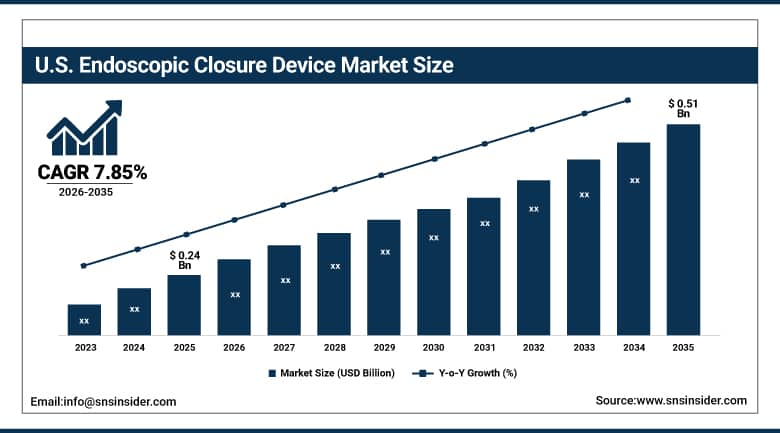
The U.S. Endoscopic Closure Device Market was valued at USD 0.24 Billion in 2025 and is projected to reach USD 0.51 Billion by 2035, growing at a CAGR of 7.85% during 2026–2035.
Leading U.S. hospitals, gastroenterology practices, and ambulatory surgical centers continue to expand adoption of endoscopic closure technologies as colorectal cancer screening programs drive higher colonoscopy volumes and as clinicians increasingly favor endoluminal closure over surgical conversion for perforations and post-resection defects. The growing capability for domestic device manufacturing, expanding physician training programs in advanced endoscopic suturing and over-the-scope clip technique, and rising Medicare and private payer reimbursement support for therapeutic endoscopy procedures help ensure sustained demand for advanced closure devices. Bariatric endoscopy growth, particularly endoscopic sleeve gastroplasty requiring reliable suture-based closure, is also broadening the domestic procedure base for device manufacturers.
In 2026, Medtronic expanded its U.S. distribution network for endoscopic suturing systems through a new physician training partnership, strengthening its ability to supply hospital and ambulatory endoscopy customers performing complex bariatric and mucosal defect closure procedures.
Endoscopic Closure Device Market Segment Analysis:
-
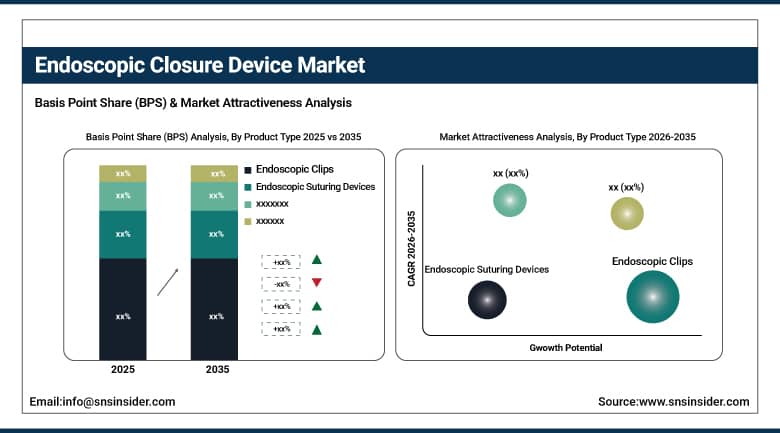
By Product Type, Endoscopic Clips dominated the Endoscopic Closure Device Market with a 42.30% share in 2025, while Endoscopic Suturing Devices is the fastest-growing product type segment with a CAGR of 9.60% from 2026–2035.
-
By Application, Gastrointestinal Surgery dominated the Endoscopic Closure Device Market with a 47.80% share in 2025, while Bariatric Surgery is the fastest-growing application segment with a CAGR of 9.90% from 2026–2035.
-
By End User, Hospitals dominated the Endoscopic Closure Device Market with a 60.70% share in 2025, while Ambulatory Surgical Centers is the fastest-growing end user segment with a CAGR of 10.30% from 2026–2035.
-
By Material, Metal dominated the Endoscopic Closure Device Market with a 53.60% share in 2025, while Biodegradable Materials is the fastest-growing material segment with a CAGR of 10.10% from 2026–2035.
By Product Type, Endoscopic Clips Led the Market While Suturing Devices Emerge as the Fastest-Growing Segment.
The Endoscopic Clips division occupied the largest revenue share in the Endoscopic Closure Devices in 2025. Endoscopic clips, whether through-the-scope or over-the-scope type, continue to be the most sought-after category of devices since they are the preferred choice when it comes to hemostasis, closure of mucosal defects, and marking of the target site for diagnostic and therapeutic interventions in endoscopy. The ease of use through existing channels on standard endoscopes, their versatility, along with their ability to perform on various endoscopy machines, and their clinical efficacy in procedures like colonoscopy and upper gastrointestinal endoscopy have cemented the dominant position of clips in both developed and developing healthcare markets. Innovations in the form of rotatable, reloadable, and larger jaw clips have further widened the scope of using clips for closure of defects.
The Endoscopic Suturing Devices segment is expected to witness the highest CAGR during the forecast period 2026-2035. Growing adoption in bariatric revision procedures, large mucosal defect closure following endoscopic submucosal dissection, and full-thickness resection site management is propelling segment growth, as suturing platforms provide more durable, tension-resistant closure than clips for large or complex defects. Rising physician training in advanced endoscopic suturing technique, expanding use of suturing systems in endoscopic sleeve gastroplasty, and growing hospital investment in interventional endoscopy programs are adding further impetus to adoption. Continued device miniaturization and improved needle-driver ergonomics are making suturing platforms increasingly accessible to a broader base of therapeutic endoscopists beyond specialized tertiary referral centers.
By Application, Gastrointestinal Surgery Dominated While Bariatric Surgery Is the Fastest-Growing Segment.
The Gastrointestinal Surgery segment dominated the Endoscopic Closure Device Market in 2025. Gastrointestinal applications remain the largest category owing to the high global incidence of GI perforations, iatrogenic injuries following polypectomy and endoscopic mucosal resection, fistulae, and anastomotic leaks that require prompt, reliable endoluminal closure to avoid surgical conversion. Higher levels of screening of colorectal cancer, increased use of therapeutic endoscopy for diseases of the upper and lower gastrointestinal tract, and the strong preference for the use of closure devices over surgical procedures whenever feasible are driving this market's growth through hospitals' gastroenterology and endoscopy departments. With the growing adoption of endoscopic mucosal resection and endoscopic submucosal dissection procedures, which include prophylactic closure, the dominance of the segment is reinforced in developed and developing healthcare environments alike.
The Bariatric Surgery segment is expected to register the fastest CAGR during the forecast period 2026-2035. Growing global prevalence of obesity, rising adoption of endoscopic sleeve gastroplasty as a minimally invasive weight-management alternative to surgical bariatric procedures, and increasing use of closure devices to manage bariatric revision complications such as leaks and fistulae are driving strong segment growth. Expanding physician training in endoscopic suturing for bariatric applications, growing patient preference for non-surgical weight-loss interventions with shorter recovery times, and rising insurance coverage for select endoscopic bariatric procedures in several developed markets are further supporting above-average growth relative to the broader endoscopic closure device category.
By End User, Hospitals dominated the Market While Ambulatory Surgical Centers Register the Fastest Growth.
The Hospitals segment dominated the Endoscopic Closure Device Market in 2025. Hospitals continue to be the major category of end-users, since most of the complicated, urgent, and high-risk therapeutic endoscopy procedures, such as full-thickness defect closure, bariatric revision, and treatment of large GI perforations, are conducted at the endoscopy centers of hospitals. The presence of specialists who have interventional skills, imaging assistance, and easy access to surgical backup in the hospital-based centers contributes to hospitals being the primary users of advanced closure clips, suturing devices, and sealants, making them the major market players worldwide.
The Ambulatory Surgical Centers segment for highest CAGR is forecasted for 2026-2035. There is an ongoing worldwide trend of shifting the diagnostics and treatment of routine endoscopic procedures, such as polypectomy and closure of mucosal defects, to the ambulatory setting. This trend is boosting the adoption of closure devices at the ASC level, as it is cheaper on a per procedure basis, faster to perform, and growing in favor among payers due to the reimbursement of outpatient endoscopy. The development of single use and cost-effective closure devices suited for ASC's work process is gaining traction from manufacturers, which in turn is boosting the adoption of clips and suturing systems in the growing ambulatory endoscopy market.
By Material, Metal Dominated While Biodegradable Materials Emerge as the Fastest-Growing Segment.
Metal emerged as the leading segment in the Endoscopic Closure Device Market in 2025. Devices made from metal materials such as stainless steel and nitinol clips are considered the leading type of materials as far as mechanical strength, reliable closure force of jaws, and biocompatibility with different types of gastrointestinal tissues are concerned. The shape memory and superelasticity property of nitinol have helped in developing over-the-scope clips, which help in securing larger volume of tissues for complete defect closure, thus enhancing the position of metals.
Biodegradable Materials will be the fastest growing segment during the period between 2026 and 2035. This will be driven by the growing demand for bioabsorbable clips and sealants that remove the need for device removal or extended retention time. Their usage is most favorable for pediatric patients and repeat procedures due to lower material burden in the body. Continued efforts towards the development of biodegradable polymers that retain enough tensile strength during the critical healing period, combined with growing investments made by manufacturers in the research and development of these products, continues to expand their availability on the market. With growing demand from physicians in terms of reducing adverse effects associated with devices, this segment should continue to experience above average growth.
Regional Analysis:
|
Region |
Major Country |
Share within Region, 2025 (%) |
|---|---|---|
|
North America |
United States |
86.20% |
|
Europe |
Germany |
24.70% |
|
Asia Pacific |
China |
40.60% |
|
Middle East & Africa |
UAE |
25.10% |
|
Latin America |
Brazil |
36.90% |
North America Endoscopic Closure Device Market Insights
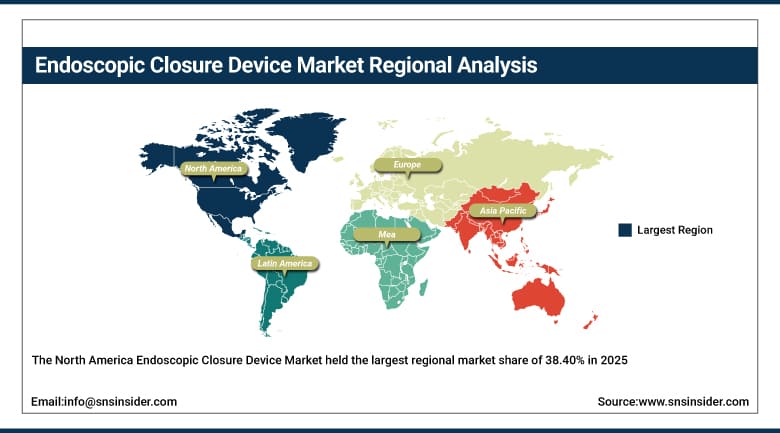
The North America Endoscopic Closure Device Market held the largest regional market share of 38.40% in 2025, owing to the region's high prevalence of gastrointestinal disorders, well-established colorectal cancer screening infrastructure, and broad clinical adoption of advanced therapeutic endoscopy techniques across hospital and ambulatory care networks. Strong reimbursement support for endoscopic interventional procedures, presence of leading device manufacturers, and extensive physician training infrastructure for advanced clip and suturing technique continue to reinforce the region's leadership position. The region's mature regulatory framework, including streamlined FDA clearance pathways for incremental closure device innovations, further supports rapid commercialization and clinical adoption of next-generation endoscopic closure technologies across both routine and complex procedural settings.
The US was the leading country within the North America Endoscopic Closure Device Market in 2025 with a market share of 86.20% of the regional market, driven by extensive domestic endoscopy procedure volume, strong bariatric endoscopy adoption, and growing ambulatory surgical center penetration of advanced closure technologies. Canada is contributing to regional growth through its own expanding gastroenterology infrastructure and growing public healthcare system investment in minimally invasive endoscopic intervention capacity, supported by increasing colorectal cancer screening participation and rising demand for non-surgical closure alternatives across provincial hospital networks.
Get Customized Report as Per Your Business Requirement - Enquiry Now
Europe Endoscopic Closure Device Market Insights
The Europe region was a significant contributor to the Endoscopic Closure Device Market in 2025, expected to register comparatively steady growth for advanced over-the-scope clip and suturing solutions during the forecast period. This is attributed to the region's well-established gastroenterology infrastructure, strong regulatory emphasis on minimally invasive clinical pathways, and growing preference among physicians for endoluminal closure over surgical repair across member states pursuing broader healthcare cost-efficiency objectives amid aging population-driven rises in gastrointestinal disease burden.
Germany is one of the major markets in Europe owing to its strong endoscopy device manufacturing base, well-developed hospital gastroenterology infrastructure, and presence of leading global closure device innovators such as Ovesco Endoscopy serving both domestic and international customers. Other countries such as France, the United Kingdom, and Italy, home to extensive public hospital endoscopy networks, are also contributing to market growth through rising screening colonoscopy volumes and growing adoption of advanced closure devices in interventional gastroenterology and bariatric procedure settings.
Asia Pacific Endoscopic Closure Device Market Insights
The Asia Pacific Endoscopic Closure Device Market is expected to witness the fastest growth rate of 10.20% CAGR during the forecast period 2026-2035. The market growth is driven by rapidly expanding hospital endoscopy infrastructure, rising gastric and colorectal cancer incidence, and growing government investment in cancer screening programs across the region's major and emerging healthcare economies pursuing broader access to advanced gastrointestinal care. Increasing physician training in therapeutic endoscopy technique and growing domestic manufacturing capability for cost-competitive closure devices are further accelerating regional market penetration across both public and private hospital networks.
China is one of the main growth drivers in the Asia Pacific Endoscopic Closure Device Market, owing to its high gastric cancer screening volume and rapidly expanding domestic endoscopic device manufacturing capability supporting both local and export-oriented hospital customers. India and Japan, both major contributors to regional procedure volume, are also supporting regional growth through expanding hospital endoscopy capacity and increasing adoption of advanced resection and closure techniques including endoscopic submucosal dissection requiring prophylactic device use.
Middle East & Africa and Latin America Endoscopic Closure Device Market Insights
Middle East & Africa and Latin American regions are gradually expanding endoscopic closure device adoption as hospital infrastructure investment grows across both regions, supported by increasing government focus on gastrointestinal cancer screening programs and rising physician training in advanced therapeutic endoscopy technique.
Brazil is set to be a prominent Latin American market fueled by its expanding private hospital network and growing bariatric endoscopy procedure volume requiring reliable suture-based closure solutions. The Middle East & Africa region has the UAE and Saudi Arabia investing in modern tertiary hospital infrastructure that is gradually increasing demand for advanced endoscopic closure devices across their expanding gastroenterology and interventional endoscopy service lines.
Market Dynamics:
Growth Drivers: Rising GI disease burden and growing preference for non-surgical endoscopic closure driving market growth
The rising global incidence of gastrointestinal disorders, including perforations, fistulae, anastomotic leaks, and post-resection mucosal defects, combined with growing physician and patient preference for minimally invasive endoluminal closure over open or laparoscopic surgical repair, are among the primary drivers of the Endoscopic Closure Device Market. Endoscopic closure devices provide a faster, less invasive alternative to conventional surgical repair, reducing hospital stay, lowering risk of post-operative infection, and improving overall patient recovery outcomes across virtually every major therapeutic endoscopy application, from routine polypectomy-related bleeding management through complex full-thickness defect repair and bariatric revision procedures.
Technological advancements in clip and suturing device engineering have significantly expanded clinical utility, with recent innovations in over-the-scope clip cap design and rotatable delivery systems improving procedural success rates across increasingly complex closure indications. Rising colorectal cancer screening participation driving higher polypectomy and EMR/ESD procedure volumes, growing adoption of endoscopic bariatric interventions requiring reliable suture-based closure, and continued device manufacturer investment in expanding therapeutic endoscopy product portfolios are further supporting demand across the forecast period, as endoscopic closure devices continue displacing conventional surgical repair across an increasingly broad range of gastrointestinal and bariatric clinical indications.
Restraints: High device and procedure costs coupled with limited endoscopist training availability limiting market expansion
One of the most critical obstacles to market growth is the relatively high cost of advanced closure devices, particularly over-the-scope clip systems and endoscopic suturing platforms, compared to conventional through-the-scope clips, which can limit adoption in cost-constrained healthcare settings and lower-resourced hospital networks. This cost sensitivity is particularly pronounced in emerging markets where reimbursement frameworks for advanced therapeutic endoscopy procedures remain underdeveloped, restricting broader clinical uptake of premium closure technologies despite their demonstrated clinical benefits.
Moreover, the shortage of endoscopists formally trained in advanced closure techniques, including endoscopic suturing and over-the-scope clip deployment, directly constrains procedure volume growth even where device availability is not a limiting factor. Besides, the technical complexity of achieving reliable closure in fibrotic, large, or anatomically challenging defects requires considerable operator experience and specialized equipment, and inconsistent reimbursement policy across healthcare systems continues to create uncertainty for both device manufacturers and hospital purchasing decision-makers evaluating capital investment in advanced closure technology.
Opportunities: Expansion of bariatric endoscopy and next-generation clip and suturing innovation creating new growth avenues
The increasing global adoption of endoscopic sleeve gastroplasty and other suture-based bariatric interventions, the rise of combination closure techniques utilizing clips alongside sealants for enhanced defect coverage, and greater emphasis on next-generation suturing and clip delivery system innovation driven by rising biotechnology and medical device funding will provide ample growth opportunities in the Endoscopic Closure Device Market. Expanding hospital investment in interventional endoscopy training programs across emerging economies will further ensure future growth as clinical capability broadens beyond specialized tertiary referral centers.
There is immense potential for growth in the area of biodegradable and bioabsorbable closure materials that eliminate long-term device retention concerns, along with continued expansion of ambulatory surgical center-focused single-use device configurations that lower per-procedure cost for outpatient providers. The increase in hospital endoscopy capacity across emerging economies of Asia Pacific and Latin America, along with growing government investment in gastrointestinal cancer screening infrastructure, will drive sustained growth in demand for advanced endoscopic closure technologies.
Recent Developments:
-
2025: Boston Scientific launched an enhanced version of its OverStitch endoscopic suturing system with improved needle-driver ergonomics, targeting hospitals performing bariatric revision and large mucosal defect closure procedures.
-
2026: Olympus Corporation expanded its endoscopic clip portfolio with a rotatable, reloadable through-the-scope clip platform designed to improve precision during hemostasis and mucosal closure procedures across hospital endoscopy suites.
-
2026: Cook Medical received regulatory clearance for an expanded indication of its endoscopic clip system, broadening its use in prophylactic closure following endoscopic mucosal resection procedures at ambulatory surgical centers.
Endoscopic Closure Device Market Key Players are:
-
Boston Scientific Corporation
-
Olympus Corporation
-
Medtronic plc
-
Johnson & Johnson (Ethicon US, LLC)
-
Cook Group Incorporated
-
The Cooper Companies, Inc.
-
Ovesco Endoscopy AG
-
Abbott Laboratories
-
STERIS plc
-
Teleflex Incorporated
-
B. Braun Melsungen AG
-
CONMED Corporation
-
FUJIFILM Holdings Corporation
-
Micro-Tech (Nanjing) Co., Ltd.
-
Ambu A/S
-
Cardinal Health, Inc.
-
Haemonetics Corporation
-
Changzhou Jiuhong Medical Instrument Co., Ltd.
-
Era Endoscopy S.r.l.
-
Endocor GmbH & Co. KG
Endoscopic Closure Device Market Report Scope:
| Report Attributes | Details |
|---|---|
| Market Size in 2025 | USD 0.72 Billion |
| Market Size by 2035 | USD 1.58 Billion |
| CAGR | CAGR of 8.16% From 2026 to 2035 |
| Base Year | 2025 |
| Forecast Period | 2026-2035 |
| Historical Data | 2022-2024 |
| Report Scope & Coverage | Market Size, Segments Analysis, Competitive Landscape, Regional Analysis, DROC & SWOT Analysis, Forecast Outlook |
| Key Segments | • By Product Type (Endoscopic Clips, Endoscopic Suturing Devices, Sealants & Adhesives, Bands & Loops, Others) • By Application (Gastrointestinal Surgery, Bariatric Surgery, Thoracic Surgery, Urological Surgery, Gynecological Surgery, Others) • By End User (Hospitals, Ambulatory Surgical Centers, Specialty Clinics) • By Material (Metal, Polymer, Biodegradable Materials, Others) |
| Regional Analysis/Coverage | North America (US, Canada), Europe (Germany, France, UK, Italy, Spain, Russia, Poland, Rest of Europe]), Asia Pacific (China, India, Japan, South Korea, Australia, ASEAN Countries, Rest of Asia Pacific), Latin America (Brazil, Argentina, Mexico, Colombia, Rest of Latin America), Middle East & Africa (UAE, Saudi Arabia, Qatar, South Africa, Rest of Middle East & Africa) |
| Company Profiles | Boston Scientific Corporation, Olympus Corporation, Medtronic plc, Johnson & Johnson (Ethicon US, LLC), Cook Group Incorporated, The Cooper Companies, Inc., Ovesco Endoscopy AG, Abbott Laboratories, STERIS plc, Teleflex Incorporated, B. Braun Melsungen AG, CONMED Corporation, FUJIFILM Holdings Corporation, Micro-Tech (Nanjing) Co., Ltd., Ambu A/S, Cardinal Health, Inc., Haemonetics Corporation, Changzhou Jiuhong Medical Instrument Co., Ltd., Era Endoscopy S.r.l., Endocor GmbH & Co. KG |

Frequently Asked Questions
Key players include Boston Scientific Corporation, Olympus Corporation, Medtronic plc, Johnson & Johnson (Ethicon US, LLC), and Cook Group Incorporated, among others.
Key opportunities include increasing minimally invasive procedures, rising adoption of advanced closure technologies, growing endoscopic interventions, and demand for faster recovery and reduced procedural complications.
The market is driven by the rising prevalence of gastrointestinal disorders, growing volume of diagnostic and therapeutic endoscopy procedures, and increasing physician preference for non-surgical closure technologies.
The Gastrointestinal Surgery segment dominated the Endoscopic Closure Device Market in 2025, accounting for approximately 47.80% market share.
The North America region dominated the Endoscopic Closure Device Market in 2025, driven by high prevalence of gastrointestinal disorders and well-established colorectal cancer screening infrastructure.
