
Enterprise Browser Market Report Scope & Overview:
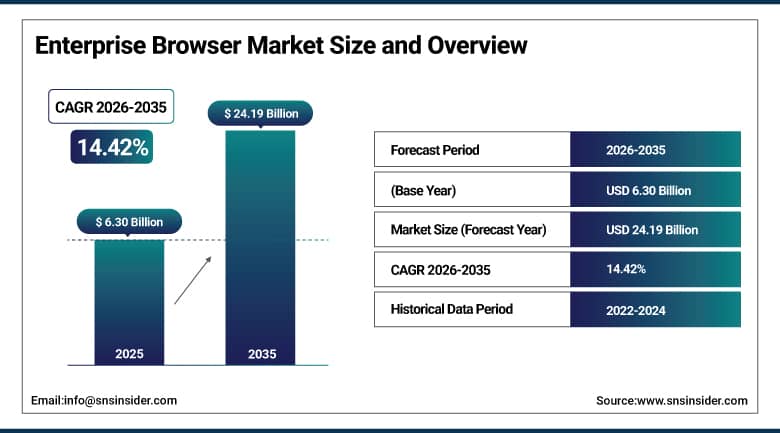
Enterprise Browser Market was valued at USD 6.30 Billion in 2025 and is expected to reach USD 24.19 Billion by 2035, growing at a CAGR of 14.42% from 2026–2035.
The key factors that contribute towards the growth of the global enterprise browser market consist of the growing number of cyber threats, the adoption of hybrid/remote working models, and the increasing demand for secure enterprise access to cloud applications. Businesses have been adopting enterprise browsers in order to increase the level of browser security, reduce data loss, and implement centralized security policies in both managed as well as unmanaged devices. Moreover, the growing adoption of Zero Trust security architecture, growing need for compliance with strict regulations, and the increasing adoption of cloud-based business applications are also aiding in the growth of the market.
Manufacturers are accelerating the development of AI-powered enterprise browsers integrated with browser isolation, identity and access management, and data loss prevention capabilities to strengthen browser security, enhance user productivity, and support Zero Trust and Secure Access Service Edge (SASE) architectures across distributed enterprise environments.
Market Size and Forecast
-
Market Size 2026E: USD 7.20 Billion
-
Market Size 2035: USD 24.19 Billion
-
CAGR: 14.42% from 2026 to 2035
-
Fastest Growing Region: Asia-Pacific
-
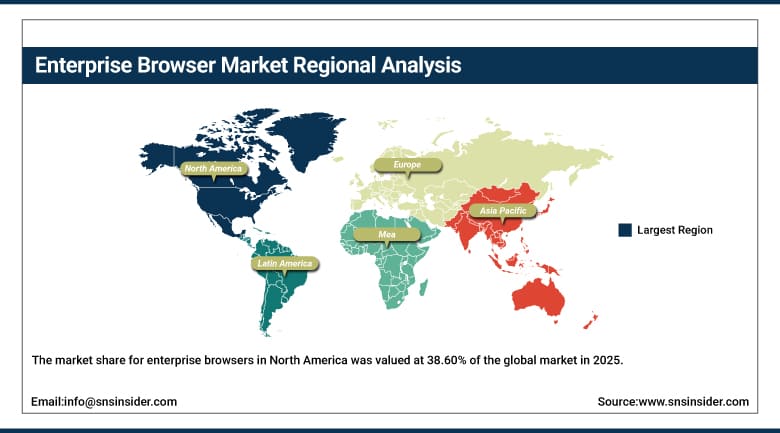
Largest Region: North America
To Get More Information On Enterprise Browser Market - Request Free Sample Report
Enterprise Browser Market Trends
-
Increasing adoption of Zero Trust security frameworks is driving demand for enterprise browsers that provide secure, policy-based access to enterprise applications and data.
-
Rising prevalence of hybrid and remote work models is accelerating the deployment of enterprise browsers to secure access across managed and unmanaged devices.
-
Growing integration of enterprise browsers with identity and access management (IAM), data loss prevention (DLP), and secure access service edge (SASE) platforms is enhancing enterprise cybersecurity and regulatory compliance.
-
Advancements in AI-powered threat detection, browser isolation, and real-time security analytics are enabling the development of enterprise browsers with improved protection against phishing, malware, and data exfiltration attacks.
-
Increasing adoption of cloud-based enterprise applications and stricter data privacy regulations are encouraging organizations to implement enterprise browsers for centralized management, secure browsing, and compliance enforcement.
U.S. Enterprise Browser Market Outlook
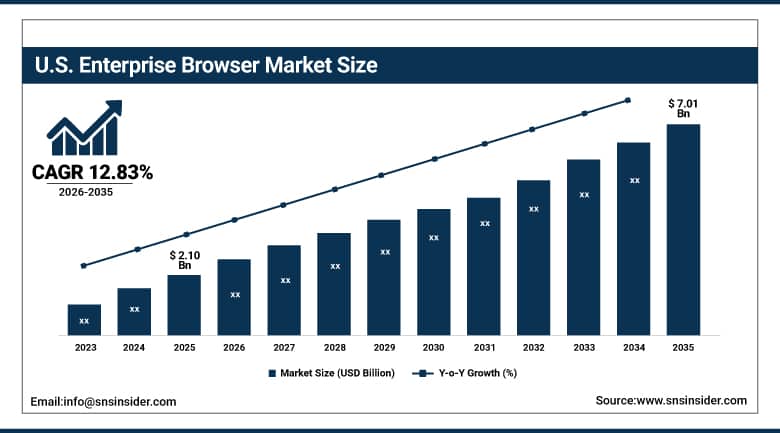
The U.S. Enterprise Browser Market was valued at USD 2.10 Billion in 2025 and is expected to reach around USD 7.01 Billion by 2035, growing at a CAGR of 12.83% from 2026–2035.
The US enterprise browser market experiences continuous growth owing to the adoption of Zero Trust Security approaches, the prevalence of cybersecurity risks, and an increased trend towards hybrid and remote working arrangements. The enterprises in various sectors deploy enterprise browsers to ensure safe access to cloud applications, protect their valuable data, and maintain security policies in managed and unmanaged environments. Enterprise browsers have become a preferred choice for improving browser security, preventing phishing and malware attacks, avoiding data loss, and ensuring compliance with various regulations. Also, the increase in investment in cloud security, integration with identity and access management (IAM), SASE, and browser isolation, and advances in AI-based threat detection can be attributed to the growing trend of the US enterprise browser market.
In February 2026: Island announced the integration of its Enterprise Browser with the AWS Security Hub Extended plan in the United States, enabling organizations to strengthen browser-native security, AI governance, and centralized threat management while simplifying enterprise cybersecurity procurement and deployment.
Enterprise Browser Market Segment Analysis
-
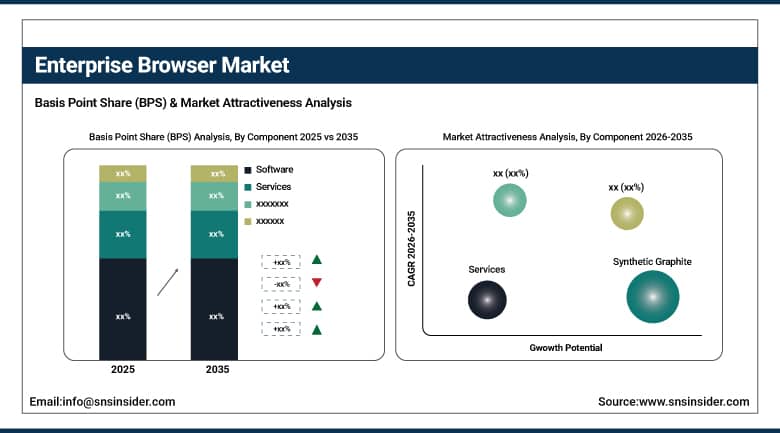
By Component, software dominated the enterprise browser market with a 68.50% share in 2025, while services is projected to be the fastest-growing segment, registering a CAGR of 15.91% during 2026–2035.
-
By Deployment Mode, cloud dominated the enterprise browser market with a 65.00% share in 2025, while on-premises is projected to be the fastest-growing segment, registering a CAGR of 19.85% during 2026–2035.
-
By Organization Size, large enterprises dominated the enterprise browser market in 2025, while small and medium enterprises (SMEs) is projected to be the fastest-growing segment during 2026–2035.
-
By Application, secure browsing dominated the enterprise browser market with a 35.60% share in 2025, while identity and access management is projected to be the fastest-growing segment, registering a CAGR of 17.89% during 2026–2035.
-
By End User, BFSI dominated the enterprise browser market with a 28.90% share in 2025, while healthcare is projected to be the fastest-growing segment, registering a CAGR of 16.44% during 2026–2035.
By Component, software dominated the enterprise browser market, while the services segment is expected to grow fastest
Market share in the software category was highest in 2025 because of the high prevalence of enterprise browser platforms that allow central management of browsers, security features, policy settings, and integration with I am, zero trust, and data loss prevention (DLP). Increasing security threats, increasing use of hybrid work styles, and increased demand for secure access to cloud applications drive the dominance of this category.
The services category will record the fastest growth rate during the forecast period because of the rising demand for consulting, implementation, integration, managed services, and technical support for enterprise browser applications. Companies are increasingly relying on services to streamline the process, ensure compliance with regulations, optimize the security policy, and manage their complex browser environment. The rising popularity of cloud enterprise browsers and managed security services is likely to fuel the growth of this category further until 2035.
By Deployment Mode, cloud dominated the enterprise browser market, while the on-premises segment is expected to grow fastest
In 2025, the cloud segment led in market share because of its ability to scale up, centralize management, reduce deployment cost, and facilitate remote/hybrid workplace environment. Enterprise browser solutions based on clouds have become popular among businesses since they help enforce consistent security policies, perform updates easily, work with cloud applications, and provide secure access to distributed workforces. Zero trust security architecture and software as a service (SaaS) have also boosted the popularity of the segment in recent years.
On-premises segment is expected to register the highest growth rate during the forecast period because of increased requirement for highly regulated industries like BFSI, healthcare, and governments, which need higher control over data, infrastructure, and security policies. Growing concerns about data sovereignty and security and regulation of sensitive information have been driving organizations to deploy their enterprise browsers on premises. Continuous development of enterprise security infrastructure and deployment capabilities are likely to drive this segment until 2035.
By End User, BFSI dominated the enterprise browser market, while the healthcare segment is expected to grow fastest
The BFSI sector will have an edge over other market segments in 2025 due to the increasing necessity for protection of sensitive financial data, ensuring security for the processes involved in digital banking operations, and meeting strict regulatory standards. Enterprise browser solutions are being adopted rapidly by the BFSI sector in order to enhance security by employing zero-trust approaches, avoiding any potential for data leakage, phishing attacks, and managing access to applications available in the cloud.
The healthcare sector will remain as the fastest growing segment during the forecast period due to the increasing digitization of healthcare, the growing use of electronic health record systems, and concerns regarding security of patients' data. There is an increasing trend among healthcare organizations to adopt enterprise browser solutions in order to ensure secure access to applications and meet regulatory standards, thus protecting their sensitive information from any cyber risks.
Regional Insights
|
Region |
Major Country |
Share within Region, 2025(%) |
|---|---|---|
|
North America |
United States |
86.40% |
|
Europe |
Germany |
21.50% |
|
Asia Pacific |
China |
42.80% |
|
Middle East & Africa |
Saudi Arabia |
29.50% |
|
Latin America |
Brazil |
38.50% |
North America Enterprise Browser Market Insights
The market share for enterprise browsers in North America was valued at 38.60% of the global market in 2025, due to the growing use of enterprise browsing solutions for cybersecurity purposes and protecting company data. Furthermore, the US market share for enterprise browsers in North America was valued at 86.40% in 2025, due to the presence of digital enterprises in the country, along with the use of zero trust framework by organizations in the country, and investments in secure access technology.
Growing concerns about cyber threats, rise in the use of remote and hybrid work models, growing demand for secure web access, identity protection, and regulatory compliance are some factors that have been driving the market growth in the region. Apart from this, innovations in enterprise browser platform, implementation of AI-based threat detection solutions, and investments in cloud security are some of the other factors that are likely to drive the enterprise browser market in the US in the coming years.
Get Customized Report as Per Your Business Requirement - Enquiry Now
Europe Enterprise Browser Market Insights
Europe is still one of the leading regions in the enterprise browser market because of its highly efficient cybersecurity ecosystem, the proliferation of digital transformation strategies, and data privacy regulations. Germany constituted 21.50% of the enterprise browser market share in Europe in 2025 owing to its sophisticated industrial landscape, extensive use of enterprise software, and adoption of secure digital workplace technology.
The growth of the enterprise browser market in Europe is driven by high demand for secure internet access, adoption of zero trust security architectures, and issues related to data privacy and compliance with regulatory requirements. In addition, innovations in browser security technology, adoption of cloud computing, and use of enterprise browsers in different sectors like manufacturing, BFSI, health care, and government are some factors expected to aid the market's continued growth in the coming years.
Asia Pacific Enterprise Browser Market Insights
The CAGR in Asia Pacific is expected to be the highest at 16.24% between 2025 and 2035 owing to the fast rate of digital transformation, growth in IT infrastructure of enterprises, and increase in use of cloud-based cybersecurity systems. Enterprises in the region are increasingly investing in zero trust security architectures, secure remote working, and browser-based enterprise security in order to protect themselves against emerging cyber threats. The China enterprise browser market held an estimated 42.80% share of the Asia Pacific enterprise browser market in 2025, driven by the large number of enterprises in the country, accelerated adoption of cloud solutions, and increased investment in cybersecurity infrastructure.
Growing governmental efforts in improving cybersecurity, increasing trend of hybrid work model, and growing awareness about secure web access and data protection are providing significant growth opportunities in the region. In addition, growth in digitization across various industries, advancements in enterprise security technology, and increasing demand for secure enterprise browsing solution are expected to fuel the growth in the market.
Middle East & Africa and Latin America Insights
Middle East & Africa and Latin America are emerging markets for the enterprise browser market, driven by accelerating digital transformation, increasing cloud adoption, and rising investments in cybersecurity across both regions. Organizations are strengthening their security posture by adopting zero trust frameworks, secure web access solutions, and browser-based security platforms to protect distributed workforces and enterprise applications. Saudi Arabia accounted for 29.50% of the Middle East & Africa enterprise browser market in 2025, supported by large-scale digital transformation initiatives and government investments in cybersecurity, while Brazil represented 38.50% of the Latin America enterprise browser market due to its expanding enterprise IT ecosystem and growing adoption of cloud-based security solutions.
Increasing awareness of cyber risks, rising implementation of data protection regulations, and expanding investments in secure digital workplaces are creating substantial growth opportunities across both regions. In addition, continued modernization of enterprise IT infrastructure, growing adoption of hybrid work models, and increasing demand for secure browsing environments are expected to support steady market growth throughout the forecast period.
Growth Driver: Rising adoption of zero trust security and secure enterprise browsing solutions.
The growing need to strengthen enterprise cybersecurity and protect sensitive corporate data has become a key factor driving the adoption of enterprise browsers across organizations. Businesses are increasingly deploying enterprise browsers to provide secure access to cloud applications, enforce security policies, and reduce risks associated with phishing, malware, and data leakage. The rapid expansion of hybrid work environments and cloud-based business operations is further accelerating market growth.
The increasing adoption of zero trust security frameworks, rising demand for secure web access, and continuous advancements in browser security technologies are further supporting the enterprise browser market. Additionally, growing regulatory requirements for data privacy, expanding digital transformation initiatives, and increasing investments in secure enterprise IT infrastructure are expected to drive sustained market growth over the forecast period.
Restraints: High implementation costs, integration challenges, and concerns over compatibility with legacy IT systems may restrain market growth.
High implementation costs and integration complexities remain major challenges for the enterprise browser market. Deploying enterprise browsers often requires investments in security infrastructure, identity management, policy configuration, and employee training, making adoption costly for small and medium-sized enterprises. In addition, compatibility issues with legacy applications and existing IT environments can delay implementation and increase deployment complexity. Furthermore, organizations must address concerns related to user adoption, browser compatibility, and ongoing security management while complying with evolving data privacy and cybersecurity regulations.
The availability of alternative secure access solutions, such as secure web gateways, virtual desktop infrastructure (VDI), and secure access service edge (SASE) platforms, further intensifies market competition and may restrain the growth of the enterprise browser market during the forecast period.
Opportunities: Growing adoption of zero trust security, hybrid work models, and cloud-based enterprise security solutions.
The increasing adoption of zero trust security frameworks and hybrid work environments presents significant growth opportunities for the enterprise browser market. Organizations are deploying enterprise browsers to secure access to cloud applications, protect sensitive business data, and enforce centralized security policies across distributed workforces. Continuous advancements in browser isolation, identity-based access control, and AI-powered threat detection are further expanding enterprise browser capabilities.
In addition, rising investments in digital transformation, increasing migration to cloud-based applications, and growing regulatory requirements for data privacy are creating new opportunities for market participants. Expanding demand for secure remote access, integration with security platforms such as SASE and SSE, and ongoing innovation in enterprise browser technologies are expected to support the long-term growth of the enterprise browser market.
Recent Developments
-
2025: Palo Alto Networks, Inc. expanded its secure enterprise browser capabilities through the Prisma Access Browser, strengthening zero trust security and secure access for hybrid work environments.
-
2025: Island Technology Inc. introduced new AI-powered security features and enhanced data loss prevention (DLP) capabilities to improve secure enterprise browsing and protect sensitive corporate information.
-
2024: Cisco Systems, Inc. enhanced its Secure Access platform by integrating enterprise browser isolation and secure web access capabilities to strengthen enterprise cybersecurity.
-
2024: Menlo Security, Inc. expanded its Browser Security platform with advanced phishing protection, secure application access, and browser isolation technologies to support organizations adopting hybrid work models.
Enterprise Browser Market Key Players
-
Island Technology Inc.
-
Talon Cyber Security
-
Citrix Systems, Inc.
-
Microsoft Corporation
-
Google LLC
-
Cisco Systems, Inc.
-
Menlo Security, Inc.
-
Netskope, Inc.
-
Cloudflare, Inc.
-
Proofpoint, Inc.
-
Broadcom Inc. (Symantec)
-
Zscaler, Inc.
-
BlackBerry Limited
-
HP Inc.
-
IBM Corporation
-
Red Access GmbH
-
Seraphic Security
-
Opera Limited.
Enterprise Browser Market Report Scope:
| Report Attributes | Details |
|---|---|
| Market Size in 2025 | USD 6.30 Billion |
| Market Size by 2035 | USD 24.19 Billion |
| CAGR | CAGR of 14.42% From 2026 to 2035 |
| Base Year | 2025 |
| Forecast Period | 2026-2035 |
| Historical Data | 2022-2024 |
| Report Scope & Coverage | Market Size, Segments Analysis, Competitive Landscape, Regional Analysis, DROC & SWOT Analysis, Forecast Outlook |
| Key Segments | • By Component (Software, Services) • by Deployment Mode (On-Premises, Cloud) • By Organization Size (Large Enterprises, Small and Medium Enterprises (SMEs)) • By Application (Secure Browsing, Data Loss Prevention, Identity and Access Management, Compliance Management, Others) •By End User (BFSI, Healthcare, IT and Telecommunications, Government, Retail, Others) |
| Regional Analysis/Coverage | North America (US, Canada, Mexico), Europe (Eastern Europe [Poland, Romania, Hungary, Turkey, Rest of Eastern Europe] Western Europe] Germany, France, UK, Italy, Spain, Netherlands, Switzerland, Austria, Rest of Western Europe]), Asia Pacific (China, India, Japan, South Korea, Vietnam, Singapore, Australia, Rest of Asia Pacific), Middle East & Africa (Middle East [UAE, Egypt, Saudi Arabia, Qatar, Rest of Middle East], Africa [Nigeria, South Africa, Rest of Africa], Latin America (Brazil, Argentina, Colombia, Rest of Latin America) |
| Company Profiles | Island Technology Inc., Talon Cyber Security, Palo Alto Networks, Inc., Citrix Systems, Inc., Microsoft Corporation, Google LLC, Cisco Systems, Inc., Menlo Security, Inc., Netskope, Inc., Cloudflare, Inc., Proofpoint, Inc., Broadcom Inc. (Symantec), Zscaler, Inc., Forcepoint LLC, BlackBerry Limited, HP Inc., IBM Corporation, Red Access GmbH, Seraphic Security, Opera Limited. |

Frequently Asked Questions
The enterprise browser market was valued at USD 6.30 billion in 2025.
The software segment dominated the market in 2025 with a 68.50% share.
