
Enterprise Knowledge Graph Market Report Scope & Overview:
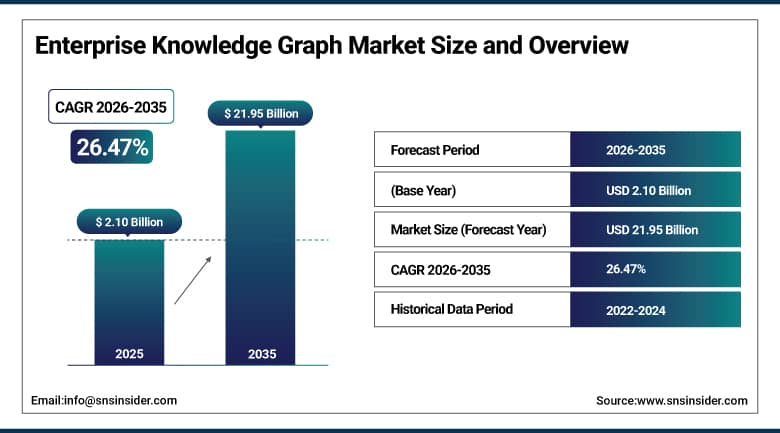
Enterprise Knowledge Graph Market was valued at USD 2.10 Billion in 2025 and is expected to reach USD 21.95 Billion by 2035, growing at a CAGR of 26.47% from 2026–2035.
The major factors fueling the growth of the global enterprise knowledge graph market include the growing adoption of artificial intelligence (AI), demand for enterprise data integration and management of knowledge, growing demand for semantic searches and customized customer experiences, and increased investment in AI-based enterprise technologies. Growing demand for enterprise knowledge graphs is anticipated to be fueled by the increased amount and complexity of enterprise data that are created within databases, applications, documentation, and clouds, as knowledge graphs assist enterprises in connecting data, identifying relations, making data accessible, and offering context for analytics and AI applications.
Further, growing focus on enhancing enterprise data intelligence, AI accuracy, efficiency, and decision-making is likely to drive the demand for knowledge graph platforms, graph database engines, and knowledge management toolsets.
In July 2026, Neo4j moved its Virtual Graph technology into public preview, enabling enterprises to create knowledge graphs directly from existing data in Snowflake, Databricks, and Google BigQuery without moving or duplicating the underlying data. The technology is designed to support GraphRAG and multi-hop reasoning for enterprise AI applications, strengthening the use of knowledge graphs as a contextual data layer for AI agents and decision-making.
To Get More Information On Enterprise Knowledge Graph Market - Request Free Sample Report
Enterprise Knowledge Graph Market Trends
-
Increasing adoption of artificial intelligence (AI) and enterprise data analytics is driving the enterprise knowledge graph market.
-
Rising demand for connected, contextualized, and easily accessible enterprise data is accelerating the adoption of knowledge graph platforms.
-
Growing investments in generative AI, GraphRAG, and AI-driven enterprise applications are boosting market growth.
-
Increasing focus on improving data integration, semantic search, knowledge management, and decision-making is supporting knowledge graph technology adoption.
-
Expanding deployment of enterprise knowledge graphs across BFSI, healthcare & life sciences, retail & e-commerce, IT & telecommunications, manufacturing, and government sectors is strengthening market demand.
U.S. Enterprise Knowledge Graph Market Outlook
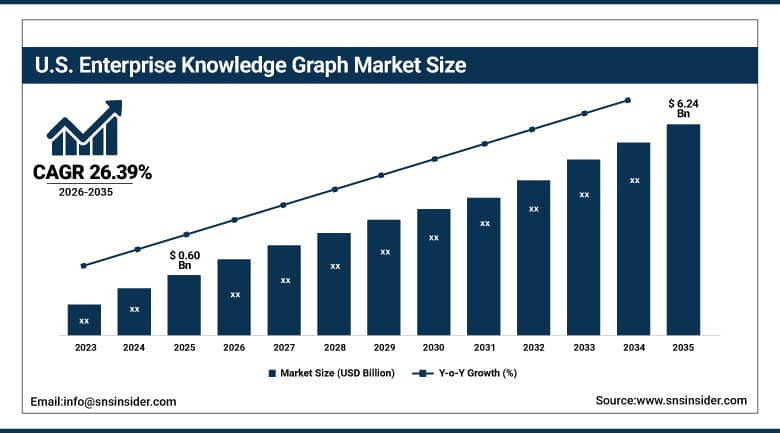
The U.S. Enterprise Knowledge Graph Market was valued at USD 0.60 Billion in 2025 and is expected to reach around USD 6.24 Billion by 2035, growing at a CAGR of 26.39% from 2026–2035.
Increasing acceptance of AI, generative AI, and enterprise data analytics will be crucial in fueling the growth of the enterprise knowledge graph market in the United States during the forecast period. Increasing need for connection of enterprise data in a contextualized manner has driven the adoption of enterprise knowledge graph platforms, which help connect information from various sources such as databases, applications, documents, and cloud-based platforms. Presence of leading technology players, enterprise software vendors, financial institutions, healthcare players, and advanced digital infrastructure along with increasing investments in AI and data management solutions is likely to drive market growth.
In addition, advancements in areas such as semantic search, GraphRAG, AI agents, knowledge management, graph analytics, and enterprise data integration are likely to drive the adoption of enterprise knowledge graphs. Generative AI infrastructure, enterprise AI applications, data governance, and intelligent search solutions are generating lucrative business opportunities. Increasing focus on improvement in areas such as data interoperability, AI context understanding, decision making, personalization, and operational efficiencies is likely to drive the adoption of enterprise knowledge graph solutions in the United States during the forecast period.
In June 2026, Neo4j acquired GraphAware to strengthen its enterprise knowledge graph and graph intelligence capabilities, combining Neo4j’s graph technology with GraphAware’s expertise in knowledge graphs and intelligence analysis. The move is aimed at helping organizations connect complex enterprise data, improve contextual understanding, and support AI-driven intelligence and decision-making while maintaining greater control over enterprise data.
Enterprise Knowledge Graph Market Segment Analysis
-
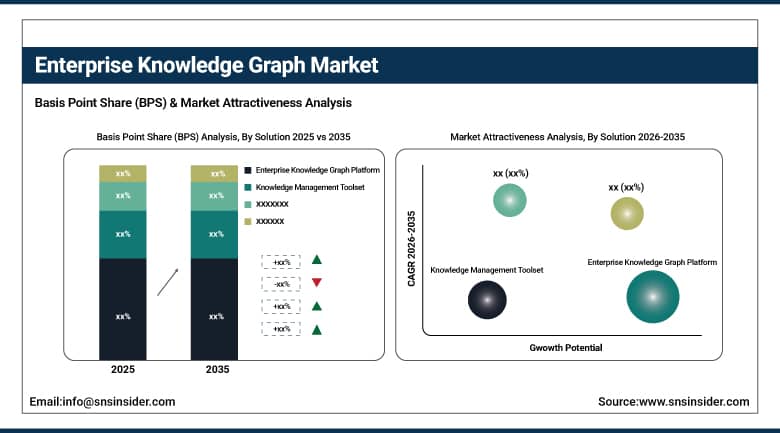
By Solution, enterprise knowledge graph platform dominated the enterprise knowledge graph market with a 48.63% share in 2025, while knowledge management toolset is projected to be the fastest-growing segment, registering a 29.42% CAGR during 2026–2035.
-
By Model type, labeled property graph dominated the enterprise knowledge graph market with a 65.30% share in 2025, while resource description framework (RDF) triple stores is projected to be the fastest-growing segment, registering a 28.22% CAGR during 2026–2035.
-
By Application, semantic search & enterprise knowledge management dominated the enterprise knowledge graph market with a 47.80% share in 2025, while recommendation systems are projected to be the fastest-growing segment, registering a 30.03% CAGR during 2026–2035.
-
By Deployment, cloud dominated the enterprise knowledge graph market with a 56.60% share in 2025, while on-premises is projected to be the fastest-growing segment, registering a 27.89% CAGR during 2026–2035.
-
By Organization size, large enterprises dominated the enterprise knowledge graph market with a 57.60% share in 2025, while small & medium enterprises (SMEs) are projected to be the fastest-growing segment, registering a 27.94% CAGR during 2026–2035.
-
By End use, BFSI dominated the enterprise knowledge graph market with a 27.10% share in 2025, while healthcare & life sciences is projected to be the fastest-growing segment, registering a 29.60% CAGR during 2026–2035.
By Solution, enterprise knowledge graph platform dominated the enterprise knowledge graph market, while knowledge management toolset is expected to grow fastest.
In the enterprise knowledge graph market, the enterprise knowledge graph platform held the largest share of 48.63%, due to its capabilities to integrate and connect diverse enterprise data sources and form an integrated knowledge layer for the purposes of analytics and artificial intelligence (AI) application. An increased usage of generative AI, enterprise data integration, semantic search, and knowledge management solutions fuels the growing demand for the enterprise knowledge graph platform. In addition, growing investments in decision making through the use of artificial intelligence (AI) solutions and the need to make enterprise data accessible and interoperable contribute to segment growth. Also, the growing use of enterprise knowledge graph platforms for GraphRAG, AI agents, and enterprise intelligence applications increases the demand for enterprise knowledge graph platforms.
In terms of the type of enterprise knowledge graph solutions, the fastest-growing segment is the knowledge management toolset segment. During the forecast period, the segment will show a 29.42% CAGR, due to the increased adoption of the knowledge management toolsets fuelled by the increased demand for the centralized enterprise knowledge, semantic information discovery, and contextual data access.
By Model Type, labeled property graph dominated the enterprise knowledge graph market, while resource description framework (RDF) triple stores are expected to grow fastest.
Labeled property graph captured the major market share of enterprise knowledge graph market in 2025 at 65.30%, owing to its ability to represent relationships between entities in flexible manner and its applicability in enterprise applications involving relationship analysis. Adoption of graph database for application such as customer 360, fraud detection, recommendation system, supply chain intelligence, and enterprise analytics is expected to drive the demand for labeled property graphs. Flexible and intuitive representation of connected data through labeled property graph is driving their adoption in enterprise applications.
RDF Triple Stores is expected to witness high growth rate during the forecast period at 28.22% CAGR from 2025 to 2035. Growing adoption of technology for semantic interoperability, linked data, knowledge representation, and standard data integration is driving the growth of RDF Triple Stores. Adoption of semantic technology for enterprise knowledge management, AI, and complex data environment is expected to drive the growth of segment.
By Application, semantic search & enterprise knowledge management dominated the enterprise knowledge graph market, while recommendation systems are expected to grow fastest.
Semantic search and enterprise knowledge management were the biggest contributors to the enterprise knowledge graph market in 2025, contributing 47.80% share due to rising demand for contextual searches, enterprise data discovery, and centralized knowledge management. Companies are making use of knowledge graphs to link structured and unstructured data and enhance search relevance and context of AI applications. The adoption of generative AI, enterprise search, and knowledge management is also contributing to segment growth.
The recommendation systems will exhibit the highest CAGR during the forecast period at 30.03% from 2025 to 2035. Rising demand for personalized customer experiences, product recommendations, and content discovery is fueling the adoption of recommendation systems that utilize knowledge graphs. Knowledge graphs are capable of identifying complicated relationships between customers, products, content, and behavior.
Regional Insights
|
Region |
Major Country |
Share within Region, 2025(%) |
|---|---|---|
|
North America |
United States |
80.63% |
|
Europe |
Germany |
25.65% |
|
Asia Pacific |
China |
42.42% |
|
Middle East & Africa |
Saudi Arabia |
25.24% |
|
Latin America |
Brazil |
47.58% |
North America Enterprise Knowledge Graph Market Insights
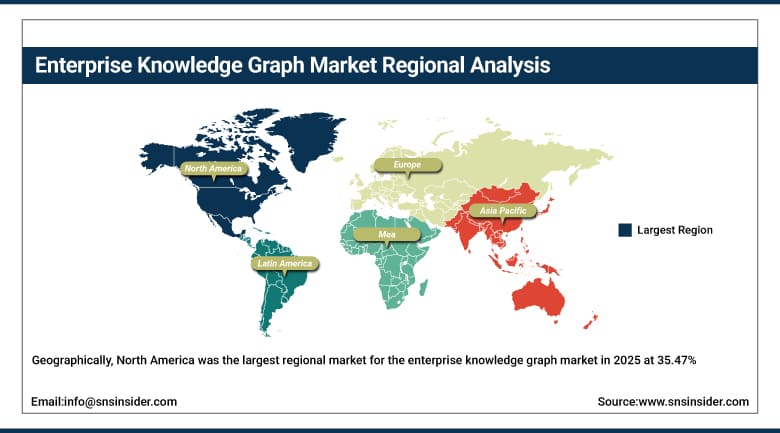
North America was the largest regional market for the enterprise knowledge graph market in 2025 at 35.47% market share owing to the presence of the robust technology industry in the region, high use of artificial intelligence (AI), and investments made towards enterprise data management and knowledge graph platforms. There have been significant investments made in generative AI, enterprise analytics, data infrastructure, and applications of artificial intelligence in the United States.
The need for connecting dispersed enterprise data, enhancing semantic search capabilities, and offering context for AI applications has led to the deployment of knowledge graphs among enterprises. Moreover, there have been developments in the AI, cloud computing, and enterprise data infrastructure in Canada. The United States acc\ounted for the highest market share of the North American enterprise knowledge graph market in 2025 owing to the presence of a robust technology industry and enterprise software market along with significant investments in artificial intelligence and data management technologies.
Get Customized Report as Per Your Business Requirement - Enquiry Now
Europe Enterprise Knowledge Graph Market Insights
The development of the European market for enterprise knowledge graphs is facilitated by rising AI adoption, increased enterprise data management projects, and increased spending on digital transformation and data governance. More and more companies in Europe are considering enterprise knowledge graphs to address disconnected data sources, enhance semantic search, facilitate knowledge management, and make decisions using AI-powered techniques.
The importance of data interoperability, regulatory compliance, and ethical application of AI technologies is opening up additional market opportunities for enterprise knowledge graphs in Europe. In 2025, Germany had the highest share of the European enterprise knowledge graph market due to the presence of developed industry, high level of digitalization, developed enterprise technology landscape, and increased spending on AI and digital transformation.
Asia Pacific Enterprise Knowledge Graph Market Insights
Asia Pacific region is estimated to experience the highest growth rate in the enterprise knowledge graph market during the forecast period owing to fast-paced digital transformation, rising usage of artificial intelligence, building up of cloud infrastructure, and rising investments in enterprise data analytics. Nations like China, Japan, South Korea, and India are developing their AI and data technology ecosystem and making investments in advanced enterprise software solutions and intelligent applications.
Rising importance being placed on effective data integration, context understanding, semantic search and artificial intelligence decision-making process is driving the implementation of knowledge graph technology solutions. China dominated the enterprise knowledge graph market share in Asia Pacific region in 2025 because of large technology ecosystem, wide digitization efforts, strong AI development capability, and investments in data infrastructure and intelligent applications. The growing generative AI and enterprise analytics ecosystem of the region is expected to provide further opportunities to the knowledge graph solutions.
Middle East & Africa and Latin America Enterprise Knowledge Graph Market Insights
Enterprise knowledge graph market in the Middle East & Africa region is likely to grow at a stable rate due to rising investments in artificial intelligence, digital transformation, cloud infrastructure, and enterprise technologies. Intelligent digital infrastructure and advanced analytics are being invested by countries in this region as enterprises are looking to make their data accessible and improve operations and AI adoption. In 2025, Saudi Arabia had the biggest market share of the Middle East & Africa enterprise knowledge graph market due to its extensive digital transformation initiatives, AI, and cloud technology investments, and use of advanced enterprise data technologies.
Latin America is seeing a consistent rise in the enterprise knowledge graph market due to increased digital transformation, adoption of cloud technologies, enterprise analytics, and demand for AI-based data management solutions. In 2025, Brazil was holding the largest market share of the Latin American enterprise knowledge graph market because of its large enterprise landscape, growing digital economy, developing technology industry, and increased investment in AI and data analytics. Growth in the use of intelligent enterprise applications, data integration technologies, and knowledge management solutions is likely to open up new opportunities for enterprise knowledge graph technologies.
Growth Driver: Rising adoption of artificial intelligence and enterprise data management driving enterprise knowledge graph market growth
The quick adoption of artificial intelligence (AI), generative AI, and enterprise data management is among the critical reasons fueling the rising demand for enterprise knowledge graphs. With the increased adoption of AI apps, there has been an emerging need for connecting disparate data sources, enhancing data accessibility, contextual awareness, and accurate AI-powered decisions. Enterprise knowledge graphs allow the creation of an integrated system that connects different entities, relations, and information within various enterprise systems.
Moreover, rising investments in generative AI, AI agents, enterprise search, and data integration solutions have been aiding market growth. Besides, the increased need for contextual and trustworthy enterprise data is leading businesses to implement knowledge graphs for enhanced information retrieval, responses from AI models, and intelligent automation. The increased usage of GraphRAG and knowledge graph-enabled AI applications would be among the driving forces behind adoption.
Restraints: High implementation complexity and data integration challenges may restrict enterprise knowledge graph market growth
Despite the considerable advantages that enterprise knowledge graphs can provide in terms of data integration and knowledge management as well as for AI applications, complex implementation and data integration issues could potentially limit the development of the market. The process of creating and maintaining an enterprise knowledge graph might be rather costly in terms of data engineering, graph database, semantic modeling, and specific technical skills. In addition, integrating data from diverse enterprise systems, legacy databases, and other data sources could also make implementation complex.
Moreover, structural, quality-related, metadata and ontology-specific differences in data could complicate the development and maintenance of knowledge graphs. Moreover, organizations might experience problems in providing data governance, security, scalability, and regular updates of graph-based data. Lack of professionals having the relevant skills in the sphere of graph technologies, semantics, and AI might be one more reason for the slow adoption of the technology, especially for small enterprises.
Opportunities: Growing investments in generative AI and intelligent enterprise applications creating new growth opportunities
The rising emphasis on generative AI, AI agents, enterprise search, and intelligent data management is resulting in the creation of huge growth opportunities for the enterprise knowledge graph market. The enterprises are making investments in knowledge graph solutions to help AI systems with accurate and relevant enterprise information in a structured and connected format, which helps in making informed decision-making possible.
The increasing use of GraphRAG, semantic search, recommendations, customer 360, fraud detection, and supply chain intelligence solutions is resulting in the creation of huge demand for enterprise knowledge graphs. Moreover, the rising investments in cloud-based data platforms, enterprise AI infrastructure, and data governance will also lead to more opportunities for knowledge graph vendors. The continuous development of AI-powered enterprise applications in North America, Europe, and Asia Pacific, along with the increasing need for connected and richly-contextual enterprise data, will create huge opportunities for enterprise knowledge graph solution providers.
Recent Developments
-
2026: Neo4j extended its knowledge graph and graph intelligence solutions, enabling increasing demand for connected enterprise data, knowledge management, and AI-enabled applications.
-
2026: Amazon Web Services (AWS) developed its graph database and enterprise data management solutions, enabling adoption of knowledge graph technology for AI, analytics, and connected data solutions.
-
2026: Microsoft developed its enterprise AI and data management solutions, enabling integration of knowledge graph technology with intelligent applications, enterprise search, and AI decision-making systems.
-
2026: Google developed its cloud, AI, and data analytics solutions, enabling the development and adoption of knowledge graph technology for enterprise data integration and intelligent applications.
-
2026: Oracle extended its enterprise database, cloud, and AI solutions, enabling demand for graph-based data management and knowledge integration and AI-driven enterprise applications.
Enterprise Knowledge Graph Market Key Players
-
Neo4j
-
Microsoft
-
Google
-
Oracle
-
IBM
-
SAP
-
TigerGraph
-
Stardog
-
Ontotext
-
Cambridge Semantics
-
Ontology Systems
-
DataStax
-
ArangoDB
-
Amazon Neptune
-
MarkLogic
-
Franz Inc.
-
GraphDB
-
PoolParty by Semantic Web Company
Enterprise Knowledge Graph Market Report Scope:
| Report Attributes | Details |
|---|---|
| Market Size in 2025 | USD 2.10 Billion |
| Market Size by 2035 | USD 21.95 Billion |
| CAGR | CAGR of 26.47% From 2026 to 2035 |
| Base Year | 2025 |
| Forecast Period | 2026-2035 |
| Historical Data | 2022-2024 |
| Report Scope & Coverage | Market Size, Segments Analysis, Competitive Landscape, Regional Analysis, DROC & SWOT Analysis, Forecast Outlook |
| Key Segments | • By Solution (Enterprise Knowledge Graph Platform, Graph Database Engine, Knowledge Management Toolset) • By Model Type (Resource Description Framework (RDF) Triple Stores, Labeled Property Graph) • By Application (Semantic Search & Enterprise Knowledge Management, Recommendation Systems, Fraud Detection & Risk Analytics, Customer 360 & Personalization, Supply Chain & Operational Intelligence, Others) • By Deployment (Cloud, On-Premises) • By Organization Size (Large Enterprises, Small & Medium Enterprises (SMEs)) • By End Use (BFSI, Healthcare & Life Sciences, Retail & E-commerce, IT & Telecommunications, Manufacturing, Government, Others) |
| Regional Analysis/Coverage | North America (US, Canada), Europe (Germany, UK, France, Italy, Spain, Russia, Poland, Rest of Europe), Asia Pacific (China, India, Japan, South Korea, Australia, ASEAN Countries, Rest of Asia Pacific), Middle East & Africa (UAE, Saudi Arabia, Qatar, South Africa, Rest of Middle East & Africa), Latin America (Brazil, Argentina, Mexico, Colombia, Rest of Latin America) |
| Company Profiles | Neo4j, Amazon Web Services (AWS), Microsoft, Google, Oracle, IBM, SAP, TigerGraph, Stardog, Ontotext, Cambridge Semantics, Ontology Systems, AllegroGraph, DataStax, ArangoDB, Amazon Neptune, MarkLogic, Franz Inc., GraphDB, PoolParty by Semantic Web Company |
Frequently Asked Questions
The enterprise knowledge graph market is expected to grow at a CAGR of approximately 26.47% from 2026 to 2035.
The enterprise knowledge graph market was valued at approximately USD 2.10 billion in 2025.
The market is driven by rising adoption of artificial intelligence (AI), growing demand for enterprise data integration, increasing use of generative AI, and the need for contextual and connected enterprise data.
North America dominated the enterprise knowledge graph market in 2025 with a 35.47% share.
